

创作上传
VIP
收藏下载
登录 | 注册有礼
查看完整案例

收藏

下载

分享

翻译
Architects:SoBA
Area:8600m²
Year:2025
Photographs:Wen Studio
Manufacturers:三元乙丙(EPDM)颗粒,浙江绿能体育产业股份有限公司
Lead Architects:Wang Ruo, Tang Haiyin
Category:Kindergarten
Design Team:Sun Xiaodi, Li Chuanzhang, Wu Yiqing, Liao Zhexuan, Wang Yuan, Shen Yichen (Intern), Xiao Yunxuan (Intern)
Clients:Yushan Town People’s Government, Kunshan
Construction Drawings:Delin United Engineering Design Co., Ltd.
Contractor:Jiangsu Wuhuan Construction Group Co., Ltd.
Contractor Managers:Kong Yuyun, Zhang Jianhua, Huang Anbao
City:Suzhou
Country:China

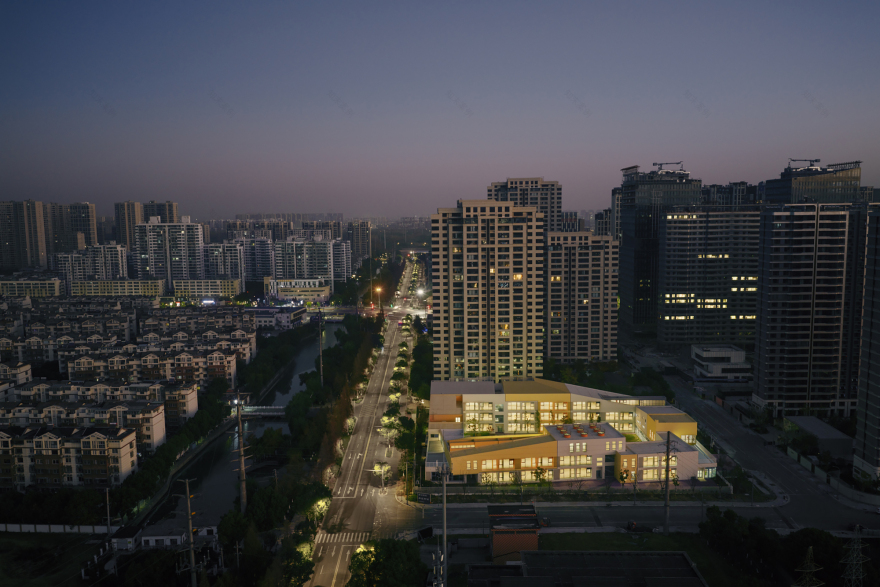
Text description provided by the architects. Block Kindergarten is located east of Hongqi Road and north of Zhenchuan Road in Kunshan, Jiangsu Province. The campus occupies approximately 1.01 hectares with a total floor area of about 8,600 square meters and is planned as a 21-class kindergarten. The site is surrounded by a complex urban context. High-rise residential towers stand to the north, with additional housing planned to the east. To the south lie several municipal facilities, including a 110kV substation, a waste transfer station, and an emergency medical center. These conditions present both spatial and psychological challenges: tall residential buildings create a sense of enclosure, while the municipal infrastructure introduces visual and environmental disturbance.


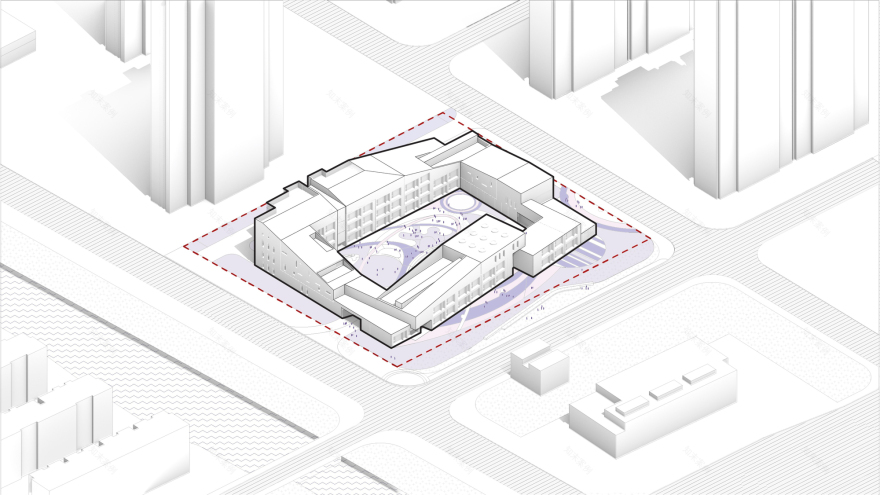
Within this dense urban environment, the project aims to create a protected inner world for children. Through layered transitions between architecture and landscape, the design gradually introduces them to the broader city and to nature. The design responds through an integrated architectural and landscape strategy. The building mass is shifted northward from the southern boundary, allowing a dense landscape buffer to form along the southern edge of the site. This green belt becomes a natural screen between the kindergarten and the adjacent municipal facilities. At the same time, the architecture adopts an enclosed layout that forms a protected internal courtyard, providing children with a safe and continuous outdoor environment.


Within this framework, the building mass draws inspiration from the logic of blocks and modular construction. Through stacking and shifting volumes, the architecture forms a layered composition reminiscent of a modular "castle." The form echoes children's experiences of play while establishing a clear and legible spatial order. Enclosure does not mean isolation. Portions of the southern mass are shifted to introduce staircases and transparent glass volumes, creating openings and visual corridors toward the city. These interventions break the continuity of the façade while maintaining the privacy of the courtyard. From inside the building, children can glimpse the surrounding city, sky, and trees through these framed views.

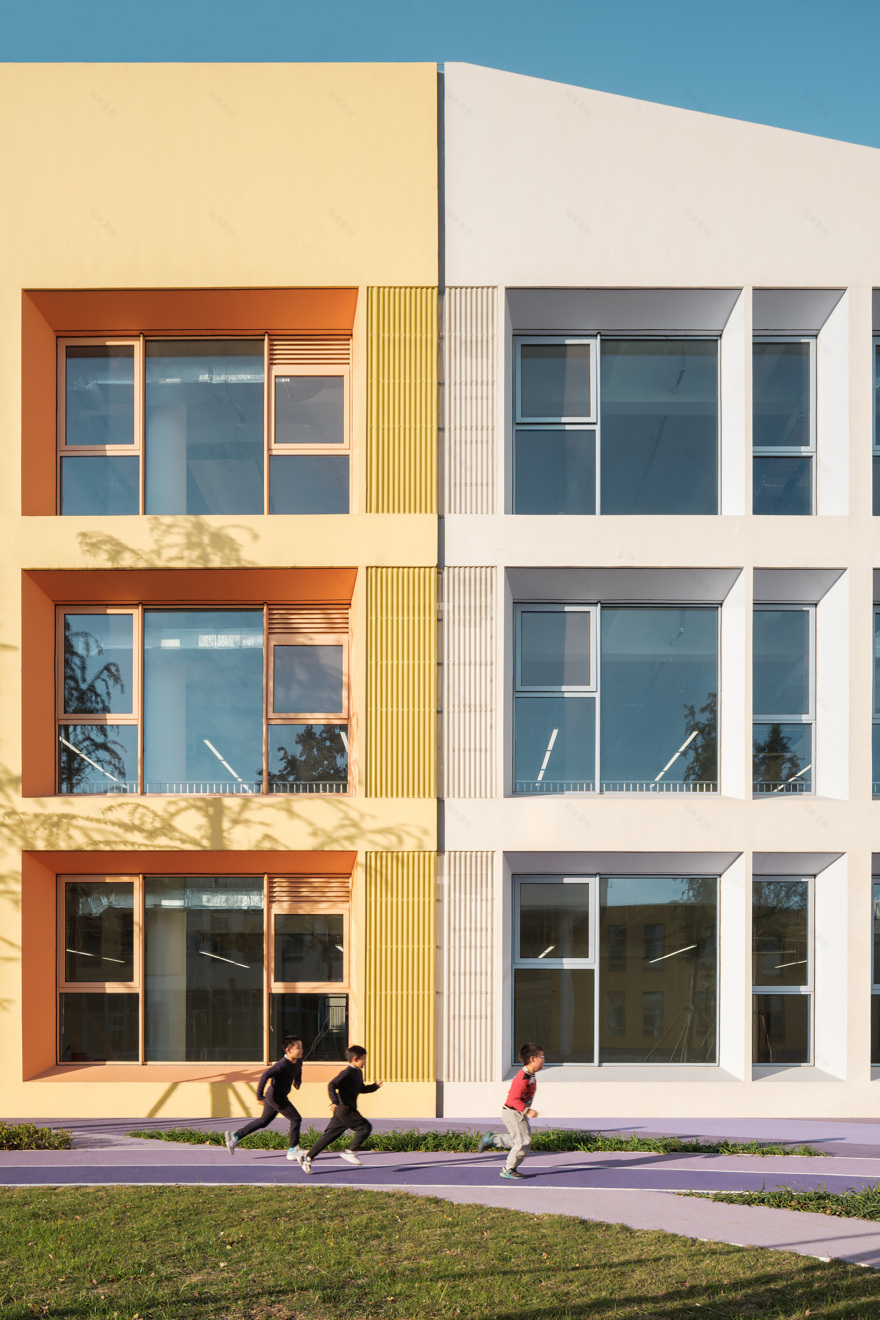

Color also plays an important role in the spatial experience. Children between the ages of three and six learn primarily through sensory perception. As educator Maria Montessori noted in The Absorbent Mind, children understand the world through their senses. In the design, color is treated as a spatial language, where variations in brightness and saturation help create gentle yet clear spatial layers. The project also references the idea of "emotional architecture" proposed by Mexican architect Luis Barragán. Through the orchestration of light, color, and spatial scale, the building becomes a place capable of evoking perception and memory. Daylight enters through courtyards, corridors, and openings, creating shifting atmospheres throughout the day.


The building is oriented north–south, with lower volumes to the south and taller ones to the north. The main entrance is located on the east side of the site, with a secondary fire access on the west and a service entrance at the northeast corner. Classroom units occupy the southern and northern wings to maximize daylight, while service spaces are concentrated in the western volume. Administrative areas are placed on the upper floors, and shared facilities such as the multipurpose hall, reading room, and music room are located at key intersections between building volumes.

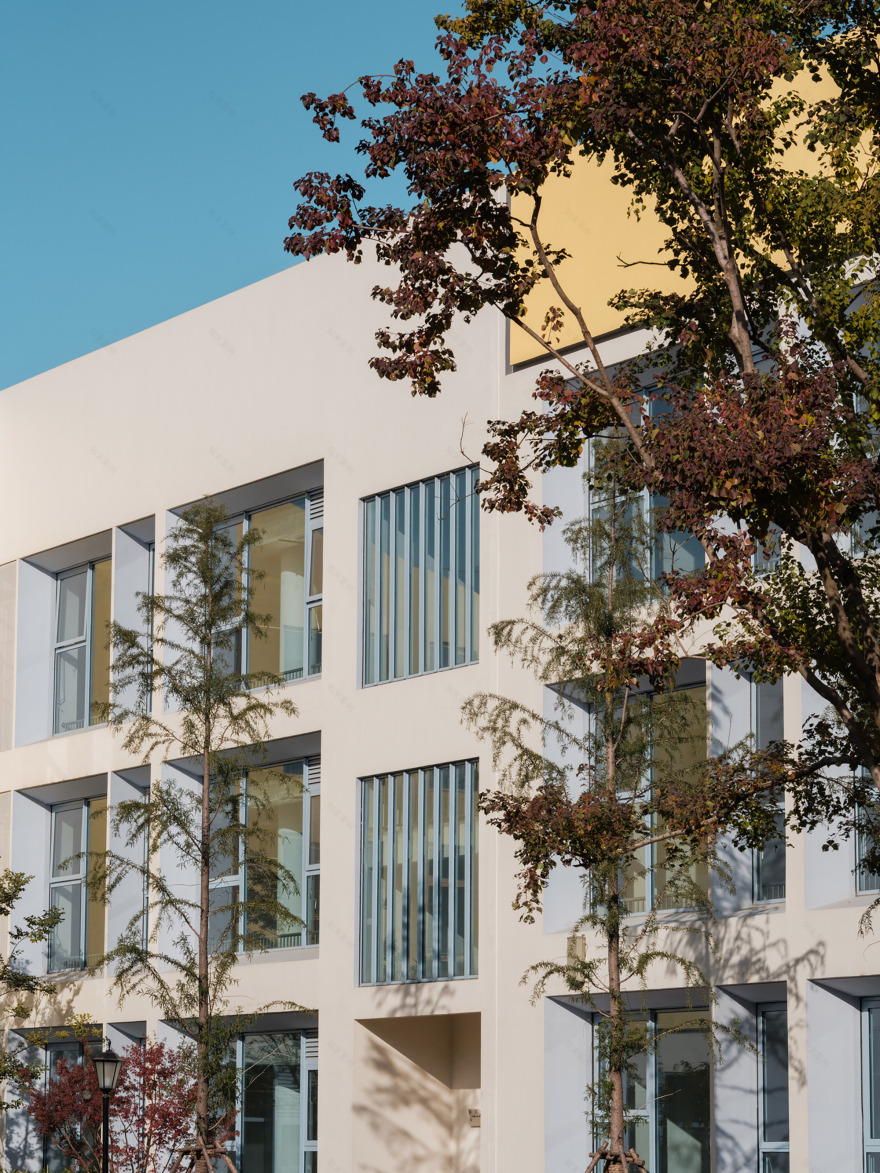
At the center of the campus lies the courtyard formed by the enclosing buildings. This space becomes the kindergarten's primary outdoor environment, including play areas, planting gardens, and landscaped spaces. The landscape design is inspired by the idea of natural cycles: a planetary map of the solar system is inscribed in the central playground, with radiating orbits organizing different activity zones.


Within the campus, several spaces encourage children to observe nature. A planting garden in the southeast allows older children to grow crops and observe seasonal change, while a rain garden in the northeast collects stormwater and introduces children to ecological cycles. In this way, the kindergarten becomes not only a place for learning and play, but also a starting point for children to understand nature and the world around them.

Project gallery




南京喵熊网络科技有限公司 苏ICP备18050492号-4知末 © 2018—2020 . All photos and trademark graphics are copyrighted by their owners.增值电信业务经营许可证(ICP)苏B2-20201444 苏公网安备 32011302321234号
苏公网安备 32011302321234号客服
消息
收藏
下载
最近