

创作上传
VIP
收藏下载
登录 | 注册有礼
查看完整案例

收藏

下载

分享
这座由KCAP为Heijmans Vastgoed设计的74米高住宅塔,将费耶诺德岛端部的一处前工业用地转化为推动鹿特丹南部滨水更新的重要引擎。项目从周边工厂、仓库与起重机中汲取灵感,通过类似集装箱叠加的体量构成,重释工业遗产。塔楼共包含142套住宅,引入多种创新居住类型——包括拥有私人泊位的水岸复式(waterlofts)、可通过汽车电梯直达的工作室住宅(drive-in ateliers)、双层通高的空中阁楼(skylofts)等,在提供马斯河与城市天际线全景视野的同时,探索滨水居住的新可能。
KCAP’s 74-metre residential tower for Heijmans Vastgoed transforms a former industrial site at the tip of Feijenoord Island into a catalyst for Rotterdam-Zuid’s waterfront revitalization. Drawing inspiration from the area’s factories, warehouses, and cranes, the 142-unit tower reinterprets industrial heritage through stacked volumes that reference shipping containers. Progressive housing typologies including waterlofts with private moorings, drive-in ateliers accessible via car elevator, and double-height skylofts offer panoramic views of the River Maas and city skyline while pioneering new residential possibilities for waterfront living.
▼项目概览,overall of the project© Ossip van Duivenbode

项目亮点
Project Highlights
历史工业场地 – 项目位于费耶诺德岛端部,该区域曾由费耶诺德船厂(1825–1935)与Hunter Douglas工厂(1933–2023)塑造,兼具工业粗粝特质与当代城市活力。
鹿特丹南部转型的催化剂 – 作为整体开发愿景的首期项目,De Piek致力于将原工业区转变为集居住、商业与公共功能于一体的滨水活力城区。
Historic industrial location – Built at the tip of Feijenoord Island, an area shaped by shipyard Fijenoord (1825–1935) and Hunter Douglas (1933–2023), where industrial rawness converges with contemporary urban vitality.
Catalyst for Rotterdam-Zuid transformation – First phase in broader development vision converting the former industrial zone into a vibrant urban quarter blending residential, commercial, and public functions along the riverfront.
▼De Piek工业区鸟瞰,aerial view of the De Piek© Ossip van Duivenbode

▼项目远景,viewing the project at distance© Ossip van Duivenbode

创新住宅塔楼 – 建筑高74米,共22层,包含142套阁楼式住宅,紧邻Piek桥布置,既作为地标,也成为重新激活该区域的入口。
六种居住类型 – 包括带私人泊位的水岸住宅、可驾车进入的工作室住宅、带内退式阳台的景观住宅、标准阁楼、公寓单元以及双层空中阁楼,面积从57至232平方米不等,提供多样化居住体验。
▼分析图,analysis diagram©KCAP

Innovative residential tower – 74 metres high across 22 storeys housing 142 loft-style apartments with unique typologies, positioned strategically adjacent to Piek bridge as both landmark and invitation to rediscover this part of Rotterdam.
Six distinct housing typologies – Waterlofts with private mooring docks on the quay, Drive-in Atelierlofts accessible via car elevator, Panoramalofts with recessed loggias, Loft Apartments, Studios, and double-height Skylofts offering varied residential experiences from 57-232 m².
▼半鸟瞰,half-aerial view© Ossip van Duivenbode

▼外观,exterior view© Ossip van Duivenbode

集装箱意象的叠合体量 – 四个体量如集装箱般错动堆叠:下部为砖结构,上部逐渐过渡为钢与玻璃,形成类似工业仓储扩展的粗犷轮廓。
可持续系统 – 采用区域供热、集中制冷、热回收系统与屋顶光伏板,并结合三层玻璃、CO₂控制通风与地板冷热系统,实现低能耗的舒适室内环境。
Stacked container-inspired volumes – Four volumes arranged like shipping containers, materialised in brick at lower levels transitioning to steel and glass higher up, creating a robust profile reminiscent of industrial warehouse construction and expansion.
Sustainable energy – District heating, collective cooling system, heat recovery system, and rooftop solar panels combined with triple glazing, CO2-controlled ventilation, and floor heating/cooling ensure optimal indoor climate with minimal energy consumption.
▼四个体量如集装箱般错动堆叠,
Four volumes arranged like shipping containers© Ossip van Duivenbode
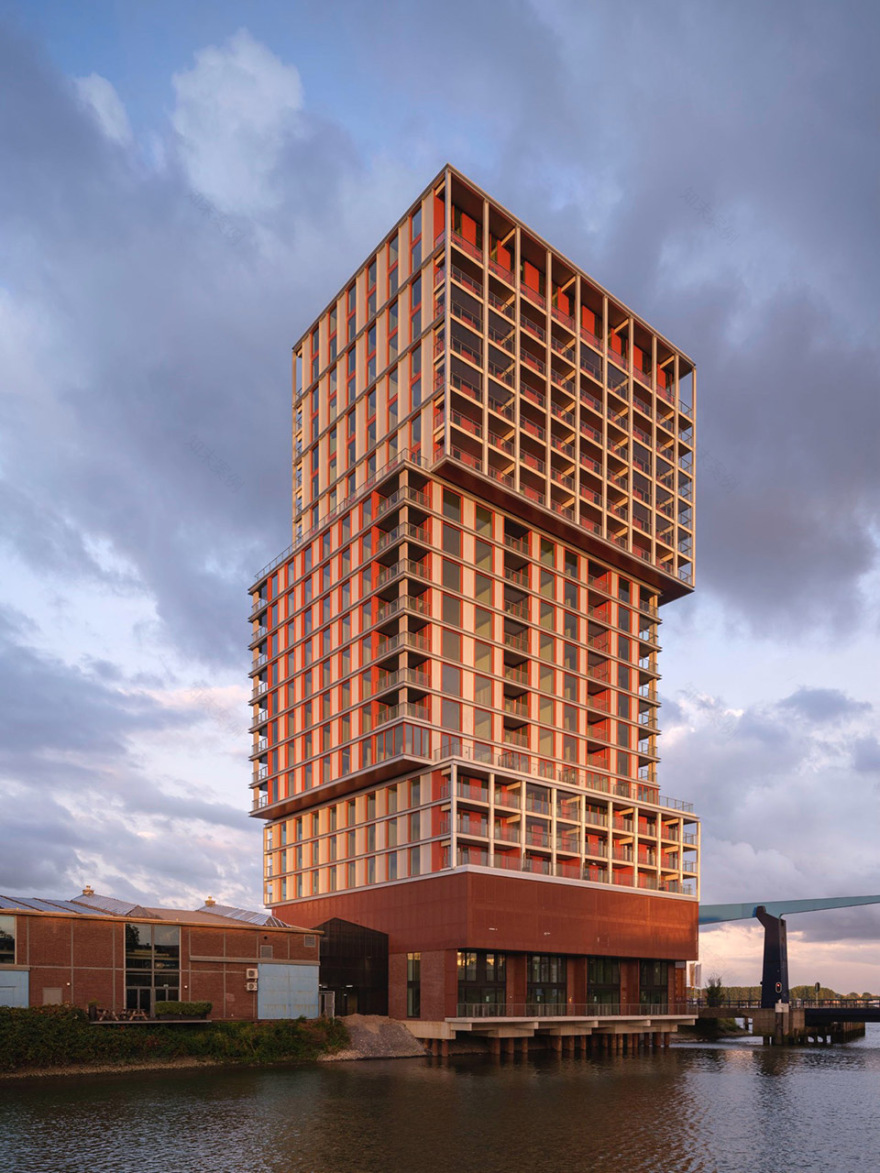
城市催化器
The Urban Catalyst
De Piek高耸于费耶诺德岛端部,以142套住宅与底层面向公众开放的咖啡空间,为曾被忽视的工业边缘地带注入新的活力。项目毗邻Piek桥,是将旧工业区转型为复合城市片区的重要组成部分。通过将居住功能引入滨水界面,建筑重新建立城市与河流之间的联系。作为系列开发的起点,它展示了区域潜力,并为未来转型奠定基础——一个工业粗粝与当代城市活力交汇的场所。
Standing 74 meters tall at the tip of Feijenoord Island, De Piek is a residential tower that brings new life to a previously overlooked industrial area in South Rotterdam, with 142 apartments and a ground-floor café that opens the quay to public use. Strategically positioned next to the Piek bridge, De Piek is part of a broader vision to convert the former industrial zone into a lively urban quarter blending residential, commercial, and public functions. By anchoring residential living at the waterfront, the tower reactivates the connection between city and river. As the first project in a series of planned developments, it demonstrates the area’s potential and sets the stage for future transformation: a place where industrial rawness meets contemporary urban vitality.
▼工业粗粝与当代城市活力交汇的场所,a place where industrial rawness meets contemporary urban vitality © Ossip van Duivenbode


工业遗产:基础与灵感
Industrial Heritage as Foundation & Inspiration
费耶诺德岛承载着深厚的工业历史。船厂与制造业曾长期驱动当地经济,这一多层叠加的历史并非背景,而是设计的直接来源。项目将仓库、工厂与集装箱的建筑语言转译为当代表达。错动上升的体量强化了工业建造与扩展的意象;而精细的材料处理与大面积玻璃则引入新的居住品质。工业遗产因此不再被简单复制,而成为塑造滨水新身份的基础。
Feijenoord Island bears the imprints of a rich industrial legacy. For decades, shipyard Fijenoord (1825–1935) and later Hunter Douglas (1933–2023) were the engines of the local economy. This layered history serves not as a backdrop but as an active source of inspiration for De Piek. The design translates the architectural language of warehouses, factories, and stacked containers into contemporary architecture. The staggered volumes rise above the quay, creating a robust profile reminiscent of the construction and expansion of industrial buildings. This composition underscores the site’s rawness, while the refined materialisation and expansive glazing introduce a new residential quality. In this way, industrial heritage is not merely replicated but reimagined as the foundation for a new identity along the river.
▼街景,street view© Ossip van Duivenbode

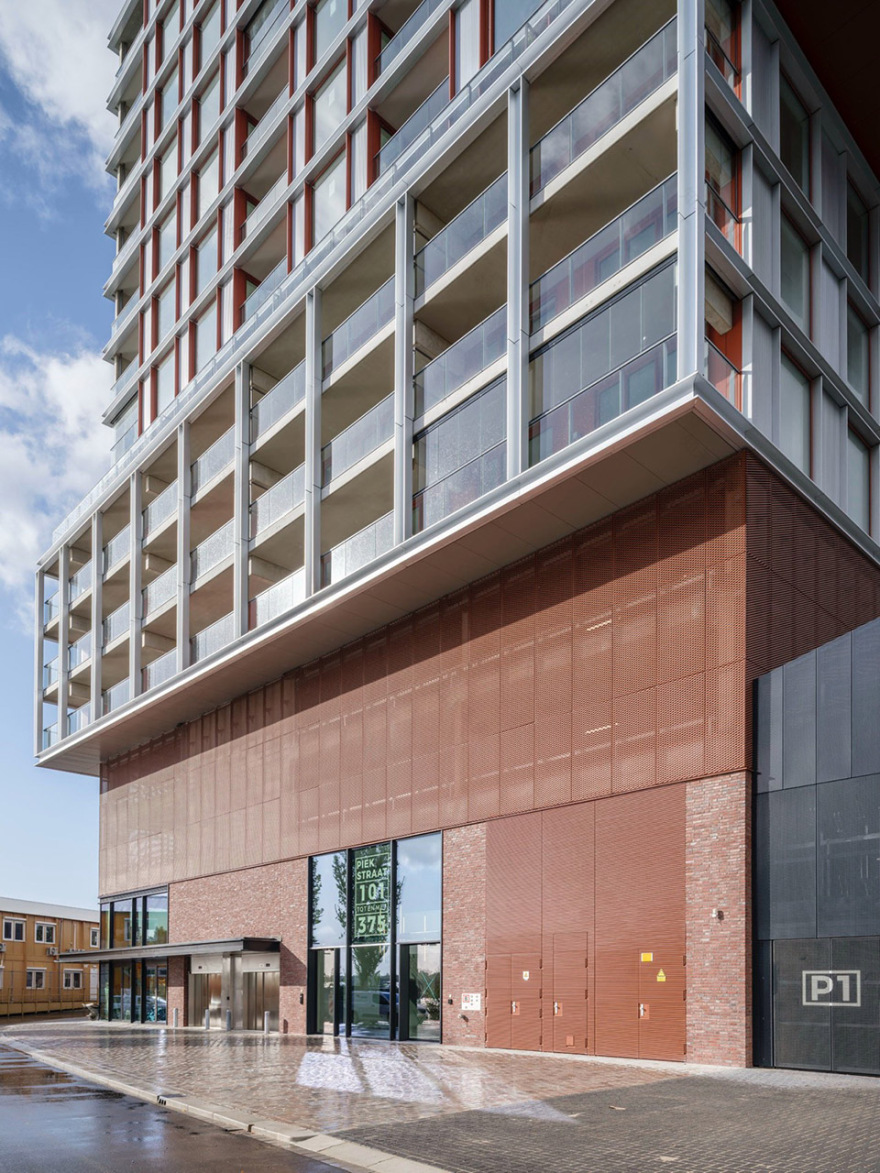
▼底层外观,exterior view of the ground floors© Ossip van Duivenbode
可持续出行
Sustainable Mobility
建筑位于鹿特丹南站步行范围内,通过设计鼓励绿色出行,减少对私家车依赖。项目提供便捷的自行车停放空间,并在入口设置带充电桩的共享汽车车位。位于三、四层的停车空间采用自然通风,提高舒适性与能效。
Located within walking distance of Rotterdam Zuid station, the tower’s design deliberately promotes sustainable transport and reduces reliance on private cars. Cycling and shared mobility are actively encouraged through generous, easily accessible bicycle storage and two shared car parking spaces with integrated charging points at the building’s entrance. The parking garage, positioned on the third and fourth floors, benefits from natural ventilation, enhancing both occupant comfort and energy efficiency.
▼上部体量外观,exterior view of the upper part of the tower© Ossip van Duivenbode

▼码头,the dock© Ossip van Duivenbode

多样化居住类型
Typological Diversity
塔楼提供多种居住单元(57–232平方米),均配备宽敞的室外空间与较高层高,包括水岸住宅、可驾车进入的阁楼、景观阁楼及双层空中住宅等。阶梯式体量形成共享屋顶露台,而集成式停车空间在未来可转化为居住用途,增强建筑的长期适应性。
The tower offers diverse housing typologies (57-232 m²) with generous outdoor spaces and high ceilings, including Waterlofts with private mooring docks, Drive-in Lofts with car elevators, Panoramic Lofts with river views, and double-height Skylofts overlooking Rotterdam’s skyline. The stepped design creates collective rooftop terraces, while integrated parking allows future conversion to living space, ensuring long-term adaptability.
▼塔楼提供多种居住单元(57–232平方米),均配备宽敞的室外空间,The tower offers diverse housing typologies (57-232 m²) with generous outdoor spaces © Ossip van Duivenbode

▼阳台,the balconies© Ossip van Duivenbode


材料表达
Material Articulation
De Piek的材料策略在工业语境与可持续理念之间建立联系。建筑基座采用砖、型钢、冲孔板与拉伸金属等材料,与码头既有建筑的尺度与质感相呼应,并通过图形标识强化工业特征。上部结构则转为更轻盈、反射性的镀锌钢立面。预制木结构立面板具备模块化与可拆卸性,可在未来重复利用。这种可循环建造方式呼应港口中堆叠集装箱的形象。锈色细部围合窗洞与内退界面,为整体工业构图增添温度。大面积玻璃强化了与城市与水体的联系,使建筑成为马斯河沿岸清晰可辨的地标。
The materialization of De Piek connects the robust harbor context with contemporary sustainability principles. The base aligns with the scale and texture of the existing quay buildings, constructed from a rugged palette of brick, profile steel, perforated cladding, and expanded metal, accentuated by graphic signage. This solid foundation anchors the building in its industrial environment and establishes a direct link to the island’s past. The upper structure introduces a lighter and more reflective façade language in galvanized steel. Prefabricated façade panels in timber frame construction are modular and demountable, designed for future reuse. This circular construction references the stacked containers that have long characterized the harbor’s image. Rust-colored accents frame windows and recessed façade planes, creating a warm, lived-in appearance within the industrial composition. Large glazing enhances the relationship with the city and the water, presenting the tower as an open and recognizable beacon along the Maas.
▼建筑基座采用砖、型钢、冲孔板与拉伸金属等材料,the base aligns with the scale and texture of the existing quay buildings, constructed from a rugged palette of brick, profile steel, perforated cladding© Ossip van Duivenbode

▼大堂,the foyer© Ossip van Duivenbode

当生活被锚定在水岸,我们不仅是在建造住宅,更是在重建城市与自身的关系。De Piek将被遗忘的边界转化为充满活力的新身份。
By anchoring life at the waterfront, we don’t just build residences—we rebuild a city’s relationship with itself. De Piek transforms a forgotten edge into a vibrant new identity.
—— Irma van Oort,KCAP合伙人
▼夕阳下的建筑,dusk views© Ossip van Duivenbode


▼场地区位,site map©KCAP

▼底层平面图,ground floor plan©KCAP

▼三层平面图,2nd floor plan©KCAP

▼七层平面图,6th floor plan©KCAP

▼十三层平面图,12th floor plan©KCAP

▼十八层平面图,17th floor plan©KCAP

▼二十二层平面图,21st floor plan©KCAP
▼剖面图,sections©KCAP

Project Team
Architect: KCAP
Client: Heijmans Vastgoed
Contractor: Heijmans Utilitaire Woningbouw
Advisors: IMd Raadgevende Ingenieurs, LBP | SIGHT, Techniplan
Typographic Design: Monice Janson Typografie
Photography: Ossip van Duivenbode
Year: 2017 – 2025
Status: Completed
Disciplines: Architecture
Client: Heijmans Vastgoed
Program: 24,500 m2 residential; c. 142 apartments, restaurant, indoor parking facilities
南京喵熊网络科技有限公司 苏ICP备18050492号-4知末 © 2018—2020 . All photos and trademark graphics are copyrighted by their owners.增值电信业务经营许可证(ICP)苏B2-20201444 苏公网安备 32011302321234号
苏公网安备 32011302321234号客服
消息
收藏
下载
最近