

创作上传
VIP
收藏下载
登录 | 注册有礼
查看完整案例

收藏

下载

分享

翻译
Architects:Horizontal Design
Area:1026m²
Year:2025
Category:Houses
Lead Team:Bing Ju, Ling Yang, Qinchao Pan
Design Team:Horizontal Design
Engineering & Consulting > Other:Praetorius and Conrad, P.C. Professional Engineering & Land Surveying
City:Catskill
Country:United States

Text description provided by the architects. At the end of 2018, during a gathering in New York, director Bing Ju met artist Emily and her husband Wolf. The couple, with extensive overseas experience and a deep understanding of Eastern philosophy, instantly connected with Bing's appreciation of Asian culture. Discussing their vision for a new home marked the beginning of a six-year design journey.


The project is located in upstate New York, about a two-hour drive from Manhattan. The 500-acre site, rich with trees and vegetation, occasionally hosts deer and other wildlife, offered an exceptional natural environment that became one of the primary inspirations for the project. Equally important were the clients themselves: one an artist deeply engaged in Buddhist and Daoist philosophy, and the other with an academic background at Harvard University. Their shared desire for a home with cultural depth, serenity, and a strong connection to nature shaped the key concepts of the design, guiding it toward an architecture that merges Eastern philosophical thinking with the physical landscape.

The project commenced in 2019 but soon encountered its first major setback with the global pandemic, which significantly delayed construction and extended the timeline until 2025. In addition to these external challenges, the early design phase required nearly a year of close collaboration with the clients, including three rounds of floor plan iterations before reaching a solution that balanced artistic vision, functional needs, and spatial clarity. Budget constraints and construction feasibility also posed challenges, particularly when the original concept of exposed concrete proved impractical, requiring a shift in material strategy without compromising the design intent.

The final construction adopts a hybrid steel and timber structure, combining strength with warmth. Instead of exposed concrete, insulated concrete forms (ICF blocks) with a finishing coat were used to address cost and efficiency concerns. Lightweight timber-framed partition walls define interior spaces, while a multi-sloped wooden roof responds to heavy winter snowfall, ensuring durability and safety. Concrete walls serve as windbreaks and visual screens, and light-toned wood surfaces capture and reflect the changing natural light, subtly marking the passage of time. These construction techniques and materials work together to create a balance between robustness and sensitivity to the environment.


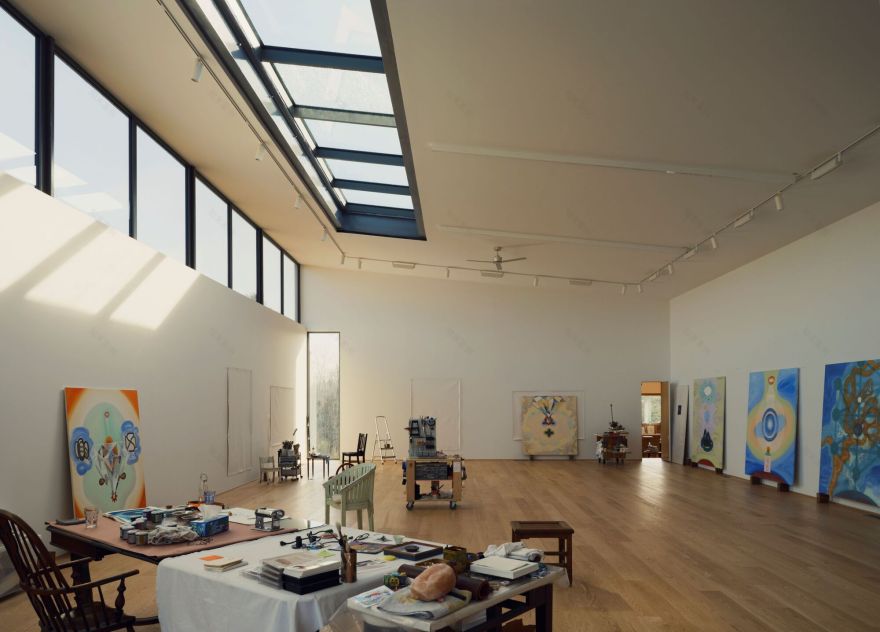
Spatially, the house is conceived as a continuous sequence inspired by the idea of "wandering in a garden." Rather than a rigid layout, volumes are arranged to interweave with courtyards, preserving existing vegetation and creating shifting relationships between interior and exterior spaces. A central gallery acts as the primary circulation spine, connecting functional areas while doubling as an exhibition space for artworks.


Public zones such as the living and dining areas are open and fluid, encouraging daily interaction, while private areas like the master bedroom, study, and meditation room are placed more centrally and enclosed by courtyards to ensure tranquility. This configuration was accomplished through careful orientation, iterative planning, and precise framing of views, allowing each space to maintain a direct or indirect connection to nature. Ultimately, the project integrates inspiration, challenges, materials, and spatial organization into a unified architectural experience that reflects both cultural meaning and everyday life.

Project gallery




南京喵熊网络科技有限公司 苏ICP备18050492号-4知末 © 2018—2020 . All photos and trademark graphics are copyrighted by their owners.增值电信业务经营许可证(ICP)苏B2-20201444 苏公网安备 32011302321234号
苏公网安备 32011302321234号客服
消息
收藏
下载
最近