

创作上传
VIP
收藏下载
登录 | 注册有礼
查看完整案例

收藏

下载

分享

翻译

Elusive architect Smiljan Radić explains how his work should not be seen as a blueprint for "good or bad" architecture, in this exclusive interview following his "surprise" Pritzker Architecture Prize win.
Radić, who became the 55th Pritzker Architecture Prize laureate earlier this month, said that although he's always wanted his work to have a global impact, the win was "a great surprise".
"I have always wanted my work to be part of a global discussion," Radić told Dezeen.
"In concrete terms, that discussion means being concerned with the opinion of a small group of architects and artists with whom I occasionally exchange ideas and can establish a real dialogue."

Smiljan Radić is known for his enigmatic and metaphorical work, such as the House for the Poem of the Right Angle in Vilches
His vision of architecture, like his output, is condensed, patient and heavily curated.
Although he has been highly regarded in architecture circles, Radić has not completed numerous high-profile cultural buildings like many other Pritzker laureates.
Perhaps his best-known project internationally was his 2014 Serpentine Pavilion.

Much of Radić's experimentation has been conducted in his residential architecture projects, such as Piedra Roja
Winning the Pritzker Architecture Prize, considered the highest prize in the field, has moved Radić more into the mainstream, with magazines and newspapers displaying his name and images all over the world. However, he does not want his work, which is heavily metaphorical, to be morally instructive.
"There is no message in what I do," he said.
"I'm not interested in it becoming a kind of sermon about what is good or bad in architecture."
The architect remains very private. His firm, Smiljan Radić Clark, does not have a website, and the architect does not use social media, something he says is intentional and fundamentally disuseful for his project.
"It does not offer a kind of communication that I find meaningful," he said of social media.
"I am not against it; I simply do not use it, as I do not consider it a useful tool for the kind of work I do. It is as if someone gave you a drill and you felt compelled to make holes everywhere."

Radić has been influenced by radical architecture and the "fragility" of certain Chilean structures
The prize's announcement was delayed after revelations that its chairman, Tom Pritzker, featured heavily in the tranche of emails associated with convicted sex offender Jeffrey Epstein. Yet, Radić was announced anyway, just a week later than in 2025.
In the face of this contentious year, when the future of the prize has been thrown into question, Radić maintained the integrity of the award. He said he has trust in the jury, which was chaired by Alejandro Aravena, the only other Chilean to have won the Pritzker Architecture Prize.
"I found out about the award in mid-January," said Radić, echoing sentiments he relayed to CNN earlier this month.
"I've spent the last 30 years working out of a small office, pushing to do the best possible within whatever conditions were on the table. Architecture has always been the obsession."
"I still believe it's a fundamentally positive act – and I continue to believe that the Pritzker Prize remains part of that positive act despite the circumstances. In the end, I trust the jury to hold that line."
Being honoured with the prize has also caused Radić to reflect on his career, which started after he graduated from the Catholic University of Chile in 1989. He founded his studio in Santiago in 1995 and worked on a number of houses, cultural institutions and temporary structures throughout the 2000s and 2010s.
His "obsession" with architecture is rooted in what he calls "radical" or "improbable realities" in the field, work that he collects in a database called associated with his institution, the Fundación de Arquitectura Frágil or Fragile Architecture Foundation.

The architect is perhaps best known for his 2014 Serpentine Pavilion
He mentioned that he is currently reading the work of conceptual architect John Hejduk, but also credited his time travelling around Europe to experience the work of architects, contemporary and historical, as his "real beginnings".
"I should say that my real beginnings go back to when I was studying in Venice in the 1990s," he said.
"At that time, I traveled to Portugal to experience firsthand the work of Álvaro Siza, and later the buildings of Francesco di Giorgio."
Beyond the conceptual, Radić continues to focus on what he calls the "fragile constructions scattered throughout Chile", which have been "deeply formative" for him.
He developed a visual essay in the 1990s that emphasised the fragility of his birth country, and even after decades of practice, it is still a term that was used heavily both in his jury citation and in the reporting about his win.

While the architect has not completed massive public commissions, he has designed a number of subtle cultural centers such as the Centro Civico in Chile
"I was particularly interested in those that conveyed a sense of freshness and strangeness, detached from both institutional historical roots and vernacular traditions," he said.
"These were structures made from materials found in their immediate surroundings, appearing and disappearing without leaving a trace or altering the site. In most cases, they were self-built constructions created by a single individual, carrying a unique and deeply personal worldview."
"I would like to think that my architecture has managed to absorb, at least in part, these ideas."
"In architecture, you generally can't create your own opportunities"
His commitment to the Chilean built environment continues to be demonstrated through his lantern-like Teatro Regional del Bíobío and recent temporary pavilions made to host events during the Chilean architecture biennial.
He hopes that his win will bring further attention to the condition of the built environment in his country.
"I hope this recognition helps encourage public institutions to pay greater attention to our cities, which in many cases have been left to fend for themselves," he said.
Radić is pragmatic about the future, specifically the future of architecture, hemmed in as it is by the desires and whims of clients – even for a Pritzker Architecture Prize winner.
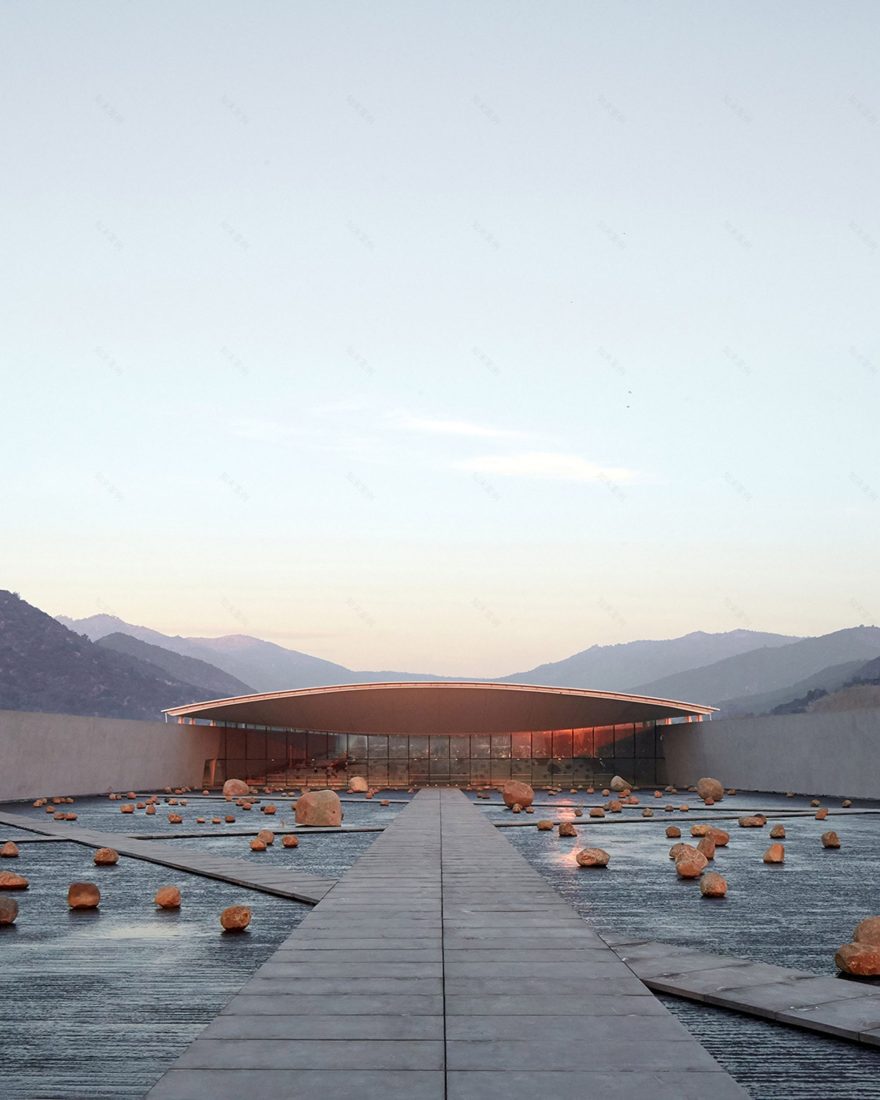
Radić's works have been commended for their metaphorical relationship with human experience, but he says his architecture is not a moral tool
"I don't know," he said when asked what's next for his practice.
"In architecture, you generally can't create your own opportunities. Clients and competitions appear unevenly, and you have to make decisions quickly, trying to experiment as much as possible."
The photography is by Cristóbal Palma / Estudio Palma.
Dezeen In Depth
If you enjoy reading Dezeen's interviews, opinions and features, subscribe to Dezeen In Depth. Sent on the last Friday of each month, this newsletter provides a single place to read about the design and architecture stories behind the headlines.
南京喵熊网络科技有限公司 苏ICP备18050492号-4知末 © 2018—2020 . All photos and trademark graphics are copyrighted by their owners.增值电信业务经营许可证(ICP)苏B2-20201444 苏公网安备 32011302321234号
苏公网安备 32011302321234号客服
消息
收藏
下载
最近