

创作上传
VIP
收藏下载
登录 | 注册有礼
查看完整案例

收藏

下载

分享

翻译
Architects:Ponomarenko Volodymyr
Area:108m²
Year:2025
Photographs:Ivan Avdeenko
Manufacturers:MONBON,Propro,Vision Lighting,Yevhen Hrybeniuk
Category:Hospitality Architecture,Coffee Shop
Lead And Design Team:Ponomarenko Volodymyr
City:Warszawa
Country:Poland

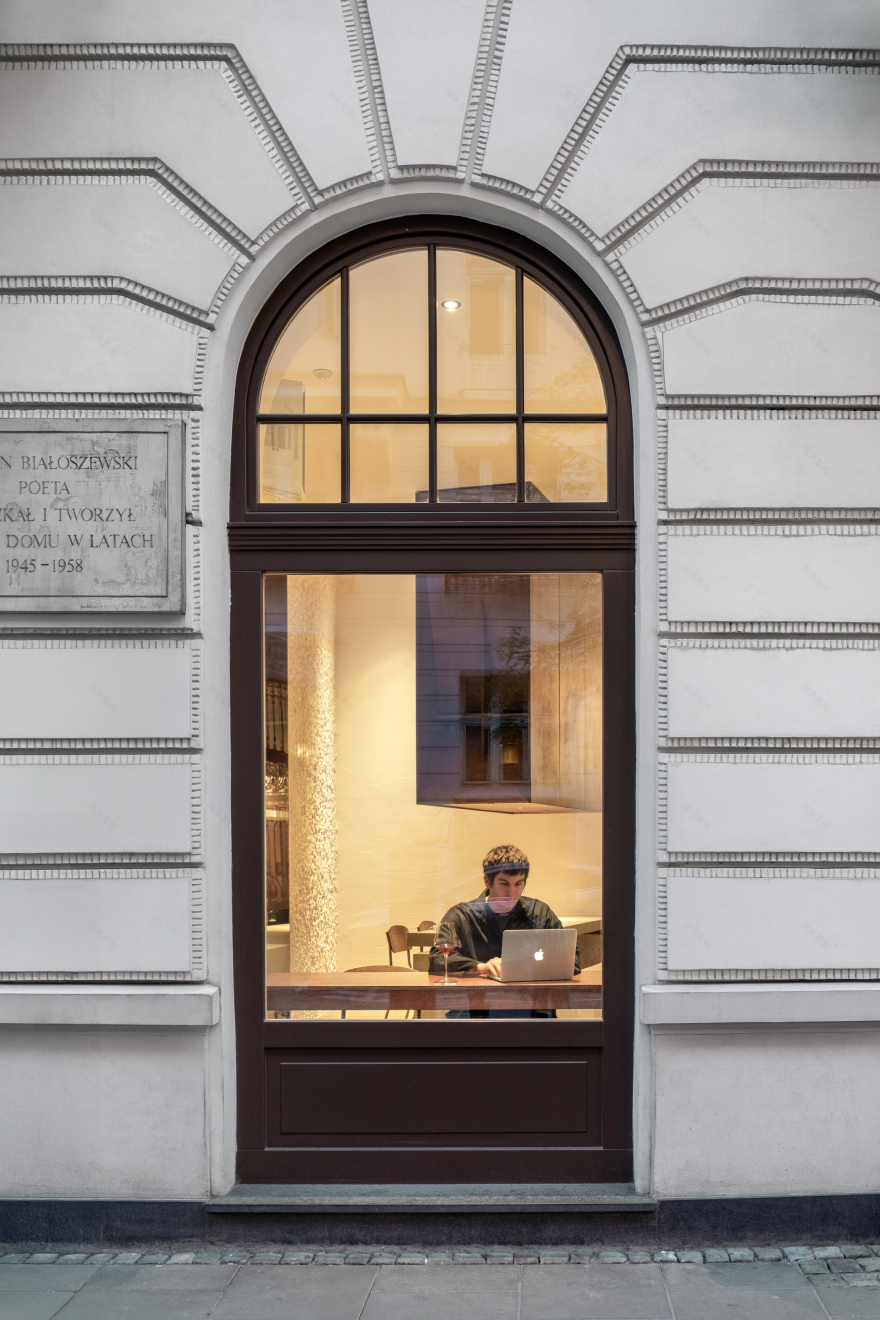
Text description provided by the architects. Warsaw's HOOD represents an exercise in duality across 108 square meters. Located at 37 Poznańska Street, the space operates on a continuous cycle, seamlessly transforming from morning coffee service to evening sets. The project consciously eschews decoration, offering instead a dialogue between raw materiality and surgically precise geometry, where calm and dynamism coexist.


Working within the shell of a pre-war tenement house, we faced the challenge of integrating a contemporary rhythm into a historical context. The task was not merely restoration, but the creation of a scenario that bridges the day's distinct timeframes. Instead of erecting walls, we employed the architectural tool of "concrete topography"—an artificial landscape that dictates movement and dwelling scenarios within the existing walls.

The concept is grounded in finding balance through contrast. The raw textures of the historical shell are counterbalanced by the sharp geometry of new interventions. Spatial dominants include a massive suspended wooden cube and a cantilevered bar, acting as sculptural elements. They combine physical weight with visual lightness, creating volumetric tension and serving as the architectural spine of the interior.


The concrete podium acts not merely as flooring, but as a navigation tool. It forms a complex relief that naturally organises seating and intuitively directs visitor flows. This variance in levels allows the venue to adapt to diverse needs, separating rapid transit zones from areas designed for slow dwelling.


The central bar forms the compositional core around which the venue's life revolves. To overcome the sensation of a narrow, tunnel-like space, we unified the two halls with a single, elongated element that binds the zones and erases the boundary between them. All proportions are designed to elongate dynamics, while glossy surfaces act as optical instruments: visually pushing back walls, multiplying natural light, and creating a complex play of reflections that adds depth to the interior.

The project's materials emphasize tactility. The palette is built upon a triad: raw white plaster as the background, polished concrete flooring as the foundation, and stainless steel work surfaces as a technogenic accent. Deep matte wood on the bar adds necessary warmth, while the precise joints of large planes form a visually clean, balanced environment.

The lighting scheme is programmed to support the venue's binary nature, ensuring a seamless transition from daytime transparency to evening intimacy. In the morning, light works to awaken, reflecting off cold steel and maintaining the city's dynamic rhythm. In the evening, the scenario shifts radically: a warm, dimmed spectrum engages, softening the brutality of the concrete.
Project gallery



南京喵熊网络科技有限公司 苏ICP备18050492号-4知末 © 2018—2020 . All photos and trademark graphics are copyrighted by their owners.增值电信业务经营许可证(ICP)苏B2-20201444 苏公网安备 32011302321234号
苏公网安备 32011302321234号客服
消息
收藏
下载
最近