

创作上传
VIP
收藏下载
登录 | 注册有礼
查看完整案例

收藏

下载

分享
踏勘场地时,山石、古树与苔径仿佛懂得识人,一路将我们引入深处。在密林中转过几道弯,眼前豁然开朗——尽头是一片开敞的广场。一株覆满苔痕的古榕屹立中央,界定着场所的“锚点”。
During the site survey, rocks, ancient trees, and moss-draped paths seemed to recognize us, guiding us deep into the woods. After winding through the dense forest, the view suddenly opened up—revealing an expansive square at the far end. An ancient banyan tree, blanketed in moss, stood at its center, defining the site’s “anchor point.”
©陈秋全
广场临空一边,有一座两层的建筑,已坍塌一角,与山坡共同围合出这个林中广场。建筑与广场原是寺庙景区的老汽车站,功能外迁后,这里逐渐沉寂。本次设计将在原址上进行翻建,置入茶室、素食餐厅与休憩功能,为景区完善配套。
On the cantilevered side of the square stood a two-story old station building, one corner collapsed, which together with the hillside enclosed this “empty” space in the forest. Originally the scenic area’s old bus station, the building and square fell into quiet obscurity after its functions were relocated. This design involves renovating the site in situ, integrating tea houses, vegetarian restaurants, and rest areas to complement the thousand-year-old Ancestral Hall.
▼清水岩主殿俯瞰视角,A Bird’s-Eye View of Qingshuiyan’s Main Hall ©谭啸

▼前厅看向丛林,Looking Out Over the Jungle from the Foyer ©谭啸

这里所说的寺庙,坐落于泉州安溪县蓬莱山北麓,是始建于北宋,至今一千余年的清水岩祖庭。蓬莱山常年云雾缭绕,宛如“蓬莱仙境”。祖庭主奉清水祖师,且融汇佛教文化,是福建、台湾及东南亚地区重要的民间信仰中心,信众逾亿,香火绵延不绝。
The temple referred to here is located at the northern foot of Penglai Mountain in Anxi County, Quanzhou—it is the Qingshuiyan Ancestral Hall, first constructed in the Northern Song Dynasty and boasting a history of over a thousand years to this day. Penglai Mountain is shrouded in mist year-round, resembling a “Penglai Wonderland.” Dedicated primarily to Patriarch Qingshui and integrating Buddhist culture, the Ancestral Hall serves as a vital folk belief center in Fujian, Taiwan, and Southeast Asia, with more than 100 million believers and an unbroken flow of incense.
▼区位、广场和老汽车站房,Location, Square, and Old Bus Station ©RESP

▼清水岩寺景区缩影,A Microcosm of Qingshuiyan Temple Scenic Area ©RESP

场地与功能
Site and Functionality
项目位于泉州安溪清水岩祖庭的核心景区内。首要原则是保留每一棵树木,让新建与自然共生。中心古榕成为组织空间与流线的关键线索。面对狭小用地和较高的落差,我们将主要功能置于地下,地面体量逐层退让,并于东侧打开一道过渡性灰空间,模糊建筑与森林的边界。
The project is situated in the core scenic area of Qingshuiyan Ancestral Hall in Anxi, Quanzhou. Its guiding principle is to preserve every tree, fostering harmonious coexistence between the new construction and nature. The central ancient banyan tree serves as the key thread for organizing space and circulation. Confronted with the narrow site and significant elevation differences, we placed the main functions underground, gradually set back the ground volume, and opened a transitional grey space on the east side to deliberately blur the boundary between the building and the forest.
▼森林中的建筑,The Building Amidst the Forest ©谭啸

▼与祖殿遥遥对望,Gazing at the Ancestral Hall in the Distance ©谭啸

▼看向西侧云海,Viewing the Sea of Clouds to the West ©谭啸
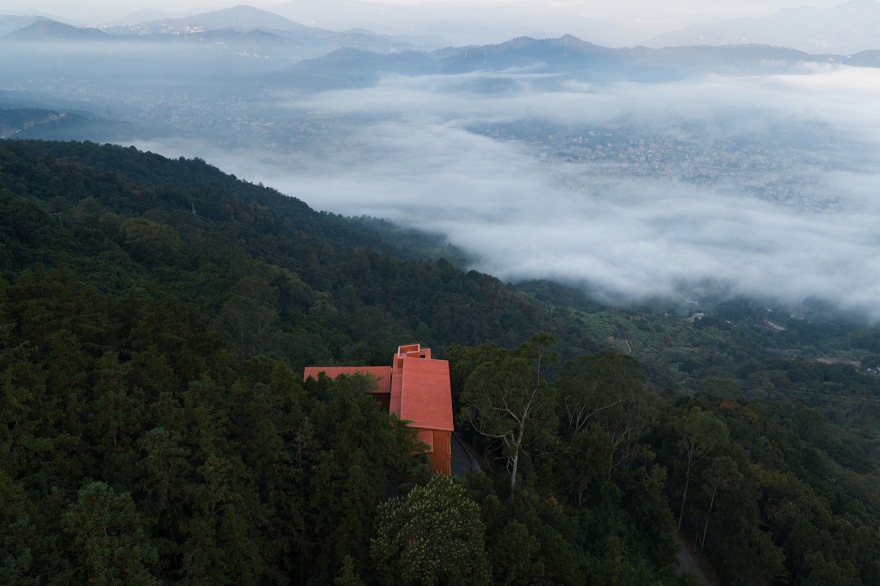
▼看向北侧重山,Viewing the Layered Mountains to the North ©谭啸

功能布局顺应地形展开。一层主入口兼具门厅与面向广场的敞厅,由此进入茶室区,房间南向庭院,北侧可观林木树干,东侧的敞开的灰空间,正对着一对守护上山古驿道的石狮。
The functional layout unfolds in harmony with the terrain. The main entrance on the first floor serves dual roles as a foyer and an open hall facing the square. From here, one enters the tea house area; the rooms face the courtyard to the south and overlook tree trunks to the north. The open space on the east side directly faces the ancient mountain trail guarded by a pair of stone lions.
▼建筑与森林互为咬合,The Building and Forest Interlock ©谭啸

▼树影下的建筑,The Building Beneath Tree Shadows ©谭啸

▼广场视角,View from the Square ©谭啸

▼古树与入口,Ancient Tree and Entrance ©谭啸

▼上山古驿道看向建筑,Viewing the Building from the Ancient Mountain Trail ©谭啸

▼由门厅看向广场,Viewing the Square from the Foyer ©谭啸

▼门厅休息区,Foyer Rest Area ©谭啸

▼门厅的眺望阳台,The Foyer’s Viewing Balcony ©谭啸

▼一层茶室走道,Tea House Corridor on the First Floor ©谭啸

▼茶室,Tea House ©谭啸

拾级而下至负一层,是素食餐厅的门厅。一侧为下沉庭院外廊,以景石与流水营造出如洞穴般的静谧过渡空间,并可转入林下室外庭院。一条后勤“桥梁”穿林而过,连接被大树掩映的既有旧楼,将其改造为厨房。门厅另一侧经前厅可达多功能厅,室外树影与远山被引入室内,由此可步入庭院,再沿人工叠石踏步盘旋返回广场。
Stepping down to the basement level, one reaches the foyer of the vegetarian restaurant. On one side lies the outer corridor of the sunken courtyard, where landscape stones and flowing water create a serene, cave-like transitional atmosphere, leading to the outdoor courtyard beneath the trees. A logistics “bridge” cuts through the forest, connecting the existing auxiliary building shaded by large trees and converting it into a kitchen. On the other side of the foyer, the multi-functional hall is accessible via the front hall, where outdoor tree shadows and distant mountains are framed into the interior; from here, one can step into the courtyard and spiral back to the square along the artificial stone steps.
▼景石与流水营造的下沉庭院1,Sunken Courtyard Crafted with Landscape Stones and Flowing Water (1) ©谭啸

▼后勤“桥梁”穿林而过,The Logistics “Bridge” Cutting Through the Forest ©RESP
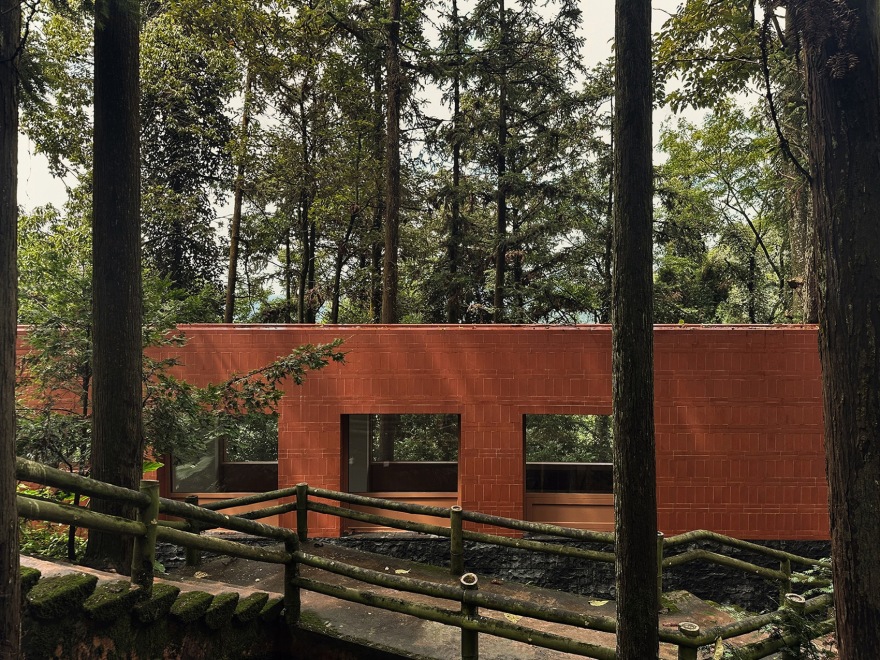
▼由“桥梁”上看向石狮,Viewing the Stone Lions from the “Bridge” ©谭啸

▼人工叠石成阶1,Artificial Stone Steps (1) ©谭啸
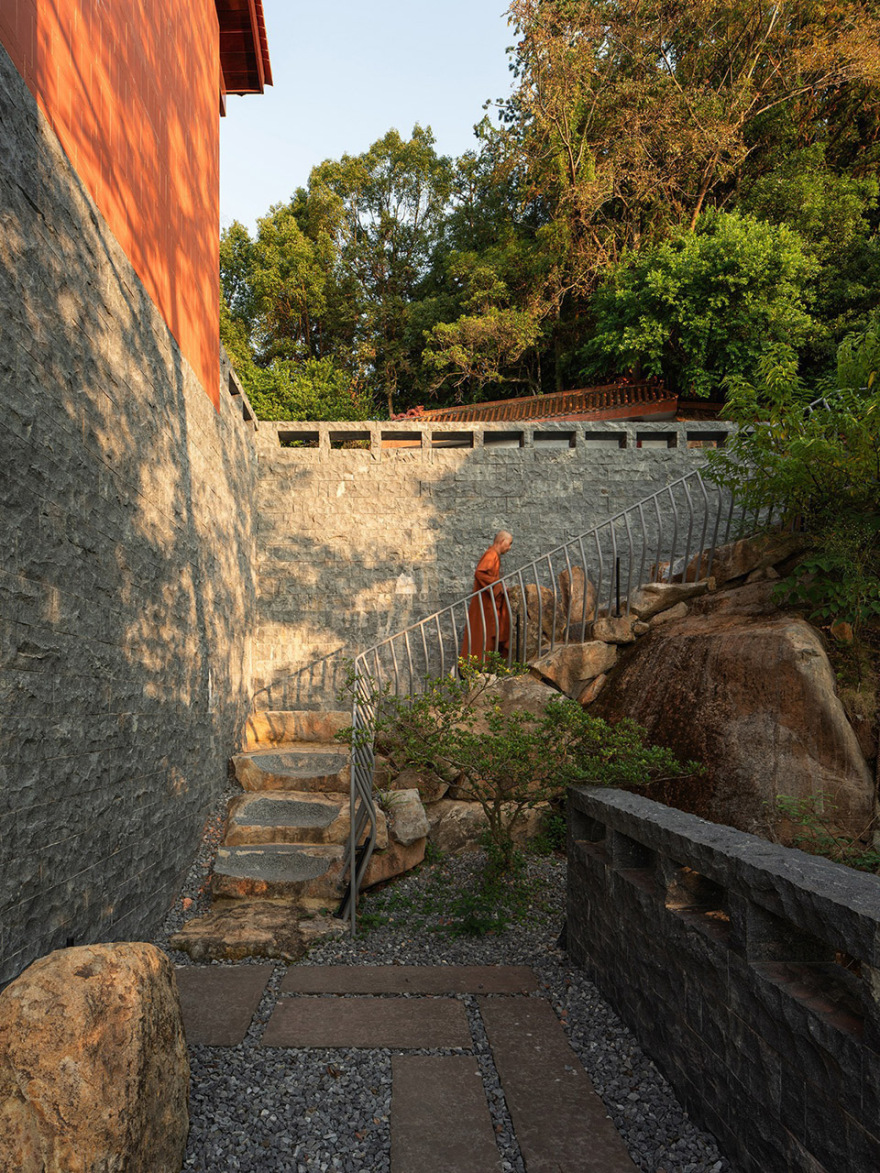
二层空间相对私密,设有休息室。东侧平台向林中延伸,与山林对话,西侧连接屋顶露台,在此可与祖殿遥遥对望。
▼木结构屋面示意图,Diagram of wooden structure roof ©RESP

The second floor is a relatively private space, housing a rest room. The eastern platform extends into the forest, engaging in a dialogue with the mountains; the western side connects to the roof terrace, where one can gaze upon the Ancestral Hall in the distance.
▼平台向林中延伸,The Platform Extending Into the Forest ©谭啸

▼屋顶露台,Roof Terrace ©谭啸

材料的在地转译
Local Interpretation of Materials
青石:建筑源于场地,其“发肤”也生发于此。我们将场地开挖所得的孤石进行加工,用于与广场同标高的负一层墙体,形成建筑的“台基”。粗粝的自然面砌筑与草莽山林气息相融。
Blue Stone: Born from the site, the building’s “skin” is rooted in the local context. We processed the isolated stones excavated from the site and used them for the basement wall at the same elevation as the square, forming the “base” of the building. The rough, natural-faced masonry blends seamlessly with the wild, rustic charm of the mountain forest.
▼场地开挖出来的孤石,Isolated Stones Excavated from the Site ©谭啸

▼门厅与多功能厅的剖透视,Sectional Perspective of the Foyer and Multi-Functional Hall ©RESP

清水混凝土:在回应时间性的命题时,材料需要回到本真的态度。多功能厅采用井字梁结构一次成型,井字格既是受力体系,也成为根据功能需要变化的光格。混凝土顶棚成为空间底色,西侧光线经黑色地坪漫反射,强化了空间的纵深感。
Fair-Faced Concrete: In response to the theme of temporality, materials should return to their essence. The multi-functional hall adopts a one-piece cast waffle slab structure; the grid serves not only as a load-bearing system but also as a dynamic light container. The concrete ceiling forms the space’s backdrop, while light from the west is diffused by the black floor, enhancing the space’s sense of depth.
▼粗粝的自然面青石墙体,Rough, Natural-Faced Blue Stone Walls ©谭啸

▼清水混凝土的井字格天棚,Fair-Faced Concrete Waffle Slab Ceiling ©谭啸

红砖:这是刻在闽南人基因里的温暖印记。我们试图解放砖的砌筑逻辑,建筑主体为剪力墙结构,红砖作为饰面,从而摆脱了承重束缚。立面采用全侧立、全顺砌、上下错缝的匀质构图。大跨度洞口采用湿挂工艺,使洞口的尺度得以释放。3mm的密缝要求一次成缝,结合传统工艺和现场多次试验,最终确定了以水灰:水泥:黄粉:氧化铁红=0.914:0.06:0.022:0.004的配比方案,使墙面呈现抽象、均匀的质感。均匀嵌入的玻璃砖,让室内墙体成为柔和的面光源,室内空间便得温润饱满。
▼红砖、玻璃砖的选样和砌筑实验,Selection and Masonry Experiment of Red Bricks and Glass Bricks ©RESP
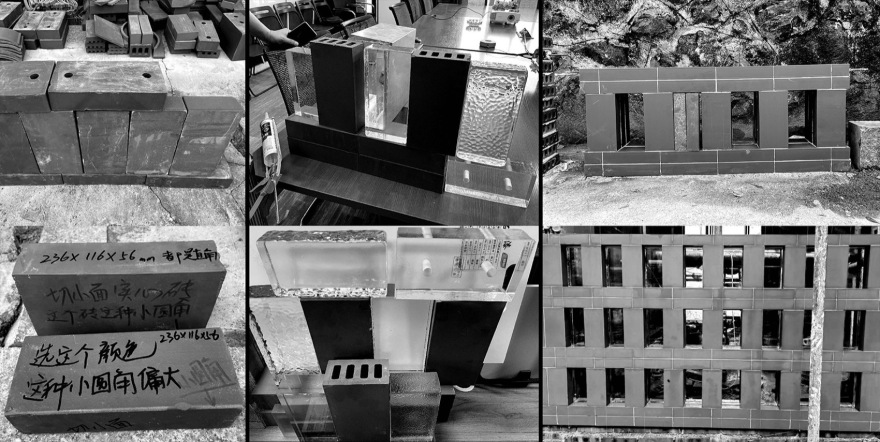
Red Brick: A warm imprint etched in the genes of Minnan people. We sought to liberate the logic of brick masonry. The main structure adopts a shear wall system, with red bricks used as cladding, freeing them from load-bearing constraints. The facade features a homogeneous composition of full side-standing, full stretcher bonding, and staggered joints. Large-span openings employ wet-hanging technique to maximize their scale. The 3mm dense joints require one-time forming; ultimately, a ratio of water-cement: cement: yellow powder: iron oxide red = 0.914: 0.06: 0.022: 0.004 was determined, endowing the wall with an abstract, uniform texture. Evenly embedded glass bricks transform the indoor walls into soft surface light sources, imbuing the interior with warmth and fullness.
▼室内墙体成为柔和的面光源,Indoor Walls as Soft Surface Light Sources ©谭啸
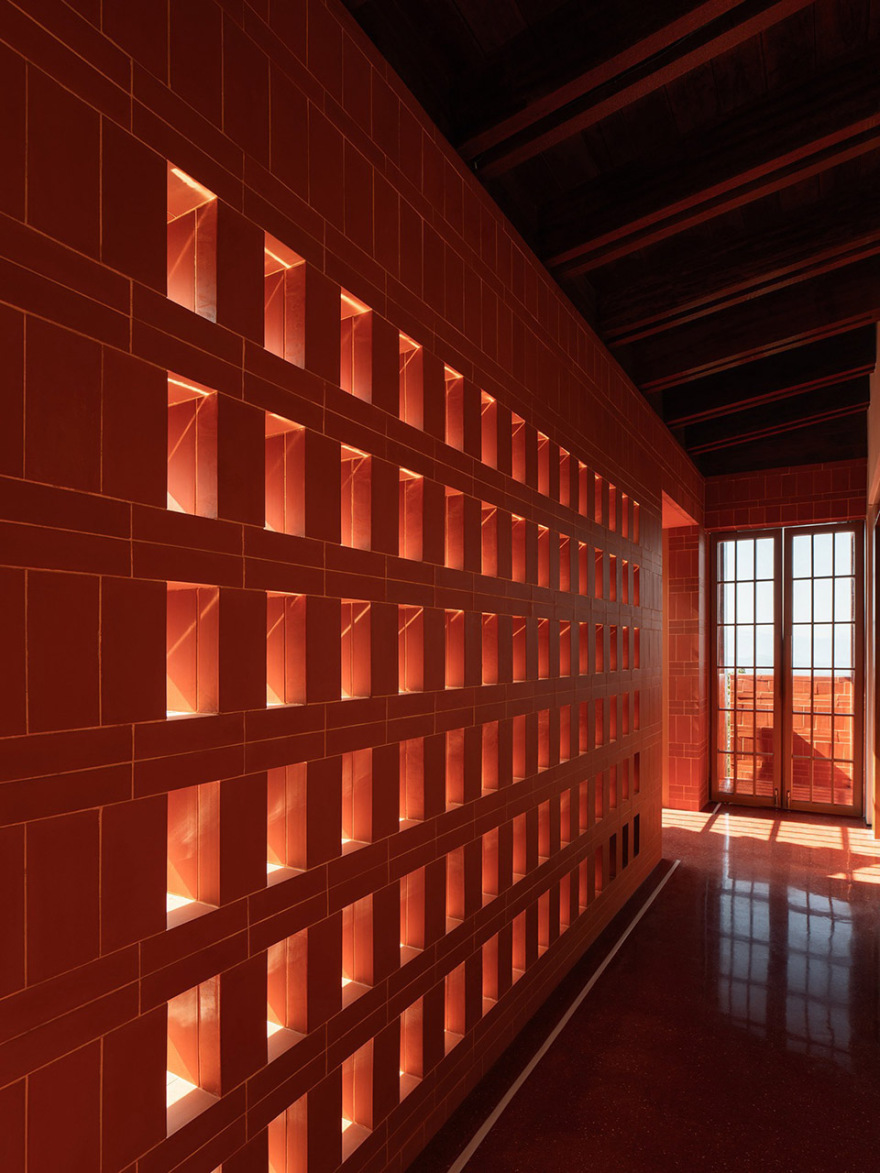
▼红砖成为室内外主要的表达元素,Red Bricks as the Primary Expression Element Indoors and Outdoors ©谭啸
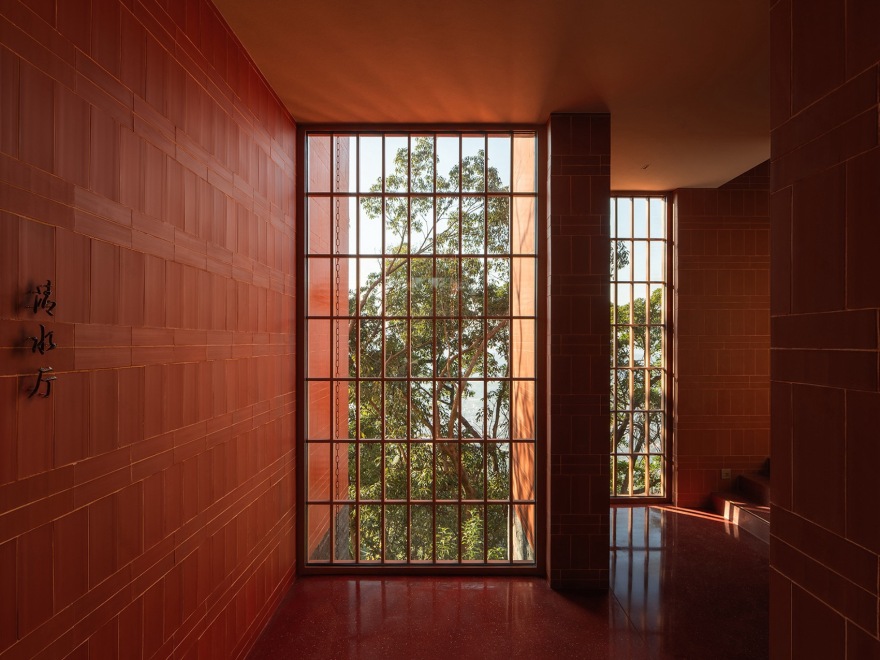
▼阳光下的温润的建筑立面1,Warm Building Facade in Sunlight (1) ©谭啸

▼阳光下的温润的建筑立面2,Warm Building Facade in Sunlight (2) ©谭啸

木构:我们将地方传统的双坡屋顶解构为单坡进行重组,形成一组姿态谦逊、高低跌落的屋顶群落。这为不同功能提供了差异化的层高与光影。结构上采用木构刚性节点,实现室内木构露明,贴近人体尺度。屋面红瓦则延续与祖殿相呼应的传统工艺,与历史肌理对话。
▼小比例木构模型制作和现场安装,Production and On-Site Installation of Small-Scale Wooden Structure Model ©RESP

Wooden Structure: We deconstructed the local traditional gable roof into single-slope units and reorganized them to form a cluster of roofs—humble in stance, with staggered heights. This provides differentiated floor heights and light conditions for various functions. Structurally, rigid wooden joints are employed to expose the indoor wooden structure, scaled to human proportions. The red tiles on the roof continue the traditional craftsmanship that echoes the Ancestral Hall, engaging in a dialogue with the historical context.
▼深色的木构让照射进来的阳光便得柔和,The Dark Wooden Structure Softens Incoming Sunlight ©谭啸

“间层”:空间的节奏与呼吸
“Interlayer”: Rhythm and Breath of Space
传统闽南民居厚实的墙体,在当代视角下看似低效,却自然形成了丰富的过渡区域。我们称之为“间层”——承担连接、缓冲与转换功能的“中间带”。
The thick walls of traditional Minnan “fortress buildings,” though seemingly inefficient from a contemporary perspective, naturally form rich transitional areas. We refer to this as the “interlayer”—a “middle zone” that undertakes the functions of connection, buffering, and transition.
▼将远山和树林框入当画的墙,Framing Distant Mountains and Forests Like a Painting ©谭啸

例如,从公共性强的下沉庭院外廊进入私密的小餐厅,需经过一个隐藏了小功能的“间层”。它使主要空间的外墙得以采用全玻璃系统自由开启,将山林四季纳入室内。黑色地铺强化了这个转换的仪式感。
For instance, to enter the private small restaurant from the highly public outer corridor of the sunken courtyard, one must pass through an “interlayer” that conceals small functions. This allows the outer wall of the main space to be freely opened with a full glass system, bringing the mountain forest’s four seasons into the interior. The black floor paving enhances the ritual of this transition.
▼素食餐厅,Vegetarian Restaurant©谭啸


在休息室,我们区分了开启扇与固定扇:开启扇侧置,而固定的玻璃不再只是一扇窗,而是一面取景的墙,将远山和树林框入当画的墙。
In the rest room, we distinguished between operable and fixed sashes: operable sashes are placed on the side, while the fixed glass is no longer merely a window, but a framing wall that captures distant mountains and forests like a painting.
▼休息室,Rest Room ©谭啸


空间的叙事与体验
Spatial Narrative and Experience
当地的清水岩寺祖殿内部空间低矮宜人,路径多向回转,穿行如探溶洞,与中国官式庙宇的威严迥异。这成为我们重要的空间借鉴。▼清水岩寺祖殿内部空间低矮宜人,路径多向回转,穿行如探溶洞,The internal space of Qingshuiyan Temple Ancestral Hall is low and inviting, with multi-directional winding paths that feel like exploring a cave ©RESP

The internal space of the local Qingshuiyan Temple Ancestral Hall is low and inviting, with multi-directional winding paths that feel like exploring a cave—starkly different from the grandeur of Chinese official temples. This served as an important spatial reference for our design.
▼犹如溶洞的负一层空间,The Basement Space Resembling a Cave ©谭啸

在二层公共区,我们刻意压低木屋盖的高度,回应祖殿那种贴近人体的尺度。进入休息室后,为获得更好的视野,又将屋顶抬高,形成错落的单坡。从楼梯走向西侧露台,需穿过一段被压低在屋盖下的台阶,其尺度与祖殿内部相仿——一抑一扬,登顶后豁然开朗,视野与祖殿相接。
In the public area on the second floor, we deliberately lowered the height of the wooden roof to echo the human-scaled intimacy of the Ancestral Hall. Upon entering the rest room, the roof is raised to capture better views, forming staggered single slopes. To reach the western terrace from the stairs, one must pass through a section of steps tucked under the roof—scaled similarly to the Ancestral Hall’s interior. This play of compression and expansion culminates in a sudden opening at the top, where the view connects seamlessly with the Ancestral Hall.
▼刻意压低木屋盖的高度,回应祖殿贴近人体的尺度,Deliberately Lowering the Wooden Roof to Echo the Ancestral Hall’s Human Scale ©谭啸

景观:借力与对话
Landscape: Leveraging Context and Fostering Dialogue
景观处理上,我们秉持“借力发力”的原则。广场是路径的尽头,建筑是边界的重塑,我们以山石修饰广场边缘,留出开阔场地。三处外部景观围绕不同思路展开:
In landscape design, we adhere to the principle of “leveraging existing context.” The square marks the end of the path, while the building reshapes the boundary. We adorned the square’s edge with rocks, preserving an open space. Three external landscape areas are developed around distinct concepts:
▼依山就势的现场叠石,On-Site Stone Stacking Following the Mountain’s Natural Slope ©RESP

借地势:西侧下往多功能厅的台阶,依山就势的现场叠石,扶手极简,弱化人工痕迹。
Leveraging Terrain: The steps leading down to the multi-functional hall on the west side feature on-site stone stacking that follows the mountain’s natural slope, with minimalist handrails to minimize artificial traces.
▼弱化人工痕迹的室外石阶,Outdoor Stone Steps with Minimal Artificial Traces ©RESP

融禅意:北侧利用开挖的巨石,片开成踏跺,出入如循石窟而下,抵达林下。
Integrating Zen: On the north side, excavated boulders are split into steps, creating a descent reminiscent of a stone cave that leads to the forest below.
▼片开巨石成踏跺,Splitting Boulders into Steps ©谭啸

叙光阴:下沉庭院以置石、流水、绿植造景。晌午时分,阳光自上而下挂在石墙上,落在景石苔藓上,潺潺流水声,便成一处雅致餐食空间。
Narrating Time: The sunken courtyard is landscaped with placed stones, flowing water, and greenery. At noon, sunlight cascades down the stone walls and onto the moss-covered landscape stones, while the gurgle of flowing water transforms the space into an elegant dining area.
▼下沉庭院的剖透视,Sectional Perspective of the Sunken Courtyard ©RESP

▼由素食餐厅看向庭院,Viewing the Courtyard from the Vegetarian Restaurant ©谭啸

▼景石与流水营造的下沉庭院2,Sunken Courtyard Crafted with Landscape Stones and Flowing Water (2) ©谭啸

结语
Conclusion
建设和思考的过程复盘简述至此,可概括为:建筑结合场地特征,空间取法清水岩寺,从场域中提炼出属于这里的建构特质,塑造一种生长于此、多年后终将再度融于山石丛林的建筑生命,以期实现环境和历史同声共响的建筑。“建筑”二字,既是名词,也是动词,我们更青睐其作为动词所蕴含的生命力。建筑已然“建筑”,而真正的建筑生命刚刚开始“建筑”。
This brief review of the construction and design process can be summarized as follows: the building integrates site characteristics, draws spatial inspiration from Qingshuiyan Temple, extracts construction attributes unique to this context, and shapes an architectural life that grows here and will eventually merge back into the rocks and forests in years to come—aiming to create a building that resonates harmoniously with its environment and history. The word “architecture” is both a noun and a verb; we favor the vitality inherent in its verbal form. The building has been “built,” yet its true architectural life has only just begun to “construct” itself.
▼生发于场地的建筑,The Building Growing from the Site ©谭啸

▼体块生成示意图,Block generation schematic diagram ©RESP

▼总平面图,Site-Plan ©RESP

▼负一层平面图,Ground Floor Floor Plan ©RESP

▼一层平面图,First Floor Plan ©RESP

▼二层平面图,Second Floor Plan ©RESP

▼剖面图,cross-section drawn ©RESP

▼东立面图,East Elevation ©RESP

▼北立面图,North Elevation ©RESP

项目名称:清水禅舍
项目类型:建筑/室内/景观/视觉
客户:安溪清水岩风景旅游区管理有限责任公司、安溪县蓬莱商会、安溪县清水文化旅游发展基金会
客户总工程师 :陈坚志
项目地址:中国福建泉州市
设计主创:厦门泛华·回应建筑工作室(RESP Studio)/陈延安 周伟栋
项目设计&完成年份:2021.10-2025.5
设计团队:陈志山、阮永鑫、游兰兰、彭勃、白思杨、叶明鸿、卓炳坤(景观深化)、颜海峰、周森炎、郭贯璋、李飞跃、康俊妹、徐鹤轩、黄志全、陈志云、吴文斌、刘小刚
施工单位:福建省安卓建设工程有限公司
灯光顾问 :成都一盏盏照明设计
幕墙顾问:厦门邝沛幕墙有限公司
摄影顾问: 谭啸 、陈秋全、RESP
建筑面积:1030平方米
结构类型:框架剪力墙结构
主要建筑材料:青石、红砖、木构、清水混凝土、水磨石地面
Project Name: Qing Shui Meditation Retreat Center
Project Type: Architecture/Interior/Landscape/Visual
Client: Anxi Qingshuiyan Scenic Area Management Co., Ltd., Anxi Penglai Chamber of Commerce, Anxi Qingshui Cultural Tourism Development Foundation
Client’s Chief Engineer: Chen Jianzhi
Project Address: Quanzhou City, Fujian Province, China
Design Principal: Xiamen Pan-China • RESP Studio / Chen Yan’an, Zhou Weidong
Project Design & Completion Year: 2021.10-2026.02
Design Team: Chen Zhishan, Ruan Yongxin, You Lanlan, Peng Bo, Bai Siyang, Ye Minghong, Zhuo Bingkun (Landscape Detailing), Yan Haifeng, Zhou Senyan, Guo Guanzhang, Li Feiyue, Kang Junmei, Xu Hexuan, Huang Zhiquan, Chen Zhiyun, Wu Wenbin, Liu Xiaogang
Construction Unit: Fujian Anzhuo Construction Engineering Co., Ltd.
Lighting Consultant: Chengdu Yizhanzhan Lighting Design
Curtain Wall Consultant: Xiamen Kuangpei Curtain Wall Co., Ltd.
Photography Consultant: Tan Xiao、Chen Qiuquan、RESP
Building Area: 1,030 Square Meters
Structure Type: Frame-Shear Wall Structure
Main Building Materials: Blue Stone, Red Brick, Wooden Structure, Fair-Faced Concrete, Terrazzo Flooring
南京喵熊网络科技有限公司 苏ICP备18050492号-4知末 © 2018—2020 . All photos and trademark graphics are copyrighted by their owners.增值电信业务经营许可证(ICP)苏B2-20201444 苏公网安备 32011302321234号
苏公网安备 32011302321234号客服
消息
收藏
下载
最近