

创作上传
VIP
收藏下载
登录 | 注册有礼
查看完整案例

收藏

下载

分享
第45届当代艺术博览会 ARCOmadrid 的项目,完全基于展会自身的材料、建造系统与生态体系,发展出“面向对象的城市主义”的新一轮实践。在本届中,方案围绕“墙”的建构展开:这一建筑装置同时作为边界、立面与城市界面运作,构建出一种源自展会内部的人工生态所衍生的“循环合成生态系统”。这面“墙”将两种既分离又相互依存的空间状态区隔开来:一方面,是由画廊、公共项目与文化基础设施构成的展会“城市中的居住性”;另一方面,是被理解为流动、停留与社会互动场所的公共空间之“城市中的日常性”。然而,这面墙并非不透明的阻隔,而是一个积极运作的界面,它建构了展会这一建筑事件,并将其直接置于城市语境之中。
The project for the 45th edition of the contemporary art fair ARCOmadrid exclusively employs fair-specific materials, construction systems, and ecologies to develop a new iteration of Object-Oriented Urbanism. In this edition, the proposal is articulated around the construction of a Wall: an architectural device that operates simultaneously as boundary, façade, and urban plane, formalizing a Circular Synthetic Ecosystem derived from a strictly fair-based Artificial Ecology. This Wall separates two differentiated yet interdependent spatial conditions: on the one hand, the domestic urbanism of the fair, composed of galleries, public programs, and cultural infrastructures; on the other, the urban domesticity of public spaces, understood as places of transit, dwelling, and social interaction. The Wall does not function as an opaque barrier, but as an active plane that constructs the architectural event of the fair and situates it in direct relation to the city.
▼项目概览,overview of the project©Imagen Subliminal Miguel de Guzman + Rocio R. Rivas

事件的建筑
Architecture of the Event
展会的城市设计将大体量画廊单元与更为紧凑、专门设计的公共装置并置,由此在其间生成一系列多尺度空间的星群,这些空间在展会与城市、居住与城市、建筑与事件之间不断摆动。在本届中,第45周年特别单元被整合于展会核心区域,并分布于两个展馆之中,作为一种横向激活机制,重新激活展会的侧向边界。这一布局强化了IFEMA 7号馆与9号馆之间的跨空间联系,并将ARCOmadrid统一为一种“事件的建筑”来阅读:一种每年仅存在五天、随后消散并重新融入循环展会经济体系的短暂都市。
The fair’s urban design juxtaposes large gallery blocks with more compact, specifically designed public pieces, generating between them a constellation of multi-scalar spaces that oscillate between fair and city, domestic and urban, architecture and event. In this edition, the special 45th anniversary section is integrated at the heart of the fair, divided into two parts—one in each pavilion—acting as a transversal activation element that reactivates the lateral edges of the fair. This layout reinforces programmatic transversality between Pavilions 7 and 9 at IFEMA and consolidates a unified reading of ARCOmadrid as an architecture of the event: an ephemeral metropolis that appears for five days each year and subsequently dissolves, reintegrating into a circular fair economy.
▼项目概览,overview of the project©Imagen Subliminal Miguel de Guzman + Rocio R. Rivas

公共项目的分布遵循一种“流线彻底均质化”的策略,消解传统中央与边缘通道之间的等级差异。通过消除这些差别,为所有画廊提供平等条件,使观众流线与吸引节点在整个场地内均匀分布。在这一语境下,“墙”成为事件的立面:一个并非表征展会、而是建构展会的建筑界面。它不是信息、图像或内容的承载体,而是组织空间关系、使用序列与“居住性梯度”的界面。展会并非被“布置”,而是通过这一连续界面被建筑性地生成。
The distribution of public programs throughout the fair responds to a strategy of radical homogenization of flows, eliminating the traditional hierarchy between central and peripheral aisles. By dissolving these differences, equal conditions are guaranteed for all galleries, ensuring that visitor flows and points of attraction are distributed evenly across the entire venue. In this context, the Wall becomes the elevation of the event: an architectural plane that does not represent the fair, but constructs it. It does not function as a support for messages, images, or content, but as a surface that organizes spatial relationships, sequences of use, and gradients of domesticity. The fair is not staged; it is architecturally materialized through this continuous plane.
▼展览空间,exhibition space©Imagen Subliminal Miguel de Guzman + Rocio R. Rivas

人工生态
Artificial Ecology
传统上,展会建筑往往生成一种“过时的生态系统”:它引入与展会语境无关的材料、建筑与流程,从而造成大量资源与能源的浪费。本项目提出一种完全相反的策略:明确以展会内部固有的建造系统、材料、参与者与经济机制为基础,构建一种自洽且自足的人工生态体系。
▼轴测图,axonometric©Pedro Pitarch architectures & urbanisms

Conventionally, fair architecture produces obsolete ecosystems, importing materials, architectures, and processes alien to the fair context and generating high levels of material and energy waste. This project proposes a radically opposed strategy: to work explicitly with the construction systems, materials, agents, and economies endemic to the fair sphere in order to construct a coherent and self-sufficient Artificial Ecology.
▼“墙”成为事件的立面,the Wall becomes the elevation of the event©Imagen Subliminal Miguel de Guzman + Rocio R. Rivas
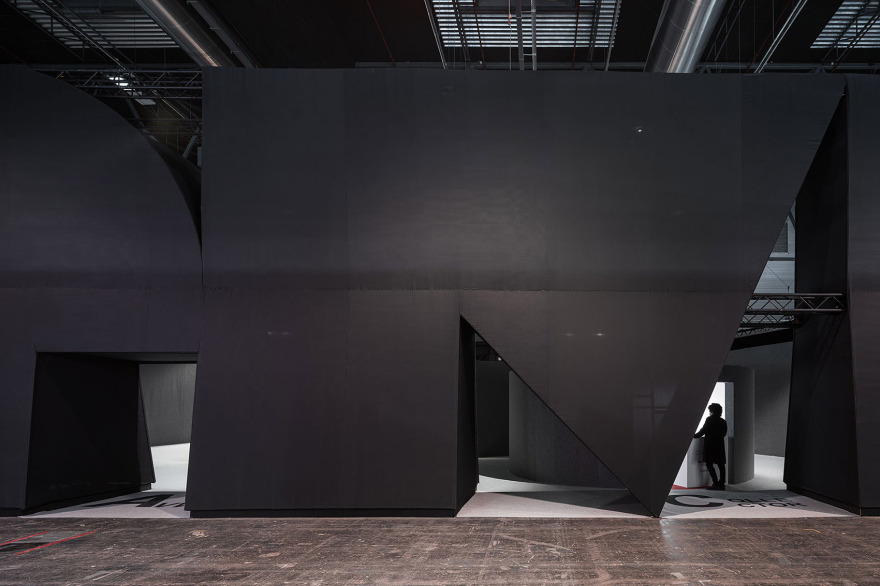
“墙”由可重复使用的工业化系统构成——例如舞台桁架、再生板材以及典型展会搭建中的基础设施构件——并以非传统方式加以使用。这些材料在展会生态中获得“第二生命”,并在三个尺度上循环:永久性(融入IFEMA建筑体系)、短暂性(在其他展会中重复使用)以及基础设施性(进入画廊的物流系统)。
The Wall is built from reusable industrialized systems—such as stage trusses, recycled panels, and infrastructural elements typical of fair assembly—used in unconventional ways. These materials acquire a second life within the fair ecosystem at three scales: permanent (integrated into the architecture of IFEMA), ephemeral (reused in other fairs), and infrastructural (incorporated into the logistical processes of galleries).
▼“墙”由可重复使用的工业化系统构成,The Wall is built from reusable industrialized systems©Imagen Subliminal Miguel de Guzman + Rocio R. Rivas

循环合成生态系统
Circular Synthetic Ecosystem
相较于其极短的持续时间,展会是资源消耗与废弃物产生最为密集的建筑类型之一。本项目延续“面向对象的城市主义”概念,将展会视为一个“循环合成生态系统”,其中材料、系统、人类与非人类主体共同存在。
▼轴测图,axonometric©Pedro Pitarch architectures & urbanisms

The fair is one of the architectural typologies with the highest resource consumption and waste production relative to its short duration. ARCOmadrid Vol. 3 continues to develop the concept of Object-Oriented Urbanism, conceiving the fair as a Circular Synthetic Ecosystem in which materials, systems, human and non-human agents cohabit simultaneously.
▼“墙”由可重复使用的工业化系统构成,The Wall is built from reusable industrialized systems©Imagen Subliminal Miguel de Guzman + Rocio R. Rivas

悬挂桁架、未经切割的再生刚性板材、重复使用的展会地毯、有机织物、租赁舞台灯光、连接系统、艺术品包装材料以及生态防水材料,共同构成项目。这些元素并非作为被覆盖或隐藏的基础支撑,而是主动呈现其建造过程、技术逻辑与生命周期。当这些元素被整合进“墙”及其所组织的建筑体系后,它们作为“对象”在循环系统中获得解放——在展会结束后,所有材料都将被完全重新纳入循环之中。
Suspended trusses, uncut recycled rigid panels, reused fair carpeting, organic textiles, rented stage lighting, fastening systems, art packaging products, and ecological waterproofing materials constitute the project. These elements do not act as an ex-novo support to be covered or concealed; rather, they reveal their constructive processes, technologies, and life cycles. Integrated into the Wall and the architectures it articulates, they claim their emancipation as objects within a circular system in which, once the fair concludes, all materials are fully reintegrated.
▼展览现场,exhibition site©Imagen Subliminal Miguel de Guzman + Rocio R. Rivas

反广告牌
Anti-Billboard
这面“墙”作为一种“反广告牌”存在:一个刻意去除内容的建筑界面。不同于传统广告牌以展示、传播与再现为核心,这一界面拒绝一切图像、文字与信息。由此,广告牌不再是传播媒介,而在本体意义上转化为建筑本身。
The Wall functions as an Anti-Billboard: an architectural plane deliberately devoid of content. In contrast to the conventional billboard format defined by the need to display, communicate, or represent, this plane renounces all image, text, or message. In doing so, the billboard ceases to be a communicative support and becomes, ontologically, architecture.
▼展览现场,exhibition site©Imagen Subliminal Miguel de Guzman + Rocio R. Rivas

这一姿态并非缺失,而是一种批判性立场。通过清空界面内容,“墙”质疑了与展会及当代城市空间相关的可见性机制、再现逻辑与视觉消费方式。“反广告牌”构建了一种“无图像的立面”与“无再现的界面”,将注意力从信息转移至材料性、尺度与空间体验本身。
This gesture is not an absence but a critical position. By emptying the plane of content, the Wall questions the mechanisms of visibility, representation, and visual consumption associated both with the fair and with contemporary urban space. The Anti-Billboard constructs a façade without image, an elevation without representation, shifting attention from message to materiality, scale, and spatial experience.
▼展览现场,exhibition site©Imagen Subliminal Miguel de Guzman + Rocio R. Rivas
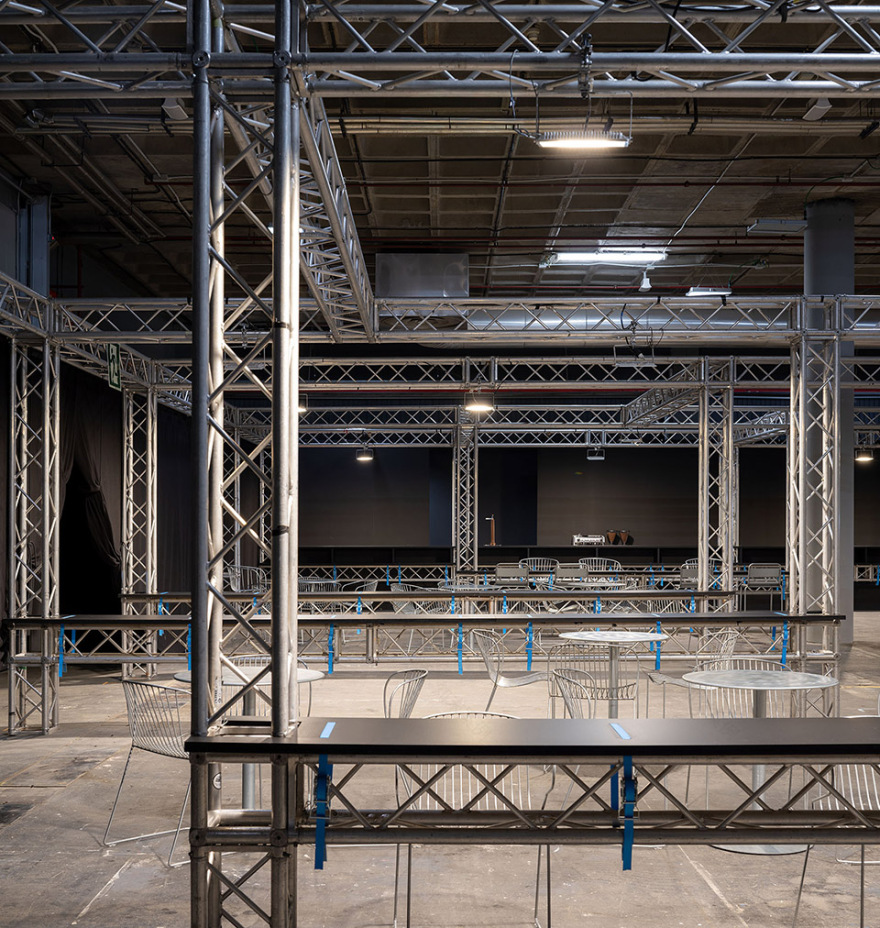
分化的居住性
Divided Domesticities
展会的空间设计有意放弃城市主义与建筑之间的传统区分,形成一种多尺度组织结构,使“居住性”与“城市性”在重叠与分离中同时存在。在“墙”的下方与周边,公共空间与展会项目被组织为一系列连续环境,在客厅、画廊与城市空间之间不断切换。
The spatial design of the fair deliberately renounces the traditional distinction between urbanism and architecture, producing a multi-scalar organization in which domestic and urban scales overlap and separate simultaneously. Beneath and alongside the Wall, public spaces and fair programs are arranged in a sequence of environments oscillating between living room, gallery, and urban space.
▼细部,detail©Imagen Subliminal Miguel de Guzman + Rocio R. Rivas

展会基础设施——包括照明、结构与技术系统——不仅提供后勤支持,同时直接建构空间体验。最终,展会被理解为一个“建筑事件”:在其中,物件、系统、使用者与合成自然共同构成复杂的多尺度语境,建筑不再表现事件,而本身即为事件。
Fair infrastructure—lighting, structures, technical systems—not only provides logistical support but constructs the spatial experience of the event. The result is a fair understood as an architectural event in which objects, systems, users, and synthetic natures configure a complex multi-scalar context, where architecture does not represent the event, but is the event itself.
▼平面图,plan©Pedro Pitarch architectures & urbanisms

▼立面图,elevation©Pedro Pitarch architectures & urbanisms

OFFICE:Pedro Pitarch architectures & urbanisms Palma 59, Bajo B 28015, Madrid
Architect:Pedro Pitarch
Team:Pedro Pitarch Guillermo Martín - Peñasco Claudia Tante Maia Mesas Lucía del Rey Enoc Pascau

南京喵熊网络科技有限公司 苏ICP备18050492号-4知末 © 2018—2020 . All photos and trademark graphics are copyrighted by their owners.增值电信业务经营许可证(ICP)苏B2-20201444 苏公网安备 32011302321234号
苏公网安备 32011302321234号客服
消息
收藏
下载
最近