

创作上传
VIP
收藏下载
登录 | 注册有礼
查看完整案例

收藏

下载

分享

翻译
Architects:Architektura
Area:218m²
Year:2025
Photographs:Matej Hakár
Manufacturers:Wienerberger,OKNA.EU,Značková okna
Structural Project:KR projekt, Kateřina Ryvolová
Category:Houses
Author:David Kraus, Miroslav Styk
Interior Design:Jan Waltr
Contractor:Radek Trojánek
Usable Floor Area:338 m²
Plot Size:3027 m²
City:Jevany
Country:Czechia

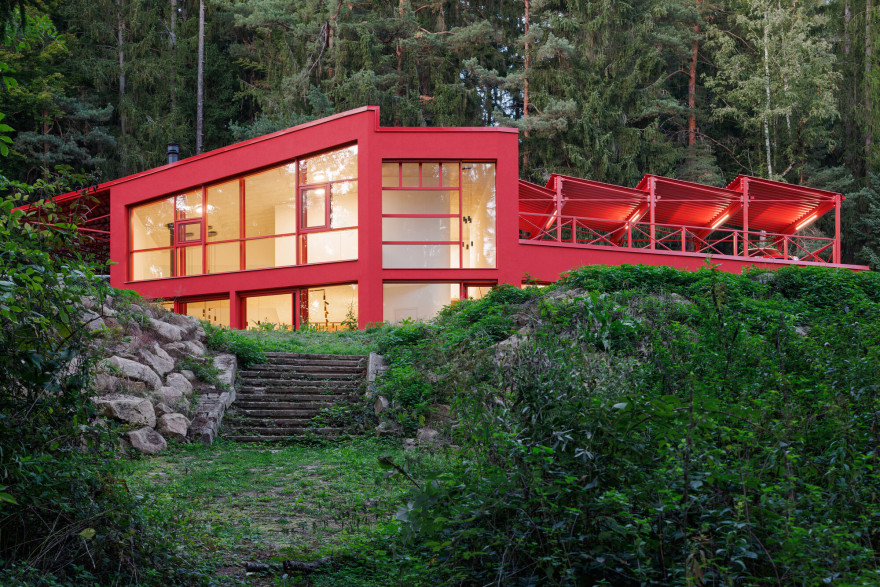
Text description provided by the architects. A spruce forest, a slope, views of giant tree trunks, a pit left after an old building, birds, deer, and flickering sun rays. Below, the surface of a lake. The access road lies at the upper edge of the plot. From the street, the house appears single-story — invisible and small; from the garden, it becomes two-story — open and large. Cars park on the roof. The massing of the house follows the slope of the terrain and the client's spatial requirements. The central staircase space (the "torso") connects the western and eastern wings — the day and night zone. The main concept is a visual axis and descent into the forest landscape. Green and red are complementary colors. The house — an organism — becomes part of the forest.


Jevany Villa is located in a densely wooded part of the village with solitary family houses. Originally, forest plots are long, bordered by an upper forest road used mostly by locals, and a lower path running along the ponds, visually shielded by mature trees. For one of these exceptional sites, the brief called for a modern house with an industrial expression. The investor chose architect David Kraus based on his earlier project a few streets away. The sloping terrain descending from north to south, with access from above, was crucial for the design. One of the key decisions was the precise placement of the building on the plot, which is relatively large. Remnants of the original house were removed, leaving a pit with a height difference of about 3.6 meters from the road. Mature trees stand up to ten meters below the building site and form a striking phenomenon — they rustle, move, and rise like sculptures toward the sky. A setback of nearly five meters from the adjacent semi-street creates a generous entrance area and parking on the roof terrace.

The orientation of the house responds to cardinal directions and views. It opens to the south and toward the forest, while remaining closed to the north and the street. From the northern upper side, the house is embedded into the slope. From the street, it appears single-storey and almost invisible; from the garden, it is entirely different — tall, glazed, generous. The core idea is the visual axis and descent into the forest landscape, as if stepping from the carport into another world. The central staircase hall (a kind of solid backbone of the creature) connects the western and eastern wings.

The house can be read in five basic operational levels: at street level, the covered parking, central entrance space, and a bright area with a study; at the forest level, the day and night zones. The entrance leads across the roof parking — a terrace covered by a sawtooth roof that immediately evokes the industrial character of the house. Three "teeth" represent parking spaces, and one represents the object´s main entrance. The roof is formed by a raw red steel structure under which cars of various colors stand. The interplay of these colors lightens the otherwise serious theme of family living. Cars park each time differently, making the visual effect always unique.


The entrance space is the central part connecting the house's levels. Immediately upon entering, the forest appears — tall trees, silhouettes that sometimes move, changing colors throughout the year. The glazing is irregularly divided, reminiscent of Mondrian's compositions. The straight staircase is dominant, accompanied by a recessed illuminated railing. One descends through a 3.5-meter-high space, passing a curved wall that guides movement into the living area. From the outside, the curve introduces a sense of something different within the otherwise angular silhouette of the house. Still at street level, just a few steps lower, is a bright study that can also serve as a guest room or gym, open both to the forest and down into the living zone.
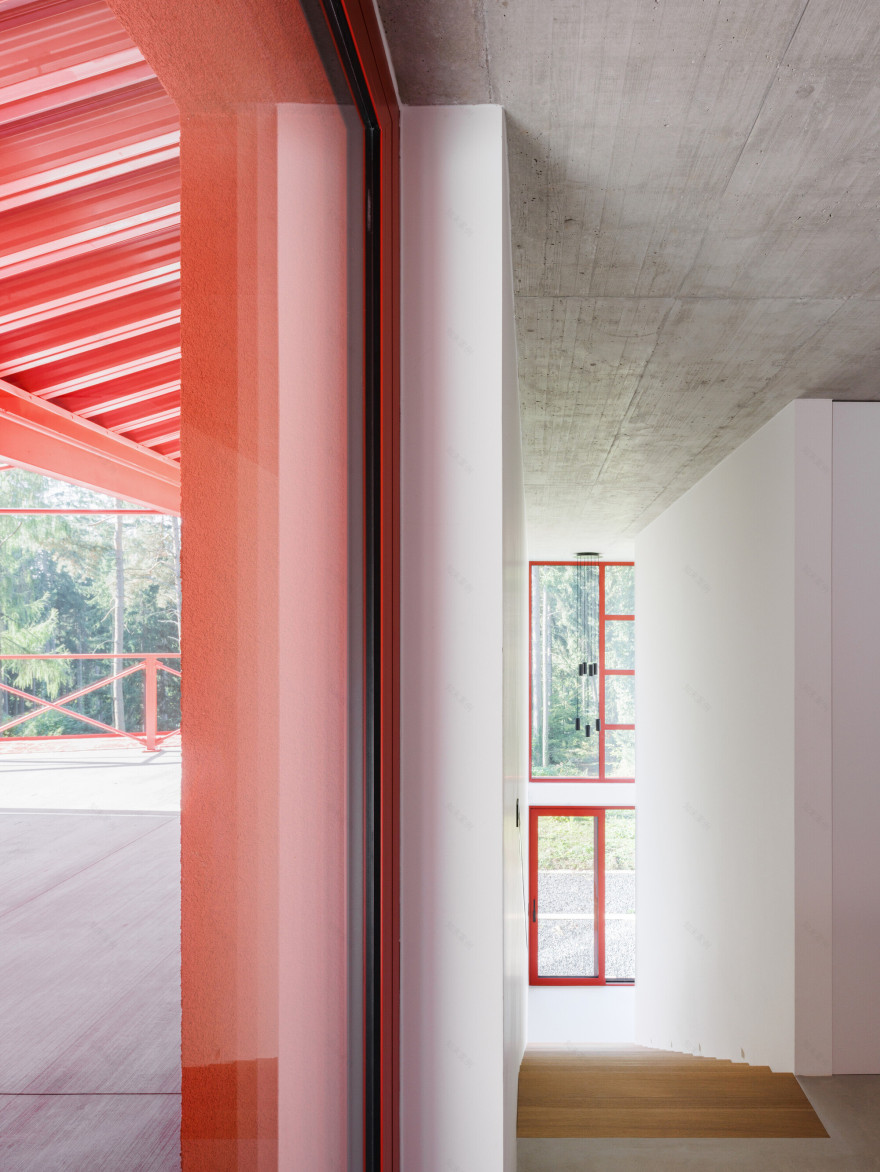
The day zone is a large central space for living, cooking, and relaxing with views. The generous space is fully connected to the surroundings; red steel window structures form a strong element contrasting with the irregular green silhouettes of the trees. The living area spans two floors; looking up, one sees raw concrete ceiling structures with formwork imprints and suspended black lights. The quiet zone is connected to the day zone by a long residential corridor with built-in white cabinets on one side. The parents' bedroom with a large walk-in closet and bathroom, as well as the children's rooms, are connected to the exterior and forest views. The corridor ends with an exit to the garden, which may later serve older children as an independent entrance.

Material-wise, this is a raw house full of red steel structures, white walls, and black accents. The kitchen is multicolored; its reddish stone surfaces contrast with black shelves, white doors, and a steel fireplace floating above the floor. Interior design was developed with Jan Waltr, who shared the architects' understanding of what the house needed.

The garden is created by nature itself. Interventions were limited to the immediate surroundings — the terrace, upper entrance area, and side staircase. A striking feature is the giant stones found on the plot after removing the original building, left and placed beside the new structure as a natural part of the environment. The plot remains visually shielded by mature trees and open toward the forest and ponds below. The forest environment is monumental, dynamic, and alive — it forms the main framework of living and the house's direct connection to the landscape. The house-organism is part of the forest.


"The house is the result of the clients' open, almost artistically tuned minds, mutual trust, constructive cooperation that both sides enjoyed, and the exceptional meticulousness of contractor Radek Trojánek during construction." (David Kraus)

Project gallery



南京喵熊网络科技有限公司 苏ICP备18050492号-4知末 © 2018—2020 . All photos and trademark graphics are copyrighted by their owners.增值电信业务经营许可证(ICP)苏B2-20201444 苏公网安备 32011302321234号
苏公网安备 32011302321234号客服
消息
收藏
下载
最近