

创作上传
VIP
收藏下载
登录 | 注册有礼
查看完整案例

收藏

下载

分享

翻译

Architecture studio Haworth Tompkins has updated and extended the Grade II-listed Theatr Clwyd in Wales, transforming the sprawling cultural centre into a "welcoming civic destination".
Situated on a hillside above the town of Mold in north Wales, Theatr Clwyd, which opened in 1976, was in need of an upgrade to its fragmented public spaces and dated facilities.
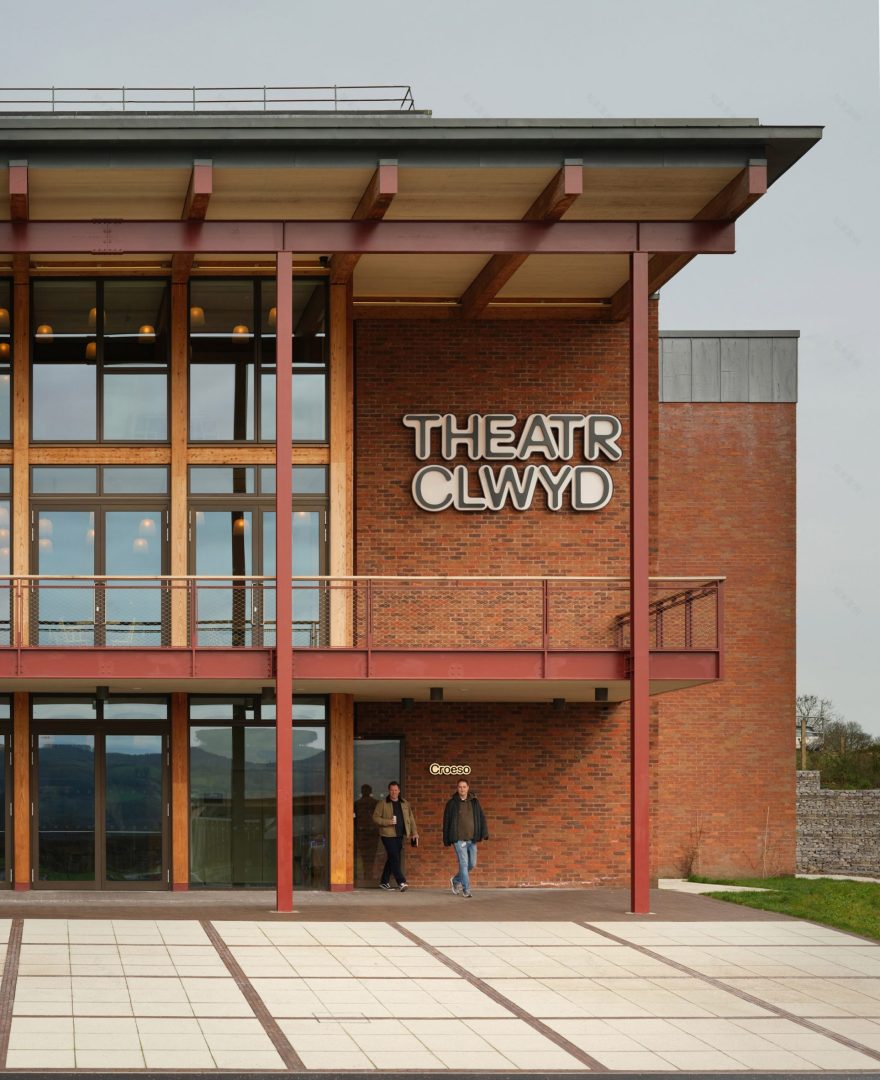
Haworth Tompkins has updated the Grade II-listed Theatr Clwyd in Wales
London-based Haworth Tompkins adopted a "deep retrofit strategy" that aimed to preserve the majority of the theatre's existing concrete and brick structure, while adding "minimal extensions".
The redevelopment also included the overhaul of the building's mechanical and electrical services, as well as fabric improvements and the integration of passive design strategies and on-site photovoltaic panels.

The theatre's existing concrete and brick structure was largely retained
"Our ambition was to retain the spirit and character of the original 1970s Grade II-listed building, while opening the building up to its spectacular rural landscape setting and to the community it serves," said studio director Lucy Picardo.
"Working closely with the theatre team, we have reimagined the building as a welcoming civic destination," Picardo continued.
"The result is a renewed theatre that celebrates its past while creating a technically capable and inspiring setting for theatre-making long into the future."

A front extension is arranged around a three-storey atrium
Central to the redevelopment was the creation of a more inviting entrance for the 10,000-square-metre complex, which could previously be entered at three different points.
"One of our design principles was to welcome everyone through the same front door and make it prominent and welcoming," Picardo explained.
To achieve this, the studio added a three-storey glazed extension to the building's front. Its timber and steel frame extends outwards to shelter an external patio at ground level and first-floor balcony.

Two existing auditoria were updated
Entering through the extension, visitors are guided into a reception and cafe at ground level, where a newly-added central staircase and lifts replace a "convoluted and restrictive" circulation core and improve accessibility.
On the first floor, the front extension has been arranged around a central atrium that traverses three levels and is framed by large timber columns that demarcate the position of the original facade.
Full-height glazing and a roof opening draw daylight into the space, which hosts a restaurant and adjacent bar overlooked by additional seating on the upper floor.
Haworth Tompkins opted for a warm and "robust" material palette for interior, combining the extension's glulam, cross laminated timber (CLT) and red-toned steelwork structure with copper surfaces and pale wooden floors.
Silicone light fixtures designed by Rob McIntyre adorn the communal spaces, along with commissioned artwork, including a ceramic tile display by Frances Priest and events room curtain by Sauda Imam.

A curtain designed by Sauda Imam enlivens the events room
Alongside the upgrading of the centre's three performance spaces, events room and cinema, the building now also includes rehearsal rooms, studios, workshops and an office.
These spaces are largely connected by an "internal street" on the first floor, which runs between the building's east and west wings.
"Part of our primary move was to make it really generous, legible and easy to navigate," Picardo said.

Rehearsal rooms, studios, workshops, and an office were added to the complex
At the building's eastern end, two existing auditoria have been largely structurally preserved and fitted with modern lighting and technical facilities.
At the opposite end of the complex, a carpentry workshop composed of concrete block walls has been built alongside new studio spaces and is overlooked by a public viewing walkway.
The studio also revamped an existing ground-floor cinema, which included the expansion of an adjacent foyer.

A new workshop is overlooked by a public viewing walkway
Other spaces, which are yet to be completed as part of the redevelopment, include a play area and a sensory garden designed to create more inclusive community spaces.
Previously, the studio completed an extension of The Old Vic in London, fronting it with a colourful facade of recycled spotlights, and completed The Court Theatre in New Zealand with timber benches and large windows.
The photography is by Philip Vile.
南京喵熊网络科技有限公司 苏ICP备18050492号-4知末 © 2018—2020 . All photos and trademark graphics are copyrighted by their owners.增值电信业务经营许可证(ICP)苏B2-20201444 苏公网安备 32011302321234号
苏公网安备 32011302321234号客服
消息
收藏
下载
最近