

创作上传
VIP
收藏下载
登录 | 注册有礼
查看完整案例

收藏

下载

分享

翻译
Architects:Kidz Studio
Area:89m²
Year:2026
Photographs:Enric Badrinas
Manufacturers:Artu
Category:Coffee Shop,Interior Design
Design Team:Sonya Plusnina, Valeriy Egorov, Antonina Polevaya, Oleg Kaigorodov, Alena Minaeva, Maria Soboleva, Egor Bogomolov
City:Barcelona
Country:Spain

Text description provided by the architects. Cinnamood is an international coffee shop chain specializing in cinnamon rolls and specialty coffee, known for its strong visual identity and distinctive spatial concept. The café is located at Carrer de l'Argenteria, 61, in the historic Ciutat Vella district, in El Born, next to the Basilica of Santa Maria del Mar, within a building from the first half of the 20th century embedded in the dense medieval urban fabric.

We had previously collaborated with the brand, developing a storybook — a scalable concept adaptable across different locations. For the new Barcelona project, we were invited again, this time to design a specific space in a new country for Cinnamood. The task was to adapt the established visual language of the brand to the architectural context of the site, preserving recognizability while integrating the concept organically into its surroundings.
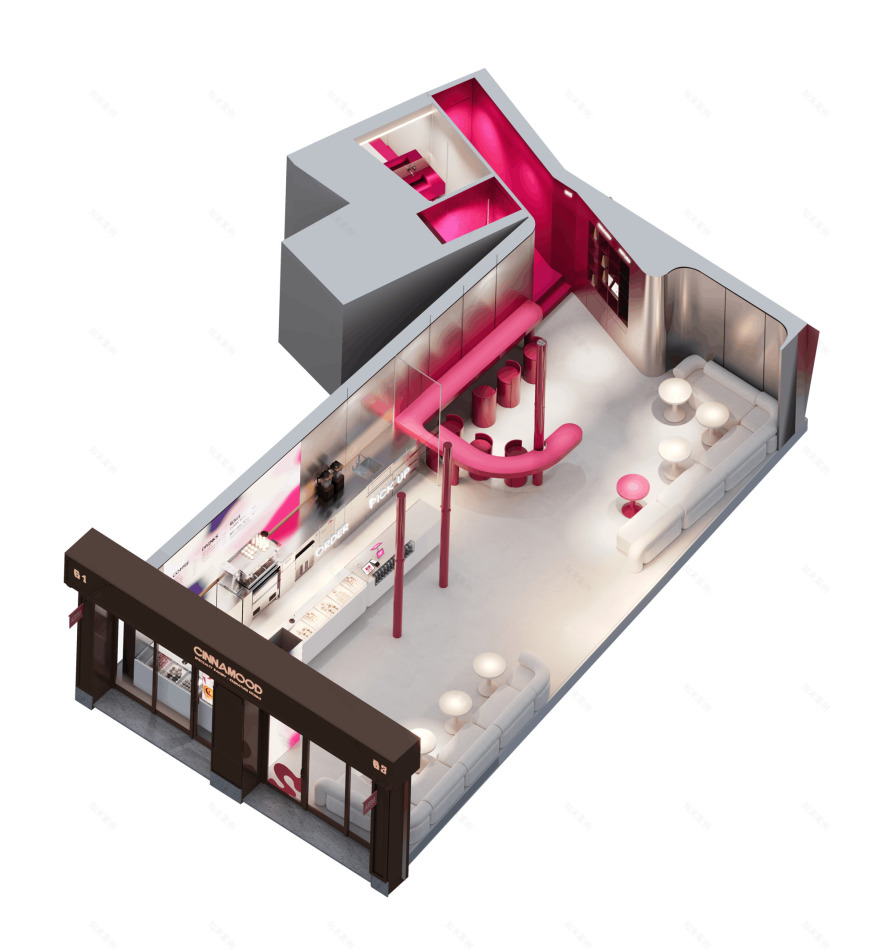
The project is based on Cinnamood's signature vibrant palette, set against a minimalist, almost futuristic background. The expressiveness of color is enhanced through a neutral base, clean geometry, and precise accents, allowing the brand to feel cohesive and confident within the new space. The layout was shaped around the existing columns inside the space. Instead of concealing them, we turned them into compositional anchors of the interior. The geometry of the counter is built around the columns, while the graphic ceiling pattern appears to "flow" outward from them, unifying the space into a single system.

All seating is kept in neutral tones, while color is concentrated in wall finishes and built-in furniture. Gradient metal panels create a seamless transition between materials, with metal fading into vibrant color. This approach enhances the futuristic feel while maintaining a calm and cohesive interior. Sharp angles were intentionally avoided, resulting in a soft, enveloping space defined by fluid forms. The main functional focus is the ordering and pick-up area. Particular attention is given to the display of pastries: the customer journey is designed so that guests gradually engage with the ассортимент and spatial logic as they move toward the counter. Seating is positioned away from potential queue zones, which are instead allocated for merchandise, preventing visual and functional congestion.

The counters are made of acrylic stone with rounded forms, reinforcing the overall soft geometry. Finishes combine gradient metal, vibrant color, and neutral surfaces that serve as a backdrop for brand accents. The project incorporates seamless digital screens for menus and entry information. Integrated into the wall planes, they become part of the architecture rather than standalone elements, supporting the idea of a cohesive, technologically integrated environment.

The interior is designed as a flexible system where architecture, graphics, and digital elements operate together. Built-in solutions, seamless screens, and fluid forms simplify navigation and enhance user experience. Materials were selected with high foot traffic in mind: acrylic stone, metal panels, and painted surfaces are durable and easy to maintain. Structural solutions allowed existing building elements to be integrated into the design without complicating the construction process, preserving clarity of form and visual lightness.

Project gallery


南京喵熊网络科技有限公司 苏ICP备18050492号-4知末 © 2018—2020 . All photos and trademark graphics are copyrighted by their owners.增值电信业务经营许可证(ICP)苏B2-20201444 苏公网安备 32011302321234号
苏公网安备 32011302321234号客服
消息
收藏
下载
最近