

创作上传
VIP
收藏下载
登录 | 注册有礼
查看完整案例

收藏

下载

分享
泸沽湖岚岳海子花园毗邻格姆女神山,面朝大海子,是致舍在高山草海湖畔打造的一处自然野生花园。设计借景于湖光山色、融合自然之美,以景观的自然流动(The natural flow of the landscape)为理念,以在地营建的方式回应场地特征;通过低干预的生态修复策略与土地肌理的艺术化转译,用生动的大地艺术景观延续地域农耕与渔牧交织的摩梭人居生活记忆。园中保留了原生植物,结合低维护草花混播,探索场地的再野化路径,让自然演替过程成为空间的主导力量。海子花园不仅是一处景致,更是一个具有时间维度的生命系统;它秉承传统园林可游可居的山水意趣,以可持续理念赋予其现代表达,为来访者带来触动人心的体验和感知。
©一步为马
Lanyond Alpine Lake Retreat, nestled beside the sacred Gemu Goddess Mountain and facing the expansive lake, is a naturally wild garden crafted by Z’scape on the alpine meadow by the lake. The design borrows scenery from the surrounding landscape, integrating the beauty of nature with the concept of “the natural flow of the landscape.” It responds to the site’s characteristics through local construction methods, adopting low-intervention ecological restoration strategies and an artistic interpretation of the land’s texture. Through vivid land art, it preserves the memories of the Mosuo people’s intertwined lives of farming, fishing, and herding. The garden retains native plants and incorporates low-maintenance wildflower mixes, exploring a path of rewilding that allows natural succession to become the dominant force shaping the space. The landscape serves as a link between people and nature, the land and Mosuo culture, outlining an ideal vision of poetic dwelling. Lanyond Alpine Lake Retreat is not merely a picturesque scene but a living system with a temporal dimension. Embracing the chinese traditional garden philosophy of being both walkable and livable, it breathes a modern expression into this timeless landscape concept through sustainable principles, offering visitors a touching and authentic experience.
▼泸沽湖岚岳海子花园,Lugu Lanyond Alpine Lake Retreat ©鲁冰
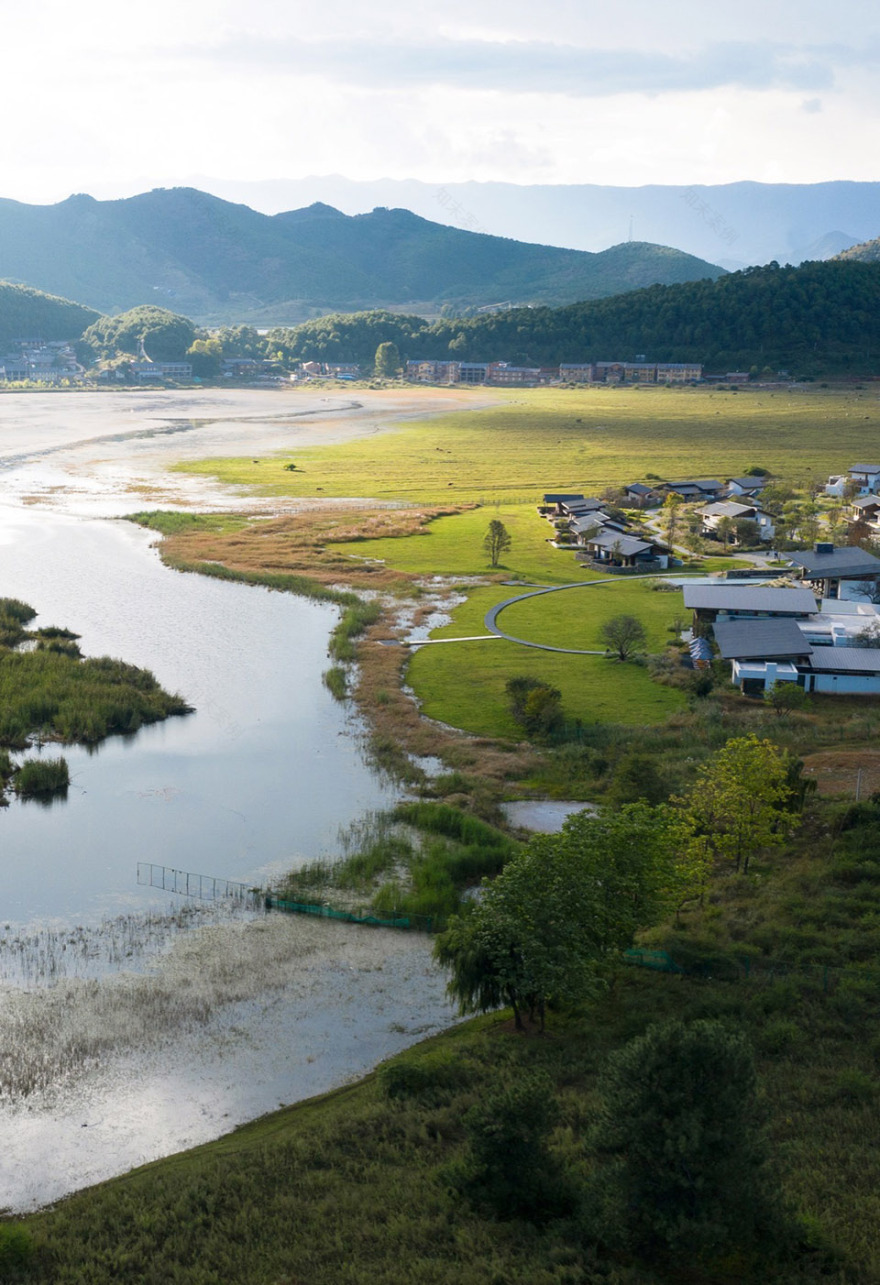
▼泸沽湖岚岳海子花园,Lugu Lanyond Alpine Lake Retreat©鲁冰
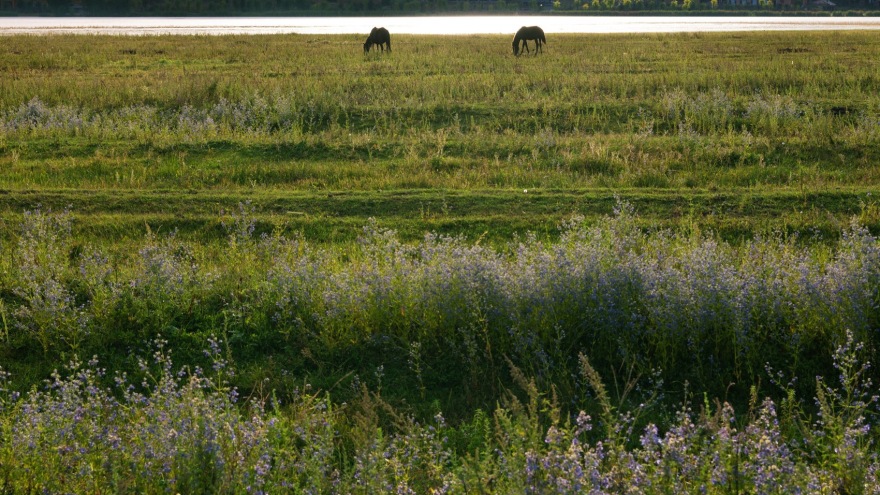

▼景观作为连接人与自然、土地与摩梭文化之间的纽带,勾勒出诗意栖居的理想图景,Landscape, as a bond connecting people with nature, land with the Mosuo culture, sketches an ideal picture of poetic habitation ©鲁冰
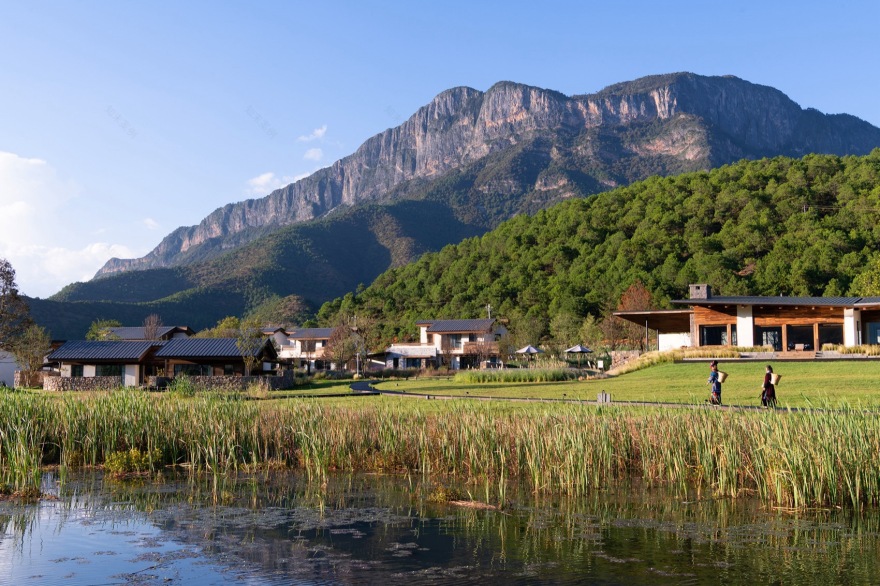


场地特征:时间中沉淀的自然和文化
Site Characteristics:Nature and Culture Settled Through Time
项目位于群山环抱的泸沽湖大海子湖畔,海拔2685米。在泛喜马拉雅高原季风气候和高山深水湖泊环境的共同作用下,场地小气候夏凉冬暖。大海子属地表型湿地,水体受季风降雨补给,水位随季节自然消涨,终年不结冰;地表的山溪汇入与坡面漫流,让广阔湖面在澄澈深邃之中暗藏着流动的韵律。作为水陆交界的湖滨带,场地岸线优美而模糊;晨昏之际,水汽沿湖面与山谷缓缓凝结、流淌,形成低悬而绵长的雾带,格姆神山与水中倒影也在云卷云舒间若隐若现。时间于此彷佛忘却了线性流逝,只随自然之流,悄然延展、往复循环。
The project is located on the shores of Dahaizi, Lugu Lake, nestled among mountains at an altitude of 2,685 meters. Shaped by the Trans-Himalayan plateau monsoon climate and the environment of a deep alpine lake, the site has a microclimate with cool summers and mild winters. Dahaizi is a surface wetland; its water levels fluctuate naturally with the seasons, fed by monsoon rainfall, and it never freezes. Surface streams and hillslope runoff give the vast, clear, deep lake a subtle rhythmic flow. As a lakeshore, the site features a gracefully indistinct shoreline. At dawn and dusk, moisture slowly condenses and drifts across the lake and valleys, forming low, lingering mist bands. The Gemu Goddess Mountain and its reflection appear and disappear amidst the drifting clouds. Time here seems to shed its linear course, quietly unfolding and cycling in rhythm with nature’s flow.
▼项目区位和鸟瞰,Project Location and Bird’s-eye View ©Z’scape
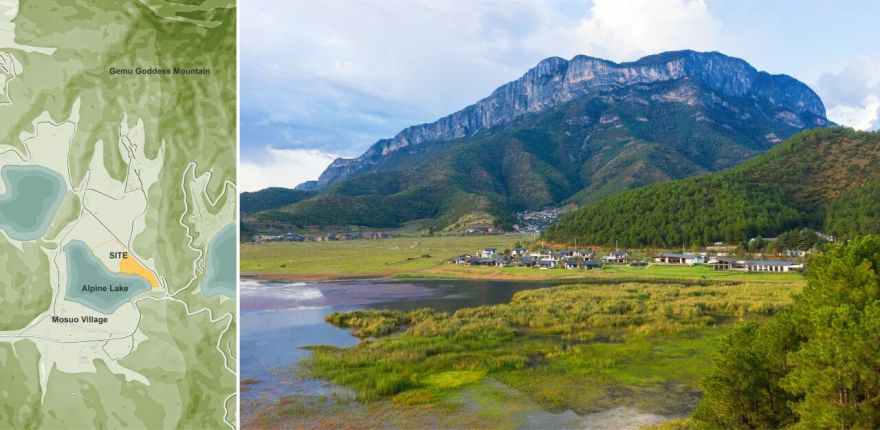
▼格姆女神山云卷云舒,时间于此随自然之流,悄然延展,The Goddess Mountain of Gumei is shrouded in ever-changing clouds. Time flows here in harmony with nature, quietly stretching out ©鲁冰


▼猪槽船是摩梭人传统的捕鱼和水上交通工具,如今也是泸沽湖上的旅游体验项目,The pig trough boat is a traditional fishing and water transportation means for the Mosuo people. Nowadays, it has also become a tourist experience activity on Lugu Lake ©中旅

海拔近四千米的格姆女神山静卧于北岸,与高山松林、湿地草海构成了“山-林-田-湖-草”的自然生态体系。这座静默的山体轮廓,既是地理的坐标,更是摩梭人心中永恒的精神图腾,见证了自然与人文漫长的共生历程。在人居文明演进中,原是游牧民族的摩梭人逐渐形成了逐水而居的聚落智慧;母系氏族村落散点分布于湖畔与山脚之间,依山就势、背山面湖,村落与自然和谐共生。摩梭人在湖畔浅滩和山间坝子耕种玉米、红米水稻、马铃薯、荞麦和豆蔬等,每年农历七月二十五的转山节便是农耕节律与古老文化信仰的共鸣回响,表达摩梭人对山水的自然崇拜。
The Gemu Goddess Mountain, nearly 4,000 meters high, rests quietly on the northern shore, forming a “mountain-forest-field-lake-grassland” natural ecosystem alongside the alpine pine forests and wetland meadows. This silent mountain silhouette serves not only as a geographic landmark but also as an enduring spiritual symbol for the Mosuo people, witnessing the long coexistence of nature and humanity. In the evolution of human settlement, the Mosuo, originally nomads, gradually developed a wisdom of living by water. Their matrilineal villages are scattered between the lakeshore and mountain foothills, nestled against the mountains and facing the lake, living in harmony with nature. The Mosuo cultivate corn, red rice, potatoes, buckwheat, and beans along the lakeshore and in mountain valleys. The annual Zhuanshan Festival on the 25th day of the seventh lunar month resonates with the rhythms of agriculture and ancient cultural beliefs, expressing the Mosuo’s reverence for nature.
▼泸沽湖岚岳海子花园融于“山-林-田-湖-草”的自然生态体系,Lugu Lake Lantuo Haizi Garden integrates into the natural ecological system of “mountain – forest – field -lake – grass” ©鲁冰

▼转山节是农耕节律与古老文化信仰的共鸣回响,表达摩梭人对山水的自然崇拜,The turning-of-the-mountains festival is a resonance of the agricultural rhythm and ancient cultural beliefs, expressing the Mozo people’s natural worship of mountains and rivers ©中旅

场地限制|Site Constraints
项目场地原为大海子湖畔的村落。村民搬迁后,这里留下了荒芜的宅基地和曾经耕种的药圃农田。泸沽湖沿岸是由水流冲积形成的洪积扇,因土壤肥沃与水文条件优越,成为村落栖居与农业耕作的理想基底,也滋养着原住民以种植和畜牧为主、采集为辅的传统生计。然而随着农业现代化的推进,过度垦殖与化肥农药的滥用打破了原有的人地平衡,大面积湿地被侵占开垦,自然植被急剧退化,加之施肥维护失当导致地力衰退,部分农田仅经一两代耕作便遭废弃。近年随着 “控湖、退坝、修复” 战略的推进,退耕还林还牧、退还湿地成为区域发展共识。此前的部分泸沽湖旅游开发将湖滨场景与在地生活压缩为即时消费的静态打卡点和旅游产品,导致湖滨生态的退化和文化体验的扁平化,地方的自然和文化被切割和异化。
The project site was originally a village by Dahaizi. After the villagers relocated, they left behind abandoned homesteads and former medicinal herb fields. The shores of Lugu Lake are alluvial fans, whose fertile soil and favorable hydrological conditions made them ideal for village settlement and farming, sustaining the indigenous people’s traditional livelihood centered on planting and herding, supplemented by gathering. However, the push for agricultural modernization disrupted the human-land balance with excessive cultivation and the misuse of fertilizers and pesticides. Large wetland areas were encroached upon, natural vegetation degraded sharply, and improper fertilization and maintenance depleted soil fertility, leading to the abandonment of some fields after just one or two generations of cultivation. In recent years, with the push for strategies like “lake control, wetland restoration, and rehabilitation,” returning farmland to forests, grazing, and wetlands has become regional consensus. Previous tourism development around Lugu Lake compressed the lakeside experience and local life into static photo spots and tourism products, causing ecological degradation and flattening cultural experiences, alienating local nature and culture.
▼场地原状鸟瞰图,Original site aerial view ©中旅

▼场地原状:荒芜的宅基地、废弃的农田 、土壤结块地力衰退、湖滨生态退化,Original condition of the site: barren rural land, abandoned farmland, compacted soil with declining fertility, degradation of coastal ecological environment ©周婷、于浩

在地营建|Construction on the site
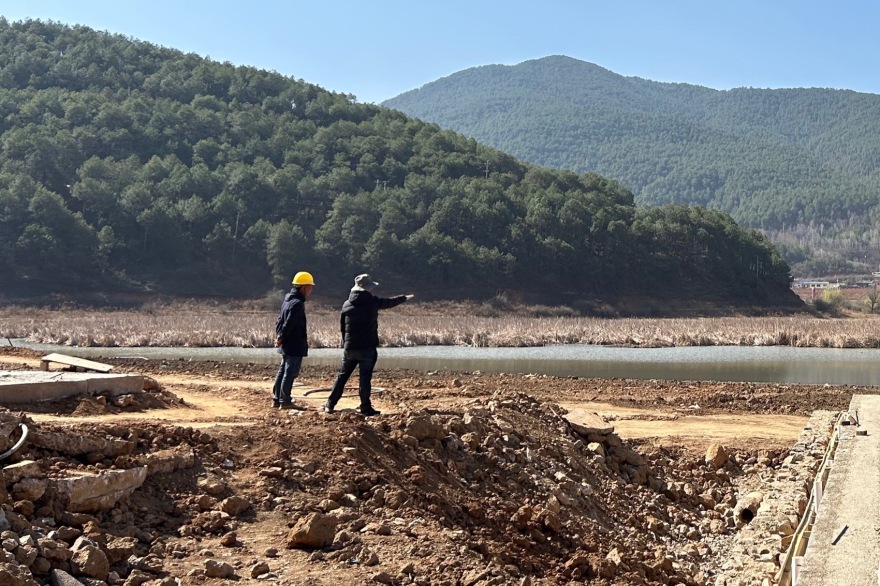
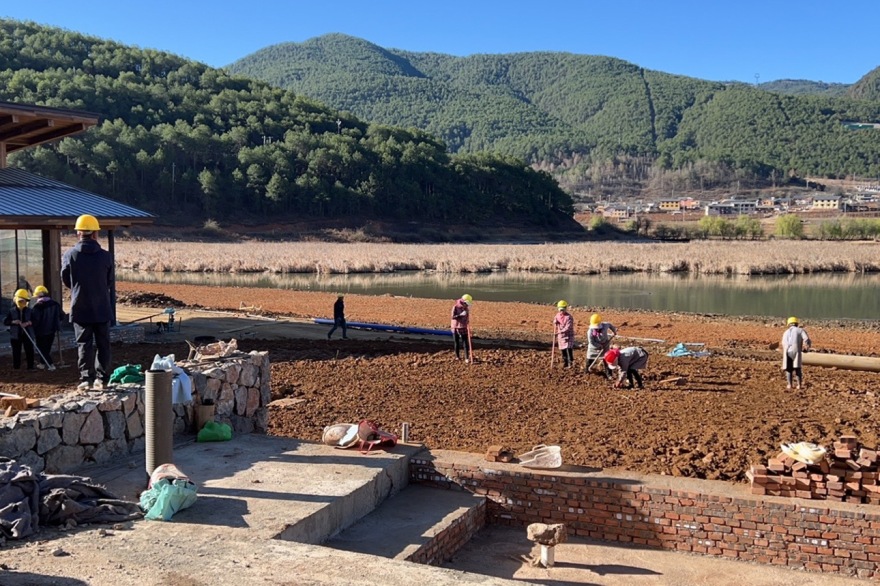
面对场地偏远、原始数据不够准确等客观制约,在落地过程中不能完全依赖施工图图纸的表达,致舍用在地营造的方式,倚重设计师对现场的直觉感知与把控经验,通过多次关键节点的施工督导和现场调改,使海子花园谦逊地融入了这片土地和自然山水。
Facing objective constraints like the site’s remoteness and lack of precise baseline data, the construction process couldn’t rely solely on construction drawings. Z’scape adopted a localized construction approach, relying heavily on the designer’s on-site intuition and experience. Through supervision and adjustments during key construction phases, the Alpine Lake Retreat was modestly integrated into this land and its natural landscape.
▼图纸之外的施工现场:致舍设计师根据现场的直觉感知与把控经验、对滨水区域进行现场调改、地形设计、指导施工放线,The construction site beyond the drawings: The architects of Zhishu designed and adjusted the site layout, terrain design, and provided guidance for construction layout based on their intuitive perception and on-site control experience of the waterfront area ©徐晗晗

▼图纸之外的施工现场:致舍设计师对材料现场打样的指导以及对软景的调改,The construction site beyond the drawings: Guidance from the architect on on-site material sampling and adjustments to the soft landscaping ©于浩


▼图纸之外的施工现场:现场依据原生大树的现状,决定新栽乔木的点位,新旧共生,The construction site beyond the drawings: The site decides the locations for new tree plantings based on the current condition of the original trees, achieving a coexistence of old and new ©徐晗晗



设计理念:景观的自然流动
Design Philosophy:The Natural Flow of the Landscape
针对场地的特征和限制,岚岳海子花园以景观的自然流动为设计理念,从只以空间形态来主导设计转向对过程与时间的关注,这一理念体现了“景观作为过程”、“景观的时间性”等设计哲学。时间难以捕捉,却通过流动得以显现,云雾聚散、光影流转、风起漪澜、水位涨落、植物枯荣、牛羊穿行的踪迹,都是时间的在场方式。设计师通过梳理地形引导水文流动,撒播乡土草花促成自然演替,组织视线通廊与漫游路径以丰富体验感知;旨在构建一个融合自然过程、空间体验与文化记忆的体系,让海子花园共生于周边的自然生境,为生物多样性提供栖息地。万物在流动中彼此感应和依存,也使景观得以融入自然与文化的演进之中。
Addressing the site’s characteristics and constraints, Lanyond Alpine Lake Retreat is guided by the concept of “the natural flow of the landscape,” shifting from a design approach dominated by spatial form to a focus on process and time. This concept reflects design philosophies such as “landscape as process” and “the temporality of landscape.” Time is elusive but revealed through flow: the gathering and dispersal of clouds and mist, the play of light and shadow, wind-sculpted ripples, fluctuating water levels, the cycle of plant life, and the paths of grazing cattle and sheep—all are manifestations of time’s presence. The designers shape topography to guide water flow, sow native wildflowers to facilitate natural succession, and arrange sightlines and meandering paths to enrich experience and perception. The aim is to build a system integrating natural processes, spatial experience, and cultural memory, allowing Alpine Lake Retreat to coexist with its surrounding natural habitat and provide a haven for biodiversity. With this flow, all things interact and depend on one another, enabling the landscape to become part of the ongoing evolution of nature and culture.
▼泸沽湖岚岳海子花园平面图,Lugu Lanyond Alpine Lake Retreat Floor Plan © Z’scape

▼岚岳海子花园以景观的自然流动为设计理念,表达对过程与时间的关注,Lanyond Garden adopts the design concept of natural flow of the landscape, expressing its concern for the process and time©鲁冰


▼构建融合自然过程、空间体验与文化记忆的体系,为生物多样性提供栖息地,Construct a system that integrates natural processes, spatial experiences and cultural memories, providing habitats for biodiversity©鲁冰

自然过程的流动|The Flow of Natural Process
设计由场地出发,尊重并顺应由气候、地形、水文、土壤与动植物共同构成的持续演变的生态系统。设计愿景并非精雕细琢一座装饰性的人工花园,而是致力于启动自然的修复进程。我们将地形塑造、水文循环与植被演替等视为生成力量,通过较少的人工干预,让“自然做功”,提升生物多样性,最终实现场地与周边自然生境的有机融合。由此,景观也成为承载自然过程的时间性载体。
The design starts from the site, respecting and responding to the continuously evolving ecosystem shaped by climate, topography, water, soil, and flora and fauna. The vision isn’t to meticulously craft a decorative artificial garden but to activate natural restoration processes. Topography shaping, hydrological cycles, and vegetation succession are treated as generative forces. With minimal intervention, “nature does the work,” enhancing biodiversity and ultimately achieving organic integration between the site and its surrounding natural habitats. The landscape thus becomes a temporal vessel carrying natural processes.
▼设计致力于启动自然的修复进程,景观也成为承载自然过程的时间性载体,The design aims to initiate the natural restoration process, and the landscape also becomes a temporal carrier for the natural processes ©鲁冰


设计对原有滨水撂荒的土地进行重塑,形成自然放坡的地形,引导地表径流,并留出大小不一的浅凹地以汇集雨水;在此基础上改良土壤撒播草籽,促进湖畔水生植物与草甸群落的演替,恢复重建能够应对气候变化和极端天气的韧性滨湖生态系统。
The design reshapes abandoned lakeside land, creating naturally sloping terrain to guide surface runoff and leaving various-sized shallow depressions to collect rainwater. Building on this, the soil is improved, and grass seeds are sown to encourage the succession of lakeside aquatic plants and meadow communities, restoring a resilient lakeside ecosystem capable of coping with climate change and extreme weather.
▼海子花园融入周边的自然生境,The project integrates into the surrounding natural environment ©鲁冰


▼海子花园雪景,Snow Scene of the project©中旅

在植物配置上,设计构建了乔灌木—地被—草甸—水生的复合群落结构。我们保留了场地上原生的云南松、滇朴、火棘、卫矛等乡土乔灌木,这是软景空间的骨架;同时混合撒播矢车菊、虞美人、蓍草、蛇莓等,再结合本地倒提壶、报春花等低维护的草花品种,让地被层得以自我更新。而从水中渐次占据优势的芦苇、香蒲、茭草、水葱等水生植物,蔓延至水岸边的波斯菊、红蓼、水蓼,再到覆地的白三叶草甸,则构成了由水及岸的自然过渡带。
For planting, a multi-layered community structure of trees/shrubs, groundcover, meadow, and aquatic plants was established. Native trees and shrubs like Pinus yunnanensis, Pistacia weinmannifolia, Pyracantha fortuneana, and Euonymus species were preserved, forming the framework. This was combined with a mixed sowing of cornflowers, poppies, yarrows, mock strawberries, along with local, low-maintenance wildflowers like Cynoglossum amabile and primroses, allowing the ground layer to regenerate naturally. Gradually dominant aquatic plants like reeds, cattails, Zizania latifolia, and Schoenoplectus tabernaemontani spread from the water, merging with Mexican asters, Persicaria orientalis, and Persicaria hydropiper on the shore, and then into the white clover meadow, forming a natural transition zone from water to land.
▼由水及岸的自然过渡带,The natural transition zone between water and land ©鲁冰、周婷


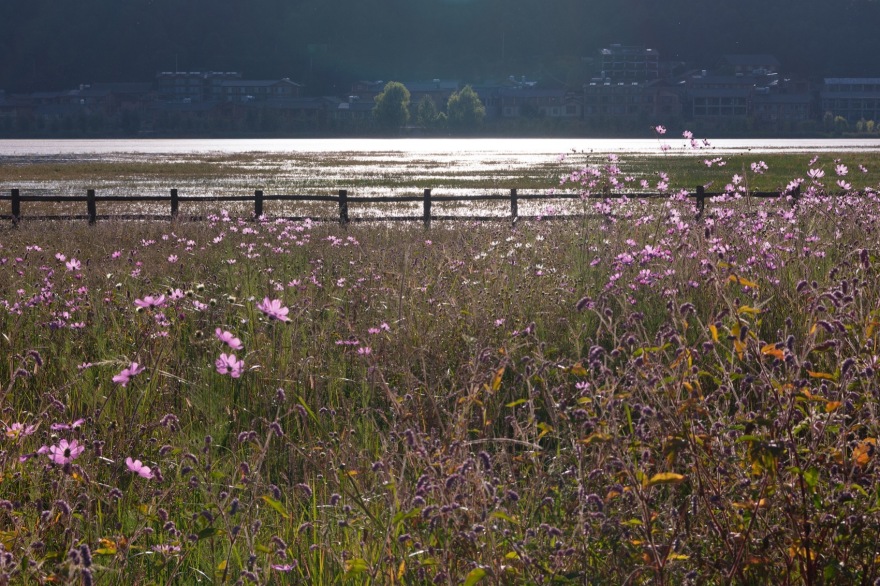


▼致舍设计师参与撒播的现场工作:春天种子撒播,随后覆盖无纺布,无纺布起锁水、保温、防冲刷的作用(中图:徐晗晗拍摄于2024年5月设计师现场二次追播)。待种子全部发芽,植株长出10CM后拆除无纺布(上图)。建成后同位置实景(下图:周婷拍摄于2025年8月),To the designers who participated in the on-site work of sowing: Spring seed sowing, followed by covering with non-woven fabric. The non-woven fabric serves the functions of retaining water, maintaining warmth, and preventing erosion (Middle picture: Xu Hanhan took this photo in May 2024 during the designers’ second on-site re-sowing). Once all the seeds have germinated and the plants have grown to 10 cm in height, the non-woven fabric will be removed (Top picture). The actual scene at the same location after completion (Bottom picture: Zhou Ting took this photo in August 2025)


▼撒播白三叶草甸施工现场和建成1年后实景,The scene of the white clover meadow construction site and its actual situation one year after completion ©徐晗晗、周婷


在美学上致舍则追求“独树偏成趣,群花不知名”的拙朴意境,这些四季更迭的植被,既有节点处的细心考量,也有大片留白给自然去演替,让花园在时间的滋养中愈发丰饶和野趣盎然。
Aesthetically, Z’scape pursues a rustic charm—where “a single tree forms a scene, and countless flowers remain unnamed.” These seasonally changing plants reflect both careful consideration at key points and large areas left open for natural succession, allowing the garden to grow richer and wilder under the stewardship of time.
▼“独树偏成趣,群花不知名”的拙朴意境,The simple and natural artistic conception of “a solitary tree presenting a unique charm, while the various flowers remain unnamed”©鲁冰、周婷

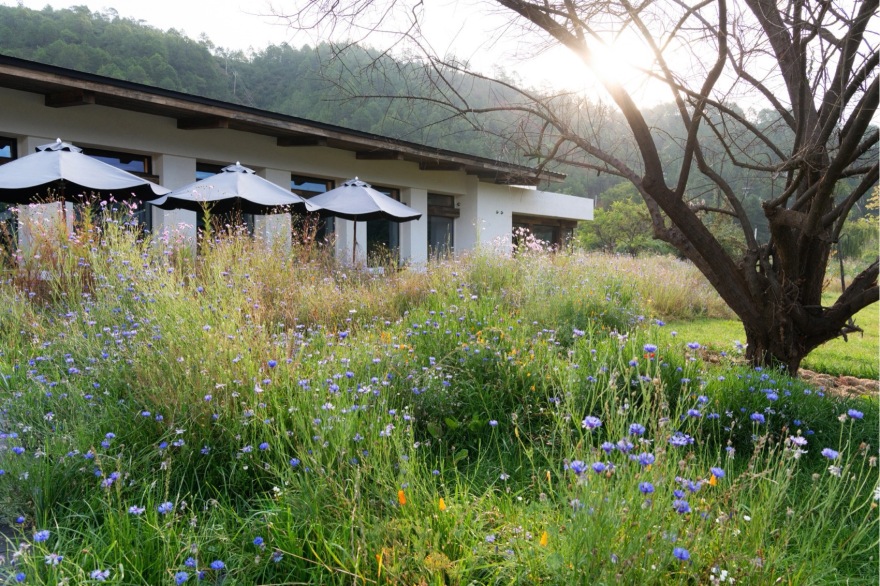
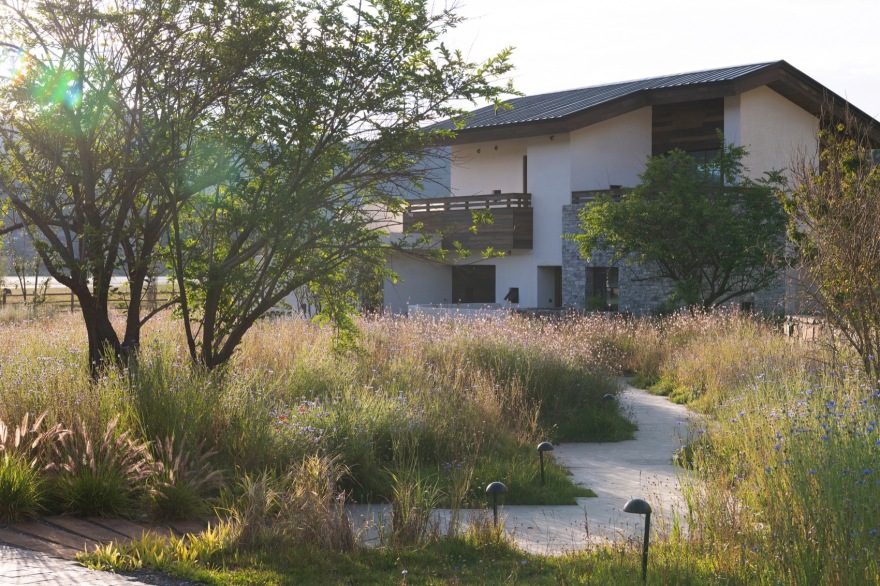

▼“独树偏成趣,群花不知名”的拙朴意境,
The simple and natural artistic conception of “a solitary tree presenting
a unique charm, while the various flowers remain unnamed”©鲁冰

空间体验的流动|The Flow of Spatial Experience
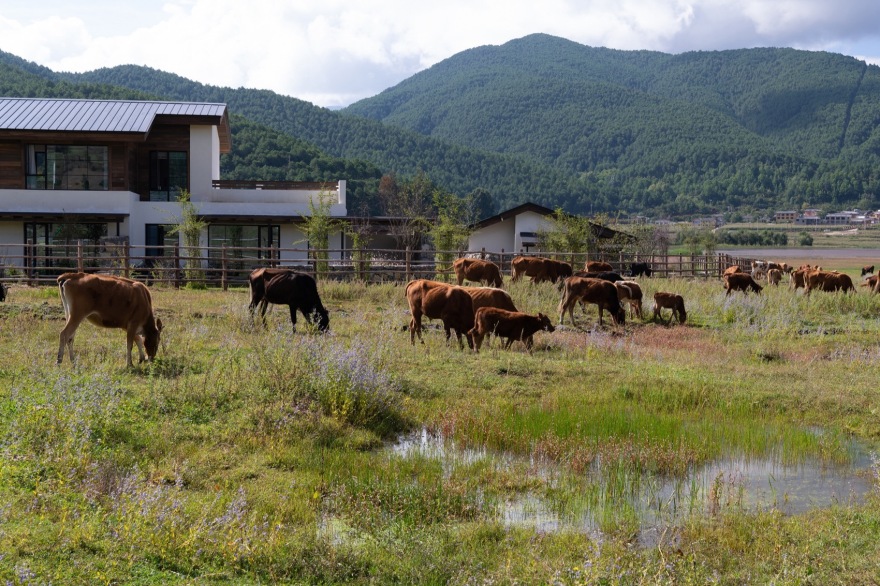
整个海子花园不设围墙,半围合的木栅栏既是游牧景观的组成元素、也暗示着花园的管理边界。人的行走自由地延展于湿地、草海与林缘之间,牛羊与飞鸟亦可随意到访。致舍不刻意追求营造主题场景和打造礼序轴线,而是以一种不为秩序所限制的松散空间组织方式——到达松林、大堂花园、可食花园、村庄花园、湖畔花园,引导到访者在时间中自在漫游体验,让自然过程与人的使用共同塑造场所的日常,也包容着偶尔迷路的可能。栖居于此并非占有风景,由观看到浸入一段与自然共处的时空;借景于湖光山色,人与湖山同频,诗意随之生长。
Alpine Lake Retreat has no walls; semi-enclosed wooden fences are both an element of the pastoral landscape and a subtle indicator of the garden’s management boundary. Human movement flows freely between the wetlands, meadows, and forest edges, while cattle, sheep, and birds are also welcome visitors. Z’scape avoids deliberately staging thematic scenes or creating formal axes. Instead, a loose spatial organization guides visitors through the pine forest arrival, lobby garden, edible garden, village garden, and lakeside garden. This encourages a leisurely journey through time, letting natural processes and human use together shape the everyday life of the place, even welcoming the occasional wandering off the path. Living here isn’t about possessing a view but about stepping into a space and time shared with nature. By borrowing from the lake and mountain scenery, people resonate with their surroundings, and poetry grows from this connection.
▼以松散空间组织方式引导到访者在时间中自在漫游体验,By adopting a loose spatial organization method, visitors can freely roam and experience time ©鲁冰

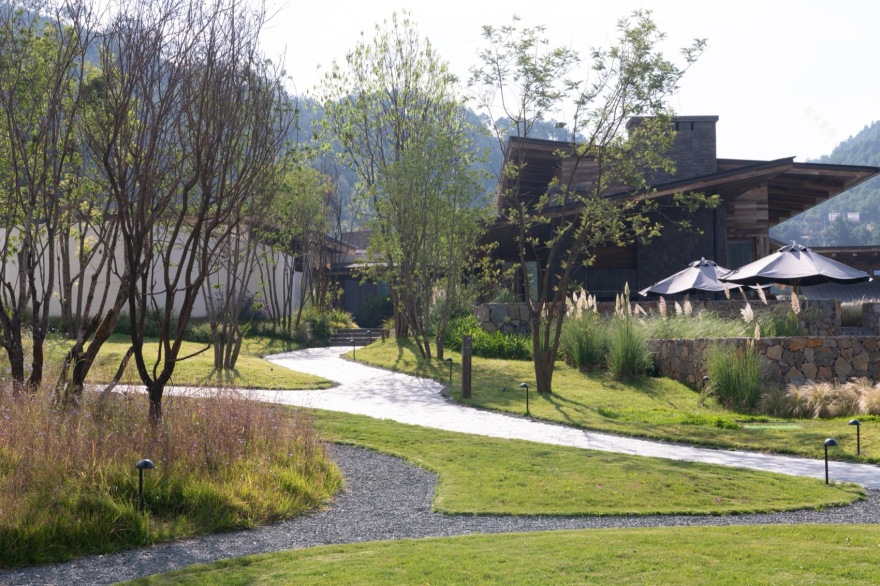

▼让自然过程与人的使用共同塑造场所的日常,Let the natural processes and human usage jointly shape the daily life of the place ©鲁冰

▼半围合的木栅栏既是游牧景观的组成元素、也暗示着花园的管理边界,The semi-enclosed wooden fence is not only a component of the nomadic landscape but also implies the management boundary of the garden ©鲁冰

▼人的行走自由地延展于湿地、草海与林缘之间,牛羊与飞鸟亦可随意到访,People’s movement freely extends across wetlands, grassy seas and forest edges. Cattle, sheep and birds can also freely visit these areas ©鲁冰

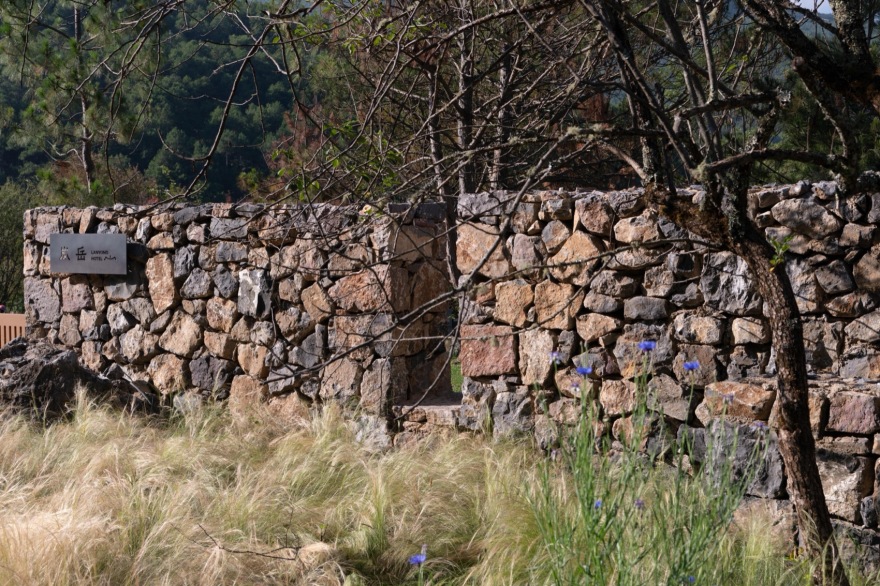
由宁沪公路转入竹泥段,毛石垒砌的寨门静立松林草野之间,昭示着自然花园旅程的开启。原生的云南松、置石与草花的自然组合成为到达的主要印象。
Turning from the Ning-Lu road onto the Zhuni section, a stone gate built of stacked rubble stands quietly among the pines and grass, signaling the start of the natural garden journey. The arrival experience is defined by a natural composition of native Pinus yunnanensis, stone and meadow flowers.
▼自然花园旅程的开启,The beginning of the nature garden tour ©鲁冰


▼原生的云南松、置石与草花的自然组合成为到达的主要印象,The natural combination of the native Yunnan pine, rock arrangements and flowering plants forms the main impression upon arrival ©鲁冰

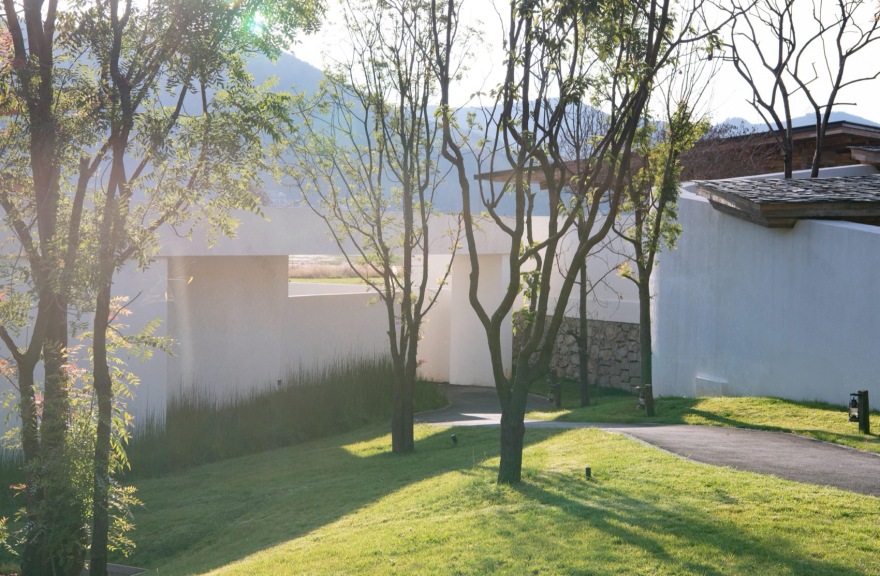
大堂花园则结合主体建筑的布局和白色墙体,以梅子树、黄连木结合菱叶绣线菊、喷雪花等形成递进的、围合的庭院空间。
The lobby garden, complementing the main building’s layout and white walls, features a layered, enclosed courtyard space with plum trees, Pistacia chinensis, Spiraea vibtei, and Spiraea thunbergii.
▼大堂花园是结合建筑布局递进的、围合的庭院空间,The lobby garden is a contiguous and enclosed courtyard space that is integrated with the progressive layout of the building ©鲁冰、周婷


餐厅外则是一处可食花园,就地取材,以砾石铺地、用旧木板钉成的条形种植带,种植不同种类的蔬菜和香料,让花园观赏性和实用性并重。
Outside the restaurant lies an edible garden, where gravel paths and old wooden board planting beds grow various vegetables and herbs, blending ornamentation with utility.
▼可食花园观赏性和实用性并重,The edible garden combines both ornamental value and practicality ©鲁冰

▼可食花园观赏性和实用性并重,The edible garden combines both ornamental value and practicality©鲁冰

▼就地取材的可食花园细部,Local materials for the edible garden details ©鲁冰

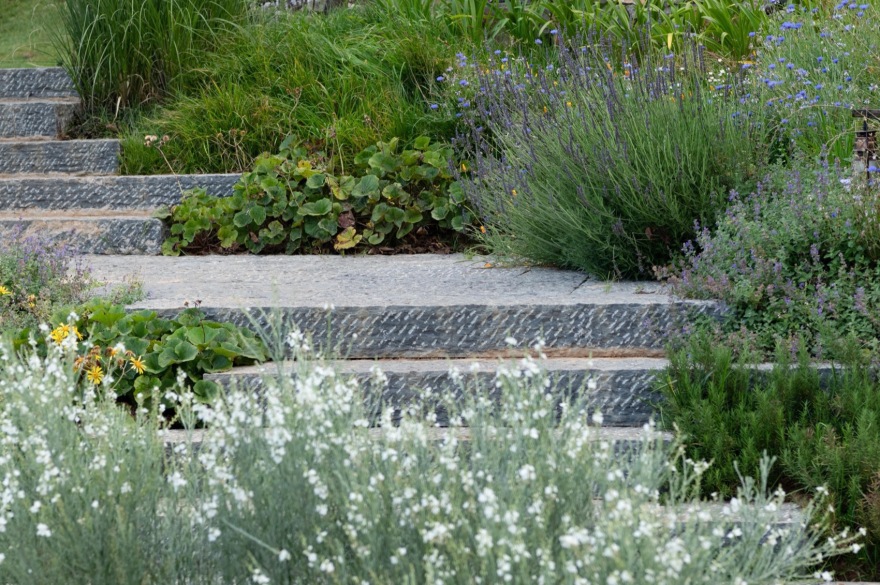
▼就地取材的可食花园细部,Local materials for the edible garden details©鲁冰

穿过公区建筑,草甸豁然展开,湖山尽收眼底。弧形木栈道和观景平台悬浮于草甸和湖畔湿地之上,设计以极简形态融入环境,在减少对湖畔栖息地的干扰的同时,引导人沉浸式地游览在湖光山色之中。水草丰美,蓼类等植物自水际蔓生至岸,空间边界在此渐次消解。湖畔花园以抬升的泳池为焦点,既框取湖山全景,又吸引鸟类饮水休憩,使人造设施成为自然景致的一部分。干砌石墙取材于场地周边,工匠的手工痕迹让传统技艺在当代延续。
Passing through the main buildings, the meadow opens up, revealing the full vista of lake and mountains. A curved boardwalk and viewing deck float above the meadow and lakeside wetland. Designed with minimal form to blend into the environment, they reduce impact on the lakeshore habitat while offering an immersive experience amidst the scenery. With abundant aquatic plants, including various Persicaria spreading from the water’s edge, spatial boundaries gradually dissolve. The lakeside garden centers around an elevated pool that frames the panoramic lake and mountain view while attracting birds to drink and rest, integrating this man-made feature into the natural scene. Dry-stone walls, built with stone sourced nearby by local craftsmen, let traditional skills live on in a contemporary context.
▼木栈道和观景平台以极简形态融入环境,减少对湖畔栖息地的干扰,The wooden walkways and viewing platforms are integrated into the environment in a minimalist style, minimizing the disturbance to the habitats along the lake ©鲁冰


▼人造设施成为自然景致的一部分,Artificial structures have become part of the natural landscape ©鲁冰
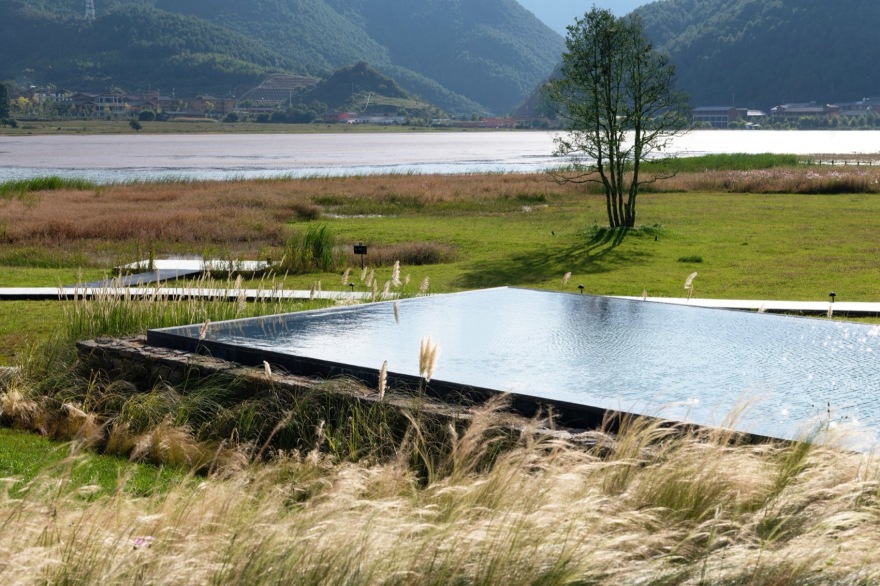

▼公区建筑与草甸之间的活动空间,The activity space between the public area building and the meadow ©鲁冰


漫步在曲径蜿蜒的村庄花园之中,有着最亲切和松弛的行走感受。设计上不求精雕细琢,反而保留手工的痕迹与粗糙的自然材质肌理。林木花草弱化建筑的体量和柔化院落的硬质边界,使园景与周边环境悄然相融。雨季,流云于檐角与树冠间缓缓游走,雨声轻落;晴日,矢车菊、天蓝鼠尾草、秋英、山桃草的小花星点,草茎轻摇;指引风的来处,那亦是海子的方向。
Wandering through the winding paths of the village garden offers the most intimate and relaxed walking experience. The design avoids over-refinement, instead preserving handmade textures and the raw quality of natural materials. Trees and soft planting soften the buildings’ mass and the hard edges of courtyards, subtly merging the garden with its surroundings. In the rainy season, clouds drift slowly between eaves and treetops, and rain falls softly. On sunny days, cornflowers, blue sage, cosmos, and Oenothera lindheimeri bloom in scattered spots, their stems swaying gently, indicating the wind’s direction—toward the lake.
▼村庄花园设计上不求精雕细琢,反而保留手工的痕迹与粗糙的自然材质肌理,The design of the village garden does not aim for meticulous details; instead, it retains the handcrafted elements and the rough natural texture of the materials©鲁冰、周婷


▼漫步在曲径蜿蜒的村庄花园之中,有着最亲切和松弛的行走感受,Walking through the winding village garden, one can experience the most intimate and relaxed walking sensation©周婷

▼林木花草弱化建筑的体量和柔化院落的硬质边界 ,The trees and flowers soften the volume of the building and smooth out the hard boundaries of the courtyard ©鲁冰


▼林木花草弱化建筑的体量和柔化院落的硬质边界 ,
The trees and flowers soften the volume of the building and smooth out
the hard boundaries of the courtyard©鲁冰

文化记忆的流动
The Flow of Cultural Memory
摩梭语中,“泸沽”意为“山沟里的湖”,湖从来不只是被远观的风景,而是生活发生的现场;千百年来,人们在此繁衍生息,湖水滋养万物,山峦护佑苍生,湖即家园。传统的摩梭村落与农田相接,山、村、田、湖相映。村落建筑多无实体中心,分散的家屋单元如叶片般散落在土地上,由祖母屋、经楼、花楼与草楼四栋木楞房围合而成。祖母屋里,火塘与炊烟升起日常的温度;经楼上,诵经声缭绕信仰的余音;花楼中,藏着属于青春的缱绻;而草楼则是最贴近土地的所在,圈养着牛、马、羊和家禽,是生计的延伸。在这里,生产、生活与信仰并未被清晰地划分界限,在日复一日中自然交织。由尚壹扬设计的海子花园主体建筑,继承了摩梭村落散点分布、依山就势的布局,以聚落形态散布于湖畔,保留了连接格姆神山与大海子的视线通廊。花园的景观和建筑结合,致力于还原传统摩梭村落和生活的原型印象。
In the Mosuo language, “Lugu” means “lake in a mountain valley.” The lake is not just a scenery to be viewed from a distance but the stage where life unfolds. People have lived here; the lake nurtures all things, the mountains protect life—the lake is home. Traditional Mosuo villages connect with farmlands, creating a landscape where mountains, villages, fields, and lakes reflect one another. Village buildings lack a single physical center; scattered family units dot the land like leaves, each compound formed by four log structures: the grandmother’s house, sutra house, flower house, and grass house. In the grandmother’s house, the hearth fire and cooking smoke bring daily warmth. In the sutra house, chanting resonates with spiritual echoes. The flower house holds the whispers of youth. The grass house, closest to the earth, shelters cattle, horses, sheep, and poultry—an extension of livelihood. Here, production, daily life, and faith are not rigidly separated but naturally interwoven. The main buildings of Alpine Lake Retreat, designed by Signyan, inherit the scattered, land-responsive layout of Mosuo villages, arranged as a settlement along the lakeshore, preserving sightlines connecting Gemu Goddess Mountain and Dahaizi. The garden’s landscape, combined with the architecture, seeks to evoke the archetypal impression of a traditional Mosuo village and way of life.
▼海子花园景观和建筑结合,还原传统摩梭村落和生活的原型印象,The landscape and architecture of Haizi Garden are integrated, restoring the original impression of the traditional Mosuo village and its way of life©鲁冰


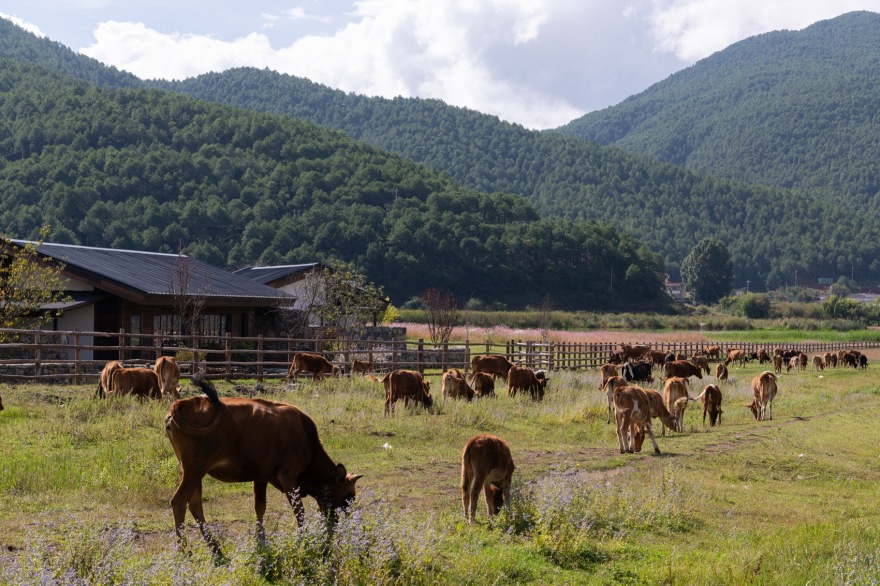
海子花园北侧,药圃农耕留下的带状垄痕被悉心保留。我们通过整理局部地形,将种植肌理转译为地景要素,在草海交汇处让人类的耕作痕迹与自然渐次消融。在天光云影之下,牧马悠然食草其间,呈现出富有地域特色、充满诗意与生机的大地艺术景观。这不仅延续了高原生产性景观的土地文化记忆,也让摩梭农耕与游牧的历史痕迹,在当代景观中获得新的生命。
To the north of Alpine Lake Retreat, the linear ridge marks left by past medicinal herb cultivation were carefully preserved. By reshaping the local topography, the planting patterns were translated into landscape elements, allowing human farming traces to gradually dissolve into nature at the meadow-lake interface. Beneath the shifting sky and cloud shadows, horses graze leisurely among them, presenting a poetic, vibrant land art landscape imbued with regional character. This not only sustains the land’s cultural memory of the plateau’s productive landscape but also gives new life to the historical traces of Mosuo farming and nomadism within a contemporary landscape.
▼整理局部地形将种植肌理转译为地景要素,在草海交汇处让人类的耕作痕迹与自然渐次消融,By reorganizing the local terrain, the planting pattern is transformed into landscape elements. At the confluence of the grass sea, the human farming traces gradually blend with the natural environment ©鲁冰

▼在天光云影之下,牧马悠然食草其间,呈现出富有地域特色、充满诗意与生机的大地艺术景观,Under the glow of the sky and the movement of the clouds, the horses graze leisurely among the grass, presenting a landscape of earth art that is rich in regional characteristics, full of poetry and vitality ©一步为马

结语
Conclusion
云南坐拥得天独厚的自然资源,亦承载着源远流长的多民族文化。泸沽湖岚岳海子花园是致舍于云南的又一落地实践,在自然与文化的交织中探寻设计和生活。面对高原海子的自然环境,设计并非创造视觉奇观或静态装饰,亦非依赖过度的人工去干预维持恒定形态。致舍以景观的自然流动为设计理念,构建融合自然过程、空间体验与文化记忆的体系,这是对本土自然与文化的在地性回响,使被现代性割裂的“地方时间”重新连结、缓缓生长。景观作为连接人与自然、土地与摩梭文化之间的纽带,在山水之间,勾勒并抵达中国人心中理想的世外桃源——人与自然共生的诗意栖居。
Yunnan is blessed with unique natural resources and a rich heritage of diverse ethnic cultures. Lugu Lanyond Alpine Lake Retreat is another realized practice by Z’scape in Yunnan, exploring design and living within the interweaving of nature and culture. Facing the natural environment of a plateau lake, the design doesn’t aim to create visual spectacles or static decorations, nor does it rely on excessive maintenance to preserve a fixed form. Z’scape, guided by the concept of “the natural flow of the landscape,” has built a system integrating natural process, spatial experience, and cultural memory. This is a localized response to the indigenous nature and culture, reconnecting the “local time” fragmented by modernity and allowing it to slowly grow. The landscape serves as a bridge connecting people, nature, land, and Mosuo culture, sketching and realizing within the mountains and waters the cherished ideal in the Chinese imagination: a poetic, harmonious coexistence of humanity and nature.
▼人与自然共生的诗意栖居,Poetic coexistence of humans and nature: a harmonious living environment ©鲁冰

平湖 仰山
气韵流动 草木蔓发
在山水环抱间 光阴静默 故土丰饶 …
泸沽湖岚岳海子花园
云南 丽江
2024
占地面积:4公顷
业主:中国旅游集团
景观设计:Z’scape 致舍景观
主持设计师:周梁俊、周婷
设计团队:于浩、徐晗晗、武书婷、孙畅、宋财富、马新月、吉立康、褚禾
建筑设计及室内设计:尚壹扬设计
灯光顾问:光石照明设计
景观施工:云南恒达生态环境建设有限公司
摄影:鲁冰、一步为马、周婷、徐晗晗、于浩、中旅
Lugu Lanyond Alpine Lake Retreat
Yunnan Lijiang
2024
Area:4ha
Client: China Tourism Group
Landscape Design: Z’scape
Lead Designers: Zhou Liangjun, Zhou Ting
Design Team: Yu Hao, Xu Hanhan, Wu Shuting, Sun Chang, Song Caifu, Ma Xinyue, Ji Likang, Chu He
Architectural Design & Interior Design: Signyan Design
Lighting Consultant: Guangshi Lighting Design
Landscape Construction: Yunnan Hengda Ecological Environment Construction Co., Ltd.
Photography: Lu Bing, Yibu Weima, Zhou Ting, Xu Hanhan, Yu Hao, CTG

南京喵熊网络科技有限公司 苏ICP备18050492号-4知末 © 2018—2020 . All photos and trademark graphics are copyrighted by their owners.增值电信业务经营许可证(ICP)苏B2-20201444 苏公网安备 32011302321234号
苏公网安备 32011302321234号客服
消息
收藏
下载
最近