

创作上传
VIP
收藏下载
登录 | 注册有礼
查看完整案例

收藏

下载

分享
该住宅位于冲绳本岛中部、宇流麻市一处安静的聚落中。业主在子女成家之后,希望在步入人生新阶段时,拥有一个更贴近自我状态的生活环境。虽然住宅需要容纳工作、兴趣与日常生活等多样活动,但设计并未从功能或房间划分出发,而是以建筑如何回应此地特有的环境条件为起点:强烈的日照、潮湿的空气以及随季节变化的风向。与其建造一个满足个别需求的容器,项目更意在建立一种能够承载生活与环境、并随时间持续演化的框架。
This house is planned in a quiet settlement in Uruma, in the central part of Okinawa’s main island. Having finished raising their children, the clients sought an environment where they could live more in accordance with themselves as they entered the next stage of their lives. Although the house was expected to accommodate a wide range of activities—work, hobbies, and daily life—the design did not begin by organizing these demands simply as functions or rooms. Instead, it took as its starting point how the architecture might respond to the environmental conditions specific to this place: intense sunlight, humid air, and winds that shift direction with the seasons. Rather than creating a container that satisfies individual requirements, the aim was to establish a frame that could receive both life and environment, and continue to evolve over time.
▼项目鸟瞰,Aerial view of the project ©Ooki Jingu


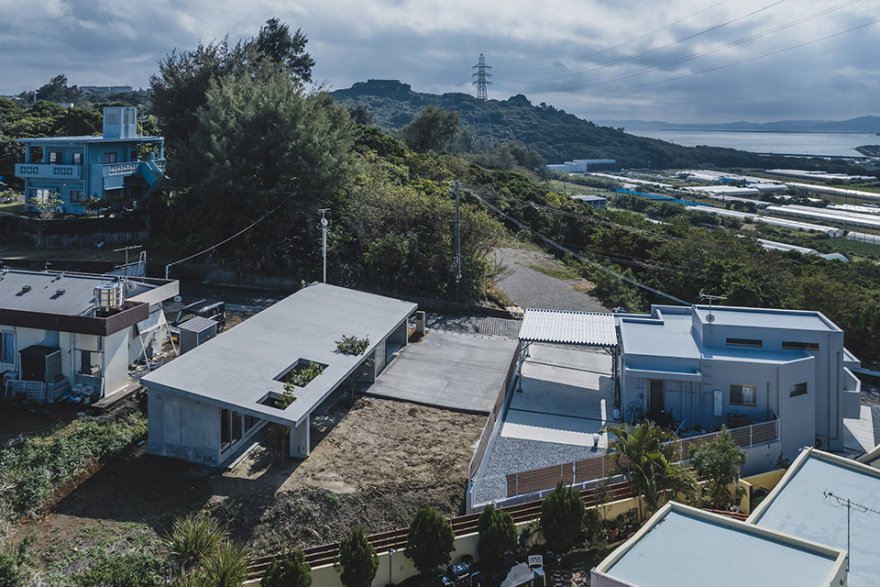
本项目并未通过单纯的向外通透来实现开放性。不同于依赖玻璃实现室内外视觉融合,设计尝试赋予建筑另一种开放形式。其线索来源于The Blank Signature:在画面中,即使远处空间未被完整呈现,人们仍能感知其存在。前景中的树木似乎阻断了景观,但这些片段通过重叠,使背后的空间依然可被感知。在这里,正是“遮挡”这一行为本身,反而生成了空间的连续性。
The project did not seek to achieve openness merely by creating transparency toward the exterior. Rather than relying on glass to visually merge inside and outside, the intention was to give the architecture a different form of openness. A clue was found in The Blank Signature by René Magritte, which depicts a condition in which the space beyond is perceived even when it is not fully visible. Although the trees standing in the foreground appear to interrupt the landscape, the fragments overlap in such a way that the space extending behind them can still be sensed. Here, it is the very act of interruption that produces spatial continuity.
▼项目外观,Overall view ©Ooki Jingu
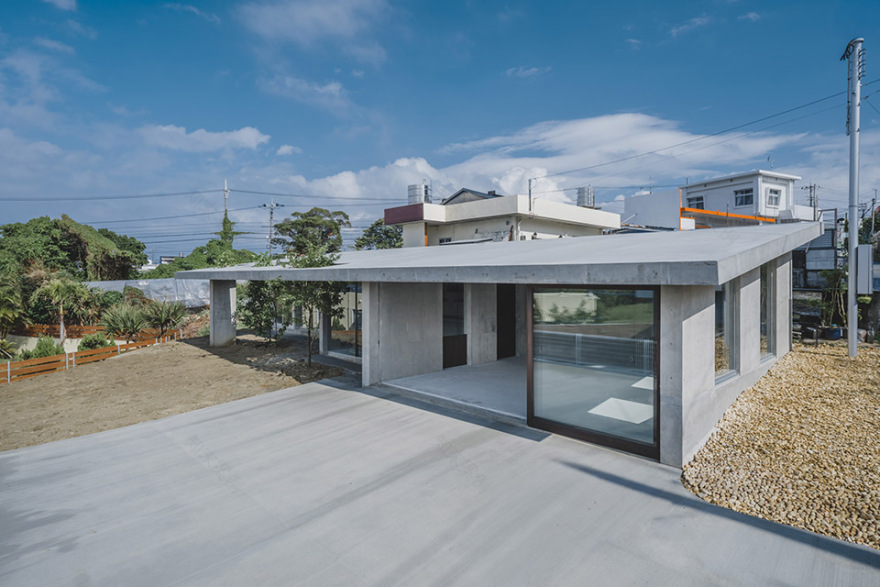

▼檐下空间与外部环境的连接,Eaves space connecting to exterior ©Ooki Jingu


建筑由一系列连续排列的钢筋混凝土墙柱构成,上方覆盖一片大屋顶。屋顶顺应场地坡度轻微倾斜,既遮挡直射阳光,又收集雨水,在其下方营造出稳定的阴影空间。它既作为庇护日常生活的外壳,抵御冲绳严苛的气候,也形成一种中介空间——类似传统“雨端(amahaji)”檐下空间——柔和地连接室内与室外。
The building consists of a field of RC wall-columns standing in succession, covered by a large roof above. Responding to the slope of the site, the roof tilts gently along the terrain, shielding the interior from direct sunlight, collecting rain, and creating a stable field of shade beneath it. It acts as a shelter protecting daily life from Okinawa’s severe climate, while also generating an intermediate zone—reminiscent of the traditional amahaji eaves—that softly connects inside and outside.
▼屋檐下穿插生长的绿植,Vegetation growing in between the eaves ©Ooki Jingu


▼可灵活使用的仓库空间,Flexible storage space ©Ooki Jingu
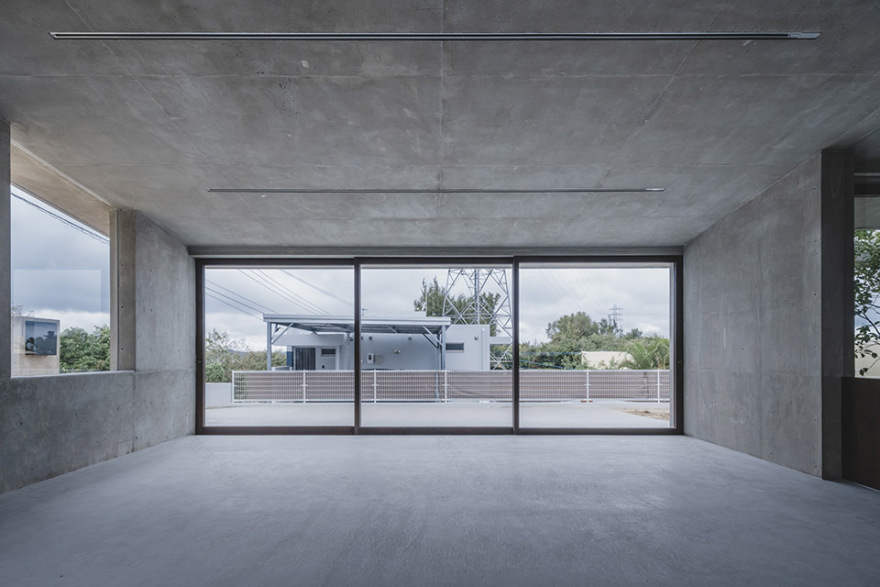

▼仓库采光,Storage space daylighting ©Ooki Jingu


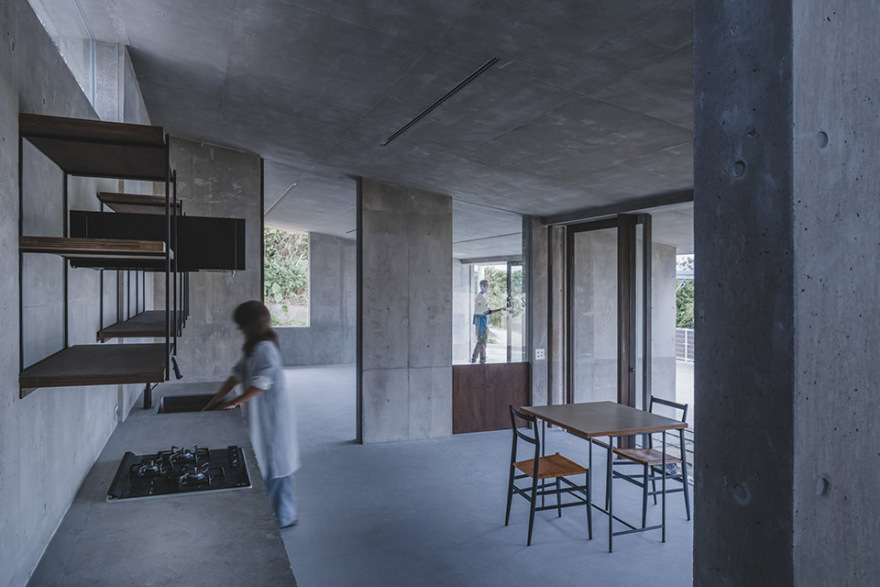
在室内,这些墙柱并不承担分隔空间的功能,而是作为相互叠置的要素存在。它们作为媒介,使人能够感知其背后的空间存在。通过层叠关系,空间的使用并未被清晰划分,而是彼此渗透、交融。在这一单一空间中,由此生成一种多层次的空间状态。空间、视线、存在感、光与风在连续中逐渐向内部延伸,并最终与建筑外部相连接。
Within the interior, the wall-columns do not function to divide space but are arranged as elements that overlap it. They operate as mediators that allow the presence of what lies beyond to be sensed. Through their layering, uses are not clearly separated but instead bleed into one another. In this way, a multilayered spatial condition emerges within what is essentially a single room. Through the continuity of space, lines of sight, presences, light, and wind extend deeper into the interior and eventually connect to the exterior of the building.
▼客厅与卧室空间,Living room and bedroom ©Ooki Jingu
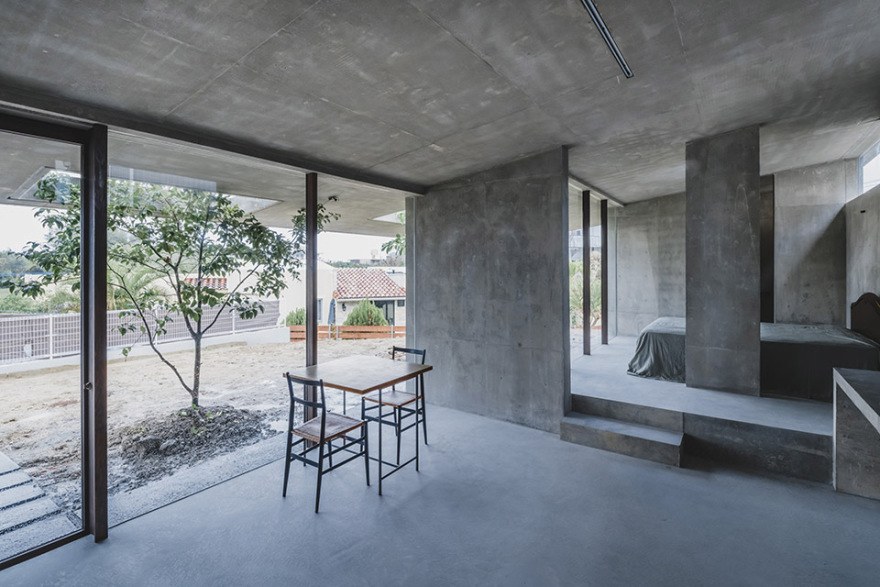
▼室内地面高差与空间分区关系,Level difference articulating interior spatial zones ©Ooki Jingu
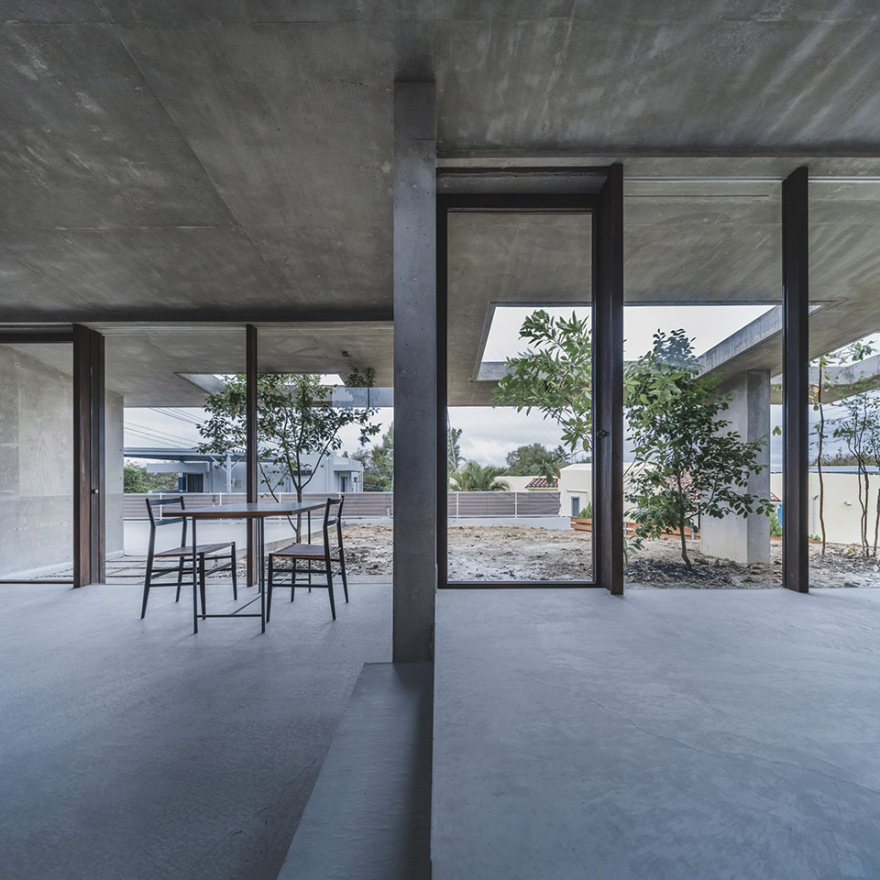
因此,空间的使用并非固定不变。半户外空间逐渐向外延展,而使用方式也随着环境条件的变化持续演化。这一建筑并非被构想为单向控制环境的装置,而是一种使居住者得以回应环境的框架。与其定义一个明确的“完成时刻”,不如仅将这一框架锚定于场地,使生活在其上不断积累。通过避免预先规定意义与用途,空间保持在一种未完成的状态,使意料之外的变化与余白能够在日常行为中不断被重新解读。
Uses are therefore not fixed. Semi-outdoor spaces gradually extend toward the outdoors, and the ways in which the spaces are used continue to evolve in response to changing environmental conditions. This architecture is not conceived as a device that unilaterally controls the environment, but as a frame through which the inhabitants can respond to it. Rather than defining a clear moment of “completion,” the frame alone is anchored to the site, allowing life to accumulate upon it over time. By refraining from prescribing meanings or uses in advance, the space remains in a state of incompletion, where unexpected shifts and margins can be continually reinterpreted through everyday actions.
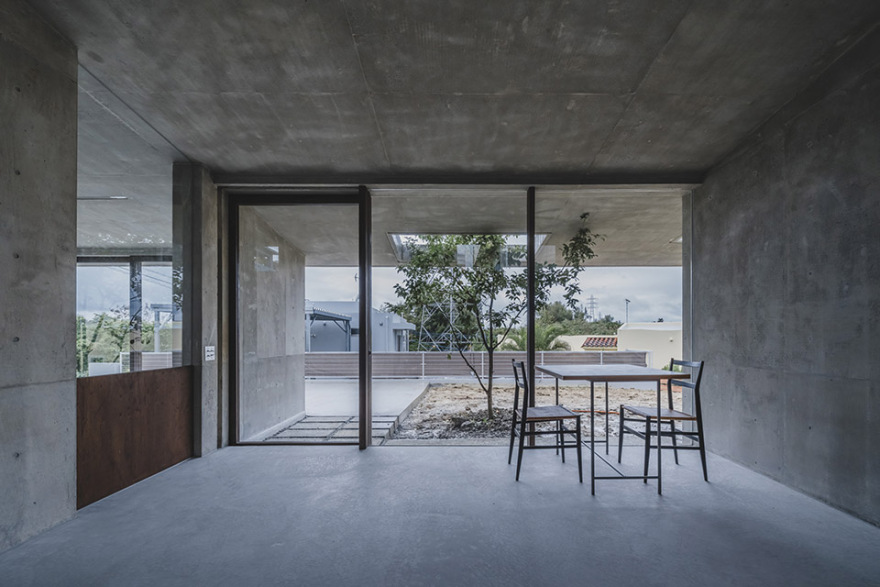
▼客厅空间,Living room©Ooki Jingu

▼室内外连续的视线关系,Visual continuity between inside and outside ©Ooki Jingu

在这一过程中,居住者自身的“风景”将随着时间缓慢生成。家具、植物以及开口的使用——这些日常行为——会为这一框架赋予暂时性的意义,而空间的理解也在时间中不断变化。
In this way, the inhabitants’ own landscape slowly takes shape over time. Furniture, plants, and the operation of openings—ordinary acts of daily life—temporarily give meaning to the frame, and the interpretation of the space evolves as time passes.
▼日常起居,Dailylife ©Ooki Jingu


因此,“重叠之‘间’”既是为特定业主而建的一处住宅,也是一次对建筑作为“介于气候与生活之间的框架”的再思考。它并不依赖视觉上的透明性,而是通过空间的切割与重组实现开放性。将自身交托于冲绳的自然环境之中,这一建筑将在时间中逐渐成熟。即便在当前使用者离开之后,它仍有可能容纳新的居住者或新的角色,继续矗立于此——成为一种能够超越单一生命而延续的建筑。
Overlap no Ma is therefore both a house for a particular client and an attempt to reconsider architecture as a frame that stands between climate and life. Without relying on visual transparency, openness is achieved by cutting and reconnecting space. Entrusting itself to the environment of Okinawa, the architecture is expected to mature over time. Even after it leaves the hands of its current inhabitants, it may accept other residents or roles, continuing to stand on this land—an architecture generous enough to endure beyond a single life.
▼夜景,Night view©Ooki Jingu

▼细节,Details©Ooki Jingu

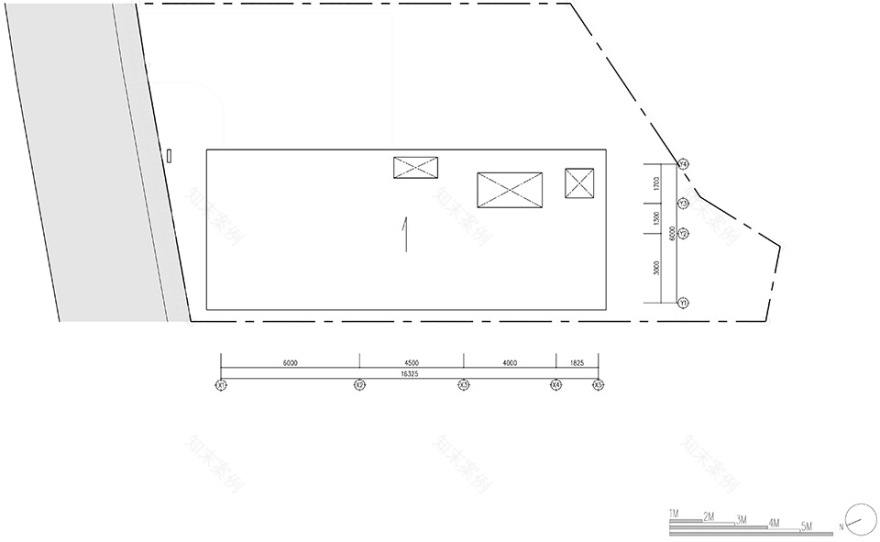
▼一层平面图,First level floor plan ©IGArchitects

▼屋顶平面图,Roof floor plan ©IGArchitects
▼立面图,Elevation ©IGArchitects

▼剖面图,Section©IGArchitects

General Information
Project Name: Overlap no Ma
Architecture Firm: IGArchitects
Firm Location: Saitama , Japan
Completion Year: February,2026
Gross Built Area: 72.83㎡
Project location: Okinawa , Japan
Lead Architects: IGArchitects Masato Igarashi
Media Provider
Photo credits: Ooki Jingu
Video link:
Additional Credits
Design Team: IGArchitects
Clients: Private
Engineering: Structure: Yousuke Misaki EQSD
Construction: Yukimitsu Shimoji ,FUN SHARE Ltd.
Etc..
Construction System: Concrete
Finishes: Concrete , Glass




南京喵熊网络科技有限公司 苏ICP备18050492号-4知末 © 2018—2020 . All photos and trademark graphics are copyrighted by their owners.增值电信业务经营许可证(ICP)苏B2-20201444 苏公网安备 32011302321234号
苏公网安备 32011302321234号客服
消息
收藏
下载
最近