

创作上传
VIP
收藏下载
登录 | 注册有礼
查看完整案例

收藏

下载

分享

翻译
Architects:Snøhetta
Area:10000m²
Year:2026
Photographs:Jared Chulski
Lighting Designer:Light-Cibles
Quantity Surveyor:Sletec Ingénierie
Landscape Architect:Snøhetta with Atelier Silva Landscaping
Environmental Design:EGIS Concept – Elioth
Acoustician:Studio DAP
structural Engineer:Khephren Ingénierie
Project Management:Omega Alliance
Category:Public Space,Theater,Refurbishment
Associate Architect:SRA Architectes
Cost Consultant:Sletec Ingénierie
Envelope:EGIS Concept – Elioth
Mep Engineer:Egis
Scenographer :KANJU
Building Services:Egis
Set Designer:KANJU
OPC:Omega Alliance
City:Nanterre
Country:France
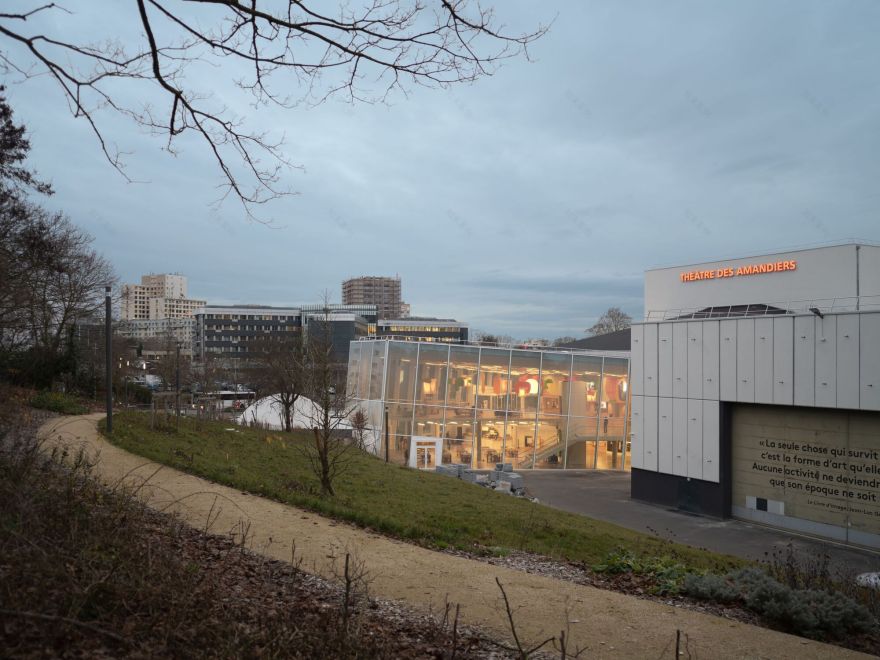
Text description provided by the architects. The rehabilitation of the Center Dramatique National Nanterre-Amandiers continues the story of a place that has long been emblematic of contemporary French theater, conceived from the outset as a space open to all. At the intersection of the city and the park, the project reaffirms the theater as a place of encounter, creation, and shared experience, deeply rooted in its local context. The architecture supports this evolution through a restrained intervention that reveals and reorganizes the spaces. The existing volumes are preserved and reorganized around a newly recomposed grand hall, the true heart of the theater. Transparency, continuity of movement, and a diversity of spaces help transform the building into a welcoming and permeable place. In this way, Les Amandiers reasserts itself as an open theater, where stage, city, and everyday life come together. The history of the Nanterre Amandiers National Drama Center (CDN) is that of a theater in constant transformation, closely linked to the city's evolution and driven by a strong artistic and social ambition. Located to the west of Paris, Nanterre is a commune within the Paris metropolitan area that, since the 1960s, has experienced profound urban and social changes. It was in this context that the city became the first to support the project of Pierre Debauche's company, whose founding intention was to bring to the theater "those who had never been there before."

In 1965, the company set up a circus tent on Avenue Joliot-Curie, on the site then known as La Côte-des-Amandiers, for the first Nanterre Dramatic Arts Festival. This temporary theater quickly became a makeshift warehouse, before the permanent building – existing prior to the current renovation – was inaugurated in 1976. From the outset, the venue embodied a dual commitment: a high level of artistic ambition coupled with a keen awareness of the theater's social role, particularly expressed through the desire to make contemporary creation accessible to audiences who had previously been excluded. This ambition has profoundly shaped the building's architecture, conceived as a tool in the service of creation. The project combines generous spaces dedicated to welcoming and engaging the public, open to the city, with more secluded areas devoted to artistic research and work. In the early 1980s, Patrice Chéreau – then director of the theater and a major figure in European theater and cinema – already emphasized that the Amandiers constituted"a highly rigorous working tool."

A Tool-Building: Refined and Adaptable - The rehabilitation project continues this lineage. It is neither a rupture nor a spectacular gesture, but a careful transformation aimed at preserving the essence of the place while firmly situating it in the present day. The intervention responds to the evolution of artistic practices, uses, and audience expectations, while renewing the dialogue between the theater, the city, and the park. The architectural approach is based on the creation of a functional "tool-building" that is restrained and practical, respecting the original design. The architecture takes a step back to allow the scenography to take center stage. The project preserves the existing volumes that can be adapted and brings them together with newly created volumes organized around a thoroughly reimagined grand hall.


An Open Theater, Rooted in Its Context - The project expands the intervention perimeter of the Nanterre Amandiers CDN to fully integrate it into the surrounding public spaces and strengthen its connection with the metropolitan area. Located in close proximity to La Défense, Europe's largest business district, the theater is discovered at the end of a pedestrian path through the André Malraux departmental park. To manage the level difference between the park and the theater and enhance its perception from a distance, the project reshapes the existing slopes, re-profiles certain embankments, and opens visual corridors through the vegetation, allowing for a gradual and natural transition. The open-air theater is thus highlighted and appears as an extension of the park, while the existing vegetation is preserved and enriched in line with the site's ecological and landscape ambitions. On the city side, the theater re-establishes a strong connection to Avenue Pablo Picasso and anticipates the arrival of the future tramway station, reinforcing its metropolitan anchoring. A large forecourt unfolds along the main façade, reaching the intersection with Avenue Joliot-Curie. Designed as a fully public space, it accommodates a variety of uses: a passageway and meeting place, a waiting area for theater-goers, and an open stage for artistic events linked to the theater's programming. The ground treatment – combining paved surfaces, street furniture, and planted areas – encourages diverse uses and ensures porosity between the city and the building.

At the junction between the forecourt and the building, the ground is excavated to create a lower plaza. A new glazed façade, following the outline of this recessed area, extends down to the theater's lower level. This intervention establishes a direct connection between the forecourt, the lower lobby, and the former planetarium, while revealing from the public realm spaces that were previously hidden, such as the restaurant, the bookshop, and the social areas. It creates generous interior volumes while maintaining an external massing at the scale of the city and reinforces the project's central idea: a theater that opens up and reaches out to its public. The existing entrance is retained on the upper plaza, while a second access point is created at the lower level. Connected to the forecourt, they organise visitor flows through a gradual staging of the arrival sequence. Through its transparency, the continuity of circulation routes and the diversity of uses it accommodates, the CDNAmandiers de Nanterre reasserts itself as a link between the city, the park and its inhabitants, fully embedded in its urban and landscape context.
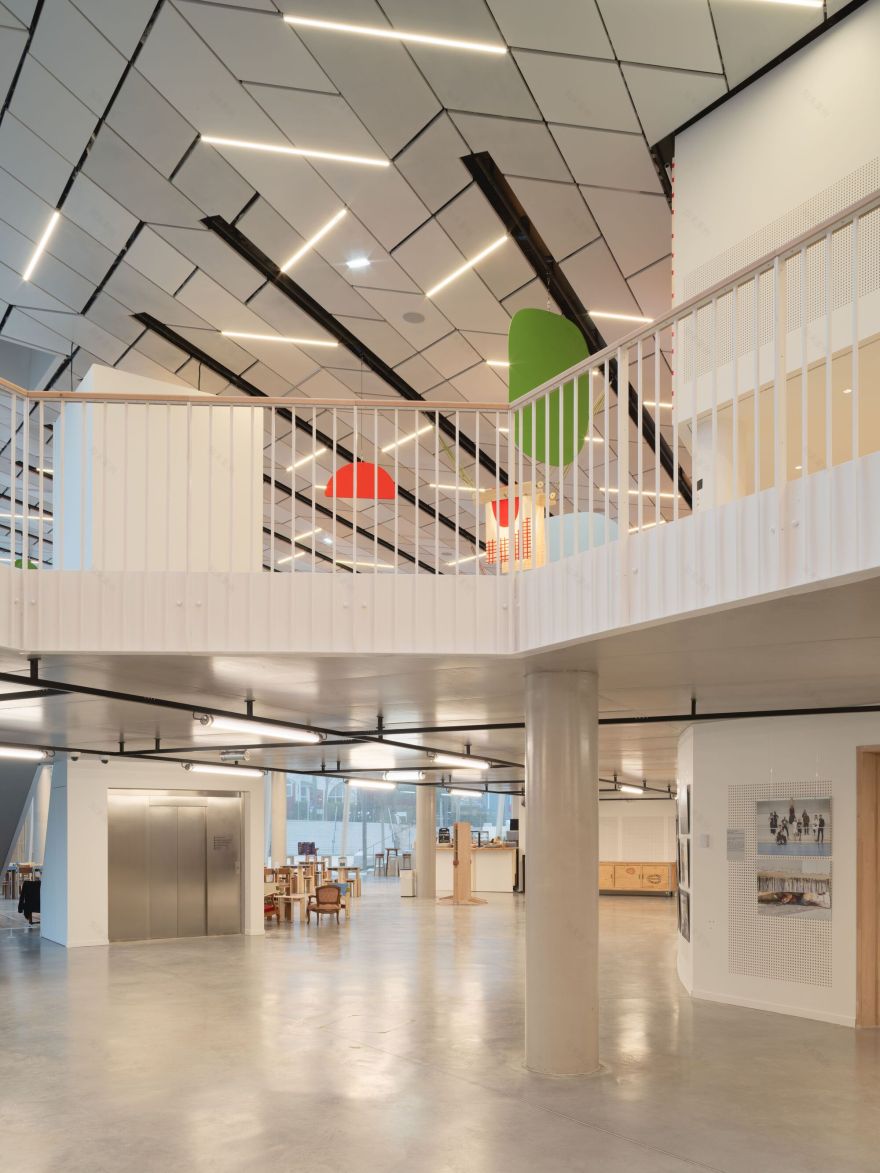
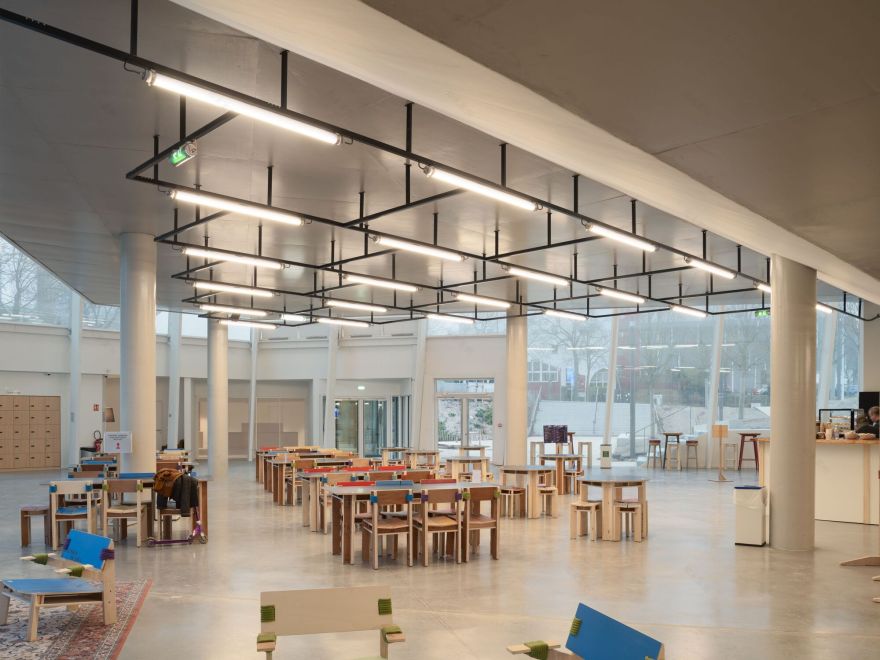
The Grand Hall: A Living Heart Between City and Park - The Grand Hall, the centerpiece of the rehabilitation project, embodies the renewed openness of the NanterreAmandiers CDN to the city and the park. Far more than a circulation space, it becomes a living and creative area, conceived as an extension of public spaces and as a potential stage for artists. While preserving the footprint of the historic hall, the Grand Hall has been thoroughly reimagined through a careful treatment of volumes and levels. Extended upward with a new roof and downward through the creation of a sunken plaza, it reveals previously hidden spaces and becomes a generous, legible, and through-going volume. Accessible from both the upper forecourt and the lower plaza, it organizes the theatre's circulation and doubles access to the auditoriums, ensuring smooth and fluid movement throughout.

Circulation within the hall is designed as an interior promenade, offering a variety of spatial experiences: mezzanines, double-height areas along glazed façades, and more intimate spaces near the auditoriums. Deliberately restrained and minimalist, the Grand Hall is conceived as an "additional venue," capable of hosting meetings, exhibitions, performances, or events, thanks to a ceiling integrated with stage equipment. Transparency, omnipresent throughout the space, changes the perception of the building throughout the day and seasons, making the theater's energy visible and supporting its mission of artistic transmission and dissemination. By day, natural light animates the volumes and reveals the raw materials; by night, the hall is illuminated, transforming the theater into an urban lantern. Connected to the restaurant and bookshop located beneath the planetarium dome, and equipped for comfort and accessibility for all, the Grand Hall becomes a hospitable and vibrant space, active beyond performance times. It fully embodies the spirit of the project: an open, generous, and unifying theater, where architecture serves both encounter and creation.
The Main Auditorium: An Iconic Space Reimagined - The Main Auditorium, both the central performance space and a symbol of the Nanterre Amandiers CDN, has undergone a profound transformation, conceived as a foundational gesture of the project. The goals are spatial, technical, and symbolic: to improve comfort and sightlines, strengthen the connection between audience and stage, and provide artists with a creation tool suited to contemporary works. Four ground-level entrances and exits, fully accessible to people with reduced mobility, have been created from both the Upper and Lower Plazas. This new access arrangement greatly improves circulation and audience flow, particularly during entrances and intermissions, while reinforcing the inclusive nature of the venue. The seating has been completely redesigned. Retaining the characteristic shell shape of the auditorium, the new arrangement builds on the existing structure and accommodates 800 spectators under significantly improved comfort conditions. Row spacing has been widened, circulation simplified, and sightlines adjusted to the new position of the stage edge. Integrated curtains allow the capacity to be reduced to 600 seats when required by certain performances, providing great flexibility without compromising the architectural quality of the space.
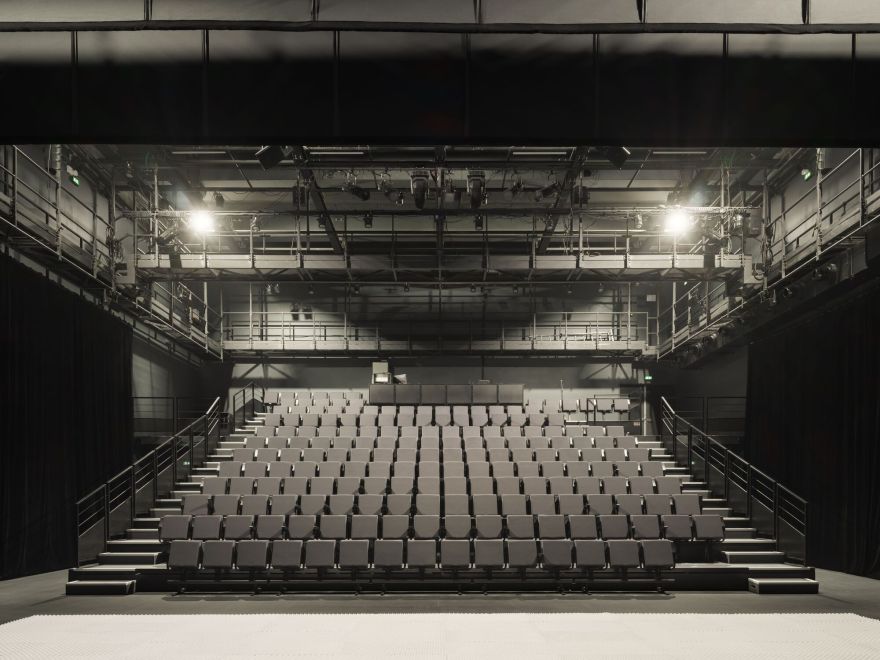
The relationship between the auditorium and the stage has been profoundly renewed. The stage house has been entirely restructured, and the advanced proscenium wall extends the stage by two meters in depth, giving it a European-standard format. The opening of the proscenium has been enlarged, fostering a more direct and intense connection between artists and audience. An additional row has been added at the stage level, accessible directly from the lower entrance, further enhancing proximity to the performance. An overhead proscenium grid, extended above the front rows, enriches the stage equipment and staging possibilities. All technical equipment has been fully modernized. Catwalks have been reorganized to reduce load breaks, the control room has been relocated to the back of the auditorium, open to the stage volume, and connected to existing spaces, with provision for a projection booth. The Main Auditorium thus becomes a premier tool for both performance and creation – highly efficient, adaptable, and faithful to the historical standards of the Amandiers.

The Flexible Space, The Small Auditorium - The new theater offers two complementary performance spaces, designed to provide flexibility, diversity, and intensity in the experience of both audience and artist. The flexible auditorium, inheriting the previous space, has undergone a comprehensive interior restructuring that allows it to quickly adapt to a wide variety of configurations and capacities. With mobile seating and motorized platforms, it can be rapidly transformed from a frontal arrangement to bi-, tri-, or quadri-frontal layouts, with visual connections to the open-air theater. This modularity, combined with access from both the lower and intermediate levels, enables a more intimate exploration of the space and encourages experimental or immersive uses. The organization of backstage areas and access points remains highly flexible, allowing smooth circulation for both artists and audiences.

The small auditorium, entirely new, complements the programme with 200 seats. Designed for more intimate or experimental forms, it is accessible from both the upper and lower levels and features a motorized telescopic seating system. The proximity of dressing rooms and technical spaces ensures efficient use for artists while providing optimal comfort for the audience. These three auditoriums, rationally organized with dressing rooms, team workspaces, and circulation areas, form a compact and legible ensemble where each space is directly accessible and fully functional. This arrangement facilitates the daily operation of the CDN, reduces unnecessary movement, and fosters harmonious interaction between artistic creation and audience engagement. The Nanterre Amandiers CDN once again welcomes artists and audiences into a rehabilitated building that remains true to its history while looking resolutely toward the future. This rehabilitation continues the founding spirit of the venue – openness, generosity, and social engagement – within a contemporary architectural framework, designed to support both today's and tomorrow's artistic practices and ways of using the space.

Project gallery


南京喵熊网络科技有限公司 苏ICP备18050492号-4知末 © 2018—2020 . All photos and trademark graphics are copyrighted by their owners.增值电信业务经营许可证(ICP)苏B2-20201444 苏公网安备 32011302321234号
苏公网安备 32011302321234号客服
消息
收藏
下载
最近