

创作上传
VIP
收藏下载
登录 | 注册有礼
查看完整案例

收藏

下载

分享
More than Human: A Land Bridge for Cultural and Wildlife Connections | STIMSON + Rialto Studio
项目陈述
PROJECT STATEMENT
位于圣安东尼奥菲尔·哈德伯格公园内的罗伯特·L.B.托宾跨桥,是美国首个同时服务于人类与野生动物通行的综合性生态跨桥。该项目以宏大的生态尺度为切入点,将一片曾被道路一分为二、宽达一英里的自然区域与公共公园重新连通。跨桥修复了贝克萨尔县最长溪流廊道沿线的重要生态栖息地,在保障公众通行与使用的同时,将野生动物迁徙通道置于优先位置。它不仅是一项基础设施,更像是地形本身的延续——在城市景观之上,重建的南得克萨斯灌丛与稀树草原生态逐渐生长展开,成为城市中“野性自然”的一种全新实践模式。
The Robert L.B. Tobin Land Bridge of Phil Hardberger Park in San Antonio is the first land bridge of its kind, for both human and wildlife passage, in the United States. At a monumental environmental scale, the bridge reconnects a once bisected, mile-wide tract of natural area and public park. It restores a major ecological sanctuary for wildlife along the longest creek corridor in Bexar county, prioritizing wildlife passage alongside people. More than infrastructure, it is a continuation of the land itself, where the life of restored south Texas scrubland and savanna unfolds over a cityscape as a new model for urban wildness.

▲最初的概念草图将生态跨桥设想为一条充满动感的“土地流线”,让地形、人群与野生动物跨越高速公路,实现公园两侧的重新连接。The first sketch of the land bridge envisioned an energetic flow of land, people and wildlife over the highway, reconnecting two sides of the park. © Stephen Stimson
项目说明
PROJECT NARRATIVE
菲尔·哈德伯格公园(Phil Hardberger Park)位于美国第七大城市圣安东尼奥,是一座占地330英亩的城市公园。公园于2007至2019年分阶段设计建设,并于2010年向公众开放,定位为一处可体验的野性自然空间:步道穿行于保留的林地与修复的稀树草原之间,而停车区、野餐区和游乐空间则嵌入原有灌丛景观之中。
在超过十年的时间里,公园被分割为两块独立地段,总体规划中的最后一项关键工程——生态跨桥——始终未能实施。六车道的Wurzbach Parkway将场地一分为二,不仅阻断了公众通行,也成为沿38英里长的萨拉多溪迁徙野生动物的致命障碍。该项目最终借助2017年市民投票通过的1300万美元市政债券和1000万美元的资助与社会捐赠得以实施。跨桥于2020年12月正式开放,目前公园日均接待游客约750至1000人。项目体现了城市野性空间建设与全市公共行动之间的协同力量。
跨桥被构想为地形本身的自然延伸。塑形土体叠加强化后的稀树草原与灌丛植被,跨越Wurzbach Parkway约175英尺,将公园两侧重新连接,并恢复与萨拉多溪生态廊道的联系。宽达160英尺的高密度植被通道一侧设置缓坡土堤,主要服务野生动物通行;同时为公众提供相对收敛且无障碍的步道系统。一条高出地面25英尺的钢木结构空中步道在树冠间蜿蜒上行,直达桥顶观景区。顶部的钢制护墙有效屏蔽城市噪声,营造出出人意料的静谧氛围,视野可远眺整座城市。桥两端设置了野生动物观察隐蔽点,既提供遮荫空间,也便于在补水设施附近观察动物活动。护墙的穿孔图案取材于场地的动植物元素,由当地艺术家创作并由景观设计团队深化设计。桥体的材料、植物选择与空间形态均基于场地条件,并体现区域生态特征。
项目占地超过20英亩,最大程度实现了资源的再利用:现场土方回填约12万立方码,并将清理的灌木粉碎后用作覆盖物。结构部分由16道拱形主梁单跨越过高速公路,无需设置中间支撑立柱;弧形横断面与钢制侧墙同时发挥场地隔离与交通降噪功能。桥台采用本地开采的石灰岩建造,并自然过渡至两侧种植坡地。主梁在夜间吊装,以避免道路封闭,单跨设计也避免了大规模路面翻修。雨水被汇集至一处面积约1英亩的湿地,既用于生态调蓄,也为野生动物提供饮水来源。地下25万加仑容量的蓄水池收集雨水,在圣安东尼奥干旱季节为灌溉系统提供保障。
野生动物生物学家参与了桥体尺度与栖息环境的研究与决策,以最大化动物通行效果。沿Wurzbach Parkway设置约3300英尺长的引导围栏,将动物引导至跨桥通道,同时通过连续的土堤与植被覆盖为其提供安全隐蔽的迁移环境。桥体内共恢复和引入50余种植物,其中许多为结果植物,可提供食物来源、栖息空间并支持相关猎物物种生存。在建成不到一年的时间里,红外相机已记录到公园内所有已知哺乳动物物种,包括山猫、白尾鹿和环尾猫等。
罗伯特·L.B.托宾生态跨桥充分展示了以景观设计为主导的跨专业团队在城市环境中构思并实施大尺度、与场地环境深度融合的基础设施的能力,同时证明了在城市空间中优先保障生态野性的现实可能。

▲该项目最早提出于2007年,作为一项为期十二年的总体规划中的最后阶段,通过全市市政债券、专项资助及社会捐赠得以实施。First conceived in 2007, the land bridge was the final phase of a twelve year comprehensive plan, enacted by a city-wide bond, grants and donations. © STIMSON

▲跨桥以野生动物安全通行与栖息需求为优先,仅为公众设置了较为收敛的步道系统、观察隐蔽点以及高架空中步道。The land bridge prioritizes safe wildlife passage and habitat, limiting humans to a narrow trail system, wildlife blinds and an elevated skywalk. © STIMSON

▲桥体结构由拱形主梁跨越Wurzbach Parkway,无需中间支撑立柱;桥台采用石灰岩建造,并自然过渡至两侧种植坡地。The bridge rests on girders arching across Wurzbach with no support columns. Limestone forms abutment walls that feather back into the planted slopes. © STIMSON and Phil Hardberger Park Conservancy

▲桥体整体形态由景观设计师主导设计,并由结构工程师提供技术支持,材料选用得克萨斯州本地资源,如石灰岩和耐候钢。The landscape architect designed the bridge in form, supported by the structural engineer, with Texas materials like limestone and weathering steel. © Rialto Studio

▲恢复种植方案的概念设计采用更为丰富的本土植物体系,重建南得得克萨斯典型的稀树草原与灌丛群落结构。A concept sketch for the restoration planting plan embraces an expanded palette of a native south Texas savanna and shrubland community. © STIMSON
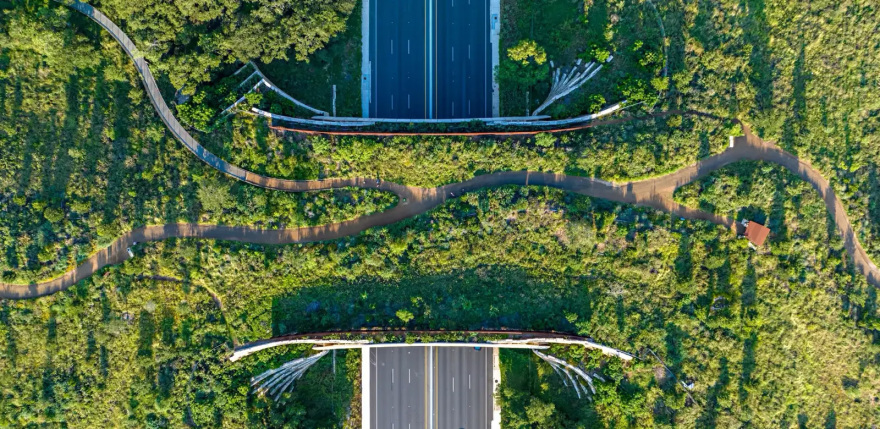
▲通过引入和恢复50余种植物,跨桥有效提升了公园栖息地的多样性,其中许多为结果植物,可为野生动物提供食物来源、庇护空间并支持食物链系统。The bridge diversifies park habitat with over 50 reintroduced species for wildlife many bearing fruits, providing shelter and supporting prey species. © Phil Hardberger Park Conservancy

▲在桥体最高处,通过植物配置、土堤塑形、碎石步道与空中步道的综合设计,将人流有序引导至跨桥南侧边缘区域。At the apex of the bridge, plants, berms, granular trails and a skywalk choreograph people strategically along the southern edge of the land bridge. © Phil Hardberger Park Conservancy
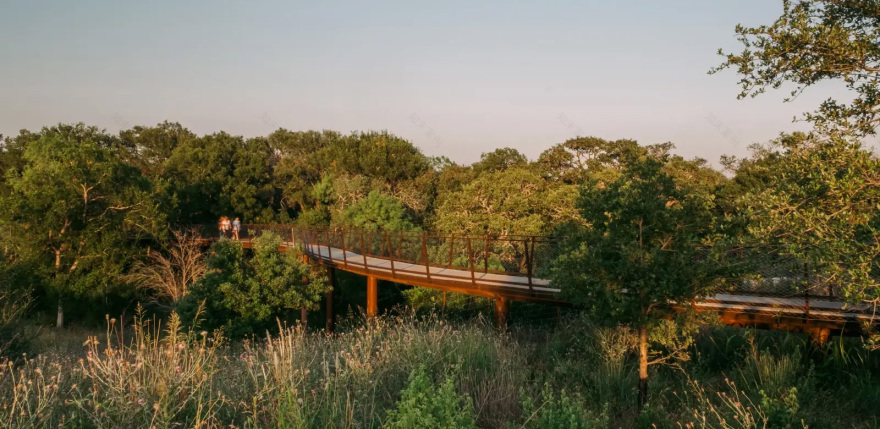
▲一条采用钢木结构的无障碍高架步道从Water Loop区域出发,在现状树冠之间缓缓上升,最终到达桥顶。An elevated and accessible skywalk of wood and steel sensitively winds through the existing tree canopy from the Water Loop to the bridge summit. © JoMando Cruz

▲步道选线充分考虑场地内具有历史意义的成熟树群,材料轻盈通透,让使用者在行进过程中保持与林地环境的紧密联系。The skywalk was sited in response to mature stands of heritage trees. Quiet and transparent materials inspire a connection to the woodland. © JoMando Cruz

▲桥顶区域的地形隆起强化了野生动物通行路径,同时钢制护墙有效隔离下方高速公路的视觉与噪声干扰。A topographic rise at the summit defines passage for wildlife and steel parapet walls protect animals from sites and sounds of the highway beneath. © JoMando Cruz
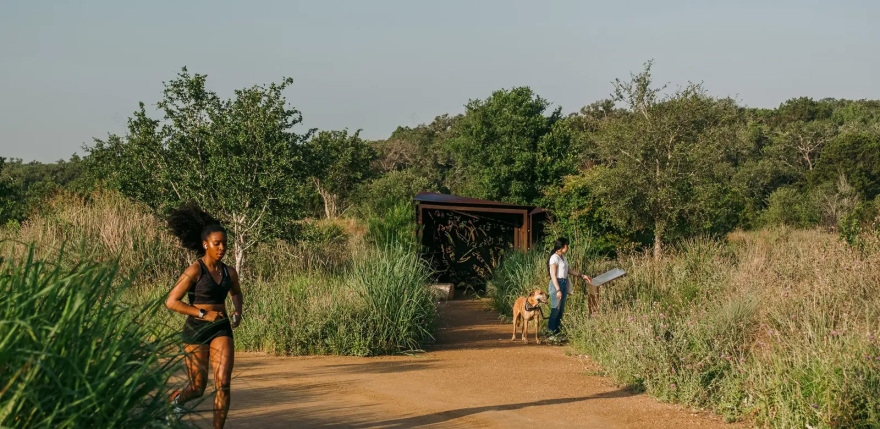
▲桥两端设置了野生动物观察隐蔽点,既提供遮荫空间,也便于在补水点附近观察动物活动。Wildlife blinds are sited at either end of the bridge, offering shade and a chance to observe animals at the recycled water guzzlers. © JoMando Cruz

▲隐蔽点的穿孔墙面图案取材于场地的动植物元素,由当地艺术家创作并由景观设计团队深化设计。The perforated walls of the blinds take cues from the site’s flora and fauna, created by local artists and detailed by the landscape architects. © JoMando Cruz

▲自生态跨桥开放以来,该公园已成为贝克萨尔县范围内野生动物迁徙的重要节点。Since the opening of the land bridge, the park has become hotspot for wildlife migrations throughout Bexar County. © STIMSON and Phil Hardberger Park Conservancy

▲在建成不到一年的时间里,红外监测相机已记录到公园内所有已知的哺乳动物通过跨桥活动。Before the first anniversary of the bridge, every mammal species known to reside within the park was captured on the land bridge’s trail cameras. © Phil Hardberger Park Conservancy and JoMando Cruz

▲持续的迁徙监测与现场观察表明,该生态跨桥运行效果显著,可作为在城市环境中优先保障生态野性的示范案例。Tracking and observations of wildlife migrations prove the land bridge is working. It can be a model for prioritizing wildness in the urban realm. © JoMando Cruz
PROJECT NARRATIVE
Phil Hardberger Park, is a 330-acre urban park in San Antonio, the 7th largest city in the United States. Designed in phases from 2007-2019, the park opened to the public in 2010 as a cultivated wild, where trails wind through preserved woodlands and restored savanna, with parking, picnic and play carved from scrubland. For over a decade, the park existed as two parcels and the last piece of the Comprehensive Plan, the land bridge, remained unrealized. Six lanes of Wurzbach Parkway severed the landscape, creating a barrier for humans and causing fatal collisions for wildlife migrating along the 38-mile-long Salado Creek. The land bridge was finally realized through a 2017 voter-approved city bond of $13 million and $10 million in grants and donations. It opened to the public in December 2020 and the park sustains 750-1,000 visitors per day. The project demonstrates a union of urban wildness and city-wide activism.
The bridge was conceived as a flowing extension of the land itself. Sculpted earth, layered with amplified savanna and scrubland, spans 175’ across Wurzbach Parkway and reconnects both sides of the park back to Salado Creek. The 160’ wide corridor of densely planted landscape is bermed along one edge for wildlife movement, while offering a narrower, accessible trail system for people. A 25 foot elevated skywalk of wood and steel sensitively winds through the tree canopy to the top of the land bridge. At the summit, steel parapet bridge walls create unexpected quietness, and the view extends for miles across the city. Wildlife blinds are sited at either end of the bridge, offering shade and a chance to observe animals at the water guzzlers. The perforated wall patterns take cues from the site’s flora and fauna, created by local artists and detailed by the landscape architects. All the materials, plants and forms of the bridge are responsive to the site and inspired by the region.
At over 20 acres, the project reused site soils and 120,000 cubic yards of earth, and recycled tons of cleared brush as mulch. Resting on 16 arched girders that stretch across the highway in a single span, there are no support columns and the structure’s bowed cross section and steel walls provide site and sound barriers from traffic below. Locally quarried limestone forms abutment walls that feather back into the planted slopes. Girders were craned into place at night to avoid road closures and the single span avoided highway repaving. Rainwater is collected in a 1-acre wetland that doubles as a wildlife watering hole. A 250,000-gallon underground cistern harvests rainwater, providing irrigation through San Antonio’s droughts.
Wildlife biologists educated decisions on bridge dimensions and habitat requirements to maximize animal crossings. Passage is guided by 3,300 linear feet of barrier fencing along Wurzbach, directing animals upwards, while berms and plantings provide continuous cover across the structure. The bridge diversifies habitat with over 50 reintroduced species, many bearing fruits, providing shelter and supporting prey species. Before the first anniversary of the bridge, every mammal species known to reside within the park was captured on the land bridge’s trail cameras, including bobcat, white-tailed deer and ringtail cat.
The Robert L.B. Tobin Land Bridge demonstrates the ability of a landscape architect-led team to conceive and design large-scale, contextual infrastructure that prioritizes wildness in the urban realm.
南京喵熊网络科技有限公司 苏ICP备18050492号-4知末 © 2018—2020 . All photos and trademark graphics are copyrighted by their owners.增值电信业务经营许可证(ICP)苏B2-20201444 苏公网安备 32011302321234号
苏公网安备 32011302321234号客服
消息
收藏
下载
最近