

创作上传
VIP
收藏下载
登录 | 注册有礼
查看完整案例

收藏

下载

分享

翻译
Architects:LABarq
Area:477m²
Year:2026
Photographs:Ariadna Polo
Manufacturers:ANKUI,DFC,Procesos en Mármoles Querétaro
Lead Architect:Juan Carlos Kelly
Category:Houses
Design Team:Ixchel Muñoz, Paulina Moreno, Saúl Cabrera
General Construction:SPEC
Engineering And Consulting > Structural:Juan Carlos Cisneros
City:Santiago de Querétaro
Country:Mexico

Text description provided by the architects. In the suburban landscape of Querétaro, where housing often follows pre-established schemes, Casa Capuchinas proposes an architectural identity built from a single material.

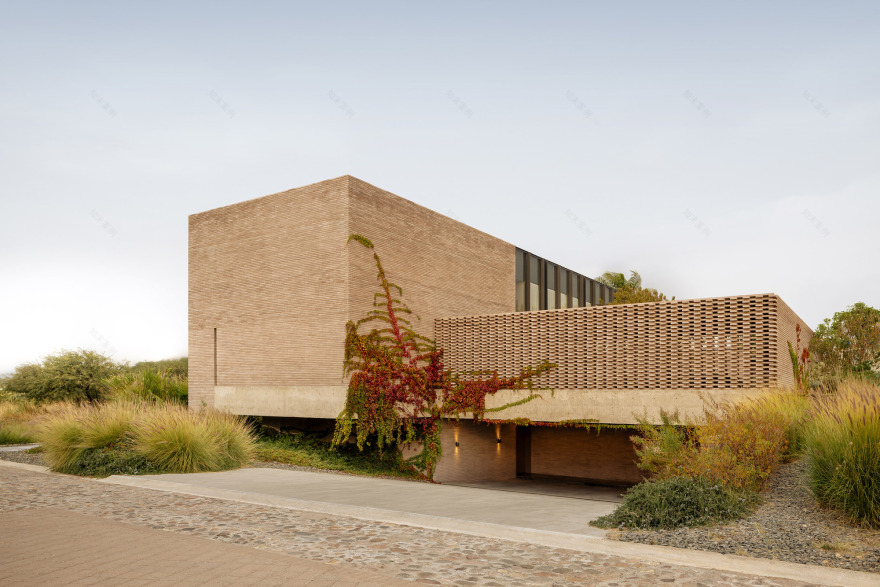
The project is developed from a specially designed concrete block, whose proportion and tongue-and-groove system—eliminating vertical joints—allow for precise modulation and a continuous finish that unifies the language of the entire house. This decision establishes from the outset a material investigation that articulates both architectural expression and constructive logic.

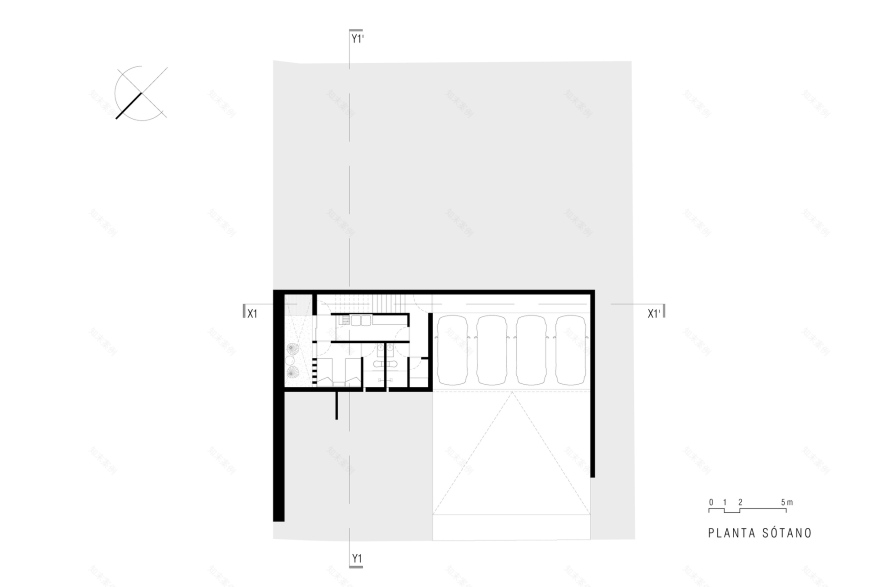
Located in a residential area with homogeneous growth, the house responds to a specific request: a user seeking an intimate, practical space with a sense of permanence, without compromising its value for future inhabitants. The programmatic strategy concentrates daily life on the ground floor—including the master bedroom—while the upper floor houses three additional bedrooms oriented towards the garden, allowing for flexible occupancy over time.

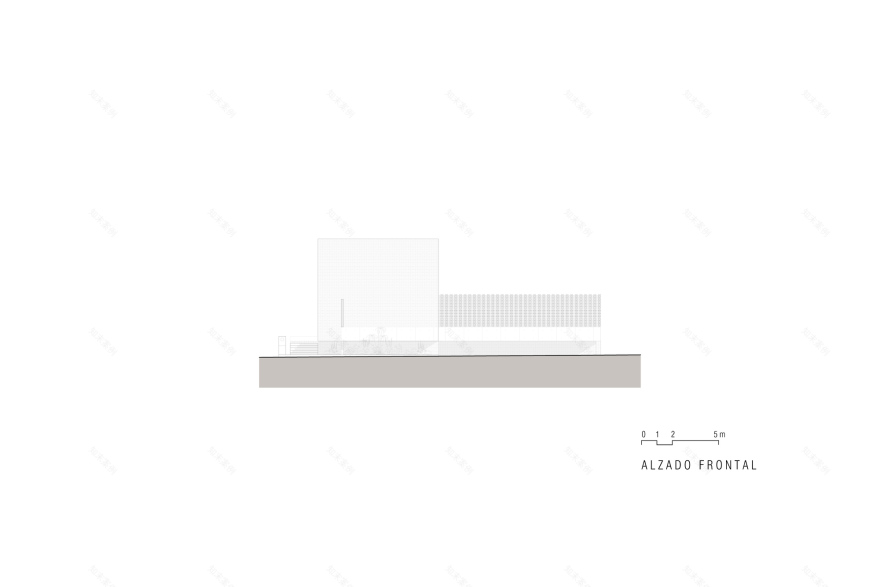
The choice of a unique material palette results in a sculptural expression where light and shadow reveal the qualities of concrete. The block covers the entirety of the volume, and on the main façade, it unfolds like a lattice that simultaneously functions as a solar filter, privacy element, and a containment for the terrace over the parking area. Conceived as a fabric that unravels and reconstitutes, this skin grants rhythm and depth to the architecture. In contrast, the second volume presents a solid façade to the street, resolving as a cantilevered body that creates a double-height interior space.


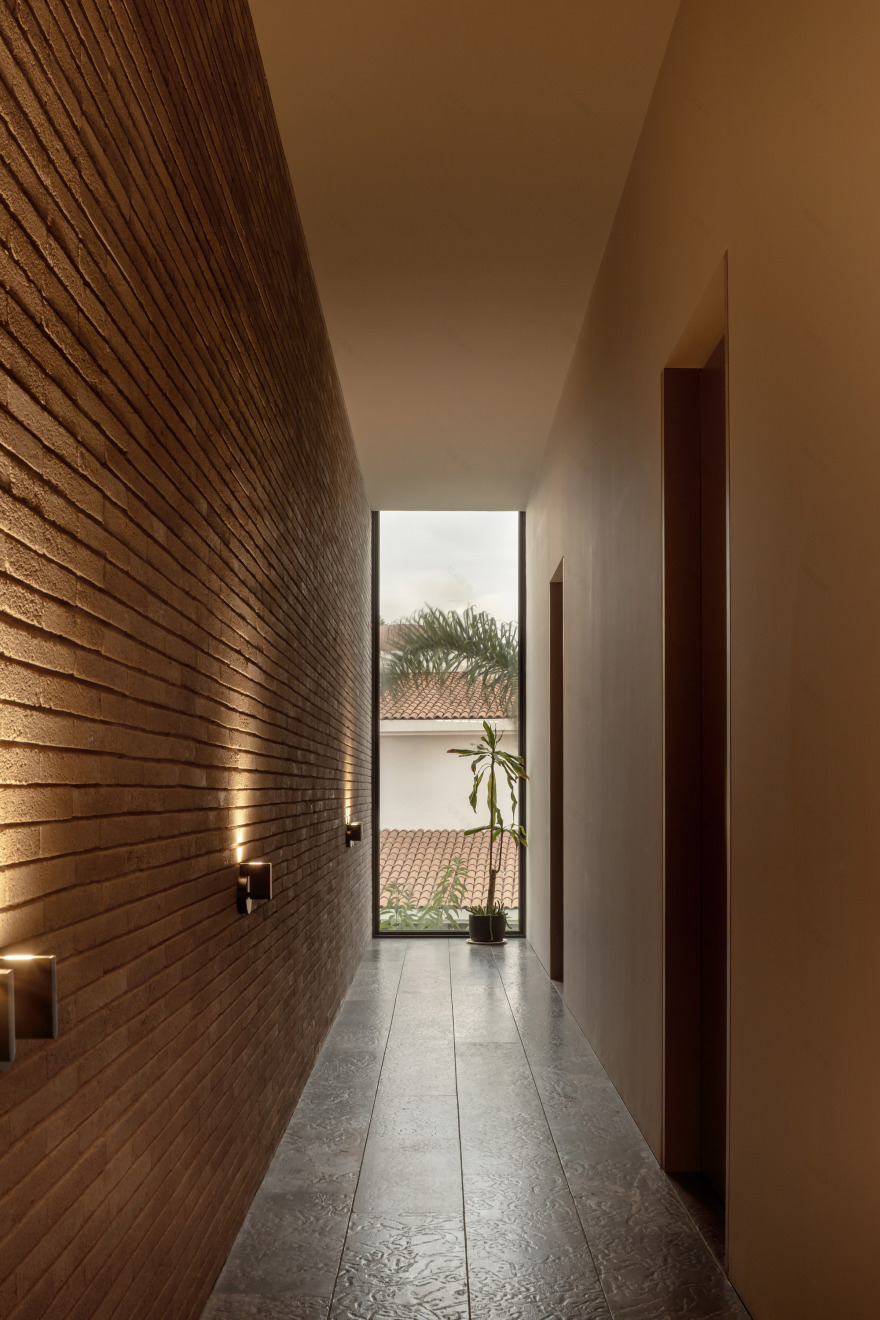
The interior is organized linearly. The ground floor articulates a main living area connected to the terrace, and a hallway accompanied by a glazed gallery that leads to the private spaces. Movable panels allow for configuration adaptation according to use: integrating or separating the kitchen, isolating the study, or transforming the television room into a more intimate space. At the end of the journey, the master bedroom is sheltered behind block screens that filter light and views without losing connection to the exterior, extending towards a private terrace linked to the garden.

The construction system of the block—4 cm high, 30 cm long, and 15 cm thick—defines a continuous pattern that structures the spatial experience. Committing to a single material involved a deep exploration of its modular, constructive, and sensory capabilities, consolidating a coherent architecture at all scales.


The landscape strategy reinforces this logic through the use of native species with low water consumption, reducing maintenance and favoring adaptation to the environment. Part of the existing trees was relocated, while a central tree acts as a climatic regulator and visual axis, shading the glazed gallery and articulating the main views. At the back of the lot, new trees frame the views from the interior areas, ensuring that each space maintains a direct connection with the landscape.

Casa Capuchinas explores the capacity of a single material to generate multiple atmospheres and architecture as a system adaptable to different ways of living. Its formal synthesis and programmatic flexibility allow it to function simultaneously as an intimate refuge and as a structure open to future transformations.

Project gallery







南京喵熊网络科技有限公司 苏ICP备18050492号-4知末 © 2018—2020 . All photos and trademark graphics are copyrighted by their owners.增值电信业务经营许可证(ICP)苏B2-20201444 苏公网安备 32011302321234号
苏公网安备 32011302321234号客服
消息
收藏
下载
最近