

创作上传
VIP
收藏下载
登录 | 注册有礼
查看完整案例

收藏

下载

分享
“整个宇宙由声音构成。” ——《奥义书》
________________________________________
初心及缘起
在快节奏的城市节拍中,人们逐渐习惯于以理性与大脑应对世界,却忽略了身体本身所发出的声音。本项目是一间以打击乐器为核心的音乐工作室,意在为城市中的个体提供一个通过“节奏”与“身体”重新连接自我、并进一步链接世界的场所。
这里并非传统意义上的音乐教室,而是一个融合了教学、演奏、身体感知与疗愈体验的实验性空间。
业主希望能与真正理解打击乐的设计师共同构建这一空间,于是找到了曾长期学习与演奏打击乐的设计师本人。对打击乐器的亲身经验,成为项目得以深入展开的重要理解基础。
多年间,因生活地点不断变化,设计师多次重新购入侯世达的著作《哥德尔、艾舍尔、巴赫——集异璧之大成》。书中关于逻辑学、视觉艺术与音乐结构之间深层关联的探讨,持续影响着设计师对于“结构”“节奏”与“感知”的理解,也埋下了希望在空间中进行多维表达的种子。多年后,这一项目成为一次恰当而自然的实践契机。
基于过往经验与充分沟通,设计师尝试通过空间提取多维度的“基因元素”,并让这些元素在空间中产生化学反应,从而构建一个独一无二、可滋养特定社群的城市疗愈空间。空间被赋予多层次的功能与表达:当鼓声成为空间的呼吸,身体在其中产生共振,节奏得以疗愈身心。
________________________________________
空间设计策略
“五感的空间”——形、色、声、光、器
形
原有平面中几乎所有墙体均为结构剪力墙,使空间被切割得零碎而狭窄,难以形成业主所期望的完整大空间。设计师通过微微转动主空间布局角度这一关键动作,激活了原本的负空间,重新建立了整体平面逻辑:原先难以使用的折角空间被整合进主空间体系,转化为可被充分利用的多功能局部。
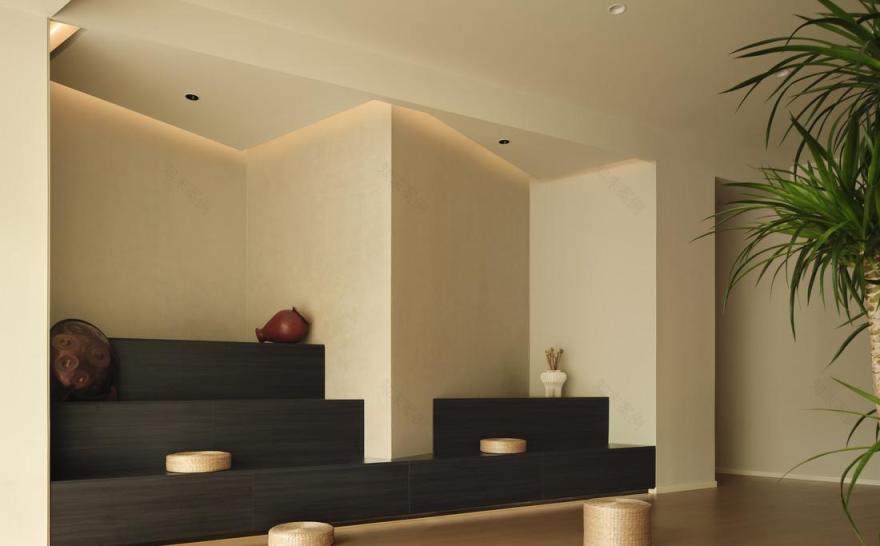
东侧折角处设置多功能阶梯,可作为演奏会观赏座位或教学使用。其角度同时回应行人行走视角,增强空间进深感,建立“看与被看”的关系,也赋予空间一定的公共与社交属性。
外立面每一跨均被充分利用,形成连续而开放的城市界面:由西至东依次为展示陈列位、结合座椅的可全开启推拉窗、主入口大门,以及可完整看到内部剧场空间的整片玻璃立面。可开可合的立面策略,在营造自然、温暖的欢迎姿态的同时,也通过可控的开合度建立对内安定、可休憩的空间氛围。
入口处的小型灰空间兼具接待、休息与手碟练习等多重功能。入口一侧的琴房兼疗愈空间采用软隔断设计:打开时与入口空间形成整体的大空间,闭合后则转化为柔软、私密的疗愈场所。
功能空间的生成同时也是对空间“颗粒度”的控制——整体呈现出秩序与纯粹,而其中仍保留个性与自由。从城市向内观看时,空间形体清晰、乐器可见;置身其中,则感受到安定与包裹。当乐器响起,声音引导身体安住当下。
由有序逻辑生成的空间序列,构成了如呼吸般的节奏感,本身即是一首空间的节奏乐章。
________________________________________
色
空间以中性偏暖的色调作为基底,营造温和、疗愈的整体氛围。适度留白与去装饰化处理,使音乐得以在空间框架中自然蔓延,空间的美学与音乐性被隐藏在更克制的暗线之中。
设计师节制地使用艺术漆,以增加必要的层次与功能区分。入口及走道的莱姆石碎拼地面,既呼应半室外花园小径的意向,也通过颗粒感与节奏性的视觉语言,形成一种安静而持续的律动,与主音乐空间的木地板形成明确而柔和的区分。
________________________________________
声作为承载多种打击乐器演奏的空间,专业的声学优化是设计的核心之一。
在平面层面,多折角墙体在整合负空间的同时,有效避免了驻波与颤动回声;整片玻璃外立面采用斜角处理,在实现内外互为景观的同时,也承担了重要的隔音功能。
构造上,整体地面被抬高,并在内部设置减震与隔音结构;天花系统中同步完成声学构造处理。乐器使用空间的墙体采用双层中空与隔音材料,负空间中的角度墙面结合内填充材料,成为高效的低频吸收体。局部厚重拉帘、地毯与屏风兼具吸音功能,所有乐器相关空间的门均采用专业隔声钢质门。
________________________________________
光
设计过程中充分考虑了多种使用场景。通透的外立面使日间自然光得以深入室内,阳光透过树影洒入空间,形成柔和而变化的光影。
从室内向外望去,正对东方体育中心的入口与阶梯,形成互为景观、彼此观看的城市关系。玻璃软隔断的拉帘与屏风用于调节光线的氛围与柔和度。
筒灯、射灯、灯带、水波纹灯等被有序配置,提供多种光环境模式。连接入口与多功能剧场的过道设置动态光效,模拟水波般摇曳的“音浪走廊”,将声波的抽象体验转译为可感知的空间动态,营造共感式的疗愈氛围。
________________________________________ 器
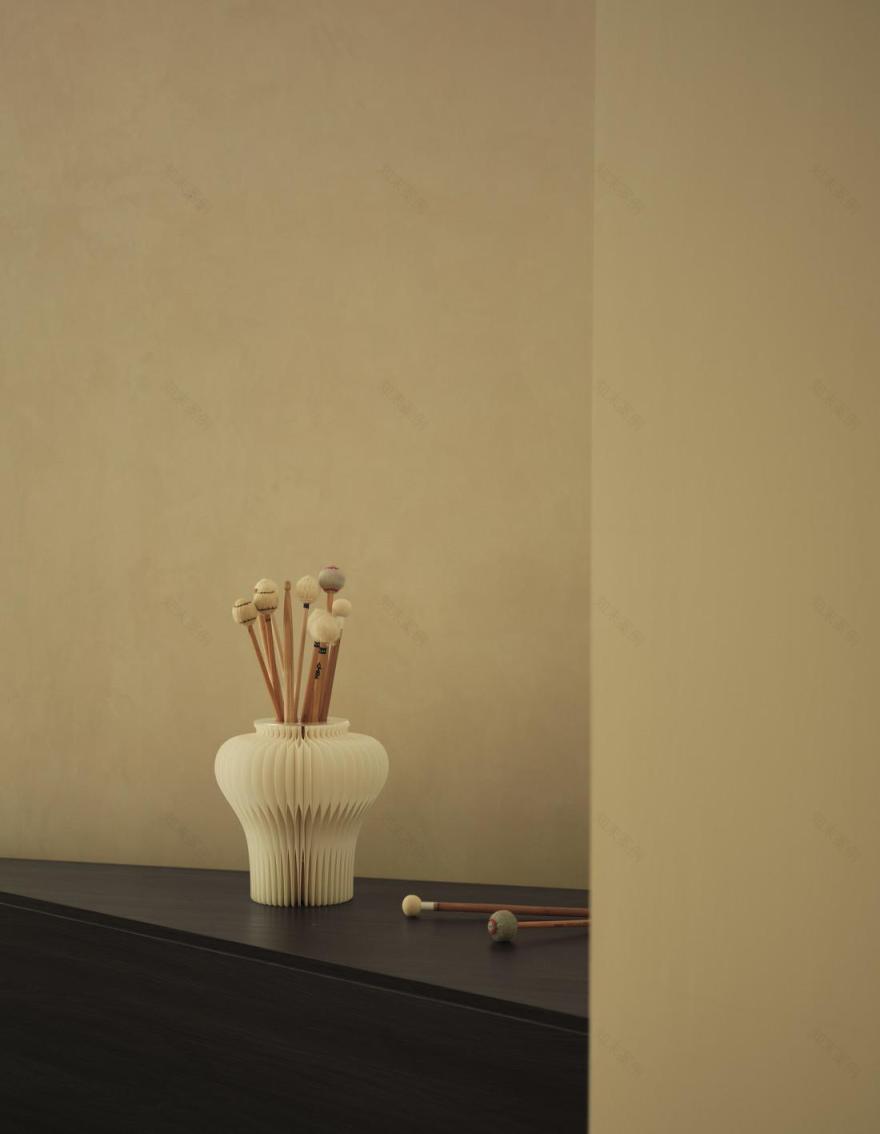
精妙的乐器本身即是一种景观。相较于大众熟知的架子鼓、军鼓或传统大鼓,打击乐器家族本身极为庞大,尤其在疗愈领域,存在着丰富而细腻的器物系统。
这些乐器被安放于温馨而宁静的空间中,如同一场面向城市的打击乐器陈列展览,向路过的人传递声音的可能性,激发潜藏的好奇与共鸣。
________________________________________
“The entire universe is composed of sound (Nada).” — The Upanishads
________________________________________
Origin and Intention
Within the accelerated rhythm of contemporary cities, people have become increasingly accustomed to operating through rational thought while gradually losing awareness of the body’s own sensory voice. This project is a percussion-centered music studio conceived as a space where rhythm and bodily perception reconnect individuals with themselves and with the surrounding world.
Rather than functioning as a conventional music classroom, the studio is designed as an experimental environment integrating teaching, performance, embodied perception, and restorative spatial experience.
The client sought a designer who could deeply understand percussion culture and performance logic. The architect, having undergone years of percussion training and performance, approached the project through this experiential knowledge, which became a crucial foundation for spatial interpretation.
Over many years and across several relocations, the architect repeatedly revisited Douglas Hofstadter’s Gödel, Escher, Bach: An Eternal Golden Braid. The book’s exploration of the structural parallels between logic, visual art, and musical composition subtly influenced the architect’s understanding of rhythm, structure, and perception. This project became an opportunity to translate these cross-disciplinary reflections into architectural form.
Through intensive dialogue and personal experience, the design extracts multiple “genetic elements” that interact spatially, forming a nurturing environment for a specific urban community. Within this space, percussion is conceived as spatial breathing; when the body resonates with rhythm, sound becomes a medium for mental and physical stillness.
________________________________________
Spatial Strategy
A Five-Sensory Spatial System: Form, Color, Sound, Light, and Instrument
________________________________________
Form
The original plan was heavily constrained by structural shear walls that fragmented the interior into narrow and inefficient zones, preventing the creation of the open spatial condition desired by the client.
A subtle rotation of the primary spatial axis became the project’s key design gesture. This movement activated previously residual spaces and reorganized them into a continuous spatial system. Formerly unusable angled corners were absorbed into the main field and transformed into flexible programmatic areas.
On the eastern side, an angled corner accommodates a multi-functional stepped platform that serves both as audience seating and teaching space. Its orientation aligns with pedestrian sightlines outside, strengthening spatial depth and establishing a visual relationship between observers and performers while introducing a subtle social interface.
Each structural bay along the façade is carefully utilized to create a welcoming urban threshold. From west to east, the façade integrates display areas, fully openable sliding windows with built - in seating, the main entrance, and a full - height glass façade revealing the internal performance space. The operable façade system balances openness and enclosure, offering warmth and accessibility while allowing interior calmness and privacy.
A transitional grey zone near the entrance serves multiple functions including reception, rest, and handpan practice. Adjacent to this area, a piano and therapeutic room uses soft partitions. When open, it merges with the entrance hall to form a larger communal space; when closed, it transforms into a private and intimate environment.
The distribution of functions reflects a deliberate control of spatial granularity. From the street, the spatial geometry appears clear and instrument - focused; from within, the environment produces a sense of stability and containment. When instruments are played, sound anchors bodily awareness in the present moment.
The ordered spatial sequence establishes a breathing rhythm throughout the interior — forming a spatial composition analogous to musical phrasing.
________________________________________
Color
A neutral warm palette establishes a calm and restorative spatial atmosphere. Controlled minimalism and reduced ornamentation allow music to expand naturally within the spatial framework, embedding aesthetic and acoustic qualities subtly rather than overtly.
Artistic coatings are selectively applied to introduce depth and differentiate functional zones. Limestone mosaic flooring in the entrance and corridor evokes the atmosphere of a semi - outdoor garden path. Its granular visual texture produces a quiet rhythmic movement that contrasts softly with the wooden flooring of the main performance area, reinforcing spatial transition through materiality.
________________________________________
Sound
As a multi - instrument percussion environment, acoustic performance formed a central design consideration.
At the planning level, the angled walls generated through spatial reorganization help eliminate standing waves and flutter echoes. The full - height glass façade is installed at a slight angle, enabling visual continuity between interior and exterior while improving sound insulation performance.
Structurally, the floor system is elevated and incorporates vibration isolation and acoustic insulation layers. Ceiling systems include integrated acoustic optimization. Walls surrounding instrument areas utilize double-layer cavities with soundproof materials. Angled residual walls filled with acoustic materials function as effective low-frequency absorbers. Additional acoustic absorption is achieved through heavy curtains, carpets, and screens. All instrument-related rooms are fitted with professional soundproof steel doors to ensure performance isolation.
________________________________________
Light
The lighting strategy responds to multiple operational scenarios. Transparent façades allow warm daylight to penetrate deep into the interior. Sunlight filtered through surrounding trees creates dynamic shadow patterns across the space. From inside, views frame the entrance steps of the Oriental Sports Center, establishing a reciprocal visual dialogue between interior activities and urban public life. Curtains and screens integrated into glass partitions allow flexible modulation of brightness and atmosphere. Layered artificial lighting systems — including spotlights, track lighting, linear strips, and ripple-pattern fixtures — provide multiple lighting modes. The corridor connecting the entrance and performance hall incorporates dynamic lighting effects resembling water ripples, translating the abstract nature of sound waves into a perceptible spatial experience that enhances sensory immersion.
________________________________________
Instrument
Percussion instruments themselves are treated as spatial artifacts and visual installations. Beyond commonly recognized drum sets or traditional ceremonial drums, percussion culture encompasses an extensive family of instruments, particularly within therapeutic sound practices. Displayed within the calm interior environment, these instruments form a public-facing exhibition visible from the street, inviting curiosity and engagement from passersby while revealing the diversity and expressive potential of percussion.




兼顾声学功效的斜角整片大玻璃外立面


流动的水波光影就像另一种声场的显现

模糊边界的看与被砍


城市界面的分享
一座打击乐手的城市感官修复站
南京喵熊网络科技有限公司 苏ICP备18050492号-4知末 © 2018—2020 . All photos and trademark graphics are copyrighted by their owners.增值电信业务经营许可证(ICP)苏B2-20201444 苏公网安备 32011302321234号
苏公网安备 32011302321234号客服
消息
收藏
下载
最近