

创作上传
VIP
收藏下载
登录 | 注册有礼
查看完整案例

收藏

下载

分享

翻译
Architects:MINOR lab
Area:211m²
Year:2025
Photographs:Arch Nango
Category:Retail Interiors
Design Team:Chen Liu (Design Principal), Dan Zhao (Project Manager / Site Supervision), Weixi Jin
City:Haikou
Country:China

Text description provided by the architects. The project is located in Haikou, Hainan Province, where the sea and tropical vegetation define the city's natural context. Approximately sixty kilometers to the northwest lies Fushan Town, the origin of coffee cultivation in Hainan. Established in the 1970s, Fushan Coffee has been embedded in regional daily life for decades, carrying both an agricultural lineage and a vernacular cultural presence. Commissioned by Fushan Coffee, the project reimagines the new coffee space as a medium for the brand's story—one that allows visitors to experience its history, production, and locality. This position informs both material strategy and spatial organization.


The existing structure is a two story concrete frame retail building. The intervention retains the original façade's materiality, with modest restoration to maintain continuity with the street context. At the entrance, a sloped canopy of corrugated aluminum panels is introduced as a lightweight addition, extending outward to form an intermediate zone. This canopy serves both as a response to the local climate and as a threshold for casual gathering. The introduction of glass street façade enhances visual permeability, allowing interior activities to become part of the city. The restrained exterior design establishes a clear identity with a subtle touch—a friendly and approachable brand mark on the street.


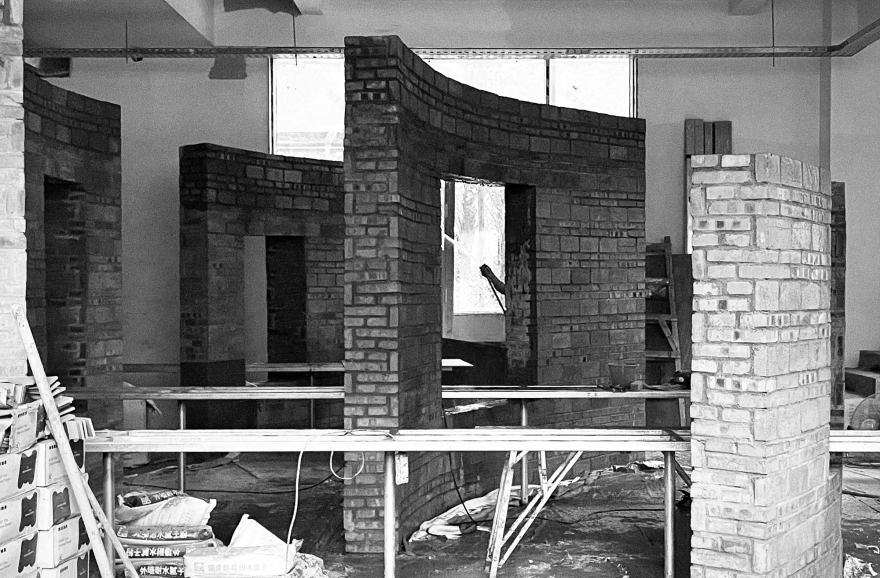
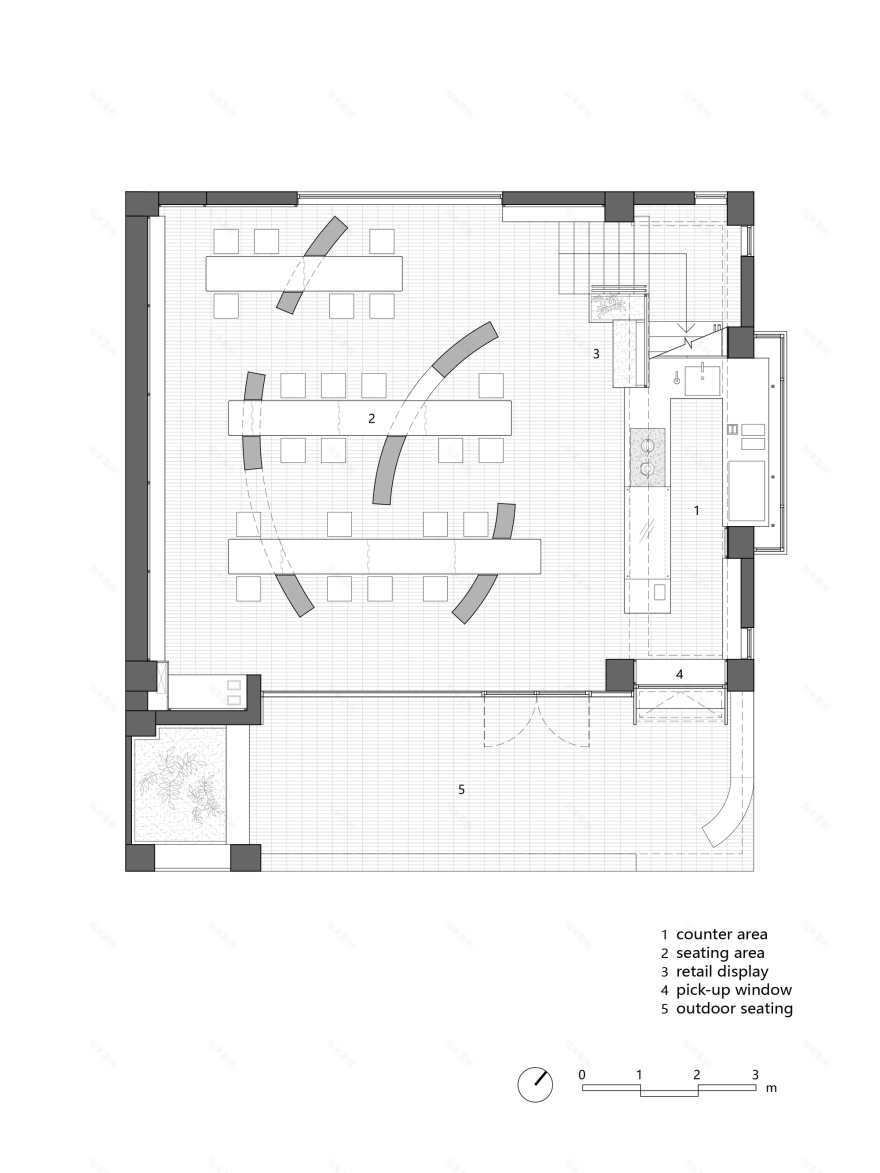
The ground floor is defined as a "Sculptural Field". Three curved walls, varying in height, intervene in the space like abstract forms, carving out distinct zones within the open layout—giving shape to movement and a sense of pause. The walls reference the weathered volcanic red soil of the Fushan coffee-growing region. The earthy texture and traces of handwork speak of the land, fostering an emotional connection between people, the space, and the coffee. Meanwhile, three continuous steel tables traverse the space, passing through the walls to create openings and sightlines. The act of coffee drinking and social interaction is framed as part of the exhibition, transforming these everyday actions into an integral part of the spatial narrative. The counter positioned along this trajectory, serves traditional Fushan coffee brewed in tin pots. The juxtaposition of earthen masonry and stainless steel introduces a deliberate material dissonance, situating the project between craft and production, past and present.


From the street, the layered curvature of the walls, combined with the movement of people, creates a dynamic spatial interface. The functions of the space are not immediately apparent but gradually unfold as visitors engage with it. This "undefined" quality gives the space its unique public character—a quality that emerges from the interplay between perception and the lived reality of everyday use.


Along the perimeter, a modular aluminum profile system integrates display and lighting functions. Its dimensional clarity and modular consistency introduce a rational ordering framework. Within the counter zone, the system evolves into a composite volume that serves as display, service, and circulation, extending vertically to wrap the stairwell and structure the transition to the upper level.

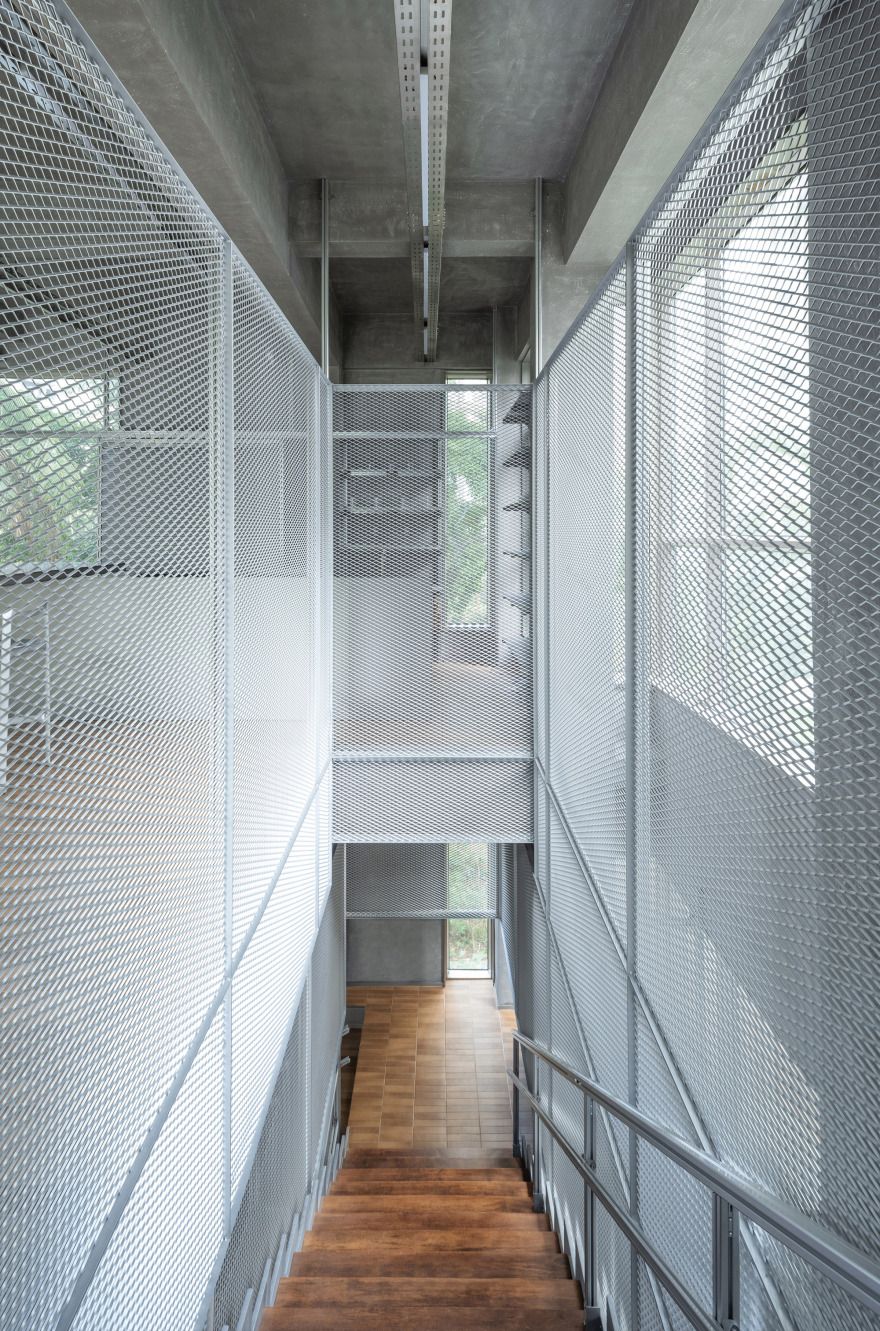
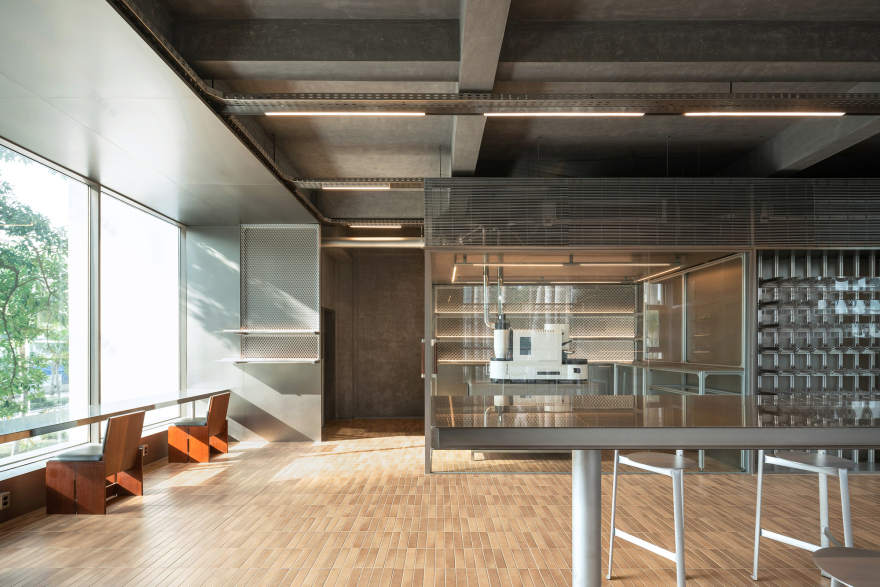
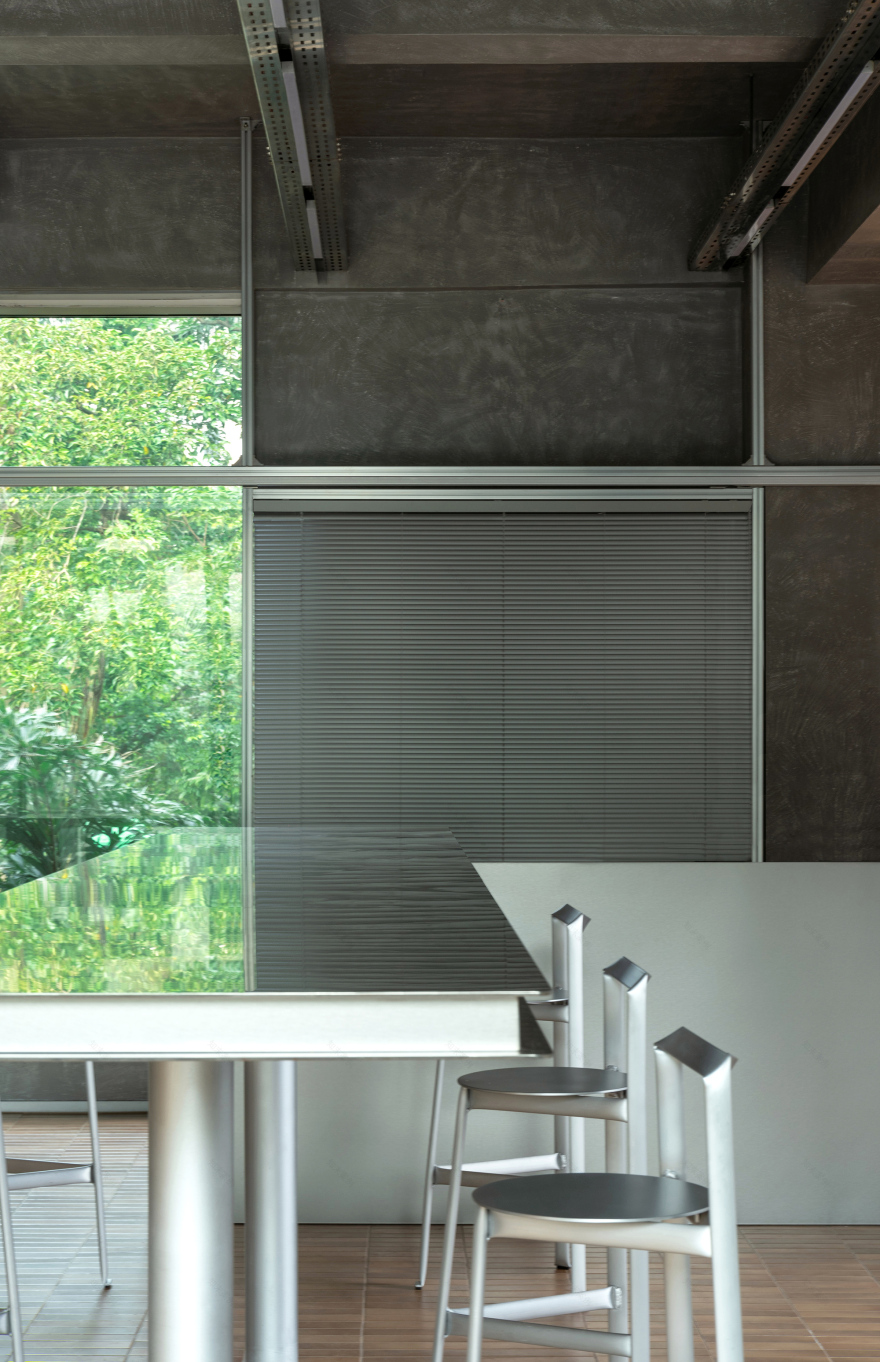
The second floor is conceived as a "coffee laboratory", oriented toward the contemporary roasting techniques while supporting research and knowledge sharing. The spatial language continues that of the lower level, while adopting a more controlled and transparent material expression to foreground function. The roasting machine occupies a key position within the space, serving as both a functional and experiential focal point. The layout is organized around a central worktable supporting staff cupping, barista training, and customer engagement, integrating roasting, retail display, and auxiliary service into a continuous operational field. Seating along the street-facing façade introduces natural light, plants, and street views, blurring the boundary between interior and exterior. In conjunction with the ground-floor transparency, it maintains an ongoing spatial dialogue with the city.


The project completes its renewal within the existing context. Through the interplay of material and construction, it establishes a balanced tension between the rough and the refined, the traditional and the contemporary, yielding a spatial experience that is both locally rooted and contemporary in its order. Through spatial narrative, the project integrates everyday experiences, production displays, and professional exchanges into a continuous public setting, transforming the space into a layered expression of the brand's identity, seamlessly embedding it into the fabric of urban life.
Project gallery






南京喵熊网络科技有限公司 苏ICP备18050492号-4知末 © 2018—2020 . All photos and trademark graphics are copyrighted by their owners.增值电信业务经营许可证(ICP)苏B2-20201444 苏公网安备 32011302321234号
苏公网安备 32011302321234号客服
消息
收藏
下载
最近