

创作上传
VIP
收藏下载
登录 | 注册有礼
查看完整案例

收藏

下载

分享

翻译
Architects:Studio Saransh
Area:1300ft²
Year:2024
Photographs:Ishita Sitwala
Category:Houses
City:Vapi
Country:India

"Architecture must do more than exist within its surroundings—it must engage with them, carving its own presence through mass, proportion, and materiality," expresses Malay Doshi, Principal architect at Studio Saransh. How does architecture express itself on a site embraced by nature? PBR House, by Studio Saransh, began with this fundamental question. Set amidst lush orchards on the outskirts of Vapi in Gujarat, this family home is designed as an exploration of materials and forms. The house, instead of relying on external cues, anchors itself through the careful articulation of spaces and a refined material palette to create a self-sustained identity that is both timeless and intimate.

The brief presented by the client was to create a house large enough to host social events, while retaining an intimate scale for everyday living. This requirement materialised in the form of a seven-bedroom house, spanning 1300 sqm across two floors, with the garden acting as both a social and a functional extension. The site plan is divided into two distinct zones: the house with its private courtyards, sit-out spaces, the kitchen garden to the west, and the deck and pool to the north, being the first; and the landscaped area to the east serving as a social space, as the second?

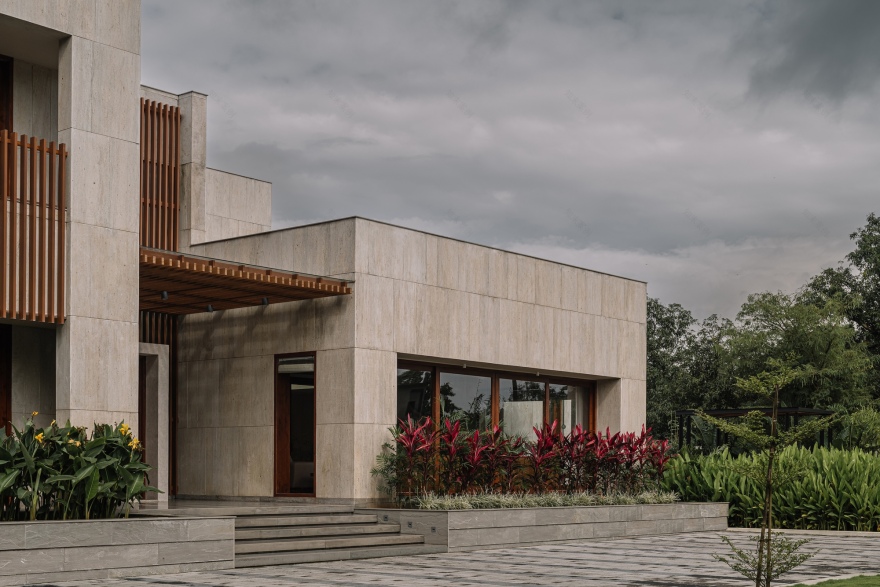
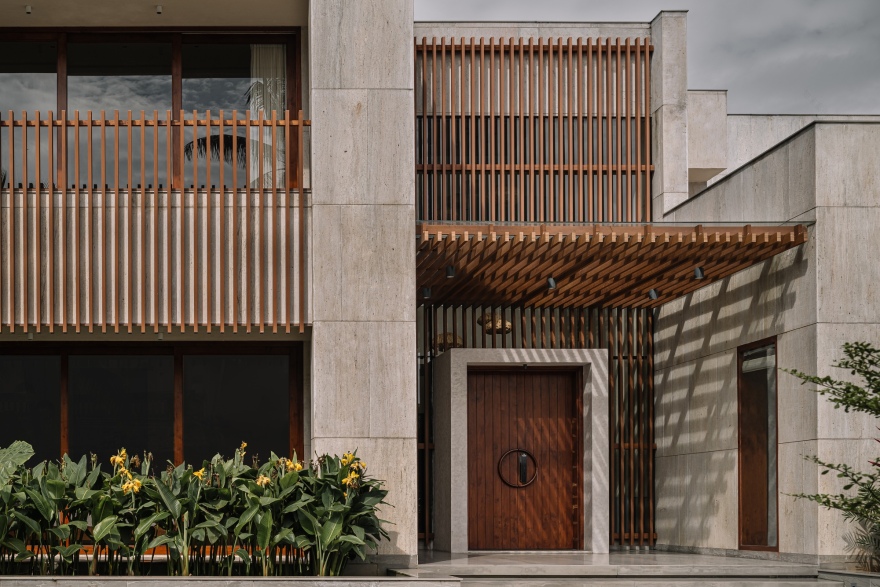
At first glance, the house presents a composition of cuboidal forms with robust grey limestone grounding the structure, while off-white granite-clad walls define its presence. However, behind the simple geometrical composition lies a deeper architectural exploration. The elevation unfolds in layers—concealing its full scale—where stoic private zones are discreetly tucked behind aluminium fins that divide the mass into 4 parts. A grand double-height bay, in contrast, opens the home to light, air, and movement. This double height gradually steps down to the northern side, culminating at the pool area, where the entire building pixelates to a more intimate scale. Carefully placed openings, custom-made on site from solid wood, ethically sourced from the nearby forest department, balance texture and tone, while the limestone plinth—a contemporary nod to the classical element—binds the composition together.

The house itself is divided into two wings: private and public, each organised around a courtyard that draws in light and provides a space for landscape to enter inside. These wings are connected by a central vestibule. To its left lie the living room, kitchen, dining, and puja, while the right wing houses private spaces. This spatial segregation extends on the first floor with a bar, and a rooftop occupying the space directly above the kitchen, while an indoor gym and three bedrooms occupy the opposite side. One courtyard takes on a narrow, linear form, connecting the dining and living area, and eventually leading to the pool deck, while the other expands in scale with a striking central staircase as its focal point. Beginning as a solid terrazzo base, the staircase gradually transforms through metal and wooden floating treads, culminating in a suspended landing that hovers within the courtyard void.


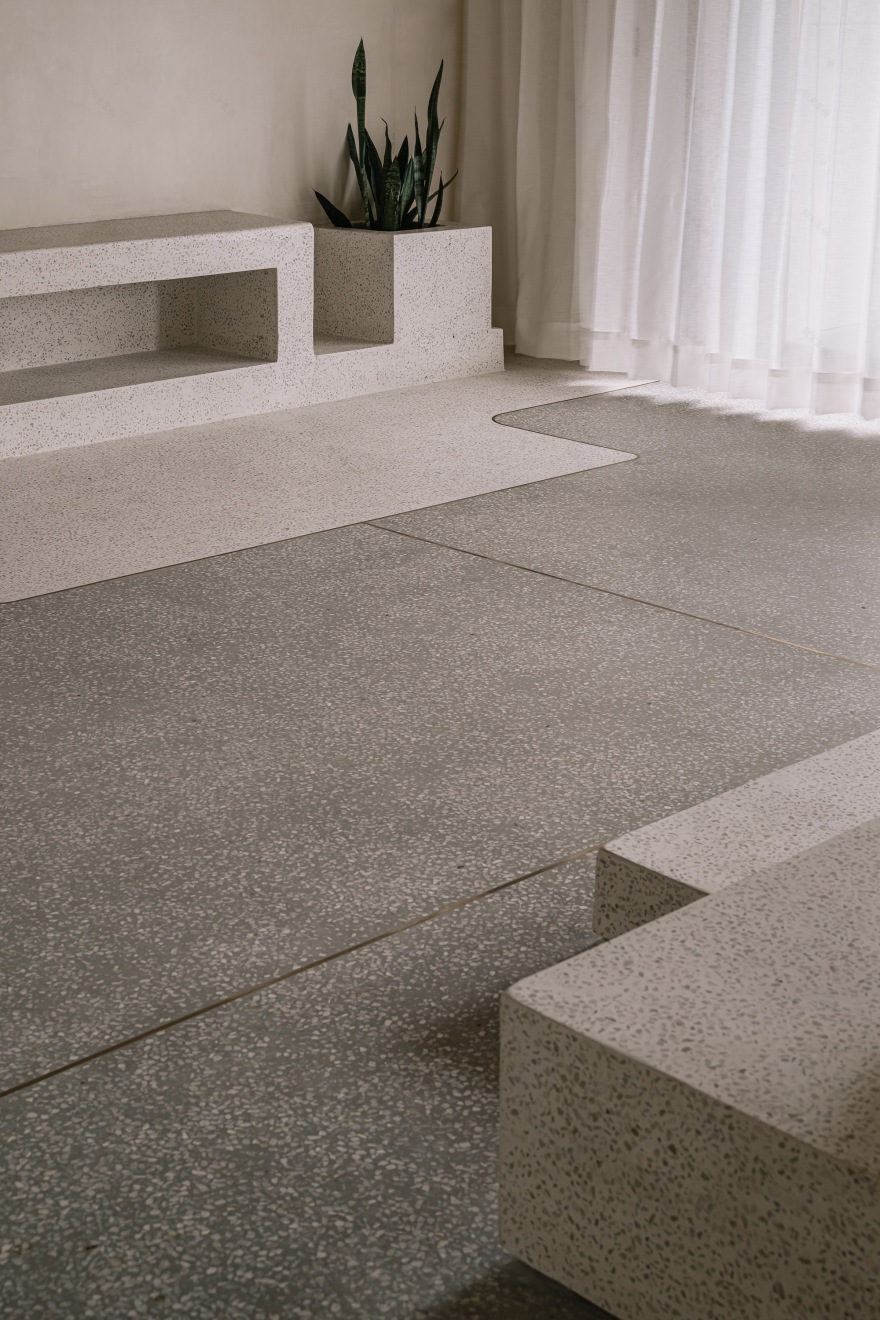
The entrance to the house is through a double-heighted vestibule, setting the tone of the interior. Upon entering, one can immediately sense a continuation of the architecture expressed on the outside. "The idea", as explained by Kaveesha, Principal Interior Designer, "was to extend the tonality of the outdoors inside, while expressing it through a different material palette." For instance, the off-white hues of granite translate into similarly toned lime plaster walls, while the grey limestone becomes cast-in-situ terrazzo on the inside. The suspended Origami-inspired lights from Oorja, crafted from Banana fiber paper, their organic forms creating an arresting focal point against the geometric precision of the architecture.


A defining feature that runs throughout the house is the elevated skirting, raised uniquely to the sill level, creating a strong horizontal datum. This architectural element not only unifies the spaces but also becomes a canvas for material exploration – its finish and character shifting as one moves from public to private zones, while maintaining a cohesive visual language. This detail exemplifies the project's central philosophy: spaces that are "different in materiality, but similar in tonality."

In the living room, the material narrative continues to unfold. Terrazzo flooring grounds the space, while plastered walls recall the off-white granite facade, punctuated by warm teak wooden accents. The subtle grain of the wood adds a tactile warmth, while the carefully selected furniture creates an inviting yet composed atmosphere. Beyond the central vestibule, the kitchen and dining areas open directly onto the linear courtyard, creating a seamless indoor-outdoor connection. A dining table, with a marble top, anchors the space, while custom-designed brass and wooden lighting fixtures lend it a bespoke character. The kitchen counter, wrapped in deep green marble, furthers the home's material exploration.

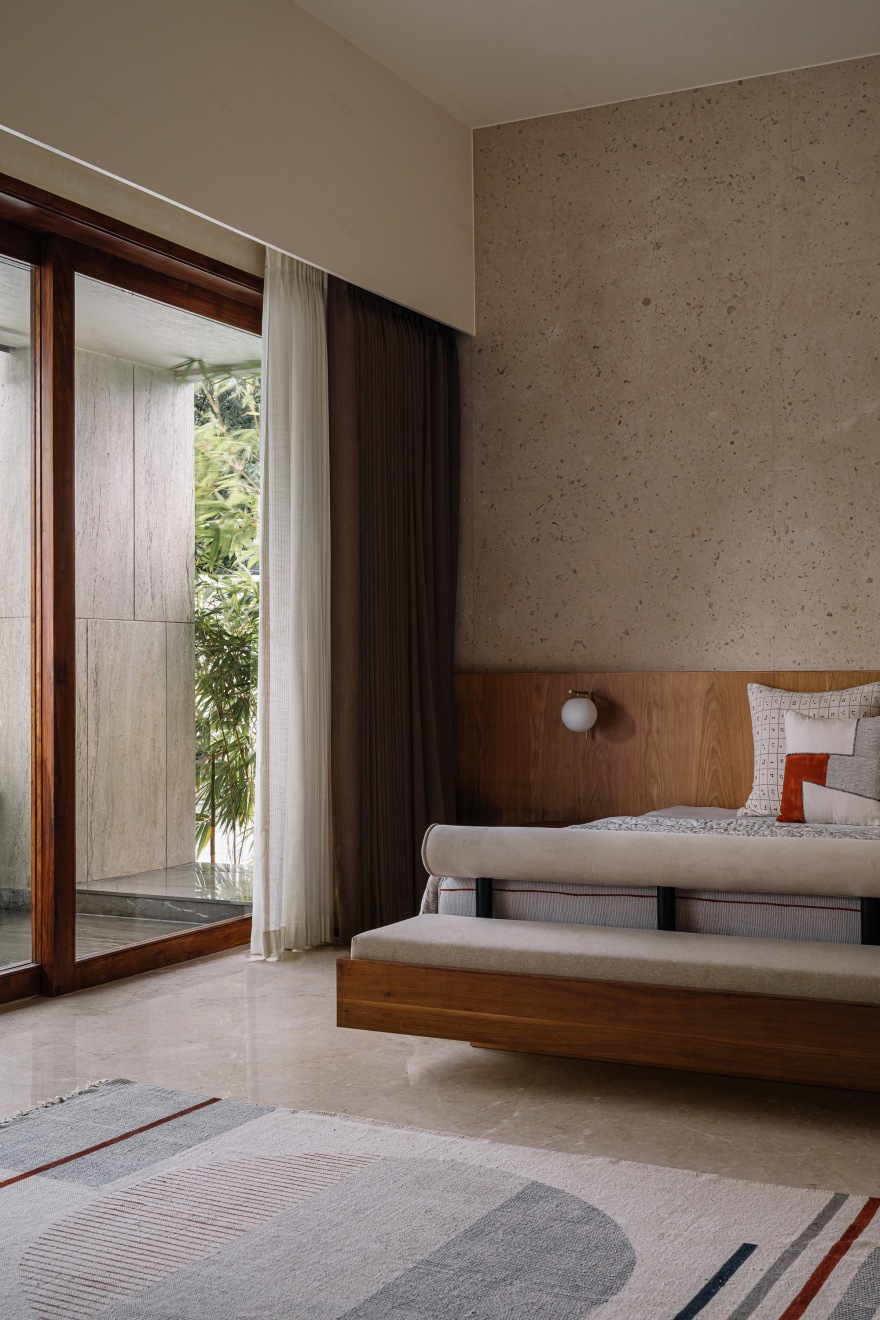
The distinction in material expression becomes more pronounced in the private spaces, where the palette shifts while maintaining the tonal harmony. This deliberate material demarcation helps define the transition from social to intimate spaces, while catering to each family member's needs and preferences. The family bedrooms, crafted as personal sanctuaries, are thoughtfully designed in complementary palettes: two featuring sophisticated grey tones and two in warm beige and a wooden palette, each with distinct wood tones that further individualise the spaces. The master bedroom features grey marble with a central Bharat Flooring cement tiles inlay—a subtle homage to the family's old home. Minimal furnishing allows the material palette to take center stage. In contrast, the mother's room is warmly dressed in oak wood panels, with a custom-designed bed and bench completing the serene atmosphere.

The daughters' room is a reflection of her distinct personality, maintaining a consistent design language while allowing for individual expression through subtle shifts in tone and material. A custom-made marble island bed anchors the room, while the grey tones of the stone finish shutters form a quiet backdrop to the space. The guest rooms each tell their own story: one features a seamlessly integrated study desk and storage solution, while another explores the grey and white palette through cast-in-situ terrazzo, with an elevated bed platform creating a striking monolithic presence. Plastered walls punctuated by lighting niches add a playful dimension to this space.

What truly defines this home isn't just its material expression and spatial choreography, but also its ability to evoke an enduring sense of belonging. From the careful exploration of materials and forms, to the thoughtful customization of interior elements: the staircase, the courtyards, high skirting line in varied expressions, and personalised touches that honour the resident's history, the design speaks to a deeper understanding of space and the human experience within it. "PBR House is about finding permanence in change, the subtle art of balancing, and grounding in openness. It is an architectural reflection of life itself," explains Kaveesha.

Project gallery







南京喵熊网络科技有限公司 苏ICP备18050492号-4知末 © 2018—2020 . All photos and trademark graphics are copyrighted by their owners.增值电信业务经营许可证(ICP)苏B2-20201444 苏公网安备 32011302321234号
苏公网安备 32011302321234号客服
消息
收藏
下载
最近