

创作上传
VIP
收藏下载
登录 | 注册有礼
查看完整案例

收藏

下载

分享
The Shepherd Arts Park: Community, Art, Play | OSD
项目陈述
PROJECT STATEMENT
Shepherd艺术公园对底特律一个人口大量流失的社区中的闲置地块进行了再生改造,使其转变为充满活力的文化交流空间。既有的社区比以往任何时候都更需要一个能够让不同年龄层人群相聚的公共场所,打破孤立与疏离的状态,重新建立联系、激发创造力并带来灵感。更新后的场地延续了原教堂作为社区精神核心的历史意义,并在此基础上塑造出一种新的公共空间形态:一个促进社交互动、艺术参与与休闲活动的社区中心,充分体现公共空间所能承载的社会与文化价值。
The Shepherd Art Park revitalizes a once-vacant 3.5-acre site in a historically depopulated Detroit neighborhood, transforming it into a dynamic cultural hub. Today, more than ever, our communities need a place for people of all ages to come together, break the cycle of isolation and loneliness, and replace it with connection, creativity, and inspiration. The newly reimagined site honors a church that once anchored the community, transforming it into a new kind of hub that facilitates the best qualities of public spaces: social interaction, art, and play.

▲黄昏鸟瞰。Dusk Aerial. © Jason Keen
项目说明
PROJECT NARRATIVE
位置
Shepherd艺术公园位于底特律Little Village片区,占地约3.5英亩。周边以年久失修的独立住宅和大量空置地块为主要特征。场地毗邻底特律河,内部保留着一座建于19世纪的罗马式教堂遗址。改造前,场地杂草丛生,外来入侵植物蔓延,其间散落着建筑废料、碎玻璃以及破损的结构残骸,整体环境荒废严重。
目标与规模
业主希望打造一个以艺术为核心、功能多元且具有强烈社区属性的文化园区。场地面临多项现实限制,包括高差难以通行、排水条件差、一条仍在使用的市政巷道,以及长期废弃带来的土壤退化与建筑遗存问题。
项目定位为助力底特律艺术复兴的重要载体,功能需求涵盖:户外艺术展区、纪念底特律艺术家Charles McGee的雕塑公园、儿童与活动空间、户外餐饮区域、公共活动场地,以及与Tony Hawk合作设计的专业滑板公园。场地内原有建筑——包括教堂、神职住宅、车库及农舍——由多家建筑团队进行适应性改造,转化为展厅、工作坊、艺术工作室及餐饮空间。
场地与环境调研
考虑到社区深厚的文化历史以及场地长期叠加形成的物质痕迹,设计团队对场地及周边社区进行了系统调研。通过影像记录材料、植被与现存结构状况,并在现场观察居民的实际使用行为。土壤检测与岩土调查显示,场地存在高含水量土层及地下建筑遗存,这些条件直接影响了总体布局以及大型装置(如雕塑)的基础设计。项目的目标并非彻底清空与重建,而是通过设计揭示并强化场地原有的历史与个性,使新建内容自然融入周边环境之中。
设计策略——功能组织与可达性
设计在整合多元功能需求的同时,强调空间的探索性与趣味性,并在尺度与氛围上呼应体量宏大的砖砌罗马式教堂。同时,项目实现了关键的场地性能目标,包括较高的透水率、无障碍通行(符合ADA标准)以及大面积乡土植物配置。
总体布局以一系列相互嵌套的户外“房间”为组织结构,每个房间承载不同活动内容。平面构成从教堂建筑形态中汲取灵感,部分空间呈现出多角的几何特征,并被赋予富有仪式感与趣味性的名称,如“中殿走廊”(Nave Alley)“艺术圣坛”(Art Altars)以及“求父宽恕”(Father Forgive Me)户外餐饮区。其中“中殿走廊”本身是一条市政通道,同时也作为社区的重要通行路径。整体动线设计旨在向周边社区开放,并在行进过程中营造逐步展开的空间体验。
设计策略——材料与植物配置
在对社区进行踏勘时,设计团队从周边环境的材料质感中发现了独特的美感。因此,项目没有回避场地的破败痕迹,而是将碎玻璃、旧砖与时间留下的痕迹转化为设计语言,通过艺术化与可持续的方式实现材料再利用。
为满足排水要求,场地大面积采用透水铺装。部分砖材来自教堂原修道院的拆除构件,经破碎处理后重新用于铺装基层。铺装中还使用了本地回收玻璃,经滚磨处理后形成圆润颗粒,既保证安全性,也呼应教堂彩色玻璃窗的历史意象。这些彩色玻璃碎石被铺设在冥想环道中,并按彩虹光谱顺序排列,象征社区作为艺术文化中心的身份。
项目还回收利用了当地风暴中倒伏的树木,并以此制作场地家具、标识与导视系统。设计团队与本地加工厂合作,将再生木材统一应用于各类构筑物,形成一致而具有地方特色的材料语言。

▲场地环境:East Village,一个历史上人口持续流失的社区。Context – East Village, A Historically Depopulated Neighborhood. © OSD

▲场地原貌:一处废弃的城市街区。Existing Conditions – An Abandoned City Block. © OSD

▲设计策略:社区导向、可达性和材料再利用。Strategy – Community, Accessibility, Material Re-use. © OSD
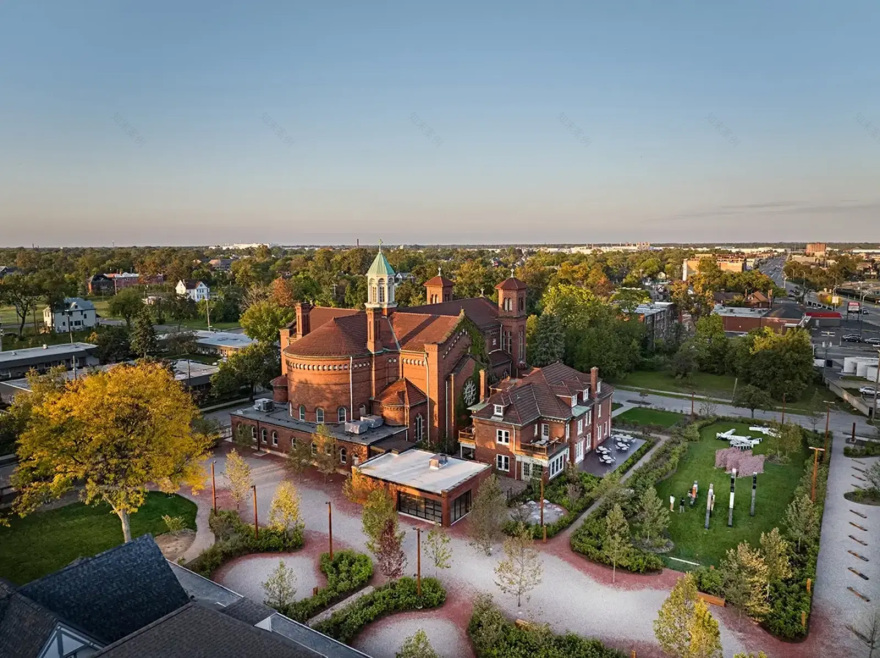
▲“中殿”黄昏鸟瞰。Dusk Aerial – The Nave. © Jason Keen

▲材料:再生砖与经过滚磨处理的玻璃,兼具可持续性与地域特色。Materials – Reclaimed Bricks & Tumbled Glass, Sustainable and Vernacular. © OSD

▲“中殿”是一条具有实际通行功能的市政巷道。“The Nave” – A Functional Municipal Alley. © Jason Keen

▲用回收木材制作的家具与标识系统。Reclaimed Wood Furnishing & Signage. © OSD

▲Charles McGee纪念雕塑公园。Charles McGee Legacy Sculpture Park. © Jason Keen

▲滑板公园与Tony Hawk合作打造。Skatepark, Tony Hawk. © OSD

▲“艺术圣坛”装置。“Art Altar” Installation. © Jason Keen

▲Charles McGee纪念雕塑公园。Charles McGee Legacy Sculpture Park. © Jason Keen

▲“中殿”与“艺术圣坛”,背景处是Shepherd教堂。“The Nave” & “Art Altar”, with Shepherd Church in background. © Jason Keen

▲总平面图。Site Plan. © OSD

▲艺术展厅入口黄昏鸟瞰。Aerial – Dusk, Art Gallery Entry. © Library Street Collective

▲平面鸟瞰。Plan Aerial. © Jason Keen
PROJECT NARRATIVE
Location
The Shepherd Art Park is a 3.5 acre block in Little Village, Detroit, characterized by decaying single-family residences and vacant lots. Close to the Detroit River, the site is home to an empty 19th c. Romanesque church. The site was overgrown with invasive plants and littered with debris, broken glass, and crumbling building materials.
Scope and Size
The client requested an arts campus with diverse program and a strong community focus. Site constraints included inaccessible grades, poor drainage, a functional municipal alleyway, and centuries of degradation and building ruins. Aimed at contributing to the city’s artistic renaissance, the client’s program requests included outdoor art galleries, a sculpture park dedicated to Detroit artist Charles McGee, play areas, outdoor F&B, events spaces, and a new skate park designed in collaboration with Tony Hawk. Existing buildings including the church, rectory, garage, and farmhouses were adaptively repurposed by multiple architectural groups into galleries, workshops, studios, and F&B spaces.
Site and context
Given the neighborhood’s unique cultural legacy and an existing palimpsest of material degradation, the team researched the site, neighborhood, and community. Photos documented materials, plants, and structures, and on-site observations noted community activity. Soil analysis and geotech investigations revealed saturated soils and buried building ruins, which informed site layout and foundation design for large elements such as sculptures. The project ambition was not to wipe the slate clean, but instead to reveal and celebrate the identity of the site and integrate the new project with its surroundings.
Design Approach
Program and Accessibility: The design integrates diverse programmatic needs; creates a sense of discovery and play; harmonizes with the vast brick Romanesque church; and achieves critical site performance goals such as a high pervious-impervious ratio, ADA accessibility, and robust native planting. The site layout is conceived as an interlocking series of outdoor “rooms” hosting the wide variety of program. The plan composition is playfully inspired by the church’s architecture. In this way, spaces hint at apsoidal geometries, and adopt names such as ‘The Nave Alley’, the “Art Altars”, and “Father Forgive Me” dining area. The Nave is a municipal alleyway doubling as a neighborhood thoroughfare.Circulation is laid out to invite the broader neighborhood and create a sense of discovery.
Design Approach
Materials and Planting: Walking around the neighborhood, the team found great beauty in materials and textures. The design team chose to embrace the story of the site, celebrate the broken glass, brick, and decay, and explore an artful and sustainable approach to material reuse. To achieve drainage requirements, porous paving is used extensively. Bricks were salvaged from the church’s decaying nunnery, then crushed and integrated with the site’s paving. Local recycled glass—tumbled and rounded—was used in the paving, paying homage to the church’s stained glass windows. The glass gravel is placed in the meditation loop, following the logic of a ROYGBIV color wheel, referencing the identity of the community as an arts hub. Wood was salvaged from local trees downed during storms. For the project, the team designed furniture, signage, and wayfinding, using the reclaimed wood, and working with a local fabricator, creating a unified material vocabulary.
南京喵熊网络科技有限公司 苏ICP备18050492号-4知末 © 2018—2020 . All photos and trademark graphics are copyrighted by their owners.增值电信业务经营许可证(ICP)苏B2-20201444 苏公网安备 32011302321234号
苏公网安备 32011302321234号客服
消息
收藏
下载
最近