

创作上传
VIP
收藏下载
登录 | 注册有礼
查看完整案例

收藏

下载

分享
Limbo Museum与Art Omi合作,荣幸呈现由建筑师Juergen Benson-Strohmayer领衔的TAELON7创作的场地特定装置《Limbo Engawa》。该项目将于2026年3月12日在Accra开幕。这一项目代表了非洲的一项开创性实践:通过跨洲机构合作,委托一位重要建筑师探索公共参与、空间实践与城市转型之间的关系。
Limbo Museum, in partnership with Art Omi, is proud to present Limbo Engawa, a two-part site-specific installation by TAELON7, led by architect Juergen Benson-Strohmayer, opening
March 12th, 2026 in Accra. This project represents a pioneering initiative in Africa that commissions a leading architect to explore public engagement, spatial practice, and urban transformation through a transcontinental institutional partnership.
▼装置概览,overview of the installation© Edem Tamakloe

▼装置概览,overview of the installation© Edem Tamakloe


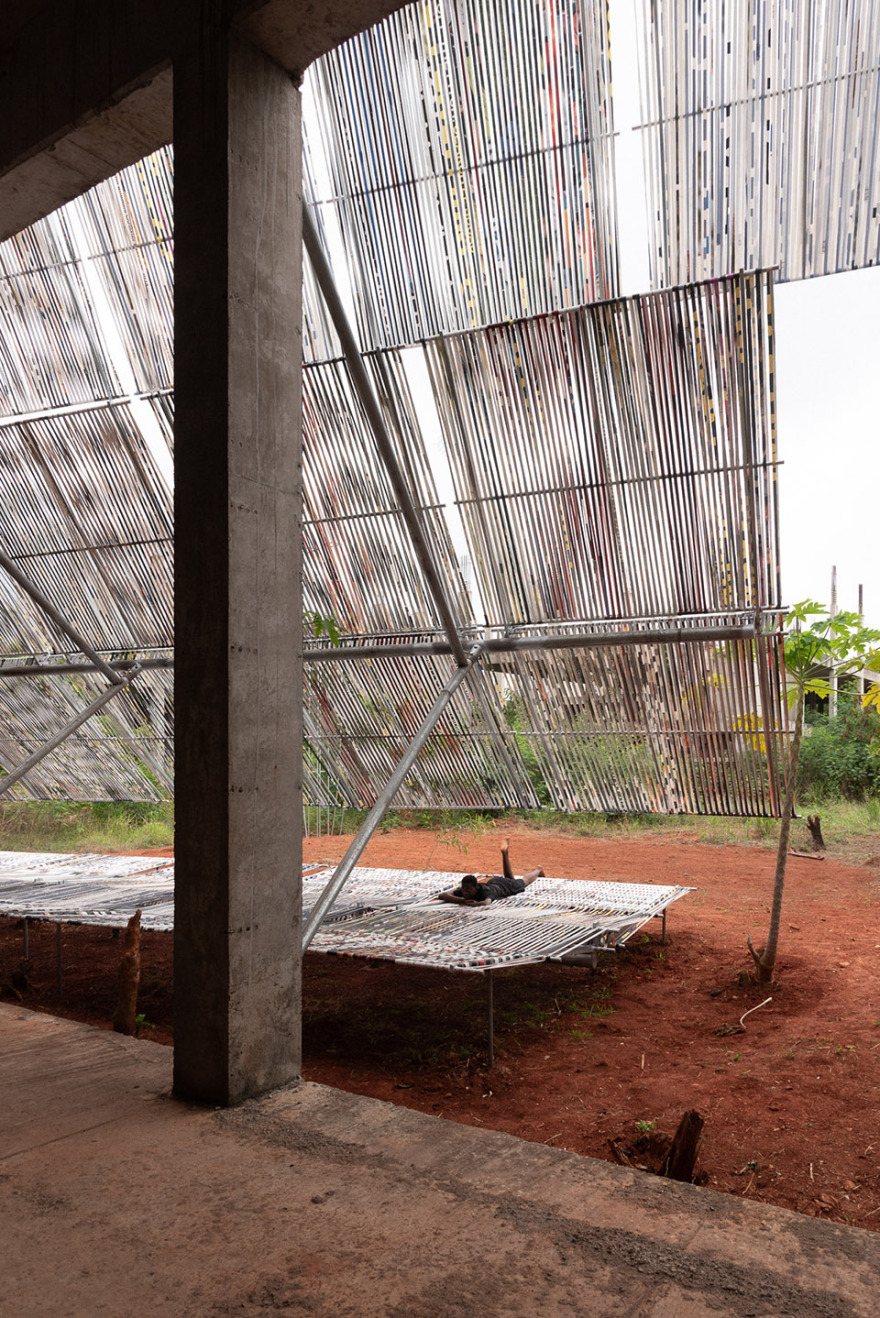
在Limbo Museum,《Limbo Engawa》重新想象未完成城市建筑与周边景观之间的边界,将博物馆尚未完工的混凝土骨架结构及其周边环境转化为可被使用、照料与相遇的空间。在快速城市化的背景下,未完工建筑常被视为被遗弃之物,其周边土地也常被忽视为“剩余空间”。该装置对此提出挑战,构建出一个让城市形态、日常劳动与公共生活彼此交汇的场所。
At Limbo Museum, Limbo Engawa reimagines the boundaries between unfinished urban architecture and the surrounding landscape, transforming the skeletal concrete structure of the museum and its surrounding landscape into spaces for use, care and encounter. In rapidly urbanizing cities, incomplete buildings are often seen as abandoned, while surrounding land is dismissed as leftover. This installation challenges those assumptions, creating a setting where urban form, everyday labor and civic life intersect.
▼构建出一个日常劳动与公共生活彼此交汇的场所,
creating a setting where urban form, everyday labor and civic life intersect © Edem Tamakloe


作品名称源自日语“engawa”,意指介于室内与室外、私人与公共之间的过渡空间。在阿克拉当代城市语境中,《Limbo Engawa》通过以人为尺度的介入方式,对这一概念进行转译,在宏大的未完成结构与其周边正在被积极耕作的土地之间建立起调和关系。
The work takes its name from the Japanese term engawa, describing transitional zones between interior and exterior, private and communal space. In the contemporary urban context of Accra, Limbo Engawa interprets this concept through human-scaled interventions that mediate between large, unfinished structures and the active cultivation of the land around them.
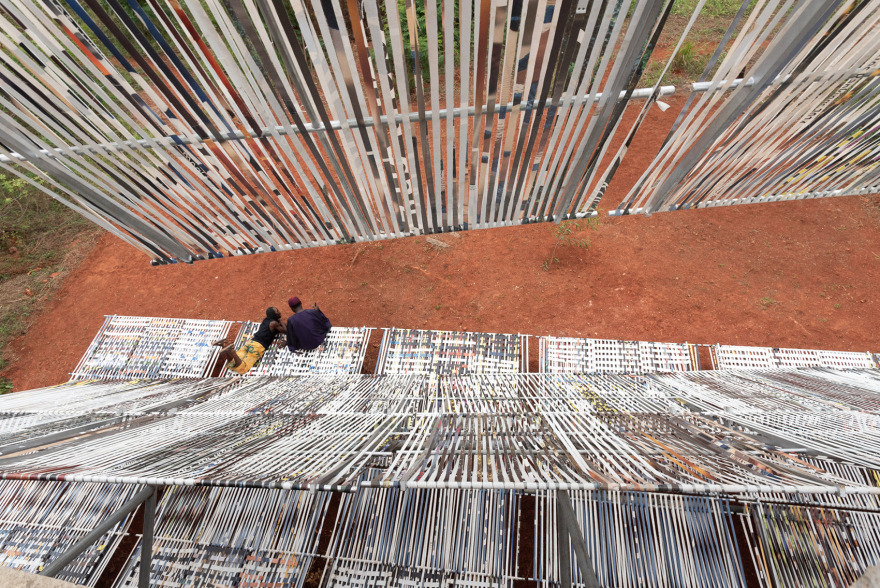
▼装置鸟瞰,aerial view of the installation © Juergen Benson-Strohmayer

▼装置鸟瞰,aerial view of the installation © Juergen Benson-Strohmayer

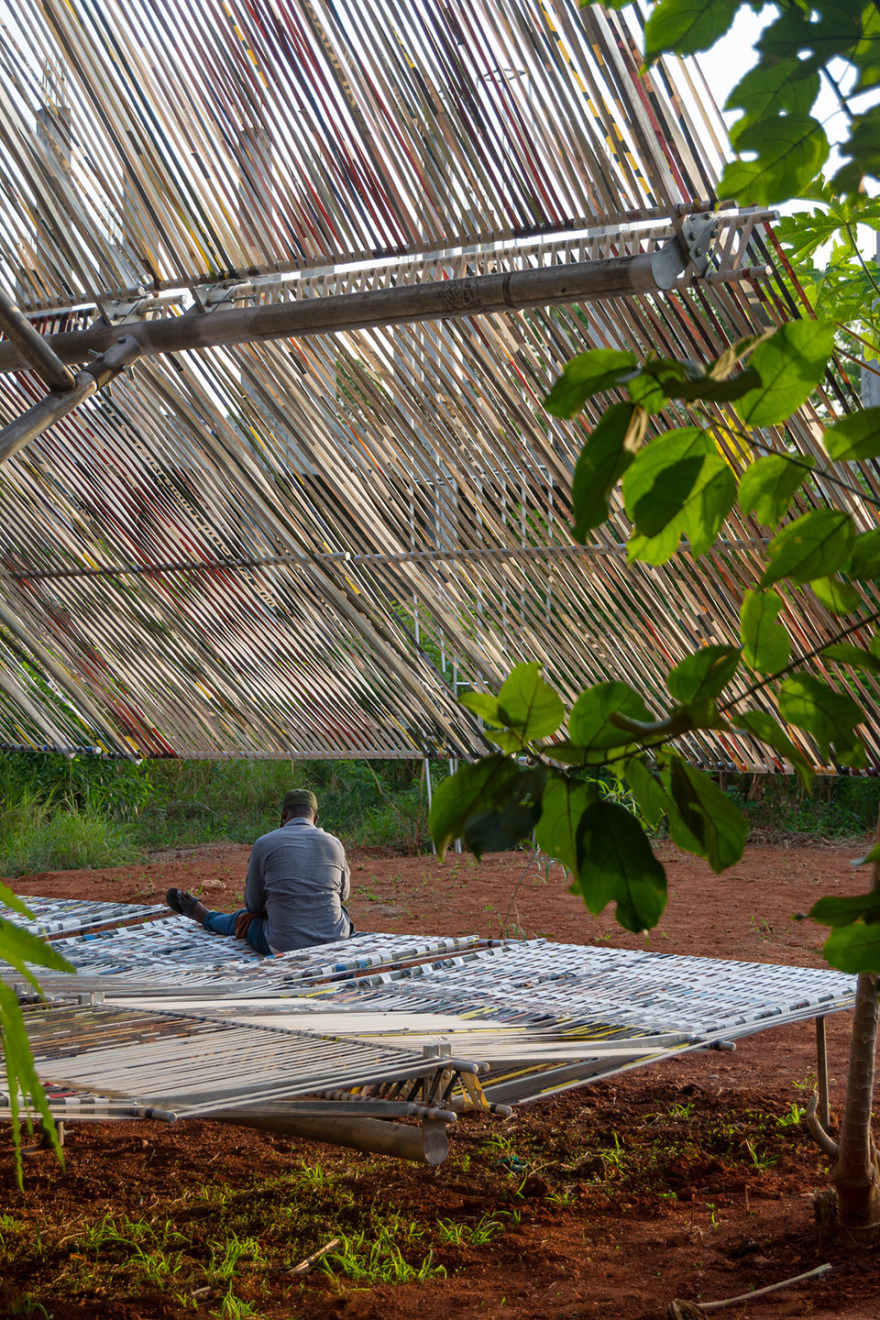
装置由模块化、轻量化的构件组成,可在现场搬运与组装。放大尺度的日床灵感来源于未完工建筑中常见的编织床具,既提供遮荫与经过过滤的视野,也为坐卧与停留创造空间,从而促进农民、看护者与博物馆访客之间的互动。材料包括钢型材以及回收的广告布条,经编织后构成框架,将在地建造方式与可持续、可适应的设计策略相结合。
The installation features modular, lightweight components that can be carried and assembled on site. Oversized daybeds, inspired by woven beds commonly used within unfinished buildings, provide shade, filtered views, and spaces for sitting or lying down, fostering interaction among farmers, caretakers, and museum visitors. Materials include steel profiles and salvaged billboard strips woven into frames, blending local construction techniques with sustainable, adaptable design strategies.
▼灵感来源于未完工建筑中常见的编织床具,
inspired by woven beds commonly used within unfinished buildings © Juergen Benson-Strohmayer

▼为坐卧与停留创造空间,
provide spaces for sitting or lying down © Juergen Benson-Strohmayer


《Limbo Engawa》并非一个固定的物件,而是一种基础设施式的姿态——临时、可移动且开放——展示了建筑如何在这些“悬置”(limbo)状态的空间中支持居住、照料与社区交流。它强调了在城市与机构语境中常被忽视的劳动与维护行为,指出即便是不完整或被忽略的场地,同样蕴含着公共性的潜力。
Rather than presenting a fixed object, Limbo Engawa operates as an infrastructural gesture—temporary, mobile, and open-ended—demonstrating how architecture can support habitation, care, and community exchange within spaces that exist, literally, in limbo. It foregrounds the labor and stewardship often invisible in both urban and institutional contexts, asserting that even incomplete or overlooked sites are vessels of civic possibility.
▼灵感来源于未完工建筑中常见的编织床具,inspired by woven beds commonly used within unfinished buildings © Juergen Benson-Strohmayer


▼一种基础设施式的姿态,an infrastructural gesture © Juergen Benson-Strohmayer


▼为坐卧与停留创造空间,
provide spaces for sitting or lying down © Juergen Benson-Strohmayer


当项目于2026年秋季在Art Omi呈现时,将经历第二次建筑转化:脱离原有依附结构,成为一个独立的景观亭。装置置于Art Omi开阔的场地之中,框景地平线、天气与季节变化,营造出一个在美国乡村语境中产生全新意义的遮荫聚集空间。阿克拉与纽约州北部的两处装置,共同构成对“engawa”的平行而又差异化的诠释。《Limbo Engawa》不再是一个单一场地的迁移作品,而成为一场由两部分组成的建筑对话——检验模块化与可重复使用系统如何在不同气候、尺度与文化条件中进行调适。
At Art Omi, where it will be installed in Fall 2026, the project undergoes a second architecturaltransformation: detached from a host structure, it becomes a freestanding landscape pavilion. Installed within Art Omi’s open fields, it frames horizon, weather, and seasonal change, creating a shaded gathering space that resonates differently within a rural American context. Together, the installations in Accra and Upstate New York operate as parallel yet distinct interpretations of engawa. Rather than a single site-specific work that travels, Limbo Engawa becomes a two-part architectural dialogue—testing how modular, reusable systems can recalibrate across climates, scales, and cultural conditions.
▼展览空间,exhibition space © Edem Tamakloe

▼展览空间,exhibition space © Edem Tamakloe


Limbo Museum与Art Omi之间的跨洲合作,体现了双方对激活被忽视与过渡性空间的共同承诺,强调劳动与公共照料的重要性,并将建筑与艺术视为跨越大陆展开实验、促进社区参与与文化对话的媒介。
This transcontinental partnership between Limbo Museum and Art Omi reflects a shared commitment to activating overlooked and transitional spaces, foregrounding labor and civic care, and positioning architecture and art as tools for experimentation, community engagement, and cultural dialogue across continents.
▼轴测图,axonometric © TAELON7

▼剖透图,perspective section © TAELON7




南京喵熊网络科技有限公司 苏ICP备18050492号-4知末 © 2018—2020 . All photos and trademark graphics are copyrighted by their owners.增值电信业务经营许可证(ICP)苏B2-20201444 苏公网安备 32011302321234号
苏公网安备 32011302321234号客服
消息
收藏
下载
最近