

创作上传
VIP
收藏下载
登录 | 注册有礼
查看完整案例

收藏

下载

分享

翻译
Architects:ENDO SHOJIRO DESIGN,td-Atelier
Area:150m²
Year:2025
Photographs:Kohei Matsumura
Manufacturers:IRIS OHYAMA,Panasonic,Sanei,Toto,toolbox
Lead Architects:Masaharu Tada, Shojiro Endo
Category:Houses,Renovation
Design Team:Ayane Abe
Landscape Architecture:Michikusa,co.Ltd.
City:Kyoto
Country:Japan

Text description provided by the architects. This project is the renovation of a traditional house located in Iwakura, in the northern part of Kyoto City. Although its exact origin is unclear, it is presumed to be a farmhouse built in the Meiji period. According to archival research, the building conforms to the typology of the "Iwakura-type minka (folk house)." This regional house type is characterized by a linear doma (earthen-floored passage) running north–south, with rooms arranged alongside it, and by a robust timber beam structure. The building is therefore considered to date from the late Edo to the Meiji period. Further investigation, including registry records and architectural surveys, revealed that extensions and alterations were carried out in the 1970s.

In response, the project treats the house's historical layers as a key design resource. The strategy is to retain the formal characteristics of the Iwakura-type minka, to restore lost elements, and to preserve those parts of the 1970s renovations that still contribute to the spatial organization. New interventions are then inserted between these different temporal layers, carefully superimposing them into a coherent whole.

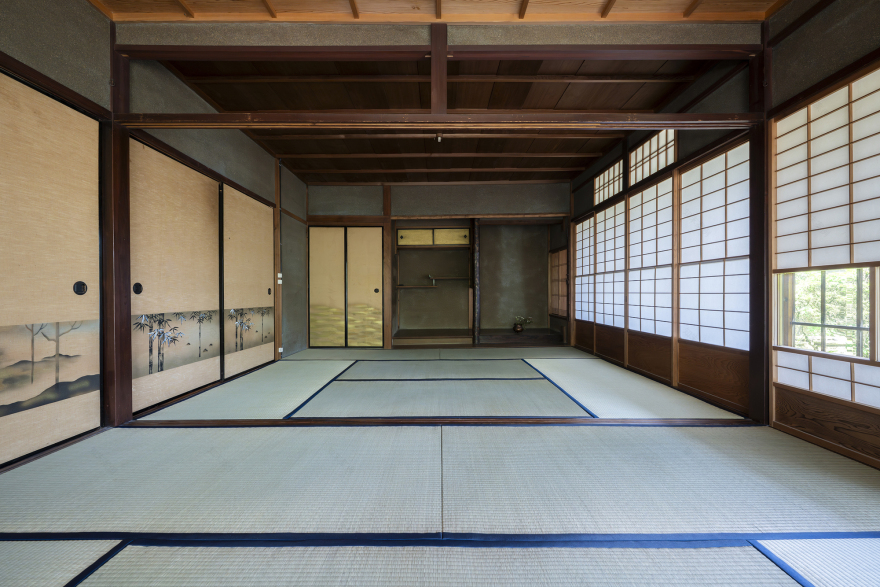
The new residents are a family consisting of a couple in their thirties and one child. In the design process, the Japanese-style rooms—key features of the traditional house—were minimally altered and primarily repaired, while the renovation focused on upgrading the kitchen and wet areas organized around the central doma.


The doma, which once ran through the house from north to south, had been replaced during the 1970s renovation with printed plywood flooring. In this project, it is restored as an earthen floor, with thermal insulation improvements applied to the surrounding areas. Within the expansive doma, three small volumes are inserted so that they gently extend into the space. This configuration introduces a range of scales and places within the otherwise continuous interior.
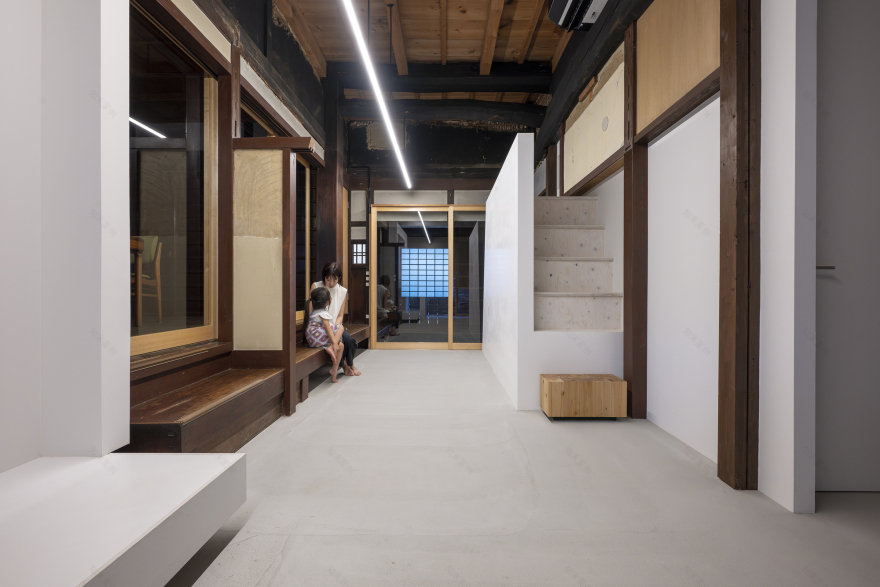

One of these, called the "observation platform," is an indeterminate space without a fixed function. It serves as a play area for the child while also allowing close proximity to the existing beams, and by slightly lifting the body off the ground, it creates a new vantage point within the house.

Rather than adopting a conventional renovation approach that strips the building to a skeleton and inserts entirely new functions, this project seeks to interpret the underlying "type" of the traditional house. By making minimal yet precise interventions in accordance with its spatial and structural logic, the existing environment is carefully tuned to support contemporary living.
Project gallery



南京喵熊网络科技有限公司 苏ICP备18050492号-4知末 © 2018—2020 . All photos and trademark graphics are copyrighted by their owners.增值电信业务经营许可证(ICP)苏B2-20201444 苏公网安备 32011302321234号
苏公网安备 32011302321234号客服
消息
收藏
下载
最近