

创作上传
VIP
收藏下载
登录 | 注册有礼
查看完整案例

收藏

下载

分享

翻译
Architects:The Purple Ink Studio
Area:11000m²
Year:2026
Photographs:Saurabh Suryan,Stories of Kunju, Advait Vinod
Category:Pavilion
Project Team:Akshay Heranjal, Arpita Pai , Aditi Pai, Nishita Bhatia, Jaikumar, Aravind Vankadaru , Priyanka Joshi, Nivya Joseph, Santhan Kerlepalli, Prajakta Barve, Swaraj Jadhao, Jaival Kansara, Mrunalni Vijay, Aziz Rajani, Janav Parekh, Siddharth Waze, Babitha Yeldho
Partner In Structure Execution:Nirmiti Collective
Installation & Execution:Pandal Planners
Program Lead And Functional Operators:Sandbox Collective, Seagull books, DC books, Sanskriti Bist (Berlin kitchen), Atelier Prati (Printing studio), On the jungle floor (Vinyl- listening room)
Client:Goethe Institute
City:Bengaluru
Country:India

Text description provided by the architects. For the past nine years, the city of Kozhikode has come together to celebrate the Kerala Literature Festival (KLF). The festival unfolds across four days against the dramatic backdrop of the Arabian Sea. KLF draws over 5 lakh visitors, transforming the coastline into a vibrant cultural landscape. With Germany being the guest nation this year, it opened a unique opportunity to reimagine the deep-rooted relationship between Germany and Kerala.


Origins and Exchange – Challenging the notion of the pavilion as fleeting, we turned towards the roots, to the early beginnings of Indo-German connections. Tracing the path of arrival of the Basel missionaries in Calicut in 1830, we return to a moment that initiated this relationship. Following this were a series of transformative engagements with the Commonwealth tile and textile factories and the literary contributions of German scholar Hermann Gundert. These stories of craft, knowledge exchange, and transition that the city and its culture underwent became the conceptual anchors for the pavilion.
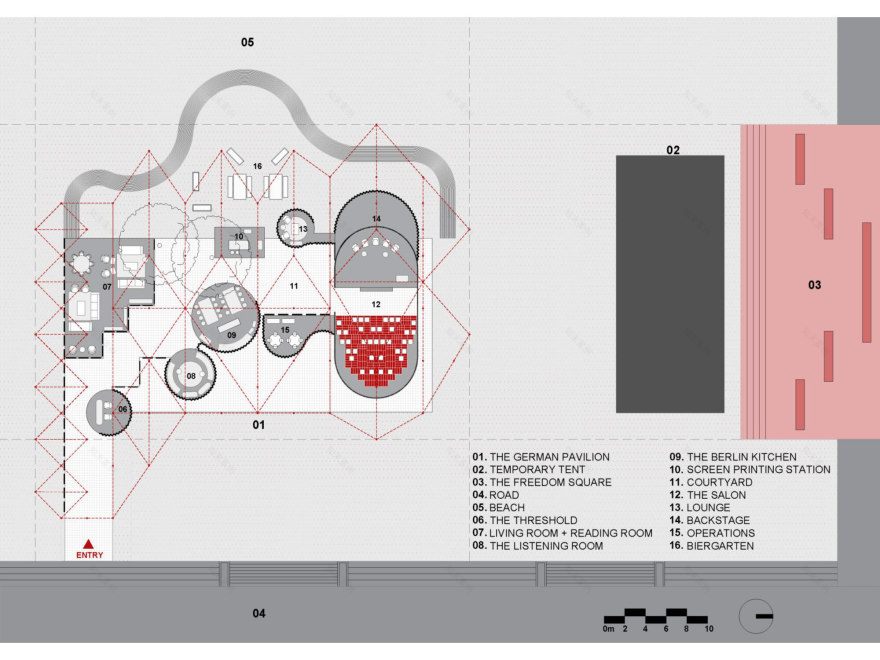

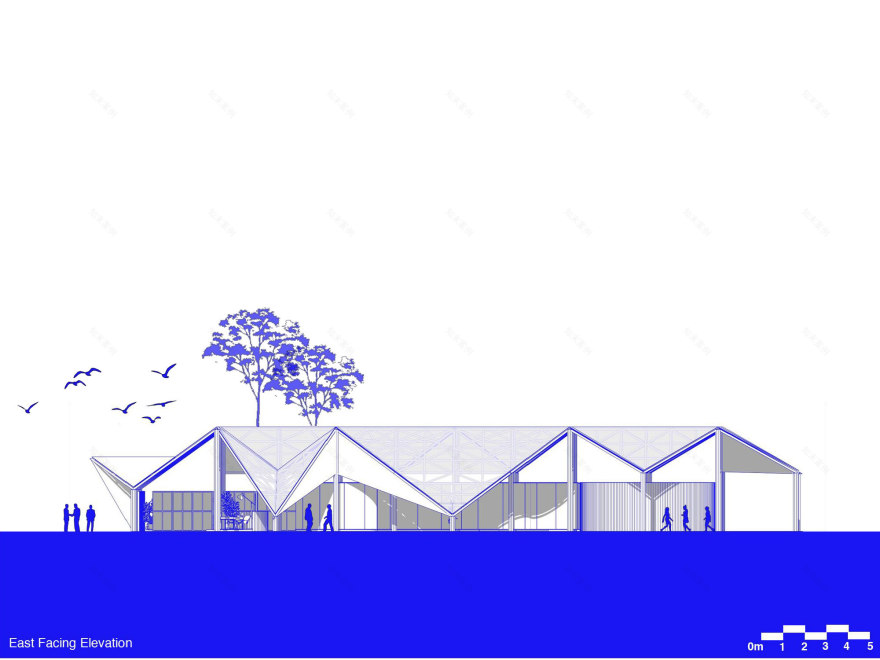
Reimagining the Pavilion – With memory becoming the form, we reimagined the pavilion to be a temporal home by the beach — a space that holds stories, craft, and moments in quiet continuity. The contrast between the ephemerality of the pavilion and the enduring elegance of a home lends the space a sense of warmth and familiarity within the vibrant intensity of the festival. Drawing from the geometry of the sail, the pavilion unfolds through angled planes responding to the openness of the beachfront. The warmth of Kerala homes is reflected in the pavilion through an imaginative coming together of movement, memory, and shelter.


Craft as Culture – Locally sourced bamboo forms the primary structural layer of the pavilion. The soft partitions with rope screens (woven cotton ropes in 'Plaine weave' technique), korra fabric (Calico cloth drapes), terracotta floor tiles, and Woven paaya (dried grass mats) form the roof covering. These are heavily rooted in the historic past of the Commonwealth Weaving Factory and the Commonwealth Tile Factory, set up by the Basel Mission in Kozhikode. Each layer was assembled through local skill, always allowing the natural form to come through. The materials allowed the pavilion to be constructed in a very small time frame on a sand bed by the beach, while also ensuring that most of the materials have a thoughtful afterlife.

Memory to Matter – The pavilion translates memory into space, an encounter into remembrance, and remembrance into a lived experience.

Project gallery


南京喵熊网络科技有限公司 苏ICP备18050492号-4知末 © 2018—2020 . All photos and trademark graphics are copyrighted by their owners.增值电信业务经营许可证(ICP)苏B2-20201444 苏公网安备 32011302321234号
苏公网安备 32011302321234号客服
消息
收藏
下载
最近