

创作上传
VIP
收藏下载
登录 | 注册有礼
查看完整案例

收藏

下载

分享

翻译
Firm: KPLN
Type: Transport + Infrastructure › Airport
STATUS: Concept
SIZE: 300,000 sqft - 500,000 sqft
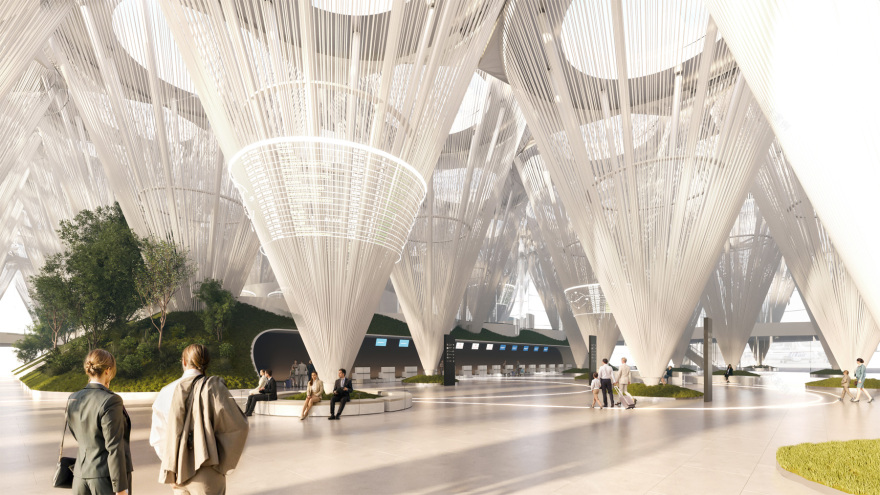
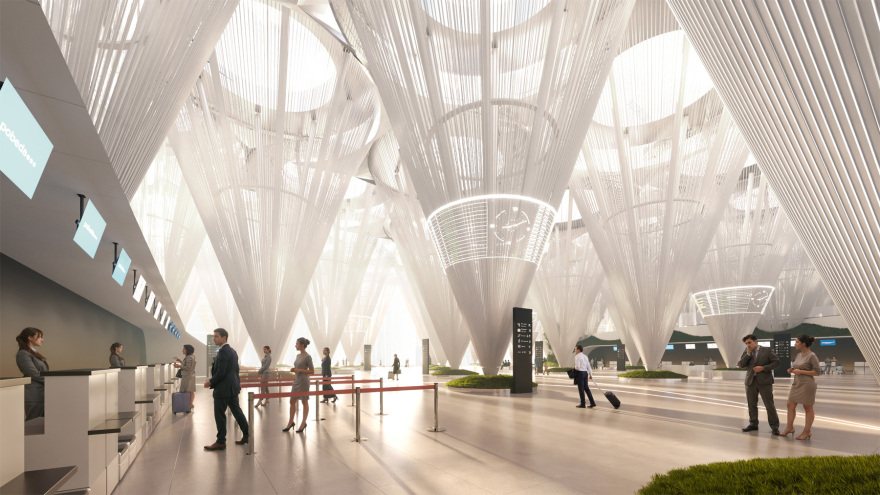
The image of Omsk Airport in the project by architectural bureau KPLN refers to the city’s history while rethinking the idea of a fortress as an open aerial harbor. The metaphor is realized through a system of inverted cones and light lanterns — visually and conceptually reflecting the idea of protection, transformed into a modern symbol of connection and movement.
The idea of the ostrog as a "guardian of the steppe" underpins the concept: inverted‑cone volumes and a mirrored reminiscence allude to the traditional fence of a Russian wooden fortress. At the same time, the defensive symbol becomes a “gateway” that opens many routes and directions — from aviation and rail to urban infrastructure.
“We took the historical archetype of the fortress and reinterpreted its image — not to ‘open’ the city: the cones became supports of light and orienting elements of movement. This is an airport that invites travel through space and historical time,” says Sergey Nikeshkin, co‑founder and partner of architectural bureau KPLN.
Light lanterns
Gigantic inverted cones — modular supports of the terminal, assembled from steel columns and thin cables — form a hypostyle “forest” of conical columns. At the top of each cone is a light lantern that pours daylight into the volumes and turns the conical elements into illuminated sculptural objects in the evening. The structure is conceived as transparent and energy‑efficient: natural lighting reduces the need for artificial illumination.
Winter garden and passenger experience
The central interior element is a winter garden, recalling the kitchen garden inside the ostrog where provisions were kept during a siege. The winter garden’s planted area is 1,687 m2 and can accommodate more than 25 species of distinctive trees. The space is organized around the cone supports: benches and green berms are planned at their bases, and the cone surfaces can host light projections and scenographic solutions that create dynamic visual effects.
Technology and sustainability
A system of 128 light lanterns, each glazed area approximately 18 m2, provides intensive daylighting of key spaces, saving energy and improving indoor comfort and air quality. The terminal’s two‑level layout reduces the need for escalators and lifts, simplifies wayfinding and makes passenger movement more intuitive.
The new airport location (15 km from the city boundary, 27 km from the city center) addresses problems of the existing aerodrome, which limits development of the city center and creates operational risks and noise pollution affecting over 10,000 ha. The terminal connects directly to the railway station via a covered bridge; within walking distance is a partially hidden parking facility whose green canopy functions as a station plaza.
Lead Architects: Sergey Nikeshkin
Author's team of architects: Sergey Nikeshkin, Ruslan Shotaev, Guzel Ibragimova, Daniil Zotov, Alina Boldina, Nina Grinko, Vladislav Rylko
Footprint: 27 452 m2
Gross floor area: 35 000 m2
Building volume: 565 948 m3
Jet bridges: 7
Parking spaces: 1,000
Location: Omsk, Russia






南京喵熊网络科技有限公司 苏ICP备18050492号-4知末 © 2018—2020 . All photos and trademark graphics are copyrighted by their owners.增值电信业务经营许可证(ICP)苏B2-20201444 苏公网安备 32011302321234号
苏公网安备 32011302321234号客服
消息
收藏
下载
最近