

创作上传
VIP
收藏下载
登录 | 注册有礼
查看完整案例

收藏

下载

分享

翻译

The 19-kilometre metro Line 5 – Eglinton has opened in Toronto, with 15 underground stations integrated into the urban landscape of the city's Midtown section.
Though it faced multiple delays and settlements between municipal groups, engineers and designers, the Line 5 LRT system opened in February, with riders entering the 25 total stations.
It connects multiple train lines and provides cross-town access for the growing population of this peripheral zone.

Toronto's Line 5 transit line has opened
The stations, which present the most visible aspect of the new line, feature a design led by design and engineering outfit Arcadis and AtkinsRéalis, alongside studios Daoust Lestage Lizotte Stecker, NORR, and Dialog.
While 10 stations are aboveground, each of the fifteen stations leading into the underground fits into a specific typology: corner, embedded or pavilion.
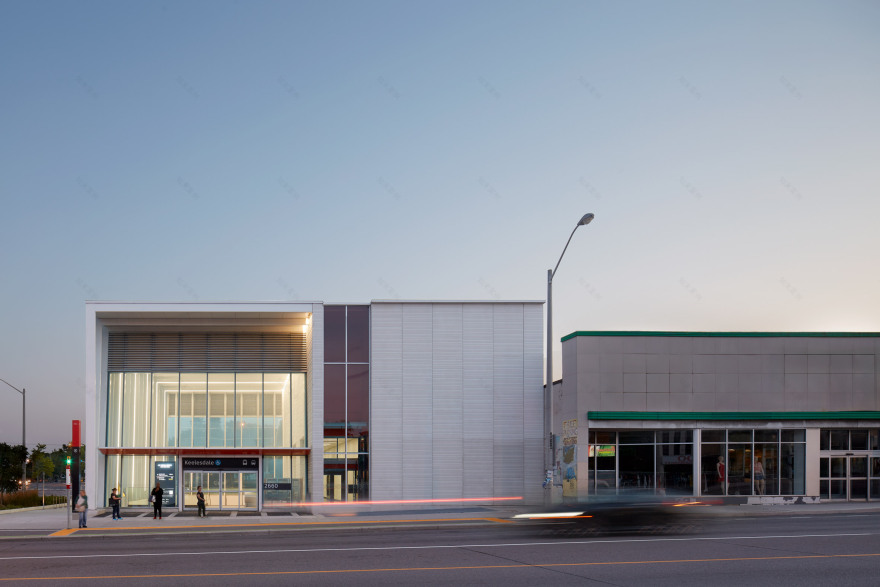
It features 15 underground stations designed by a team led by Arcadis and AtkinsRéalis
For example, the function of the Embedded Station is to integrate directly into the infrastructure, with slabs strong enough to support building overhead and at other points, modular wall structures to be integrated into adjacent buildings.
Though their functions differ, Arcadis lead designer Lisa D'Abbondanza said that the stations were meant to have a unified visual identity – light-filled during the day and glowing beacons at night.
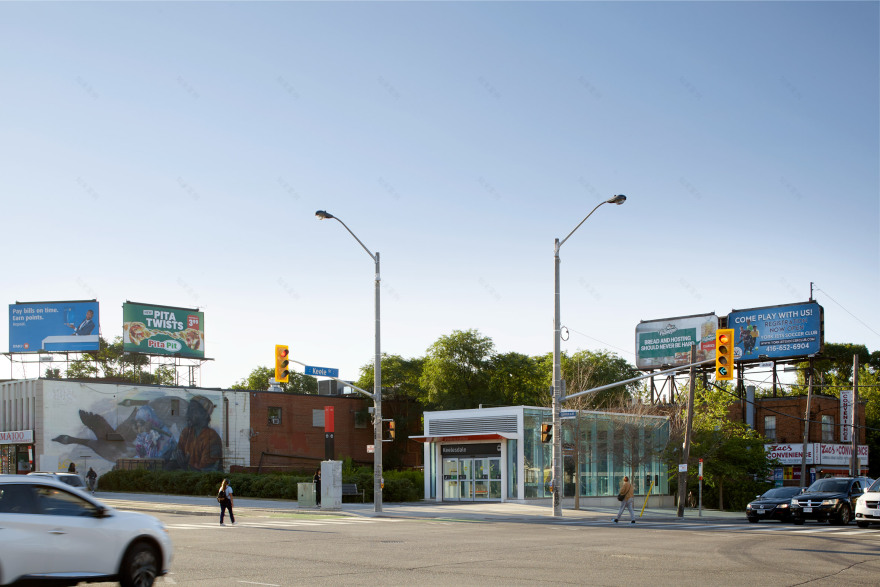
Different typologies allowed for different integration into the streetscape
"Every element was designed for intuitive, connected journeys and addressing the needs of the city, the neighbourhood, and the individual," D'Abbondanza told Dezeen.
"These typologies strengthen each neighbourhood, but maintain a unified architectural language throughout."

Most of the station entries are glass pavilions to filter light in. Photo by Arcadis/AtkinsRéalis
Though the project's opening was delayed by as much as six years, it features one of the longest underground metro lines to be completed in Canada or the United States, not including extensions, in the 21st century. It matches Vancouver's 2009 Canada Line, though Line 5 has one more kilometre underground.
In other urban cores such as Chicago, New York and Montreal, the latest efforts to build new subway lines were made in the 1980s, if not earlier.
"We needed a lot of transit because we hadn't been building transit in Toronto for a long time," said D'Abbondanza, who noted the last major push in the city was in the 1950s.

The team created wide open spaces with intuitive wayfinding
Toronto is the fastest-growing city in Canada and the United States, and the project was initiated in the 2000s, with construction starting in 2011.
An initial design programme was put together by Metrolinx with support from Canadian architecture studio Gh3*
Several engineering innovations were brought to bear on the project, including a sequential excavation method, some top-down construction to maintain traffic flow, and the strategic use of shotcrete, sprayable concrete, to eliminate the need for formwork.

At night, the stations were designed to be beacons
At one point in the line, a historic 500-tonne structure used as an amenities building by film company Kodak was pushed back from the street to make room for the Mount Dennis Station. It will now become a community centre.
The use of multiple different typologies allowed for multiple interventions at the community level, according to D'Abbondanza, who said that in some cases, the stations actually added outdoor community space, such as plazas and bike shelters.
Even some of the larger underground platforms were conceived as plazas. These undergrounds were given modern ventilation systems that allow them to "breathe".
"We always try to focus on clearing away the functional and bringing in large amounts of space so that we can reclaim the underground environment
as really a dynamic public realm," said D'Abbondanza.

Park spaces and bike shelters were built into some of the stations. Photo by Arcadis/AtkinsRealis
For some of the functional above-ground areas, such as mechanical systems, murals were painted. And the wayfinding and furniture for much of the system was rendered in an orange colour.
For the LRT aboveground portions, D'Abbondanza said the first green tracks – porous planted areas underneath the track – in Canada were utilised.
Overall, she said that the line will transform the experience of the city, and cut down on trips, reducing exchanges, especially to the airport.
"It will have a transformative effect on the city and each neighbourhood over time," she concluded.

The aboveground portion features Canada's first greenrail. Photo by Arcadis/AtkinsRealis
Other recent news in mass transit includes a series of stations designed by Foster + Partners and others for California's long-delayed high-speed rail line.
Meanwhile, in the United Kingdom, RIBA president Chris Williamson has designed a speculative elevated high-speed railway line that would connect Northern England, Wales, Scotland, Northern Ireland and Ireland.
The photography is by A-Frame unless otherwise stated.
Project credits:
Client: Infrastructure Ontario and Metrolinx
Constructors: Crosslinx Transit Solutions– EllisDon, Aecon, FlatironDragados Canada and AtkinsRéalis
Design and engineering lead: AtkinsRéalis and Arcadis
Architecture: Arcadis (Lead), Daoust Lestage Lizotte Stecker, NORR, DIALOG
Urban design: Arcadis (Lead), Daoust Lestage Lizotte Stecker
Landscape architecture: Arcadis
Design excellence: Daoust Lestage Lizotte Stecker (Lead), Arcadis
Structural engineering: AtkinsRéalis (Lead), Arcadis, LEA, Entuitive, RJC, Dr. Sauer & Partners
Mechanical engineering: AtkinsRéalis (Lead), Arcadis, HHAngus
Electrical engineering: AtkinsRéalis (Lead), Arcadis, HH Angus
Civil engineering: AtkinsRéalis (Lead), Arcadis, LEA
Utilities engineering: AtkinsRéalis (Lead), Arcadis, LEA, AUE, DPM Energy, Utility Solutions Corporation, Telecon
Geotechnical: AtkinsRealis (Lead), Thurber Engineering Ltd
Transportation engineering: Arcadis (Lead), AtkinsRéalis
Systems engineering and systems integration: AtkinsRéalis
Building code & fire safety engineering: Jensen Hughes
Interior design: Arcadis Public
Lighting: Total Lighting Solutions
Signage & wayfinding: EntroCommunications
Pedestrian modelling: AtkinsRéalis(Lead), Jensen Hughes
Vertical transportation: KJA Consultants
Universal design: DesignABLEEnvironments (Lead), Arcadis Crime Prevention Through Environmental Design:RHEA
Visualisation: Arcadis (Lead), Norm Li
Art consultant: Curio Art Consultancy
Heritage conservation: Richard Unterman
LEED/sustainability: Green Reason
Microclimate analysis: RWDI Consulting Engineers and Scientists
Noise and vibration: J.E. Coulter Associates, ATS
Operation/LRT modelling: AtkinsRéalis
Specifications: DGS Consulting Services(Lead), AtkinsRéalis, Arcadis
Hydrogeology: AtkinsRéalis
Corrosion control: APE
南京喵熊网络科技有限公司 苏ICP备18050492号-4知末 © 2018—2020 . All photos and trademark graphics are copyrighted by their owners.增值电信业务经营许可证(ICP)苏B2-20201444 苏公网安备 32011302321234号
苏公网安备 32011302321234号客服
消息
收藏
下载
最近