

创作上传
VIP
收藏下载
登录 | 注册有礼
查看完整案例

收藏

下载

分享
南海大沥曾是一座典型的珠三角产业型城镇,奔跑在快速发展的高速公路上,忽视了对有温度的城市多元公共生活的关注。随着南海区千灯湖城市轴线北延,这座城市正式开启从工业向宜居的转型,在密集城区中挖掘更多的公共空间,打造更多的公园。
Dali in Nanhai District was once a typical industrial town in the Pearl River Delta. As it raced along the fast track of development, it neglected the nurturing of diverse and human-centered urban public life. With the northward extension of the Qiandeng Lake city axis in Nanhai District, Dali has officially embarked on a transformation from an industrial town to a livable urban environment, unlocking more public space and creating new parks within its dense urban fabric.
▼从“一朵云”生长出来的屋顶,Roofs Evolving from “A Wisp of Cloud” ©吴嗣铭

▼顶视图,top view©吴嗣铭

本案坐落于花地河畔,沿河一线,地理位置优越,从属于盐步老龙1432片区。该区域历史上曾经是“省佛通衢”的交通要道。如同盐步直街、盐步酒厂、三圈火柴厂等一系列承载着盐步商贸文化的老地标,永平仓也因商贸往来、航运交通而生。随着时代的发展,它逐渐失去旧有功能,闲置废弃,却占据了城市滨水最优质的景观活动空间。
This project enjoys a prime riverside location along the Huadi River, within the Yanbu Old Dragon 1432 Zone. Historically, the area was a vital transport artery known as the Guangzhou-Foshan thoroughfare. Like Yanbu Zhijie Street, Yanbu Distillery, Sanquan Match Factory and other historic landmarks embodying Yanbu’s commercial heritage, Yongping Warehouses emerged from regional trade and river shipping activities. Over time, they gradually became obsolete and derelict, but still command the city’s most valuable waterfront landscape and public activity space.
▼盐步老龙1432片区系列改造(一旧云公园与盐步酒厂的关系),Urban Renewal Projects of Yanbu Old Dragon 1432 Zone (Spatial Relationship between Yat Gau Wan Park and Yanbu Distillery) © 竖梁社
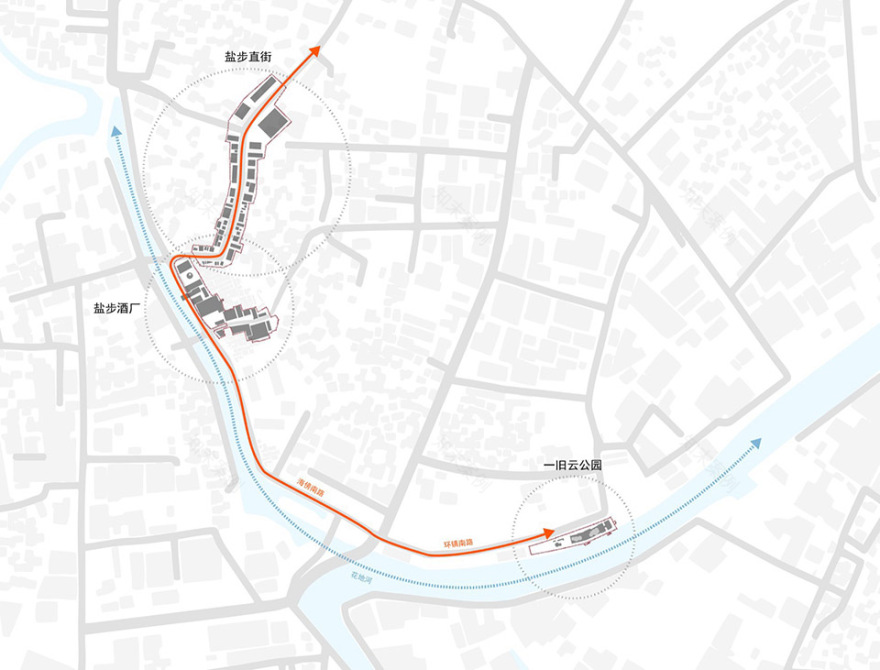
▼沿河航运仓库改造后形成景观带,Riverfront Shipping Warehouses Transformed into a Waterfront Landscape Belt © 竖梁社

01.一旧云——城市公共灯塔
01.A Wisp of Cloud — An Urban Public Beacon
作为大沥镇城市更新进程中第一个滨水建筑活化更新项目,我们希望搭建一个具有标志性意义的公共艺术装置,成为整个城市公共空间系统搭建的重要锚点。
As the first waterfront revitalization project in Dali Town’s urban renewal initiative, we aim to create an iconic public art installation that will serve as a pivotal anchor for the town’s broader open space network.
▼“一朵云”的初步构想,Initial Concept of “A Wisp of Cloud” © 竖梁社
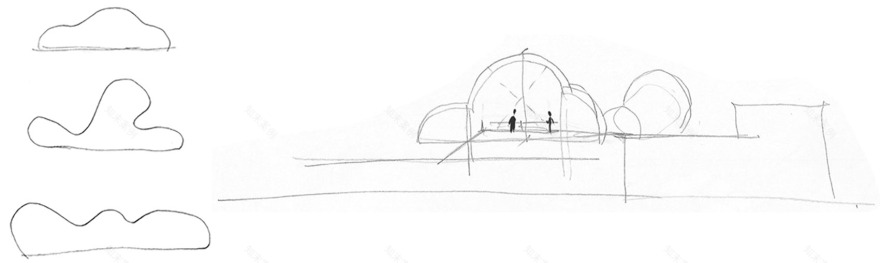
▼屋顶标志性构筑物的多版过程方案,Design Iterations of Iconic Roof Structure © 竖梁社

装置的原点是一朵从花地河畔旧仓库屋顶生长出来的白云,它兼具景观性与公共艺术属性,具有话题性与传播度;它既是周边居民的日常休闲场所,也是城市公共精神的物质载体。它像一个灯塔,阐明大沥城市公共空间系统搭建的宣言。
The installation originates from a white cloud rising from the roofs of the old warehouses along the Huadi River. It embodies both landscape and public art attributes, boasting strong topicality and high social visibility. Serving as a daily leisure space for local residents, it also acts as a physical carrier of the urban shared spirit. Like a beacon, it articulates Dali’s vision for building a comprehensive urban public space system.
▼从“一朵云”生长出来的屋顶,Roofs Evolving from “A Wisp of Cloud” ©吴嗣铭


02. 空间的立体叠合
02. Vertical Stacking of Spaces
项目整体用地呈长条形,除去河岸边的防汛通道,可用空间十分有限。为了保证足够的商业经营面积、确保项目自身造血能力,同时尽可能地解放城市滨水公共空间,达到城市公共空间与商业运营的平衡,我们决定将公园托举到屋顶,让公共空间沿河道方向延伸至屋面。屋面以下的完整仓库空间则留给商业运营。
The site is long and narrow, and usable space becomes highly limited once the riverside flood control path is excluded. To ensure sufficient commercial floor area for the project’s financial self-sufficiency, while maximizing the urban waterfront realm and achieving a balance between shared space and commercial operation, we elevated the park to the rooftop, allowing open space to extend along the river onto the roof. The full warehouse volume below is dedicated to commercial use.
▼把公园托举到屋顶,Elevating the Park to the Rooftop © 竖梁社

通过两种空间类型的立体叠合,商业活动与公共休闲同时获得了一个完整的沿江观景面。这是一种在紧张用地条件下产生的空间策略,也是对传统“公园”与“商业”二元对立关系的重新思考。
Through the vertical stacking of two spatial types, both commercial activities and public recreation gain a full riverside view frontage. This spatial strategy is developed under tight land constraints and also rethinks the traditional binary opposition between “park” and “commerce.”
▼空间叠合,活动昼夜不间断,Spatial Stacking for Continuous Day-and-Night Activities © 竖梁社

▼商业功能激活仓库空间,丰富公众活动,Commercial Activation of Warehouse Spaces for Enhanced Public Activities © 竖梁社

03. 改造中的取舍权衡
03. Trade-offs in Renovation
在整个改造设计过程中,设计团队内部对于旧建筑的保留价值有过多次讨论和纠结。从历史保护的角度来讲,旧仓库本身的建筑品质并不高——歪歪扭扭的砖木混合结构,不同大小、不同类型的砌体在立面上的混搭——并没有太多值得保留的风貌价值要素。但作为建筑所处时代中的“河边仓库”这一建筑类型,简单实用恰恰代表了大多数。作为一个时代切片,它也的确诉说了一段“不是那么讲究”的建造历史。
During the renovation design process, the team had extensive discussions and debates over the preservation value of the existing buildings. From a heritage conservation perspective, the old warehouses are architecturally undistinguished: distorted brick-wood structures with a haphazard mix of masonry sizes and types across the facades, possessing few significant heritage features worth preserving. Yet as typical riverside warehouses of their era, their simplicity and utilitarian nature embody the reality of most buildings at the time. As historical fragments, they bear witness to an unpretentious chapter of construction history.
▼旧仓库的历史风貌痕迹,Traces of Historic Features in the Old Warehouses © 竖梁社

最终,我们做出了取舍:木屋架和瓦屋面让位于可供儿童奔跑的屋面公园和屋面以下更高的层高,商业建筑通透的玻璃界面则让位于仓库立面上的历史痕迹。
In the end, we made deliberate trade-offs: the wooden roof trusses and tiled roofs gave way to a rooftop park where children can play, as well as higher interior ceilings below. The transparent glass facades prioritized for commercial use were sacrificed to preserve the historic traces on the warehouses’ facades.
▼从封闭仓储到开放休闲的江岸(改造前后对比),From Enclosed Warehouses to an Open Riverfront Leisure Destination (Before & After) © 竖梁社 / 吴嗣铭

新与旧在旧仓库的檐口完成了交接,在一仓、二仓的旧墙与攀援网格之间形成了叠合。这一叠合并非终点——随着植物的生长,这段建造的历史将被继续书写。
Old and new converge at the warehouses’ eaves, creating an overlap between the original walls of Warehouse 1 and 2 and the new climbing trellises. This overlap is not an end in itself: as the plants grow, the architectural history of this site will continue to be written.
▼外立面上的新旧交接,Old-New Dialogue on the Facades ©吴嗣铭

04. 不平的地面
04. Uneven Ground
在决定木屋架和瓦屋面让位于屋面公园之后,我们开始思考:这座平凡的老仓库上,应该生长出一个什么样的、独一无二的公园?十年前,竖梁社在白房子民宿项目里曾经尝试在密集的民居屋面上“飞檐走壁”。但当去掉了旧瓦片之后,仓库的坡屋面似乎有了更多的可能性。在传统建筑当中,平的是地面,不平的是屋面;站的是地面,看的是屋面。屋面的形式甚至成为建筑物划分等级的形制标准。
After deciding to give way to a rooftop park instead of retaining the wooden roof trusses and tiled roofs, we began to wonder: what kind of unique park should take shape on these unassuming old warehouses? A decade ago, Atelier cnS explored a “roof-hopping” design approach in the White House Guesthouse project, creating elevated walkways across the dense residential rooftops. For the warehouses, however, removing the old tiles has opened up far greater possibilities for the sloped roofs. In traditional architecture, the ground is flat while roofs are pitched; people stand on the ground and look up to the roofscape. Roof forms even functioned as a hierarchical standard for classifying buildings.
▼屋顶的生成过程,Roof Formation Process © 竖梁社

当屋面被剥离到只剩抽象的坡度时,这份“不平”给我们带来了更多的想象空间:草坡、台阶、互动墙面、花园、绳网、滑梯……屋面的抽象起伏激发了空间与活动的多种可能性。
Stripped down to their abstract slopes, these “uneven” surfaces offer ample room for imagination: grassy slopes, steps, interactive walls, gardens, rope nets, slides and so on. The abstract undulation of the roofs has sparked diverse spatial and programmatic possibilities.
▼屋顶的建造过程,Roof Construction Process © 竖梁社 / 吴嗣铭

▼屋顶的多样性互动,Diverse Interactions on the Roofs ©吴嗣铭

这一切的活动,都是与原本只可远观的建筑屋面的亲密互动。当屋面上打闹的小孩沿着不平的屋面进行攀爬时,老仓库屋面的形态与角度变得可以更加感知。人,也在此刻与仓库建造时所选择的形态发生了遥远的联系。
All these activities enable intimate engagement with building roofs that were once only meant to be admired from afar. As children run and climb across the undulating rooftops, the shape and angles of the old warehouse roofs become deeply tangible. At this moment, people also form a timeless connection with the very form chosen when the warehouses were first built.
▼人与屋顶的亲密互动,Intimate Interaction Between People and the Roofs ©吴嗣铭


废弃材料的再生利用、场地原生肌理的保留,是我们对场地记忆延续的最直接的回应。新材料选择上,我们用清水混凝土、金属等现代抽象材料,与旧建筑的砖瓦形成材质与视觉对比,强化新与旧的对话;
Recycling waste materials and preserving the site’s original texture is our most direct response to carrying forward the site’s memory. For the new materials, we employed modern and abstract materials such as exposed concrete and metal to create material and visual contrasts with the bricks and tiles of the old buildings, enhancing the dialogue between the old and the new.
▼仓库外立面的新材料改造,Renovation of Warehouse Facades with New Materials ©吴嗣铭
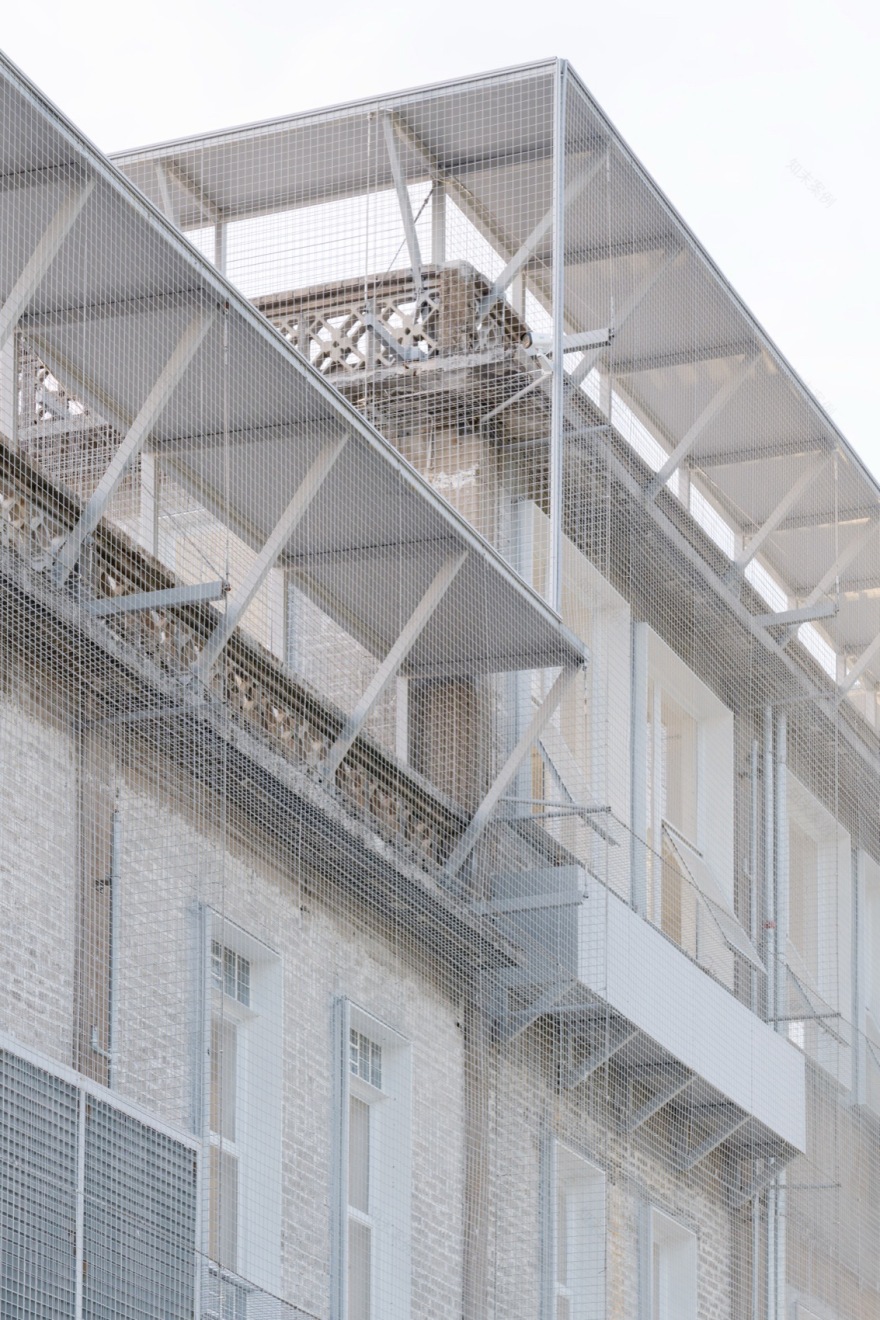

▼仓库空间与新材料的结合,Integration of Warehouse Space with New Materials ©吴嗣铭


▼仓库空间与新材料的结合,Integration of Warehouse Space with New Materials ©吴嗣铭

改造中产生的大量建筑废料,我们并未简单丢弃,而是让它们以新形式融入空间:拆除的石材做成江边的石笼栏杆、广场铺装;旧木檩条和旧窗被改造为建筑通道的展示装置。在我们看来,这些废料是场地记忆的载体,让它们留在空间,才能让旧仓库的历史在改造后有迹可循。
Rather than simply discarding the large amount of construction waste generated during the renovation, we repurposed it into new spatial elements: reclaimed stone was used for riverside gabion railings and square paving; old wooden purlins and windows were transformed into display installations along the corridors. In our view, these materials embody the site’s memory. Retaining them in the space ensures the history of the old warehouses remains traceable after renovation.
▼拆除的石材保留为江边栏杆,Reclaimed Stone for Riverside Gabion Railings ©吴嗣铭

▼旧石材用于广场铺地,Reclaimed Stone for Square Paving ©吴嗣铭

我们始终认为,城市更新不仅是建筑本体的更新,更要尊重场地原有空间肌理。因此,我们保留了仓库之间的原有通道,使其与新屋面形成架空通道关系。
We firmly believe that urban renewal is not just about renewing the buildings themselves, but also requires respect for the site’s original spatial fabric. Therefore, we preserved the original passages between the warehouses, transforming them into an elevated circulation system that bridges with the new rooftops.
▼改造中的旧材料回收利用,Recycling of Reclaimed Materials During Renovation © 竖梁社
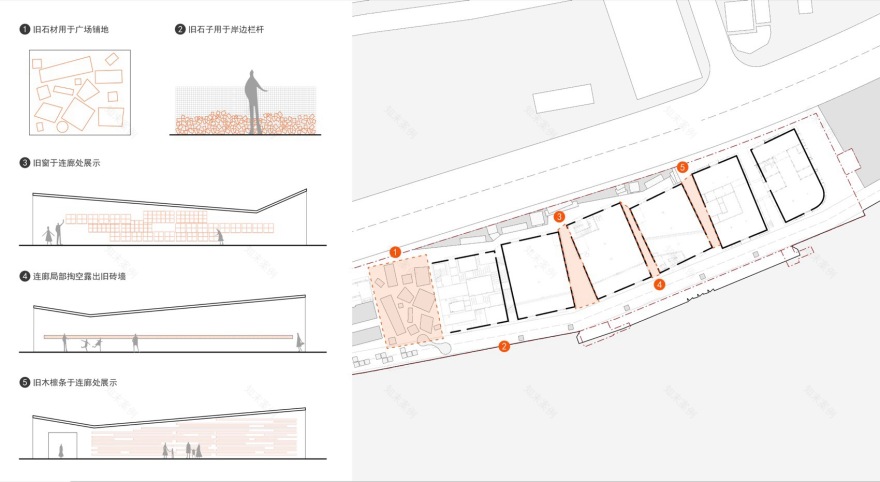
▼旧窗、旧檩条于连廊处展示,Old Windows & Purlins Displayed Along Corridor ©吴嗣铭

我们将这些通道比作“血管”,仓库主体为“肌肉”,这些“血管”的价值远不止人流疏导:它们打通了场地景观视线,实现滨水景观的移步换景;与江边形成穿堂风,自然带走建筑内部热量,实现生态节能;更让屋面公园、商业空间与滨水空间互联互通,让整个项目的空间成为有机整体。此外,我们在屋面下设置设备夹层,专门放置空调外机、屋面ETFE气膜设备等,既保证了公共与商业空间的整洁,也让设备布局更系统,实现功能需求与空间美学的统一。
▼保留并架空原有的四条通道形成“血管”,Preserving & Elevating Four Original Passages as “Blood Vessels” © 竖梁社

We regard these passages as the site’s “blood vessels” and the warehouses as its “muscles.” Their value extends far beyond pedestrian flow: they open up visual corridors across the site, creating a shifting scenery experience along the waterfront; they enable cross ventilation with the river to naturally cool the building interiors for ecological energy efficiency; and they seamlessly connect the rooftop park, commercial spaces, and waterfront areas, integrating the entire project into an organic whole. In addition, a mechanical floor is inserted beneath the roof to accommodate air conditioning condensing units, rooftop ETFE cushion system and associated mechanical equipment. This ensures a neat appearance in public and commercial spaces, systematizes the equipment layout, and achieves unity between functional needs and spatial aesthetics.
▼原有通道与新屋面形成架空关系(改造前后对比),Original Passages Forming Elevated Connections with New Roofs (Before & After) © 竖梁社 / 吴嗣铭

结语
Conclusion
“一旧云”,在粤语中是“一片云”的意思。它轻盈又具象,是景观装置,更是城市宣言。作为大沥首个滨水建筑活化项目,我们始终希望,这座从旧仓库屋顶生长出来的白云,不仅是周边居民的日常休闲场所,更能成为城市公共精神的物质载体——如灯塔一般,昭示着大沥搭建公共空间系统的坚定决心。
In Cantonese, “Yat Gau Wan” means “a wisp of cloud.” Light and vivid, “a wisp of cloud” is not only a landscape installation but also an urban manifesto. As Dali Town’s first waterfront adaptive reuse project, we hope this cloud-like installation—rising from the rooftops of the old warehouses—will serve not just as a daily leisure space for residents, but also as a tangible carrier of the city’s civic spirit; a beacon heralding Dali’s commitment to building a systematic public space network.
▼从“一旧云”到“城市灯塔”,From “A Wisp of Cloud” to an Urban Beacon ©吴嗣铭


如今,这份构想已落地为真实的城市生活图景,这里也成为广佛交界处颇具人气的打卡地。傍晚时分,临江草坪上吹风的市民、斜坡花园里奔跑的孩子、工业风背景下拍照的年轻人,共同勾勒出公园最鲜活的日常。
Today, this vision has come to life as a vibrant urban scene, turning the site into a popular landmark in the Guangzhou-Foshan border area. At dusk, local residents enjoying breeze on the riverfront lawn, children running in the sloped park, and young people taking photos against the industrial backdrop together paint the park’s most lively everyday picture.
▼云上的公园活动图景,Scenes of Daily Life in Yat Gau Wan Park ©吴嗣铭

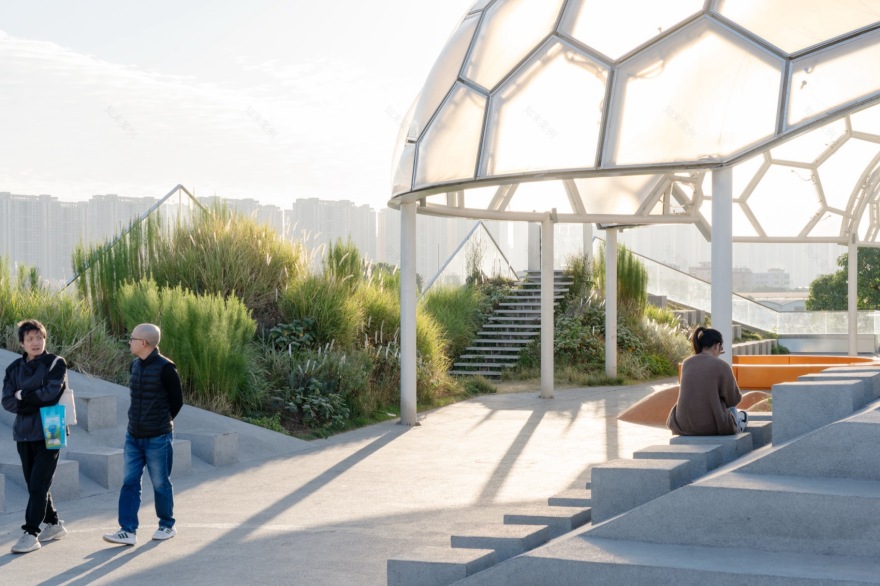

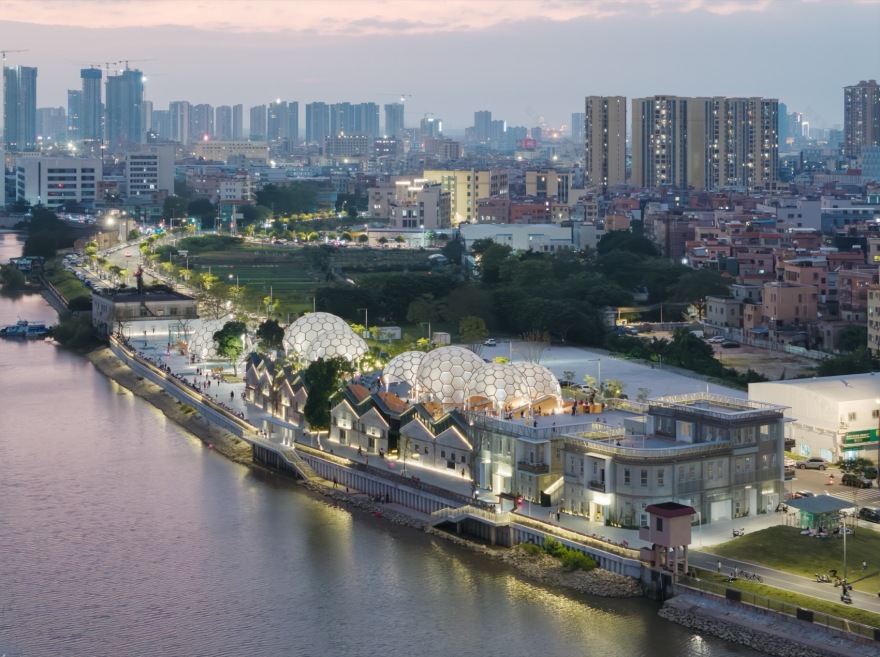
当广佛两地的歌声在江边回荡,当城市露营文化节的灯火点亮夜空,正如我们最初的愿望,这座从工业仓库蜕变而来的公园,正在融入新的城市肌理,成为广佛边界处城市公共生活的重要一环。
As songs from Guangzhou and Foshan echo along the river, and lights from the Urban Camping Festival light up the night sky, this park—evolved from industrial warehouses—is, as we first envisioned, blending into the new urban fabric and becoming a vital part of public life in the Guangzhou-Foshan border area.
▼夜晚的一旧云公园,Yat Gau Wan Park at Night ©吴嗣铭


▼项目改造后总平面图,Master Plan (Post-Renovation) © 竖梁社

▼5.6仓南立面图,South Elevation of Warehouses 5 & 6 © 竖梁社

▼1、2仓墙身大样图,Wall Details of Warehouses 1 & 2 © 竖梁社

项目名称:南海大沥永平仓改造设计
项目类型:建筑、景观
设计方:广州市竖梁社建筑设计有限公司
项目设计:2023.3 - 2024.3
完成年份:2025.10
主持建筑师:朱志远、宋刚、钟冠球;
设计团队:项目负责人:林海锐 建筑、景观、室内一体化设计:张紫琪、陈晓茵、林东燕,蔡雅倩,林海欣,丁文渊(实习)
项目地址:佛山市南海区大沥镇海景大道东
建筑面积:4311㎡
摄影版权:吴嗣铭
合作方:深化设计:晟艺建筑设计工作室
客户:佛山市南海区大沥镇一四三二产业投资有限公司
Project name:Renovation Design of Yongping Warehouses, Dali Town, Nanhai District
Project type:Architecture, Landscape
Design:Atelier cnS
Design year:2023.3-2024.3
Completion Year:2025.10
Leader designer & Team:
Design Direction:Zhiyuan Zhu, Gang Song, Guanqiu Zhong
Project Director: Hairui Lin
Design Team: Ziqi Zhang, Xiaoyin Chen, Dongyan Lin, Yaqian Cai, Haixin Lin, Wenyuan
Project location:Haijing Avenue East, Dali Town, Nanhai District, Foshan City
Gross built area: 4,311 m²
Photo credit: Siming Wu
Partner:Construction Drawing Design:Shengyi Architectural Design Studio
Clients: Foshan Nanhai District Dali Town 1432 Industrial Investment Co., Ltd.


南京喵熊网络科技有限公司 苏ICP备18050492号-4知末 © 2018—2020 . All photos and trademark graphics are copyrighted by their owners.增值电信业务经营许可证(ICP)苏B2-20201444 苏公网安备 32011302321234号
苏公网安备 32011302321234号客服
消息
收藏
下载
最近