

创作上传
VIP
收藏下载
登录 | 注册有礼
查看完整案例

收藏

下载

分享

翻译
Architects:Bernard Tschumi Architects
Area:16222m²
Year:2025
Photographs:Iwan Baan
Lead Architects:Bernard Tschumi Architects
Structural Engineering:Alberti Ingénieurs SA,Arup
Category:Educational Architecture,Institute
Lead Team:Bernard Tschumi, Joel Rutten, Sonia Grobelny, Christopher Ball, Valeria Paez Cala, Wenjun Yu, Kai Blatt, Tina Marinaki, Clement Luk Laurencio
Architecture Offices:Fehlmann Architectes SA
MEP:SRG
Civil Engineering:Karakas & Francais
Consultants:BCS SA
Acoustics:EcoAcoustique
Lighting Designer:Lumière Electrique
Landscape Design:Forster
City:Rolle
Country:Switzerland

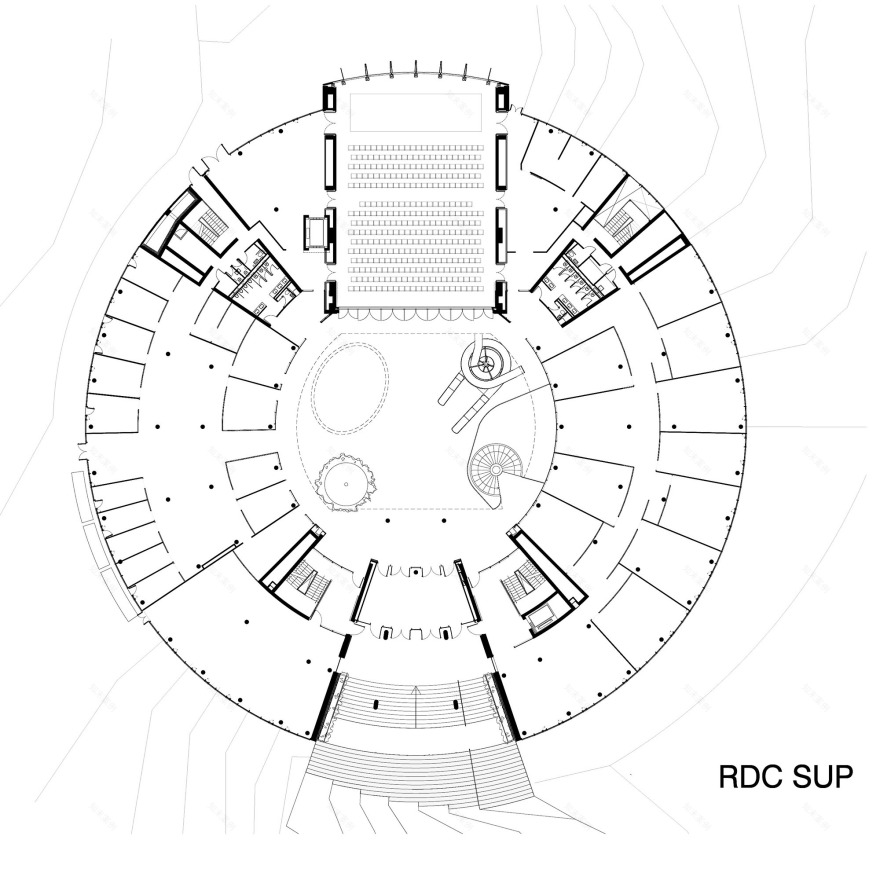
Text description provided by the architects. Bernard Tschumi Architects is pleased to announce the completion of Philo, a new building for student innovation at Institut Le Rosey, an international boarding school near Geneva, Switzerland. A key feature of the new building is its dynamic circulation concept. Vertical and horizontal pathways generate movement and intersect the central atrium, which acts like a covered public square. The atrium is surrounded by three concentric walkways. The first walkway runs directly along the four levels of the atrium; the middle one distributes the various classrooms, while the outer walkway acts as a continuous balcony, providing an extension to the classrooms in good weather.

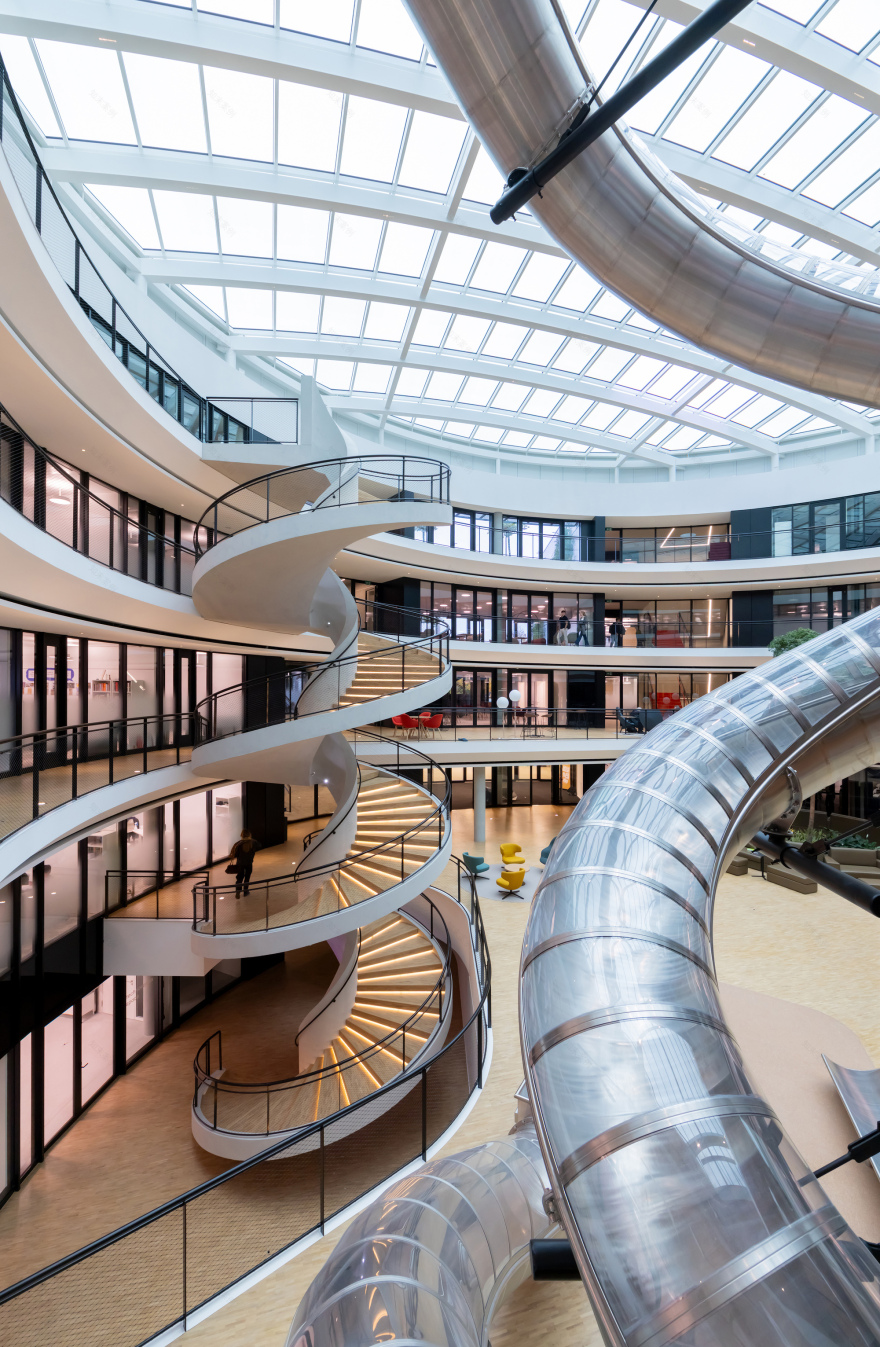
Philo hosts five levels of classrooms, laboratories, and programs to support student innovation, including a Fabrication Lab, a Start-up or Incubator Space, and a Pitch Room for events, organized around a grand atrium with a spiral staircase and two toboggan slides in a double-helix configuration.

Classrooms, labs, and circulation spaces are designed to maximize flexibility. Partitions can be moved or removed to allow for multiple configurations of 90 classrooms. Such flexibility will maximize the building's future utility and limit embodied carbon. Informal zones scattered throughout the building promote spontaneous interactions among students, teachers, resident entrepreneurs, and guests. On the perimeter, classrooms open onto balconies and small gardens that encourage exchange and collaboration.

The circular structure enters into a conversation with the historical campus and the adjacent metal-domed concert hall completed by Bernard Tschumi in 2014. The new scientific and entrepreneurial counterpart to the arts center raises the architectural question: How to establish a dialogue without one building overshadowing the other, so that the whole becomes greater than the sum of its parts?

Philo uses a similar material palette to the earlier Carnal Hall: steel, concrete, wood, and glass. The shared vocabulary unifies the two buildings yet allows each to express its own identity and relationship to their common context. A notable difference is Philo's planted exterior walkways, which change color with the seasons.

The aluminum façade uses triple glass and 2 mm-thick stainless steel-edged panels. The horizontal bands of planted balconies, combined with the tinted glass and exterior roller blinds, help protect the envelope. The cupola covers the 30 m diameter atrium with a minimal curved-steel tube structure. The curvature allows for lightness, and electro-chrome glass keeps the building open to the sky, reducing solar heat gains in summer while allowing sunlight into the atrium.

Regarding its sustainability features, cylindrical designs are inherently efficient, offering a high internal volume relative to the total envelope area. While natural ventilation is possible, air renewal is mechanically controlled to limit energy loss. Heating and cooling are achieved via heat pumps using water from the adjacent Lake Geneva. Photovoltaic panels on the green roof provide much of the energy used throughout the building. Overall, in the words of the client, the building is "a forward-looking educational tool that embodies Le Rosey's ambition to pioneer new pathways in learning."
Project gallery


南京喵熊网络科技有限公司 苏ICP备18050492号-4知末 © 2018—2020 . All photos and trademark graphics are copyrighted by their owners.增值电信业务经营许可证(ICP)苏B2-20201444 苏公网安备 32011302321234号
苏公网安备 32011302321234号客服
消息
收藏
下载
最近