

创作上传
VIP
收藏下载
登录 | 注册有礼
查看完整案例

收藏

下载

分享
Babel项目源于位于墨西哥图卢姆的一项住宅与酒店开发需求。项目以业主提出的清晰象征性与形式性前提为起点——一座塔楼以及以拱券为核心的建筑语言——但在与场地相遇后,这一设想转化为一种伦理立场:以气候、时间与植被作为建造的基本要素。
Babel is born as a response to a residential and hotel project in Tulum, Mexico, with a clear symbolic and formal premise outlined by the client —a tower and an architectural language articulated through arches— that, when confronted with the territory, transforms into an ethical statement: to build with climate, with time, and with vegetation as matter.
▼项目概览,overall of the project© Albers Studio

在图卢姆城市边缘,旅游开发带来的森林砍伐与基础设施压力已逐渐显现,而该地块却仍被丛林环绕,几乎未受城市化影响;除了一些既有的人为痕迹,周边环境基本保持原始状态。基于这一背景,项目不再只是体量构想的实现,而转向一场深层反思:如何在不破坏生态逻辑的前提下进行建造?如何在保持空间清晰性的同时提升环境价值?又如何让一个旅游与居住复合功能的项目,扎根于一个需要审慎、修复与延续的场所?
▼草图,sketches© V Taller

At the urban edge of Tulum, where tourist pressure has caused deforestation and infrastructural strain, the site appeared surrounded by jungle, with virtually no urban impact; except for a prior trace of intervention on the lot, the surroundings remained intact. In light of this, the project ceased to be merely the materialization of a volumetric idea and became a deep reflection: how to build without cancelling ecological logic? how to add environmental value without sacrificing spatial clarity? how to anchor a touristic and residential program to a territory that demands prudence, repair, and continuity?
▼庭院空间鸟瞰,aerial view of the central courtyard© Funciono


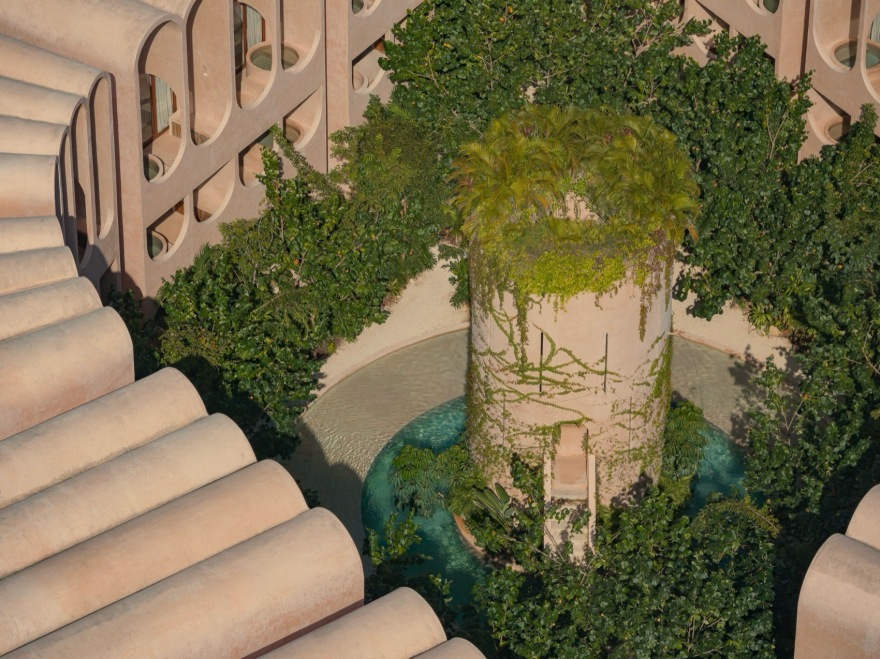
对此,设计给出的不是形式回应,而是一种立场:重建建成环境与自然之间的关系,使场地重新焕发生命,并以尊重的方式将其重新嵌入周边生态体系之中。因此,Babel既是栖居之所,也是一种伦理宣言——一个灵活且可持续的共生框架,能够预见气候、社会与经济的变化,而不沦为孤立的飞地。项目的目标不仅是实现可居住的空间,更是提出一种长期存在的“底板”,让人类生活与生态系统在其中达成平衡与共生的节奏。
The response was formulated as a stance rather than a gesture: to rebuild the bond between the built and the natural, to return life to the place, and to reinsert it respectfully into the ecological matrix that surrounds it. Babel thus aspires to be both refuge and ethical declaration, a flexible and sustainable framework of cohabitation that anticipates climatic, social, and economic transformations without becoming an isolated enclave. The goal is not simply to enable a habitable complex, but to propose a long - term canvas where human life and the ecosystem find balance and a shared rhythm.
▼连续的拱形形成有韵律的节奏感,
the continuous arches create a rhythmic sense of harmony© Albers Studio


▼户外楼梯,outdoor staircase© Albers Studio

为实现这一目标,项目的关键策略不是扩展占地,而是主动收缩:通过垂直集约化来集中密度,将土地归还丛林,并让“空白”成为调节环境的媒介。不同于传统通过水平廊道扩展而导致不透水面增加的方式,交通系统被整合进高效的垂直核心之中。最终,项目在3,510平方米的地块上实现了6,176平方米的建筑面积,同时将实际占地控制在2,155平方米——相比传统水平展开模式减少近40%的土地占用。这一策略通过保留可渗透地表与再植林区,促进含水层补给,形成一种“土地经济学”。相关城市研究表明,垂直紧凑的发展模式可减少高达30%的城市蔓延及其环境外部性,从而将土地压力转向更紧凑、可控的发展路径。这一策略不仅未削弱经济效益,反而加以强化:通过优化土地利用、缩短流线、减少对景观的干扰,并保留视野资源——而这些本身亦构成项目价值的重要部分。
▼分析图,analysis diagram© V Taller

To sustain this intention, the key decision was not to expand the footprint, but to retract it: to concentrate density vertically, to return land to the jungle, and to turn emptiness into an environmental regulator. Instead of deploying horizontal corridors that multiply impermeable surfaces, circulations are grouped in highly efficient vertical cores. Thus, the project develops 6,176 m² of built area on a 3,510 m² plot and limits its effective footprint to 2,155 m² —a strategy that reduces land consumption by nearly 40% compared to horizontal schemes—, promoting aquifer recharge by preserving permeable surfaces and reforestation zones. This “land economy” aligns with urban evidence that associates vertical compactness with up to 30% less sprawl and environmental externalities, shifting territorial pressure toward a more compact and manageable pattern. Far from contradicting profitability, it reinforces it: optimizing land use, shortening routes, minimizing landscape interference, and preserving views that also constitute part of the project’s value.
▼建筑与环境的融合,the integration of architecture and the environment© Daniel Villanueva

▼中央圆柱形塔楼,central cylindrical tower building© Daniel Villanueva

▼外立面近景,closer view of the external finishing© Daniel Villanueva

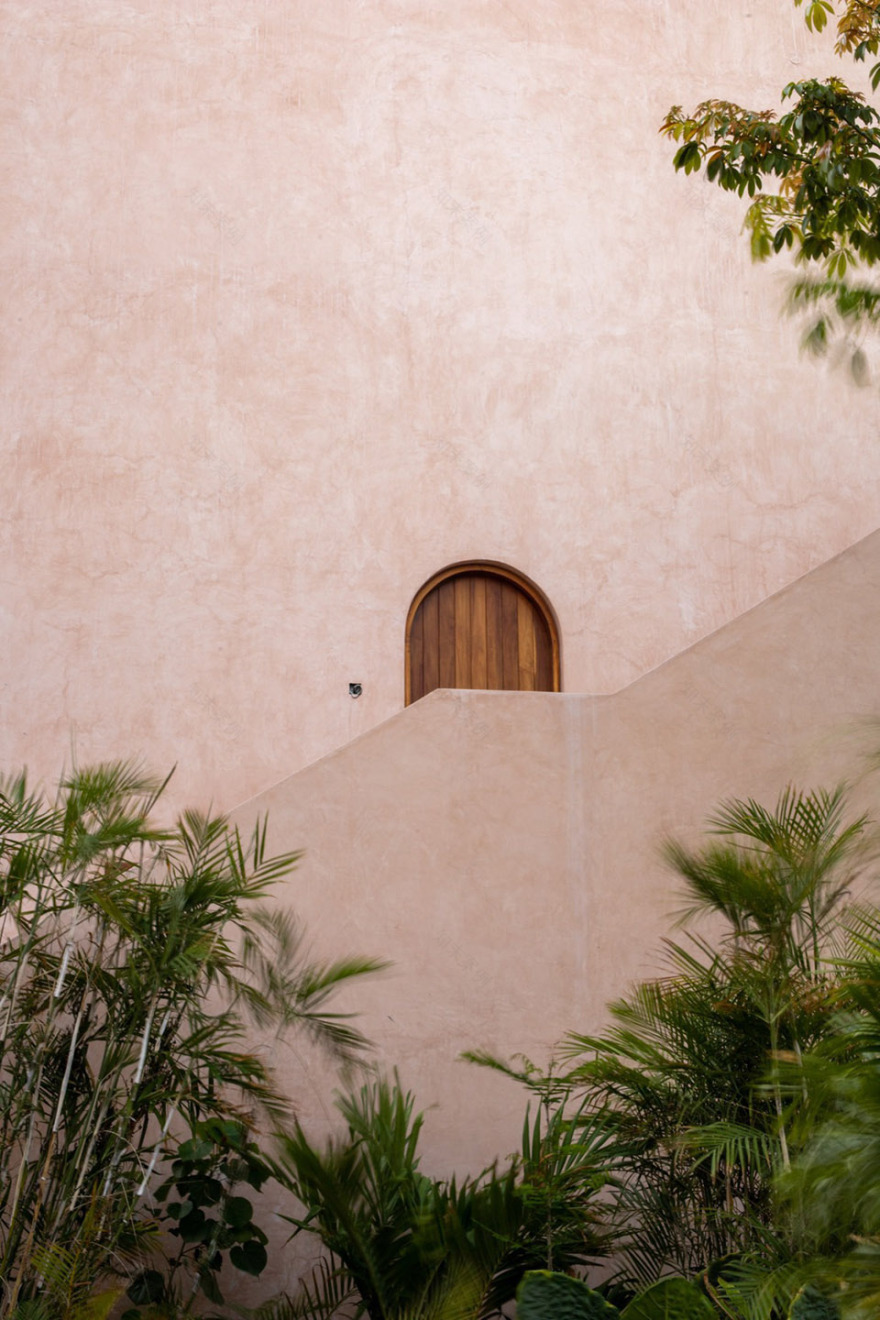
在这一原则之下,整体布局得以确立:两条相互补充的曲线围合成一个“眼形”平面,环抱着中央的空隙。这个空隙——既是庭院,也是微气候调节器与社交核心——组织起整个系统,并赋予其清晰可感的空间脉动。围绕其展开的是分布于三层的59个单元,结合居住与酒店功能,使空间全年保持活力,而不依赖于旅游季节的周期性波动。这种混合并非商业策略,而是一种“可居性语法”:厨房、起居—餐厅、浴室、带按摩池的花园以及卧室,根据其在曲线中的位置进行模块化配置,使每个单元都能针对具体场地条件微调开敞度与遮阳方式,强化室内外之间的连续性。
With this principle, the layout was conceived: two complementary curves form an eye-shaped plan that embraces a central void. This void —a courtyard, a microclimatic regulator, and social heart— organizes the whole and gives it a recognizable pulse. Around it are arranged 59 units across three levels, combining residential and hospitality uses to sustain life throughout the year without falling into touristic seasonality. The mix is not a commercial strategy but a grammar of habitability: kitchen, living-dining area, bathroom, garden with jacuzzi, and bedroom are modulated according to their position along the curve, so that each dwelling fine-tunes its openness and shading to the site’s specific condition, reinforcing continuity between interior and exterior.
▼半鸟瞰,half-aerial view of the project© Funciono


▼外观细部,details of exterior view© Funciono


当功能延伸至公共区域时——如融入植被之中的共享办公空间、设有草本蒸汽浴、按摩与冥想室的水疗区、提供素食料理与本地食材无酒精鸡尾酒的餐厅与酒吧、禅意花园、瑜伽室,甚至设有“睡眠管家”的ASMR空间——Babel构建起一个日常化的生活生态系统。它拒绝将自身塑造为被消费的度假对象,而是通过低强度的健康生活方式,将日常活动融入庭院氛围与光的节奏之中。
When the program expands into common areas —coworking immersed in vegetation; a spa with herbal steam baths, massage, and meditation rooms; a restaurant and bar offering vegetarian cuisine and local-ingredient mocktails; a zen garden; a yoga studio; and even an ASMR room with a “sleep concierge”— Babel sustains an everyday ecosystem that rejects the objectified resort model in favor of low-intensity wellness routines integrated into the courtyard’s atmosphere and the cadence of light.
▼连续的拱形形成有韵律的节奏感,
the continuous arches create a rhythmic sense of harmony© Daniel Villanueva


▼由缝隙空间看拱形,viewing the arch shape from the gap space© Daniel Villanueva

业主所期望的塔楼,被精确地置于两条曲线的几何重心之上。它并非一个任意叠加的地标,而是承担着组织、导向与秩序构建的角色。其存在具有“神经中枢”般的意义:既引导动线、提供空间参照轴线,同时又尊重庭院的流动性。塔楼内部对土耳其浴(hammam)传统进行了再诠释:通过对光线的严格控制、克制的材料表达以及有利于内省的空间氛围加以呈现。顶部的小型开口过滤自然光,使光影在一天之中不断变化。圆柱体最终在顶部形成一个三角形开口,作为观星的眺望口——视线被从侧向干扰中解放出来,向上延伸,使天空成为建筑的另一种材料。
The tower requested by the client finds its exact place in the geometric centroid of these two curves. It does not impose itself as an arbitrary landmark; it organizes, orients, and orders. Its presence is neuralgic: it structures movement, provides an axis of reference, and at the same time respects the courtyard’s fluidity. The interior of the tower reinterprets the tradition of the hammam: rigorous control of light, sober materiality, and atmospheres conducive to introspection. Small overhead openings filter natural light and allow the day to draw a changing relief of shadows. The cylinder culminates in a triangular opening that functions as a stargazing lookout; the gaze is isolated from lateral distractions and rises, clear, making the sky another material of the project.
▼塔楼被精确地置于两条曲线的几何重心之上,
the tower finds its exact place in the geometric centroid of these two curves © Albers Studio


▼三角形观星的眺望口,triangular-shaped observation deck for stargazing © Albers Studio
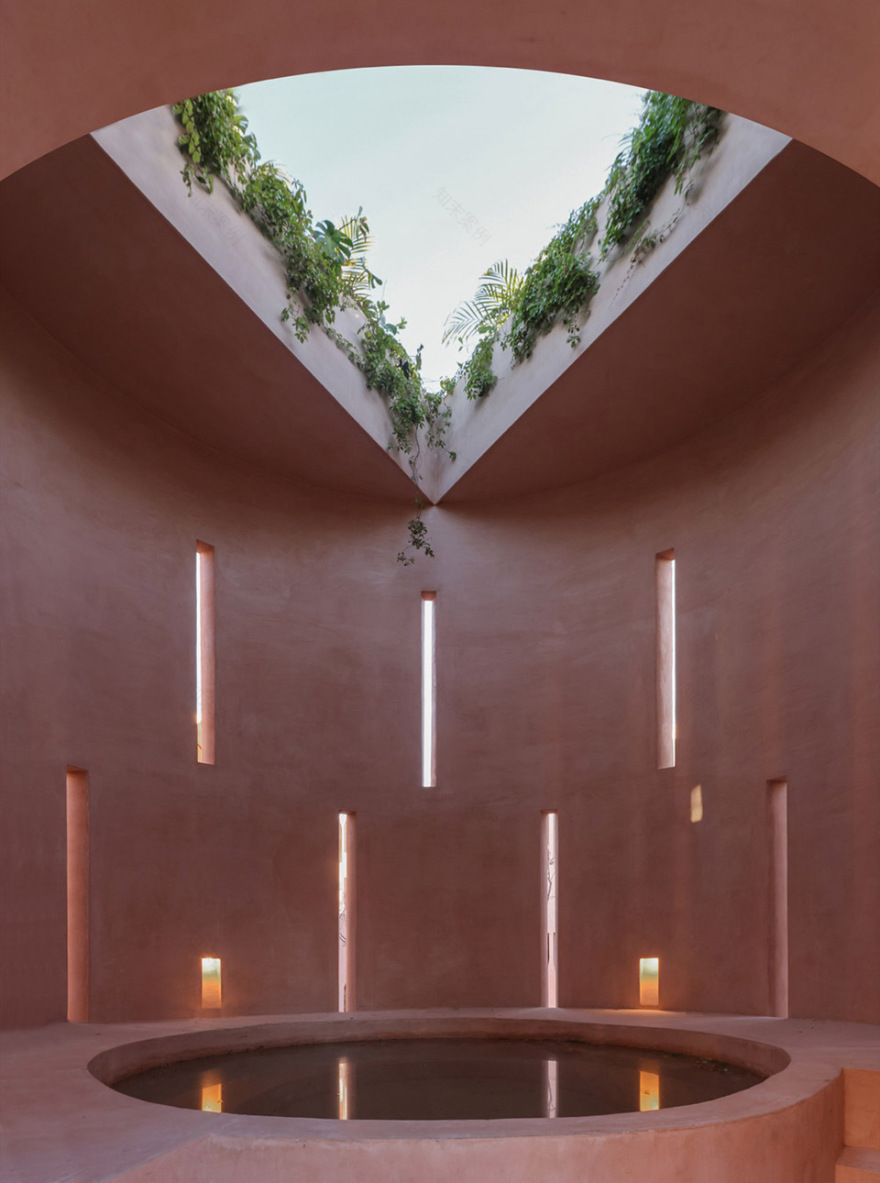
在塔楼基座处,一个圆形水池强化了庭院的几何关系,同时作为建筑与自然之间的微妙过渡界面。水面的反射放大了空间感知,其水体质量调节空气、缓和核心区域温度,并与拱廊的遮阴共同作用,维持全天稳定的微气候。在Babel中,水成为热环境系统的一部分,与墙体的热惰性及自然通风共同降低室内负荷,减少对主动设备系统的依赖。
At the base of the tower, a circular pool emphasizes the geometry of the courtyard and operates as a subtle threshold between architecture and nature. Its reflections amplify spatial perception; its water mass tempers the air, softens the temperature of the core, and, together with the shading of the arcades, contributes to a stable microclimate throughout the day. In Babel, water is part of the thermal system which, along with wall inertia and cross ventilation, reduces internal loads and dependency on active systems.
▼塔楼基座处的圆形水池,the circular pool at the base of the tower© Albers Studio


▼水池,the pool© Daniel Villanueva

在整个建筑群中,光成为一种结构性要素。曲面与自然辐射之间的相互作用,使墙体与拱顶在时间流逝中不断改变其空间特质。通往各单元的路径强化了这种空间“感知训练”:楼梯被设计为光的隧道,狭窄而精确地向上延伸,直至顶部光线引导最后一段路径,空间随之豁然展开,形成双层高度与拱形空间,释放体量。压缩与释放的序列教会人如何阅读建筑——理解建筑随光而动,每一个界面都在重新编排人的注意力。
Light, throughout the complex, becomes structure. The interaction between curved surfaces and natural radiation causes walls and vaults to change character with the hours. Access to the units condenses this spatial pedagogy: staircases conceived as tunnels of light lead upward, narrow and precise, until the overhead illumination guides the final stretch and the space opens with double heights and arches that expand the volume. The sequence of compression and release teaches one to read the building, to understand that architecture moves to the rhythm of light, that each threshold reprograms attention.
▼光成为一种结构性要素,light, throughout the complex, becomes structure© Funciono


▼庭院中的自然景观,landscape in the courtyard© Funciono


▼拱形单元,the arch units© Funciono


景观作为一种“主动装置”,参与并强化这一空间编排。渐变式种植策略调节了从公共到私密的过渡:通过控制视线、调节阴影、缓和风环境、引入可停留的半阴空间,并在室内外之间编织生态连续性。植被在过滤与显露、保护与开放之间不断转换,形成多层次的亲密界面,以回应不同使用方式与停留节奏。
The landscape accompanies this choreography as an active device. A gradient planting design regulates the transition from public to private: managing views, modulating shadows, softening winds, introducing habitable penumbras, and weaving ecological continuity between exterior and interior. The vegetation filters and reveals, protects and opens, creating layers of intimacy that respond to the variety of uses and tempos of each stay.
▼细部,details© Albers Studio


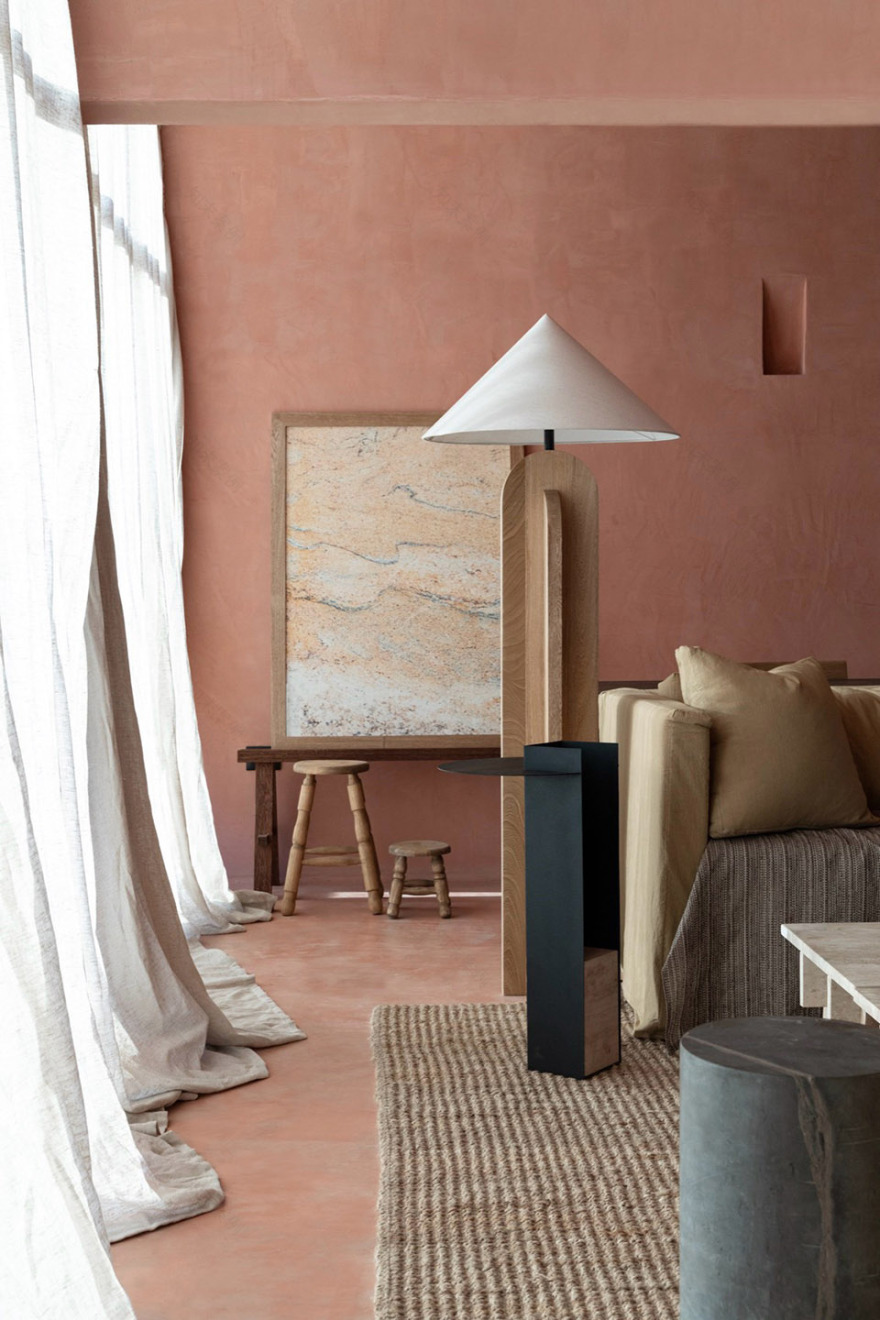
材料策略在支撑气候逻辑的同时,也保持了文化根基。主要饰面采用尤卡坦半岛传统的石灰基抹灰材料chukum,其热传导性能优于常规合成涂层。除具备吸湿性与热惰性外,该材料还显著降低维护频率——远低于传统灰泥——并可将饰面寿命延长至常规50–80年之上,同时形成一种矿物质肌理,使建筑自然融入景观。室内空间采用去饱和色调,以白色纺织品(以亚麻为主)与热带木材(如Tzalam、Machiche与Parota)构成家具与细部,从而延续光的品质并与环境对话。陶土制品作为手工艺点缀,将空间体验锚定于在地知识之中。这并非一种中性的美学,而是一种“主动的克制”,使气候、光影与植被的声息共同完成日常场景。
Materiality sustains this climatic agenda without losing cultural grounding. The main finish is chukum, a traditional lime-based stucco from the Yucatán Peninsula whose thermal conductivity outperforms typical synthetic coatings. In addition to its hygroscopic inertia, this material minimizes maintenance —requiring interventions far less frequent than conventional stucco— and extends the finish’s lifespan potentially beyond the usual 50–80 year range, with a mineral patina that integrates the building into the landscape. Inside the units, a desaturated palette, white textiles —mainly linen— and tropical woods —such as Tzalam, Machiche, and Parota— in carpentry and furniture prolong the quality of light and dialogue with the context. Clay pieces function as artisanal accents that anchor the experience in local knowledge. This is not a neutral aesthetic, but an active sobriety that allows climate, shadow, and the sounds of vegetation to complete the everyday scene.
▼饰面采用尤卡坦半岛传统的石灰基抹灰材料chukum,
the main finish is chukum, a traditional lime-based stucco from the Yucatán Peninsula© Albers Studio

▼圆窗,the circular opening© Albers Studio

场地的技术限制——包括无法在平屋顶布置设备——促使设计采用整合性解决方案。所有设备系统被集中布置于垂直核心中,在不干扰立面与屋顶形态的前提下,实现有序组织、便捷维护与可达性。这种运行上的紧凑性减少了管线距离,简化了检修过程,并保护了建筑表达,同时释放屋顶与边界空间用于被动性能优化:更少的遮挡、更低的热岛效应,以及更纯净的视觉环境。
The site’s technical limitations —among them the impossibility of dedicating flat roofs to equipment— led to integrated solutions. Systems are housed within the vertical cores, where they find order, access, and maintenance without interfering with façades or crowns. This operational compactness reduces paths, simplifies inspections, and protects architectural expression, while freeing roofs and perimeters for passive performance: fewer obstacles, fewer heat islands, less visual noise.
▼视觉通廊,the visual corridor © Albers Studio


在环境层面,Babel选择与气候协同,而非对抗。通过朝向与体量错动,引导新鲜气流的流动;拱券与穹顶有助于散热,形成深邃的阴影与稳定室内环境的空间“腔体”。庭院中的水体、分层植被以及墙体的热容量共同构成一个系统,用以缓冲昼夜温差,使舒适性成为几何与构造的结果,而非依赖机械设备的补充。无障碍设计亦遵循同样的清晰逻辑:可识别的导视系统、无障碍通行路径、停歇节点与防滑表面被整合其中,同时不破坏整体形式的连续性。
Environmentally, Babel works with the climate rather than against it. Orientation and stepping allow fresh air currents to flow; arches and vaults help dissipate heat, generating deep shadows and chambers that stabilize interiors. The courtyard’s water, the layered vegetation, and the thermal mass of the walls compose a system that dampens daily thermal oscillation, making comfort a result of geometry rather than a mechanical supplement. Accessibility follows the same logic of clarity: legible signage, unobstructed routes, resting points, and grip surfaces are integrated without breaking the project’s formal continuity.
▼室内浴室,indoor spa© Spaces by Conie

▼几何之美,the beauty of geometry© Spaces by Conie


在这一语境中,“拱”获得了三重属性:结构的、光学的与象征的。它既承担受力与跨越空间的功能,维持空间连续性;又通过过滤辐射,营造深阴影与层次丰富的半明空间;同时作为不同领域之间的界面——自然与建筑、公共与私密、沉思与开放之间的媒介。这里并不存在对历史形式的直接挪用,而是一种对拱这一原型的克制运用,使其成为组织、调和并赋予意义的工具。
In this context, the arch acquires a threefold condition: structural, luminous, and symbolic. It resolves loads and allows spans that favor spatial continuity; it filters radiation to produce deep shadows and tonal penumbras; and it acts as an interface between realms: nature and architecture, public and private, contemplation and openness. There is no literal citation of historical repertoires; there is a disciplined use of a form capable of ordering, mediating, and giving meaning.
▼客厅,living room© Lazarillo

▼室内一角,corner of interior© Lazarillo

▼接待空间,reception area© Lazarillo

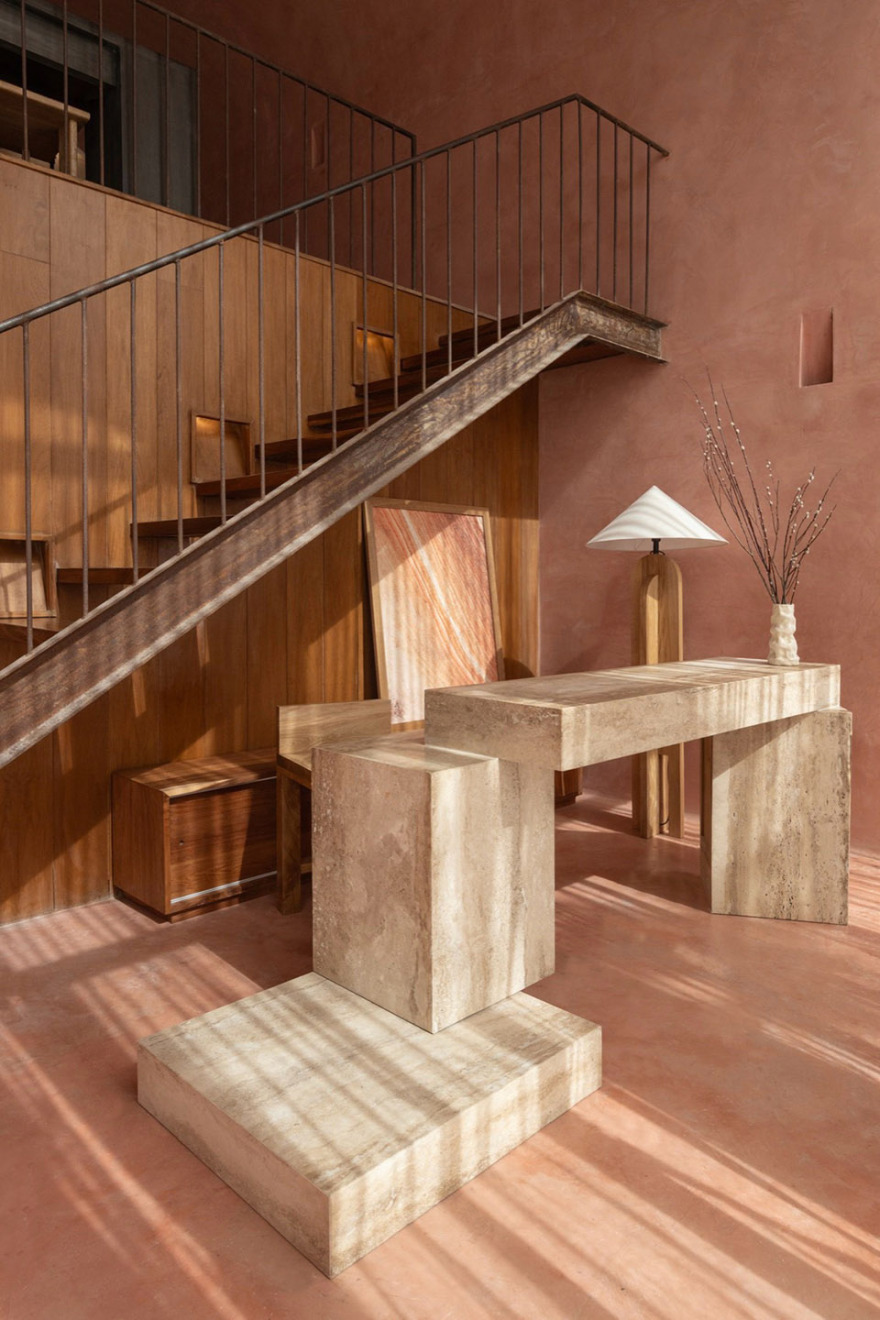
▼餐厅,dining area© Lazarillo
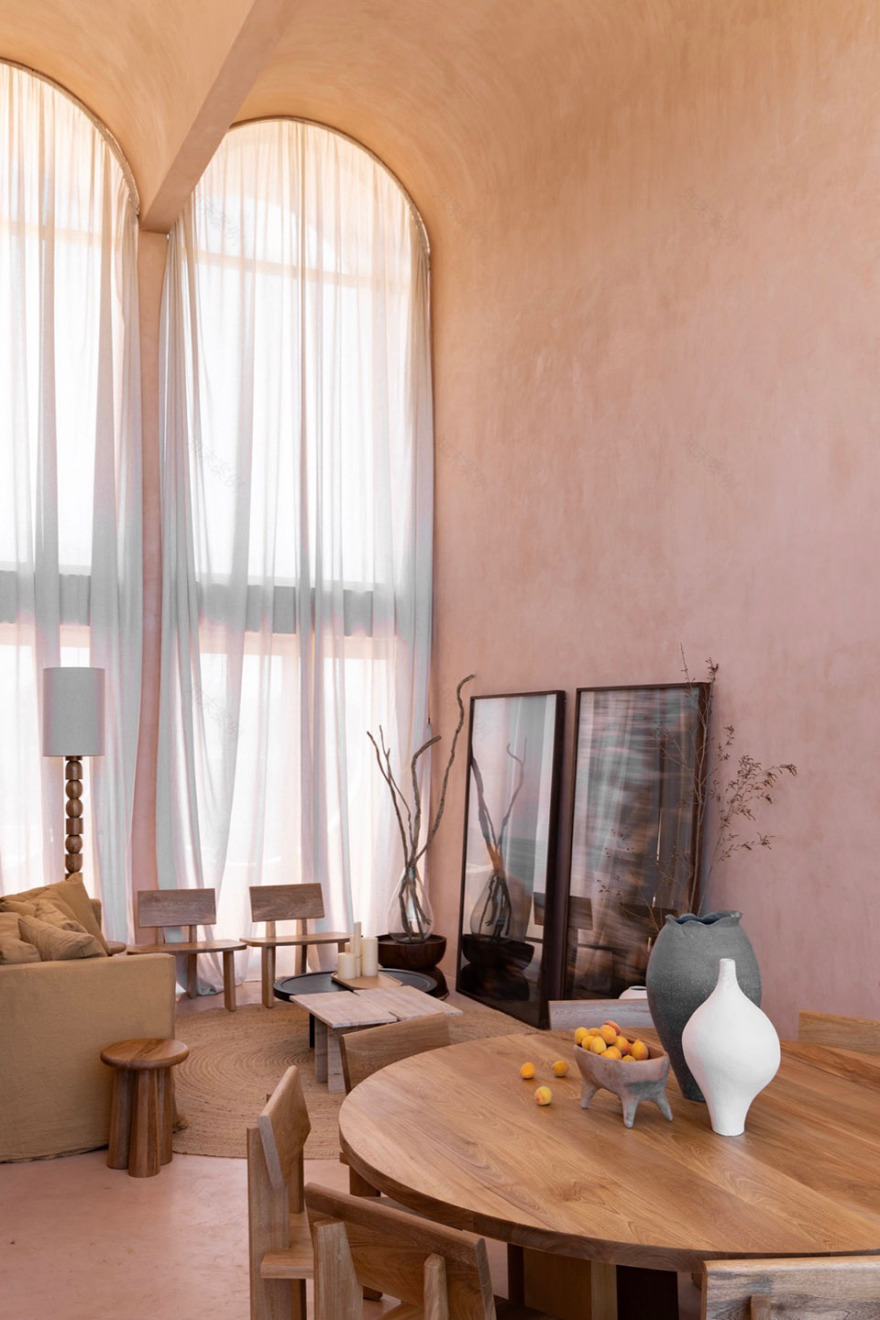
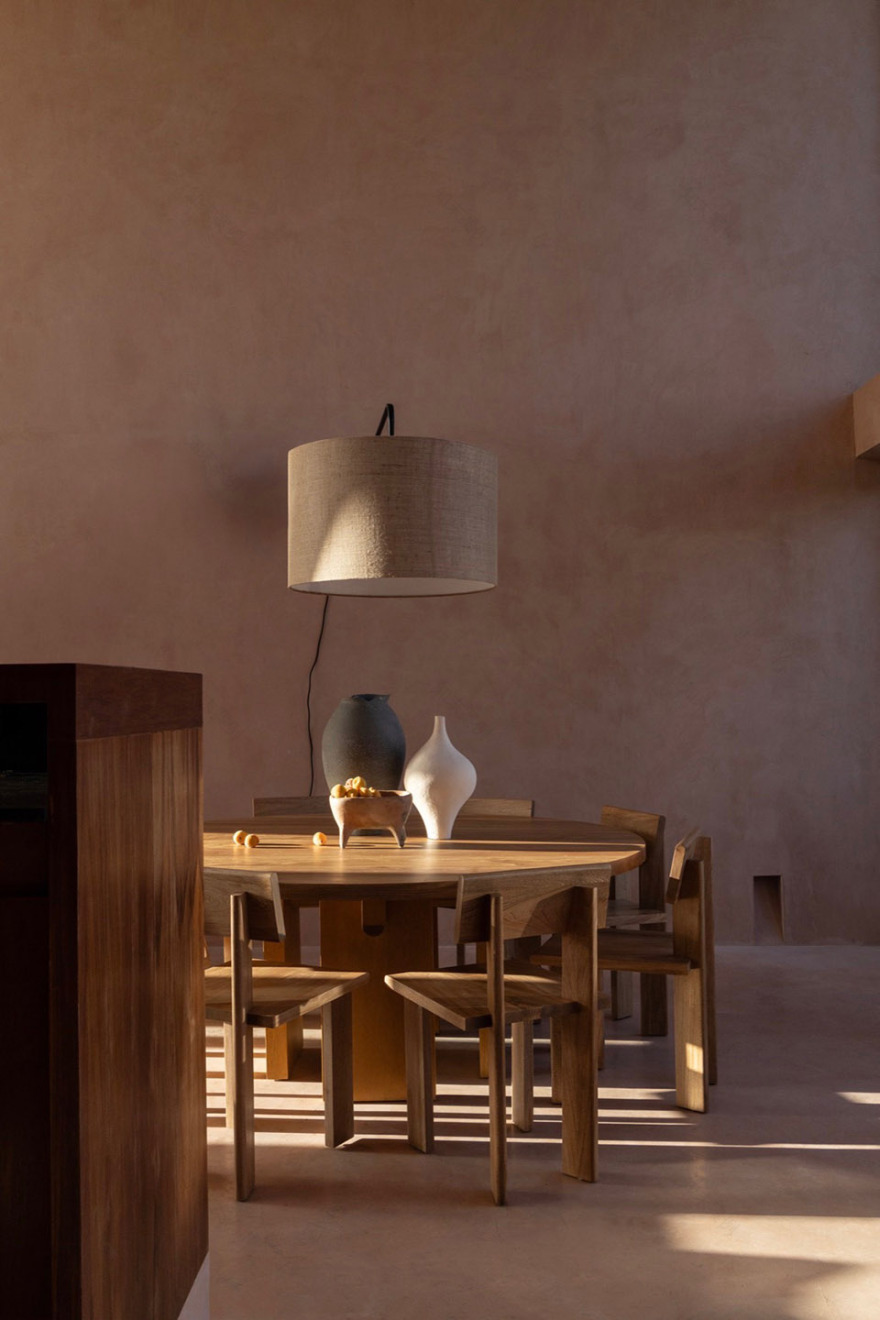
▼精致温暖的室内空间,refined and cozy interior space© Lazarillo
所有这些最终汇聚为一种超越技术层面的“耐久性”。耐久性不仅意味着选用能够在严苛气候中优雅老化的材料,以及构建便于维护的系统;更在于提出一种回应场地的居住方式,使光、水与植被成为设计的基本材料,从而转化为共享的价值。因此,Babel并非作为一个孤立对象存在,而被视为一种再生性的介入:它减少占地、通过垂直集约化集中密度、将土地归还自然过程,并提出一种不仅止于降低破坏、而是主动“回馈”——回馈景观与社区——的旅游开发模式。
Everything converges into a notion of durability that exceeds the technical. Durability is, yes, choosing materials that age with dignity in a demanding climate and organizing systems where maintenance is simple. But it is above all about proposing a way of inhabiting that is attentive to the site, capable of turning light, water, and vegetation into design material and, therefore, into shared value. That is why Babel is not offered as an isolated object but as a regenerative agent: it reduces footprint, concentrates density vertically, returns land to living processes, and proposes a touristic development that does not settle for minimizing damage but aspires to give back —to the landscape and the community— more than it takes.
▼精心布置的家具,sophisticatedly arranged furniture© Spaces by Conie


▼楼梯下的沙发,sofa under the staircase© Spaces by Conie


▼由餐厅看客厅,viewing the living room from the dining area© Spaces by Conie

▼卧室,bedroom© Spaces by Conie

在这一平衡之中,业主的诉求得以实现,同时不牺牲场地本身的内在逻辑:塔楼得以存在并承担组织作用;拱券得以建立并生成空间氛围;功能混合确保了活力与经济性;而最终留存下来的,是场地自我修复与生长的体验——呼吸的庭院、引导行走的光、调节气候的水,以及随时间愈发丰盈的植被。由此,Babel被理解为一个向环境学习、并在此过程中不断放大其价值的整体。
In that balance, the client’s expectation finds fulfillment without sacrificing the intelligence of place. The tower exists —and organizes—; the arches stand —and build atmospheres—; the mix of uses ensures activity and economy; and yet, what remains is the experience of the site restoring itself: the courtyard that breathes, the light that teaches one to walk the building, the water that cools, the vegetation that thickens over time. Babel is thus understood as an ensemble that learns from its environment and, in doing so, amplifies it.
▼会客厅,lobby© Funciono

▼双层通高的空间,double-height living space© Funciono

▼卧室细部,details of the bedroom© Funciono

▼浴室,bathroom© Funciono

▼细部,details© Daniel Villanueva

▼窗帘,curtain© Daniel Villanueva


▼细部,details© Daniel Villanueva

▼平面图,plan© V Taller

▼屋顶平面图,roof plan© V Taller

▼剖面图,sections© V Taller


BABEL
Location: Tulum, Quintana Roo, Mexico
Plot: 3,510 m²
Built Area: 6,178 m²
Date of Completion: April 2024
Architecture: V Taller
Lead Architects: Miguel Valverde and Daniel Villanueva
Design Team: Andrea Castro and Karina Ortega
Construction: Empresa MAQTE and Bramah Desarrollos (Ricardo Ávila)
Interior Design: Carlos y Pablo
Lighting Design: Carlos y Pablo and V Taller
Photography: Albers Studio, Spaces by Conie, Lazarillo, Daniel Villanueva and Funciono

南京喵熊网络科技有限公司 苏ICP备18050492号-4知末 © 2018—2020 . All photos and trademark graphics are copyrighted by their owners.增值电信业务经营许可证(ICP)苏B2-20201444 苏公网安备 32011302321234号
苏公网安备 32011302321234号客服
消息
收藏
下载
最近