

创作上传
VIP
收藏下载
登录 | 注册有礼
查看完整案例

收藏

下载

分享

翻译
Architects:Giordano Hadamik Architects,Gosplan,caarpa,studio.skey
Area:750m²
Year:2025
Photographs:Anna Positano, Gaia Cambiaggi | Studio Campo
Manufacturers:Flexform,Santa & Cole,Atelier 278,Carl Hansen,Cassina,De Padova,Dedon,Ethimo,Ethnicrafts,Filva Srl,Frama CPH,Fred Rigby,GUBI,Gloster,Gubi,Lumina,Monolith,Mor Design,Piet Boon,Project 213A, +10Roda,Studio 125,The Corner Studio,Tribu,URBI ET ORBI,Up&Up,Vitra,Zanat,studio.skey,wdstck-10
Structural Designers:Signorelli Evaso Moncalvo ingegneri associati
M&E designer:studio tecnico Taccini
Lighting design:Gemma Scartabelli
Quantity surveyor:Roberto Ombrina
Category:Lodging,Landscape Architecture
Design Coordination:Giordano Hadamik Architects + Gosplan
Design Leaders:Nadine Hadamik (Giordano Hadamik Architects), Lorenzo Trompetto (Gosplan)
Design Team:Daniele Giordano (Giordano Hadamik Architects), Nicola Lunardi (Gosplan), Veronica Rusca (Gosplan), Marina Mori (Gosplan), Selene Vacchelli (Gosplan)
Landscape Coordination:caarpa (Marta Carraro, Francesco Forni)
Landscape Design Team:Pietro d’Albertis (caarpa), Mauro Di Domenico (caarpa)
City:Recco
Country:Italy

Text description provided by the architects. On November 10, 1943, the city of Recco was destroyed forever. Twenty-two bombers of the British Royal Air Force dropped 33 tons of explosives, attempting to demolish the railway bridge, an iconic element of the town and a crucial point for the supply of Nazi-fascist troops. The bombing caused the deaths of numerous civilians and almost completely destroyed the characteristic Ligurian village. The town was razed to the ground. On November 11, the landscape around the railway bridge bore the spectral image of one of the most picturesque villages on the Levante coast: Recco was now only a memory, with only a few houses and a few scattered monuments left intact. During the years of reconstruction, some renowned architects were called upon to revive the town, including Luigi Vietti, the designer of the Town Hall building. Among the victims of the bombing was a large part of a beautiful Franciscan complex dating back to the 1400s, of which the church was almost entirely destroyed.


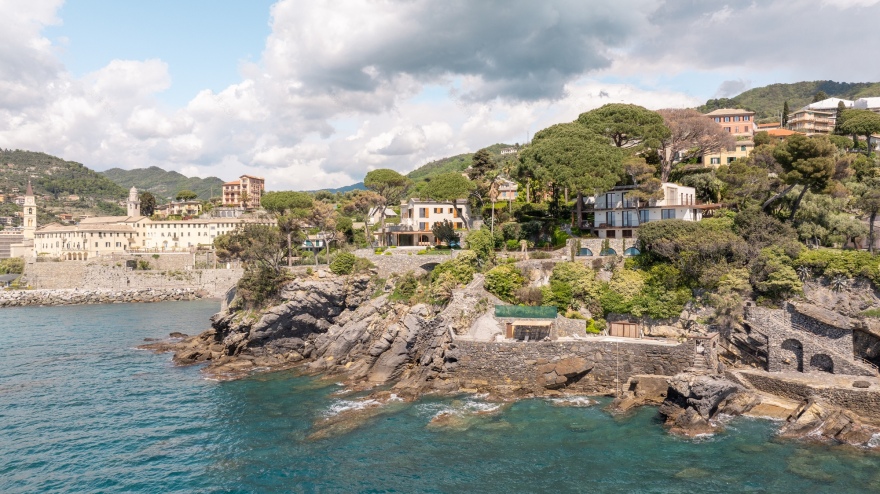
The complex overlooks a splendid bay (the Bay of the Friars), which takes its name from the monastery. The main part of the complex is composed of a long volume that, with its system of terraces, outlines the façade along the beach. To the east of the complex, a large green promontory is characterized by a system of gardens and private villas that complete the image of one of the few places in the town where the pre-war character is still visible: at the end of the 1800s, before an intense development of the area, this was a large private park, owned by a single villa. From the early years of the 20th century, the large park was subdivided into lots, but the main part remained linked to a large villa, located in the center of the land, which defined this area. The building is singular and eclectic, characterized by heterogeneous and incongruent additions, although, in reality, the entire volume was constructed during the same period. A massive three-story main body, with a traditional layout and gabled roof, rests on a stone porch and intertwines with a more modern volume, characterized by four large windows. The result is a disordered mass, probably the result of speculative decisions or continuous stylistic changes, aimed at increasing the volume or, at least, the view of the Ligurian coastline.

As mentioned, the building is not exemplary from a sculptural point of view, but it highlights great spatial richness and a potential relationship with the park that is absolutely commendable. The park, like many Ligurian gardens, is characterized by large terraces, and the villa was designed to enjoy access to the garden at every level. The large park (about 5,000 square meters) rests on the cliff and extends, along the rock, to the Friars' Beach. The pre-existing vegetation, as in the Italian romantic tradition, is a mix of native and exotic plants. An exoticism so internalized that it has now become tradition. Maritime pines are indeed accompanied by Aleppo pines, cypress trees, and olive trees, which are juxtaposed with camphor trees and monumental cycads. Palms, although threatened by the red palm weevil, are a must. This aspect has been further emphasized in the access area to the guest rooms, where, through careful planning, Mediterranean plants greet exotic flowers such as Echium, Euphorbia, and Strelitzia.


In 2020, the property, previously divided into four separate units, was purchased with the intention of transforming it into a single- family villa. The project's goal was ambitious: to give the building an appearance more in tune with its context and to reconnect the relationship between the villa and the surrounding environment. This promontory, with its monastery, has remained in the post-war cityscape as one of the few iconic fragments of present-day Recco. For this reason, from the outset, the project was approached as a landscape intervention: the work on the building was not meant to strengthen its identity but rather to lighten its presence, improving the façades and reinforcing the relationship between the interior and exterior, which already existed in some parts of the villa. The non-stereometric nature of the volume originally stemmed from the desire to adapt the building to the steep terrain, giving each floor of the villa the opportunity to open up to a portion of the private garden.

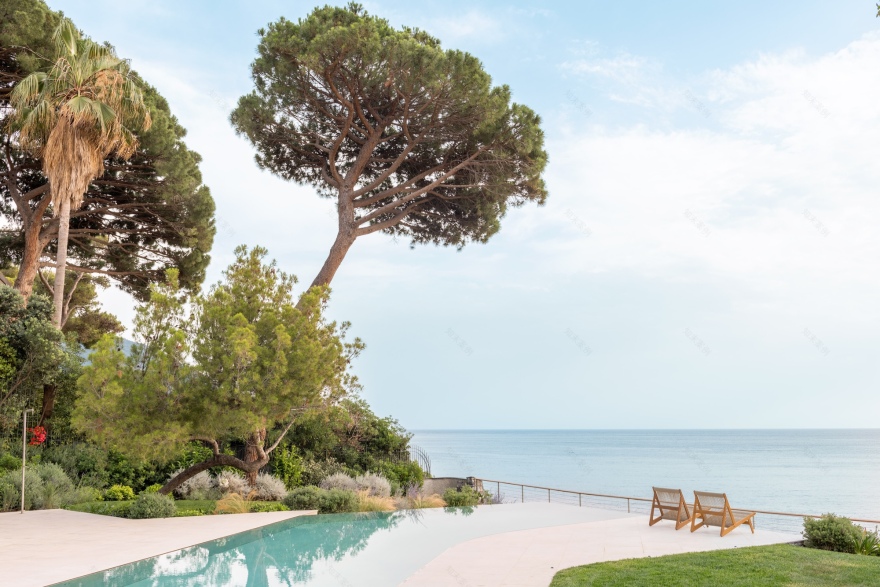
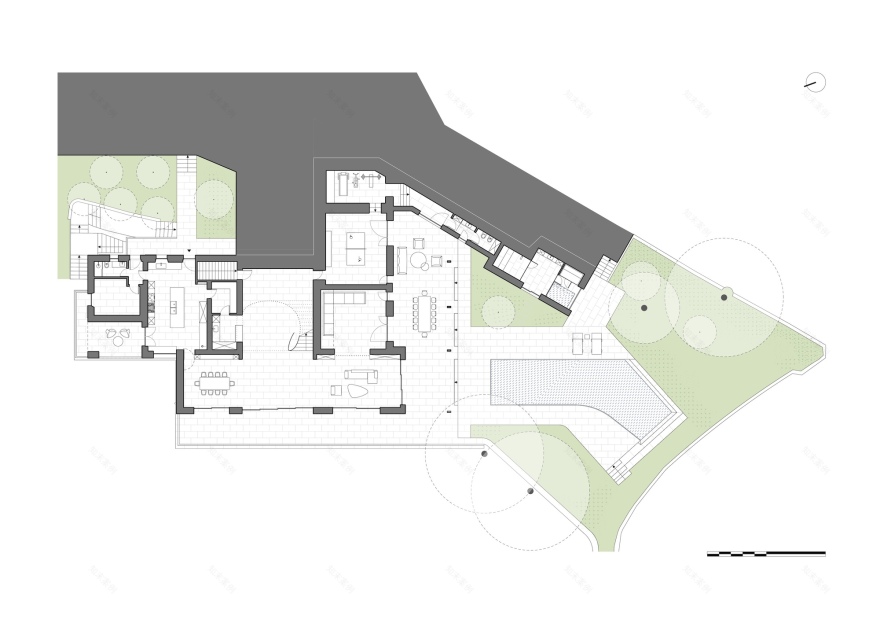
However, this potential had remained unexpressed due to neglect and an incomplete garden design. For this reason, the architects from Gosplan and Giordano Hadamik (partners in the project) decided from the outset to collaborate with the caarpa landscape studio to develop the relationship between architecture and landscape. The goal was to create a new balance in which the landscape would enter as much as possible into the domestic spaces, making the common areas of the house extend toward the coast. In this spirit, the new pool was designed, integrating aesthetically into the glazed volume of the living room. Its rotated shape creates a geometric relationship between the villa and the cliff profile on which it stands. A unique aspect of the pool is its relationship with water: thanks to a complex mechanical system, the bottom of the pool can rise, changing its depth and, consequently, the color of the water, until the pool completely disappears, transforming into a large terrace. For this reason, large slabs of Botticino marble (a material widely used in Recco during the post-war reconstruction, particularly by Luigi Vietti for the Town Hall) were laid in strict continuity with the indoor flooring of the house.

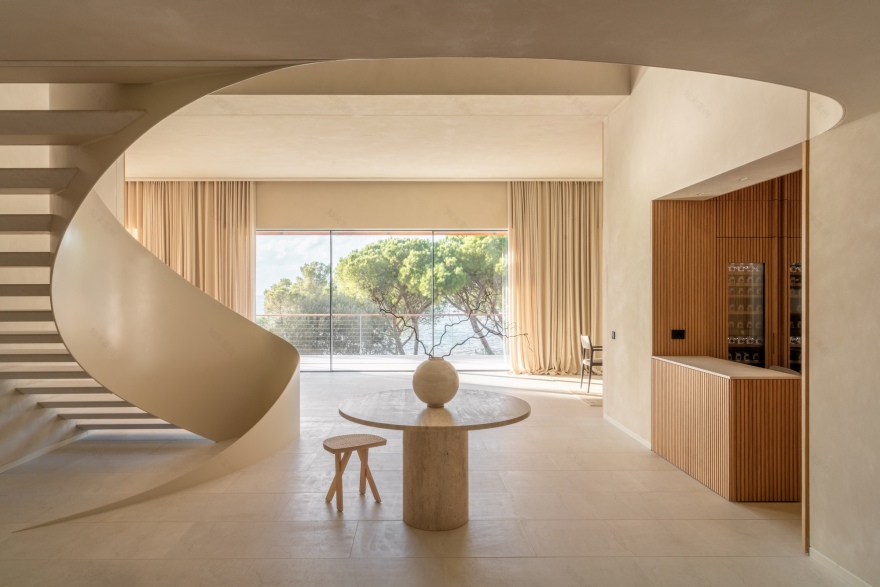
The living room was conceived as the spatial core of the villa, capable of visually and spatially linking the various portions of the garden, which, at different levels, surround the building. Through the windows, it is possible to glimpse the sea even from the garden areas located uphill. The living room thus takes the form of a large loggia, 5 meters high, a covered garden space carved out of the villa's mass. From this space, the boundary between house and garden becomes blurred and immaterial; only a large wooden pergola softens the internal light and creates an architectural link between the villa's volumes. Just as around the pool, Botticino marble is used for the paths and resting areas near the villa, while toward the more remote areas of the park, the white and regular hardscape is replaced by local split gray stone. The change aims to blur the humanized spaces into the landscape, amplifying the sense of immersion in nature.

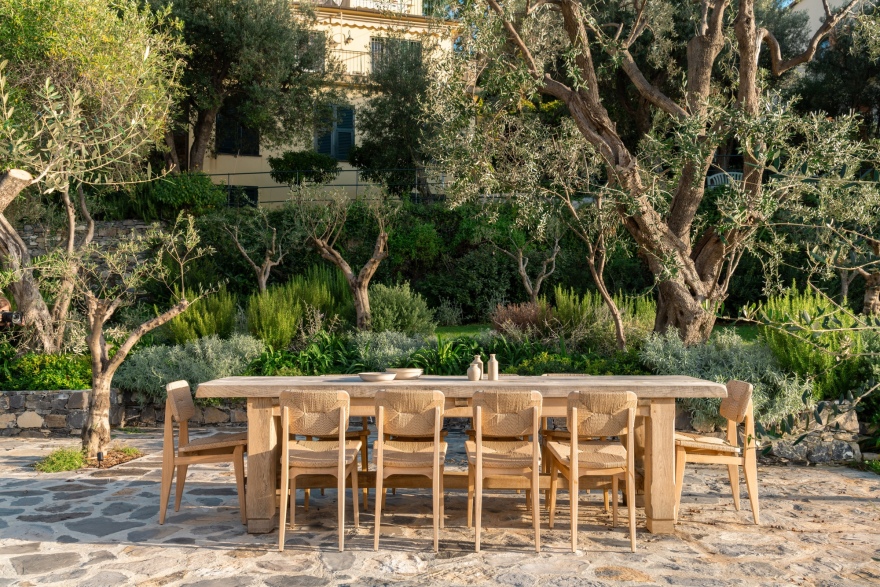
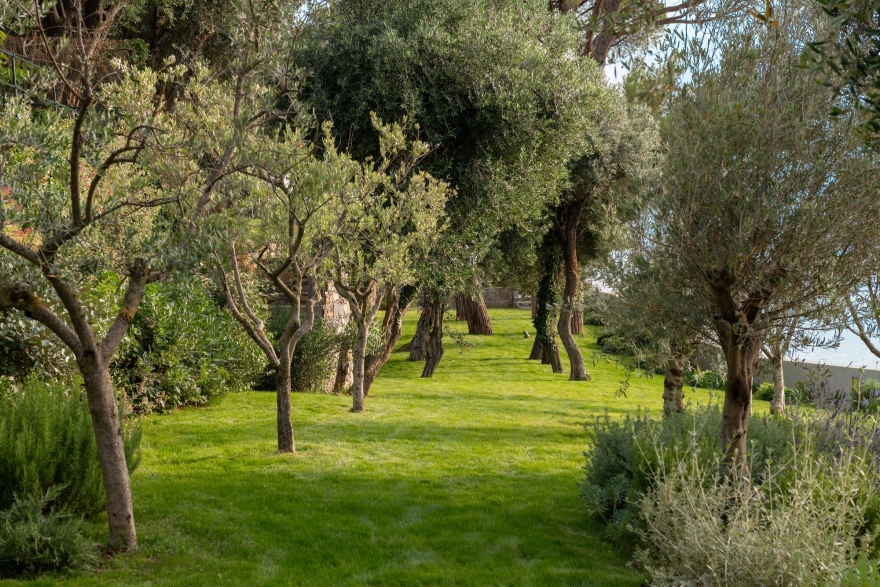
The choice of vegetation also follows this logic in a delicate and gradual manner. In the upper part of the park, a shaded garden leads to the guest room entrances, surrounded by evergreen volumes and borders of Hydrangeas, Farfugium, and bulbs. As you approach the living area, the park makes way for the architecture, simplifying its design and leaving wide grassy surfaces; breathtaking views thus open up, even from inside the villa. Approaching the sea, between the olive tree groves, which have been maintained and increased, one can enjoy a glimpse of Ligurian rural life, where Mediterranean borders typical of this region offer not only stunning silvery textures of foliage and discreet flowers but also fragrances that transport you among the sun-drenched creuse, the ancient mule tracks of Liguria. The tall trunks have all been preserved, while the many existing olive trees have undergone a limited replacement of diseased plants, keeping the original number intact. Many species of fruit trees have been newly planted to evoke the productivity of the coastal terraces before mass tourism.
The boundaries of the garden are a mix of typical Mediterranean scrub plants (Pistacia lentiscus, Arbutus unedo, Spartium junceum) that frame the property without creating a barrier, but form, in turn, a linear garden that changes in size and height, blending with the surrounding plants. In the park, there is also a boathouse and a small private spa, housed in a dry stone volume, an element that strongly interacts more with the typical terracing of Ligurian gardens than with the villa's architecture. The interior of this space is characterized by a luminous contrast, accentuated by the dark Cardoso marble cladding, which softens the light coming from the window that faces the garden adjacent to the pool.


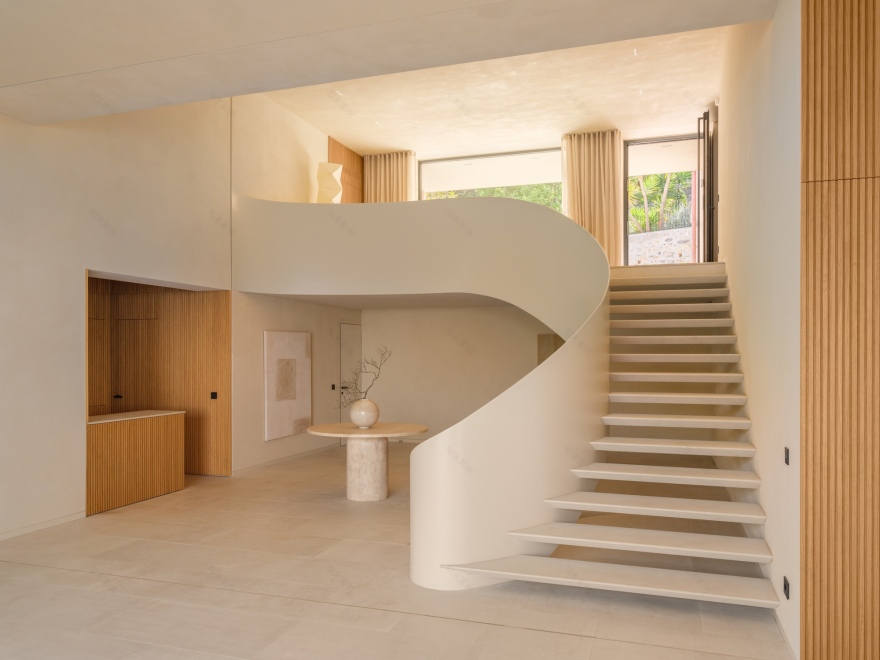
The villa's interiors are marked by a consistent material palette: Botticino marble is used throughout, including in private spaces, while natural lime, which defines the exterior, also coats the interiors. Custom-made oak furniture with a vertical slat motif defines each room, addressing technical needs, concealing equipment, and contributing to sound absorption. The FF&E and bespoke furniture design introduce tactile, natural materials—live-edge timbers, linen, rope, nubuck, and leather—which contrast with the architectural palette of marble, lime, and glass. A restrained color scheme, clean lines, and carefully curated pieces lend the interiors a timeless, relaxed elegance. Studio.skey of London coordinated the furnishings and decorative elements, combining iconic vintage pieces with refined Italian designs by Flexform, Cassina, B&B Italia, and Ceccotti.
Project gallery








南京喵熊网络科技有限公司 苏ICP备18050492号-4知末 © 2018—2020 . All photos and trademark graphics are copyrighted by their owners.增值电信业务经营许可证(ICP)苏B2-20201444 苏公网安备 32011302321234号
苏公网安备 32011302321234号客服
消息
收藏
下载
最近