

创作上传
VIP
收藏下载
登录 | 注册有礼
查看完整案例

收藏

下载

分享
2024年,咖啡烘焙师Andrew Werbowyj将其独特风格与对细节的极致关注带入蒙特利尔Mile Ex社区的本地烘焙领域。在柏林与多伦多学习过第三波咖啡烘焙技艺后,Werbowyj希望拥有一个能够实践烘焙工艺的场所。但更重要的是,他希望与一群志同道合的人分享这份热情——为他们提供一个温暖、舒适的空间,而不仅仅是远程办公的替代场所。社区所具有的工业气质与不矫饰的氛围,恰好成为承载这一愿景的理想背景,于是Café Even应运而生。
In 2024, coffee roaster Andrew Werbowyj brought his unique style and meticulous attention to detail to the local roasting scene in the Mile Ex neighbourhood of Montreal. Having previously studied the art of third wave roasting in Berlin and Toronto, Werbowyj wanted a place to practice the craft of roasting. But more than that, he wanted to share his passion with a dedicated audience looking for a cozy spot that was more than an alternative remote workspace. The industrial and unpretentious attitude of the neighbourhood was the ideal setting for his future vision, and Café Even was born.
▼项目概览,overall of the project© Félix Michaud

Werbowyj为这家咖啡馆设定的核心,是一种以咖啡师为中心的体验:让每一位顾客都能感到被欢迎,并被鼓励去交流、学习与品尝。他的价值观围绕着“过程”展开——强调从咖啡豆到一杯咖啡的转化过程中所蕴含的时间、节奏与手工艺精神。于是,一个问题自然浮现:为何不创造一个空间,将咖啡的仪式感与一种平静、均衡的氛围融合在一起? Future Simple Studio受邀将这一愿景转化为空间语言。作为一个设计团队,我们的价值观与之契合:我们倡导创造力、工艺以及经得起时间考验的设计。我们相信,建筑作为一种实践,可以通过深思熟虑的方式建立连接、激发多元视角,并创造值得铭记的体验。
Werbowyj’s program for the café included a barista-centric experience where each customer felt welcomed and encouraged to chat, learn and taste. His values revolved around the process, the slowness and craftsmanship involved in the transformation of bean to cup. Why not create a place that blends the ritual of a coffee with a feeling of calmness or evenness within? Future Simple Studio was approached to translate his vision architecturally. As a studio, our values aligned with his: we champion creativity, craft, and timeless design. We believe in architecture as a practice where a thoughtful approach can help to build connections, uncover different perspectives, and allow for memorable experiences.
▼空间围绕咖啡制作过程展开,
the space is centered around the coffee-making process© Félix Michaud
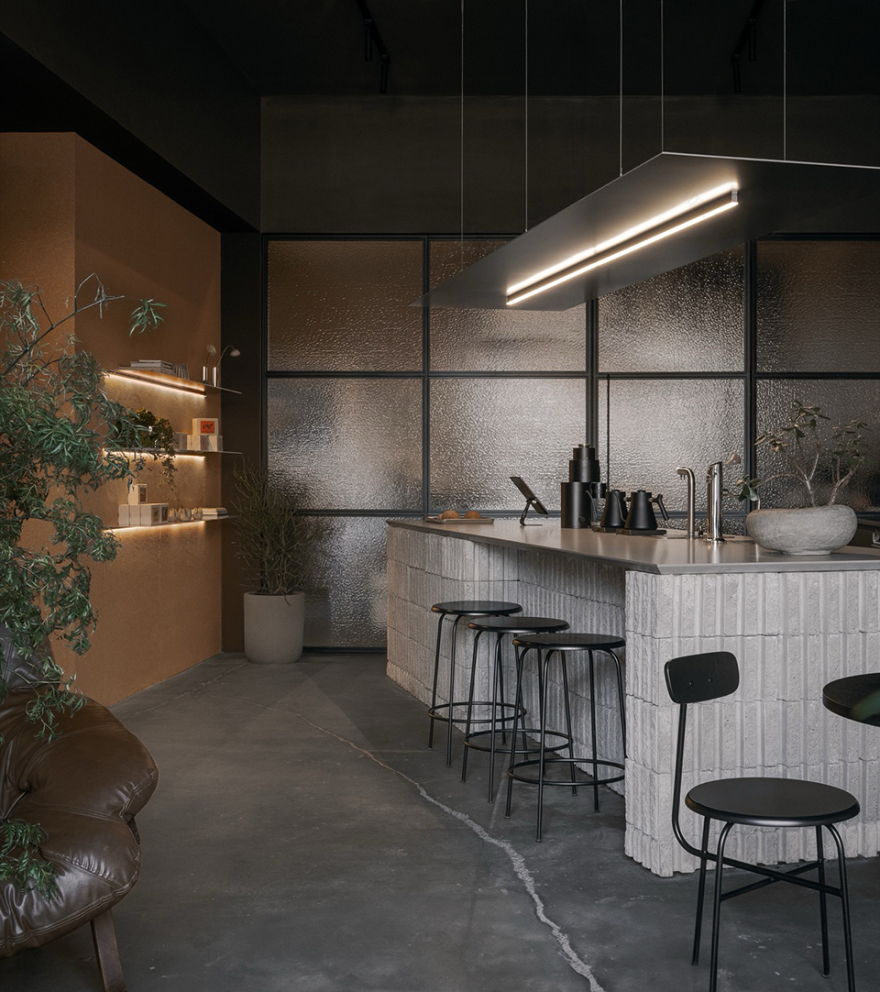
▼Andrew Werbowyj制作咖啡的场景,the scene of Andrew Werbowyj making coffee© Félix Michaud

在与Werbowyj的共同讨论中,我们逐渐明确了一个方向:打造一个如同“他人之家”的空间。我们设想,当人们走进朋友的厨房时那种熟悉与放松的感觉,并试图将这种氛围转化为一种能够给予路人以归属感的环境。很快我们意识到,这家咖啡馆的真正意义在于时间中逐渐发生的交流、对话与片刻体验。而这些互动的核心,正是手冲咖啡所蕴含的仪式性——它成为日常生活的一部分,也参与了咖啡豆转化为液体的“炼金术”过程。建筑所面临的挑战,在于如何呈现并强化这一过程的不同阶段。
Together with Werbowyj, we discussed creating a space that felt like someone’s home. We brainstormed the possibility of evoking the feeling when one walks into a friend’s kitchen and creating an environment that could instill comfort and belonging in a passerby. It quickly became evident that the importance of this café lay in the exchanges, conversations and moments that would be made over time. The heart of these interactions is the ritualistic nature of making the perfect drip coffee, being part of someone’s daily routine and taking part in the alchemic conversion of bean to liquid. The architectural challenge was to celebrate the different stages of the process.
▼熟悉与放松的居家氛围,
a familiar and relaxing home environment© Félix Michaud

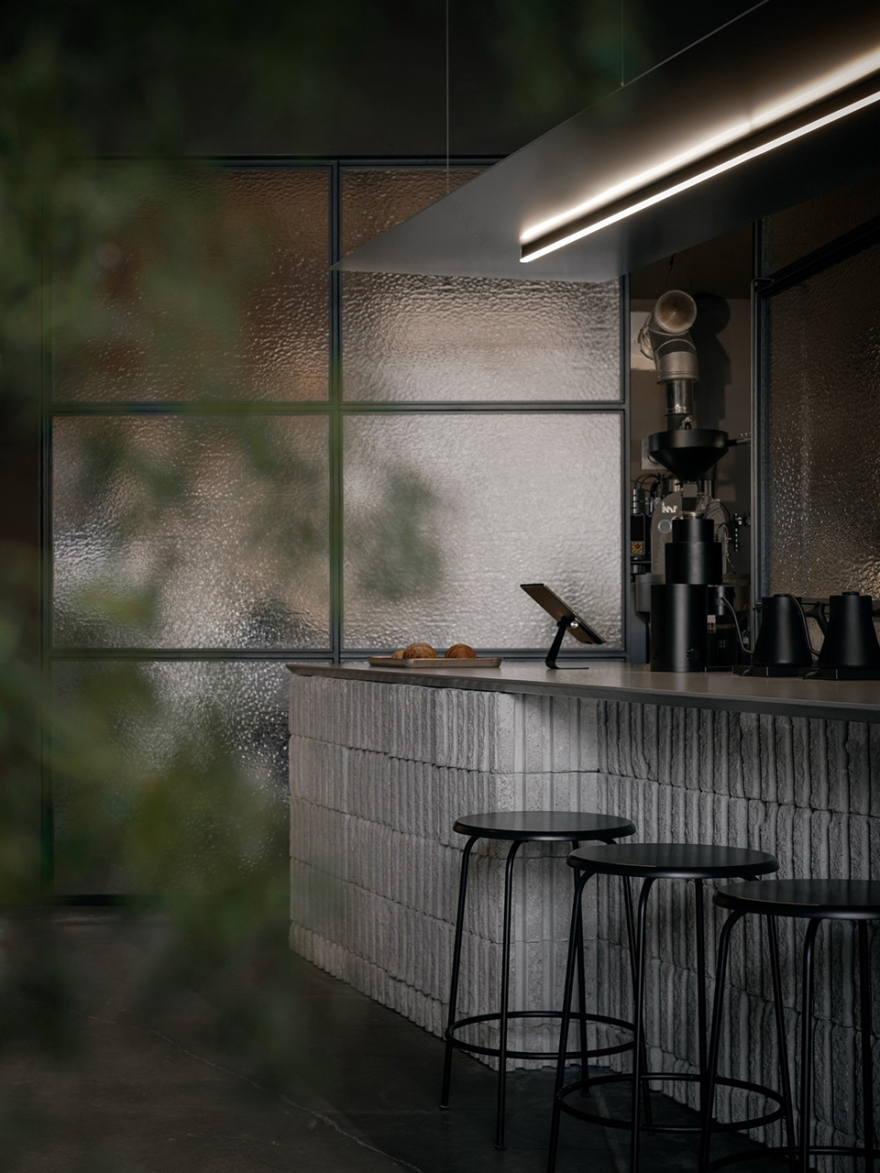
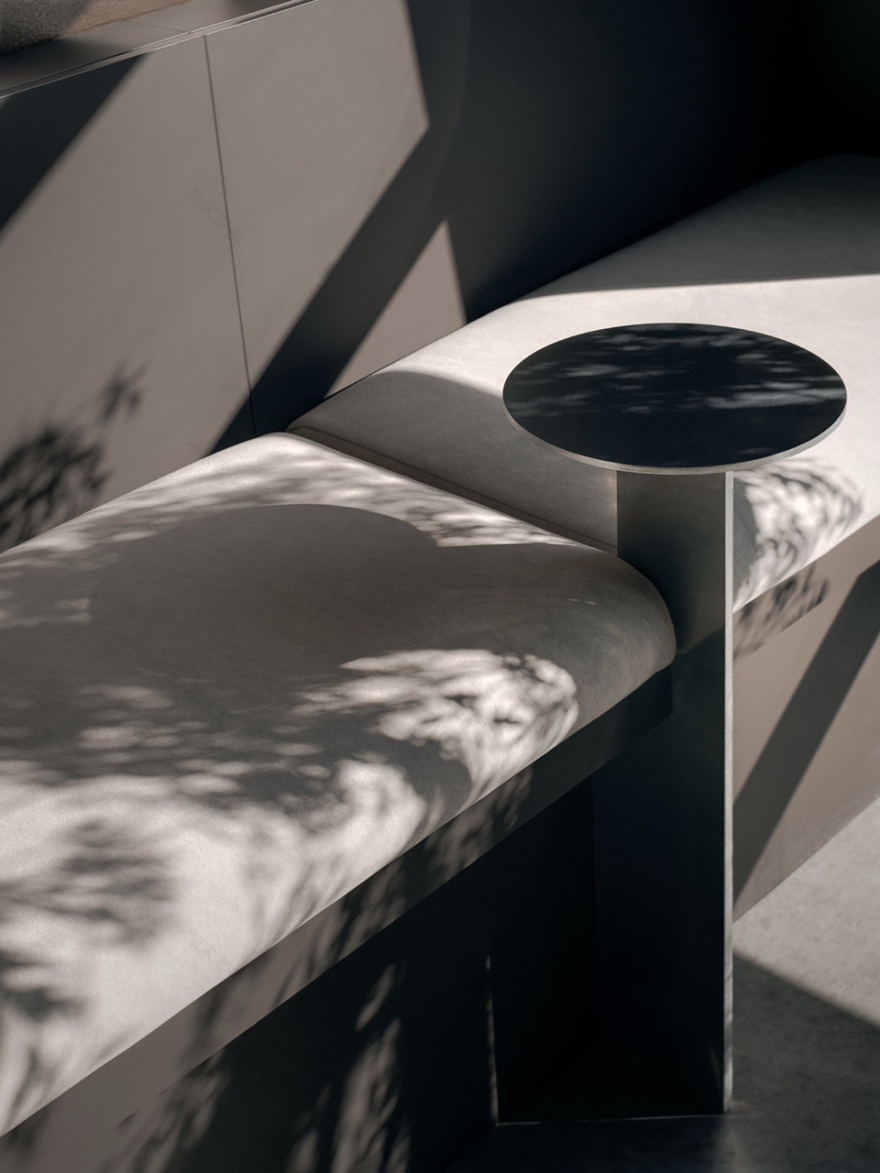
在仅有约1,170平方英尺的既有工业空间中,同时容纳咖啡烘焙与冲煮功能成为一项程序上的挑战。此次室内改造的首要策略,是在“前场”与“后场”之间建立清晰划分。鉴于知识分享是Werbowyj愿景的核心,我们设计了一道具有质感的玻璃隔断——既半透明又具渗透性——作为首个介入元素,以此构建烘焙初始阶段与冲煮最终阶段之间流动而连续的关系。为在物理分隔的同时保持空间的连贯性,我们通过一条连续的内置家具将前后场连接起来。从后场延伸出的一条“线”一直抵达前立面与原有车库门,视觉上将室内纵深与外部街道联系起来,同时激发路人的好奇心。除了视觉表达,这一元素也具备高度功能性:在后场,它作为主要的包装区域;向前过渡为主吧台后的操作台;最终降低成为座椅区——顾客可以在此独自品饮(配以小型圆桌),或以卡座形式并排就坐。
Tasked with the programmatic challenge of incorporating both roasting and brewing in an existing industrial space of only 1,170 sq ft., our first move in this interior renovation was to establish a division between ‘front’ and ‘back’ of house activities. Since knowledge-sharing was central to Werbowyj’s vision, we designed a textured glass partition—both translucent and permeable—as the first element to shape the fluid relationship between the initial stages of roasting and the final stages of brewing. To balance the physical separation, we connected the front and back with a continuous element of built-in furniture. Extending from the back, a line was drawn to the front facade reaching the existing garage door, visually linking the depths of the interior space to the outside and piquing the curiosity of passersby. Aside from its aesthetic role, this element is highly functional. At the back of the house it begins as the main packaging area, smoothly transitioning to a prep counter space behind the main bar and finally dropping to become a bench, where patrons can sip their drink solo with individual round tables, or side by side banquette seating.
▼半透明又具渗透性的玻璃隔断,
translucent and permeable glass partitions© Félix Michaud

接下来,我们希望空间能够主动引导顾客并形成富有动态的流线。因此对西侧墙体进行了重新设计,以塑造入口体验。为了强调从室外进入室内的“缓慢过渡”,我们设置了一个弧形入口,并以轻薄的织物帘将入口走廊与主要空间分隔。顾客的视线随后被自然引导至一个斜向布置的主品鉴吧台。吧台的位置选择打破常规,从视觉上释放了流动路径,使顾客可以围绕吧台自由移动,从而削弱传统“交易式”的顾客与服务者关系。整体建筑构思(parti)成为对几何体量细微变化的探索。平面如同一幅现代主义绘图,其完成依赖于对各基本体量之间张力关系的反复推敲与精细平衡。
Next, we wanted to ensure the space actively engaged the clients and created a dynamic circulation. We opted to rework the west wall, enabling us to mold the entry experience. To celebrate a slow transition from the outside, we created a curved entryway separating the entry hallway and the main space with a sheer woven curtain. Patrons’ attention is then intuitively directed to the main tasting counter placed at an angle. The positioning of the bar was an unconventional decision that visually liberated the flow of movement, leaving patrons to move all around the bar, and disrupting the transactional nature of customer-server interactions. The architectural parti became an exercise in the subtle shifts of geometric blocks. The plan was approached like a modernist drawing, its success relying on the iterative refinement of balanced tensions amongst the elemental volumes.
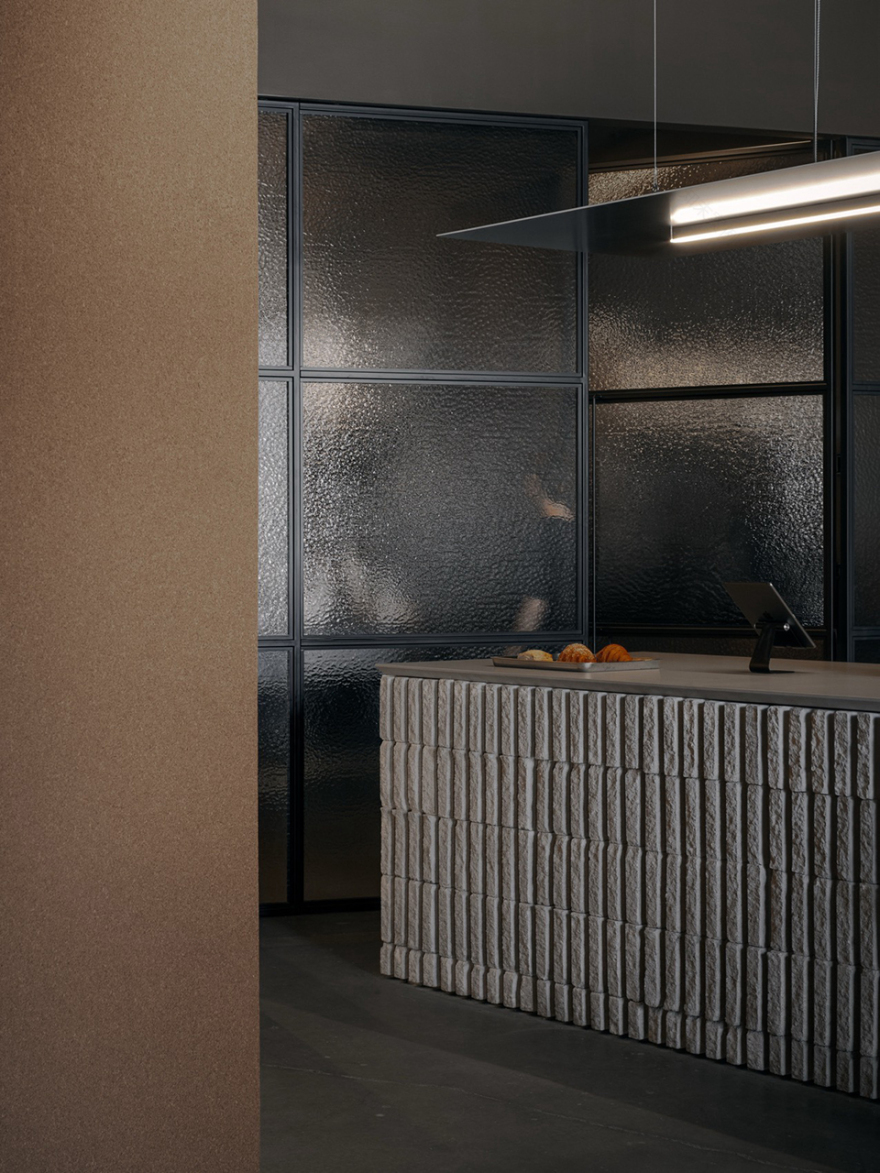
▼吧台表面的肋状混凝土单元,
the rib-shaped concrete units on the surface of the bar counter© Félix Michaud

Werbowyj希望打造一个兼具灵活性与公共性的空间体验,但这一愿景也带来了相应的挑战。首先,在开放空间中设置烘焙设备会产生声学问题。为此,设计采用了多种具有吸音效果的材料——如软木墙面、肋状混凝土砌块以及柔软织物帘——以减弱噪音影响。同时,我们设置的玻璃隔断不仅在功能上实现了空间分区,也进一步降低了噪声,并将人们的注意力引向其后的活动。其半透明特性将烘焙过程转化为一种“影像剧场”,凸显出其中的魅力。这种非常规玻璃(称为Chinchilla)具有细密纹理与类似毛皮的质感,从远处看呈现出明显的波纹效果。这一有机界面将工匠的动作传递给顾客,形成一种持续上演的编排,让人隐约感知一杯咖啡背后所凝聚的劳动与技艺。
Werbowyj’s desire to create a flexible space and communal experiences came with its challenges. For one, having a roaster in an open room posed acoustic problems. Textured materials—cork walls, ribbed concrete blocks, soft curtains—were used to attenuate sound impact. Next, the glass partition we installed created a programmatic separation, further reducing noise, and at once drawing attention to the happenings behind it. Its translucency highlights the magic of the roasting process by turning the activity into a shadow theatre. The unconventional glass (called Chinchilla) is characterized by fine lines and a fur-like texture that creates a striking wave pattern when seen from afar. This organic screen transmits the movement of the artisans to the customer, an ever present choreographed routine hinting at the amount of work that goes into the art of making one cup of coffee.
▼兼具灵活性与公共性的空间体验,
a flexible space and communal experiences© Félix Michaud

▼座位区,seating area© Félix Michaud

接下来的挑战是在有限的前场空间中容纳四种不同的座位形式。为此,设计通过相互叠合的“微型空间”来实现多样化使用。在主吧台与品鉴区,Audo Copenhagen的高脚凳使顾客能够直接与咖啡师交流——既适合熟客日常停留,也吸引好奇者深入了解咖啡文化,并承载更为私密的品鉴体验。卡座则被设计为既可独处,也可促成偶然相遇:由本地Foutu Tissu制作的软垫长椅,搭配MDT Mobilier设计的节奏感十足的圆形铝质边桌,使顾客可以在半私密状态下阅读、处理邮件,或与朋友相聚。其余空间配以Audo Copenhagen的可移动桌椅,可根据需要灵活调整以容纳更大规模的群体。最后,一张复古休闲椅——也是最受欢迎的位置——安置在高大的盆栽旁。整个座位区域始终处于变化之中,熟客会像在老朋友的客厅里一样,自然地移动家具、调整空间。▼圆形铝质边桌,round aluminum side tables © Félix Michaud
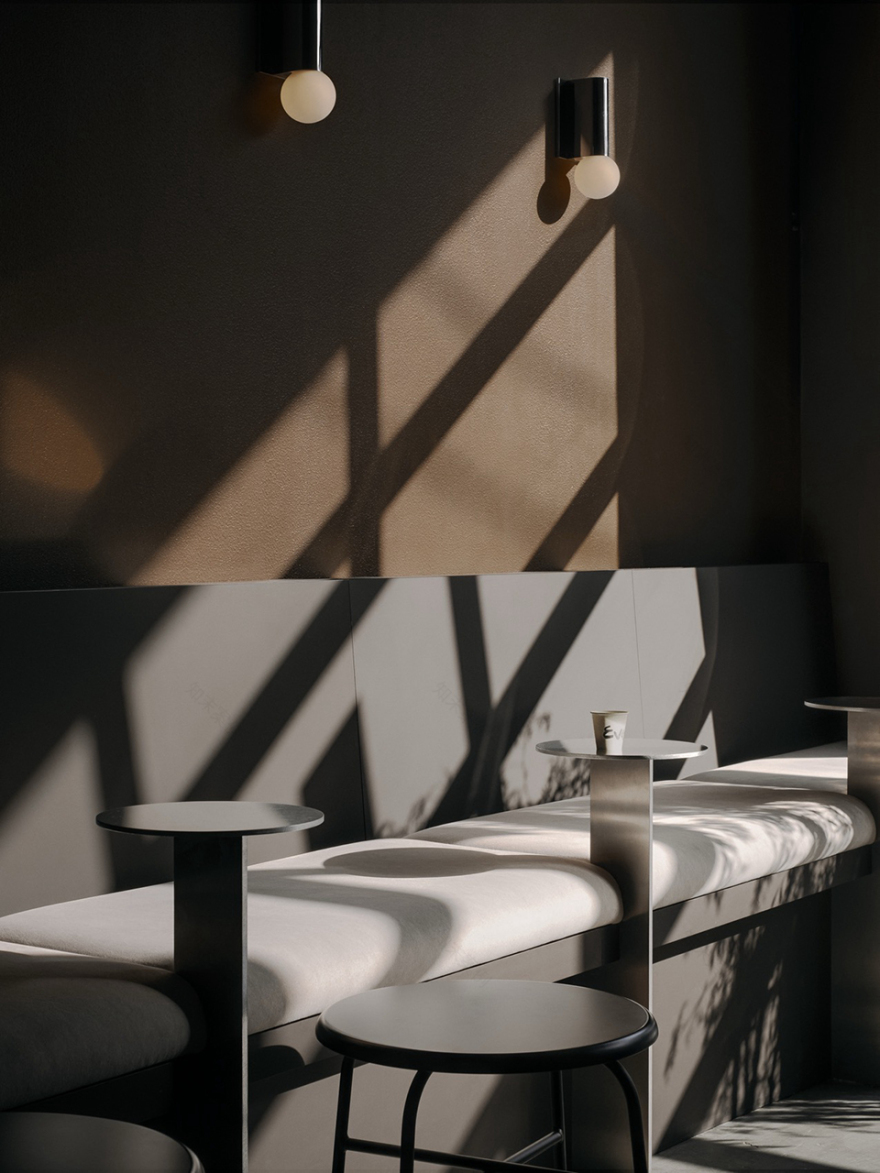

▼细部,details© Félix Michaud
材料的选择成为营造“居家感”的关键,使这家咖啡馆区别于城市中常见的明亮、纯白空间。在与Werbowyj的初步讨论中,设计灵感源自蒙特利尔粗野主义建筑遗产以及Mile Ex社区的工业氛围。在有限预算条件下,Future Simple Studio选择使用常见的建筑材料,并通过创新性的处理方式提升其原始特质。这种“将日常转化为珍贵”的策略,依赖于对工艺与细节的高度关注,也正是对Werbowyj愿景的回应与延续。每一种看似朴素的材料,皆因其能够与相邻元素形成对话而被选用,从而增强整体空间的触感体验。从入口弧形墙面上带有颗粒质感的软木饰面,到贯穿前场咖啡区与后场烘焙区的肌理涂料,再到玻璃隔断中反复出现的起伏纹理,以及吧台所使用的肋状混凝土砌块——这些细部都让人联想到咖啡粉的质感,使顾客沉浸在一种温暖而包裹性的氛围之中。
The material palette of this project became a way to create a homey environment, differentiating this coffee shop from the standard white, bright, spaces that exist around town. Initial conversations with Werbowyj revealed inspiration from Montreal’s brutalist past and the industrial nature of the surrounding Mile Ex neighborhood. Working with a restricted budget, Future Simple Studio opted for common construction materials, elevating their raw characteristics by developing innovative ways of working with them. This approach of transforming the common into precious required a focus on craft and attention to detail that was reflective of Werbowyj’s vision. Each humble material was chosen for its ability to dialogue with its neighbor, enhancing the overall tactility of the space. From the pebbling in the cork applied to the curved entry wall, to the textured paint that extends from the front cafe to the roastery, the repeating undulation in the glass partitions and the ribbed concrete blocks of the bar counter, every accent is reminiscent of coffee grounds and serves to envelop the client in coziness.
▼产品展示区,display area of the product© Félix Michaud

▼细部,details© Félix Michaud

为进一步强化“如同走入家中”的体验,Future Simple Studio在入口通道设置了一道长帘,形成一个半透明的过渡性“隧道”,柔化了室外与室内之间的转换。织物的柔软质感如同一层薄纱,过滤着人们对咖啡馆内部的视线,营造出一种微妙的期待感。同时,它也成为座位区的层次化背景,在漫射光中界定出一个更为私密的空间。整体色彩以大地色系为主,直接取自咖啡豆在烘焙过程中由生豆到焦糖再到深褐色的变化阶段,并与光洁的铝制构件及设备形成对比。温暖与冷静在此交织,营造出层次丰富的氛围,既鼓励交流,也容纳安静的独处时刻。在更为细腻的层面,一系列有机细节为空间注入自然的温度:陶艺家Edith Sévigny-Martel手工制作的略带不完美的花器,其内生长着略显笨拙却生机盎然的常绿植物,以及艺术家Mie Kim形态不规则的器皿。这些关于“不完美之美”的细小提示,不仅呼应了品牌的理念,也进一步强化了空间所呈现出的舒适感与生活气息。
To further emphasize the feeling of being welcomed into one’s home, Future Simple Studio introduced a long curtain along the entrance corridor, creating a semi-transparent tunnel, easing the transition from outside to inside. The softness of the fabric acts as a veil, filtering one’s view into the café, creating a moment of anticipation. It also serves as a layered backdrop to the seating area, defining an intimate space with diffused light.
The earthy colour palette draws directly from the different stages of the coffee beans as it travels through the roasting stages—from green to caramel to rich brown—and sits in contrast with sleek aluminum elements and equipment. Together, warm and sleek create a layered atmosphere encouraging engaged conversation and quiet reflection.
On a more intimate scale, organic accents infuse the space with earthy warmth: the imperfect handcrafted planter by ceramicist Edith Sévigny-Martel, the clumsy yet lush evergreen plant housed within, and misshapen drinkware by artist Mie Kim. These small reminders of the beauty of imperfection not only echo with the brand ethos, but also deepen the sense of comfort and lived-in charm that defines the space.
▼织物的柔软质感如同一层薄纱,
the softness of the fabric acts as a veil© Félix Michaud

▼入口,entrance© Félix Michaud

吧台上方悬挂着一件定制灯具,轻盈地漂浮在顾客头顶,框定咖啡师与客人之间亲密的互动关系。这一超大尺度、仿佛无重力的铝板从上方重新定义了空间,以一条LED光带投射出柔和光线。看似简单的手势,却引导视线、呼应下方的操作节奏,并为空间增添一种轻盈而富有氛围的光感。这种材料语言也延续至展示咖啡产品与品牌物件的悬浮搁架,由MDT Mobilier制作的金属结构,与整体温暖色调形成清晰而克制的对比。
Above the counter, we designed and fabricated a custom light that hovers just over customers framing the intimate exchange between barista and guest. The oversized and seemingly weightless aluminum plane redefines the café from above, casting a soft glow from a single LED line. A simple gesture, it draws the eye, mirrors the movements of the barista below and adds an ethereal luminosity to the bar. Its materiality is echoed in the floating shelves that showcase merchandise, coffee boxes, and branding by Wedge. Also crafted by MDT Mobilier, this sleek metal shelving provides a crisp contrast to the warm tones beyond.
▼吧台上方的定制灯具,
custom light above the bar counter© Félix Michaud

在所有项目中,设计团队始终寻找与本地工匠合作的机会,通过定制构件丰富空间叙事。在预算有限的条件下,他们以材料运用与细部设计为突破口,力求以最小成本实现最大表达,使每一件定制元素同时具备功能性与空间个性。品鉴台与吧台便是这一策略的典型体现。设计希望将其塑造为视觉焦点与空间中的独特建筑表达。通过在传统吧台基层结构外覆以肋状混凝土单元,项目得以引入Mile Ex社区常见却少用于室内的砌块材料。通过定制45度斜接拼缝,实现了干净利落的转角处理——考虑到砌块高度,这一细节实现并不简单,却为空间带来精致的垂直感与细腻的工艺表达。同时,拼缝中的细微不规则与肋状肌理又强化了材料未经修饰的原始气质,隐约回应品牌的个性。
In all of our projects, we seek opportunities to collaborate with local makers, crafting bespoke elements that enrich the narrative of the space. Given the restricted budget, we sought creative solutions to maximize impact through material use and thoughtful detailing, ensuring that each custom piece added both function and character to the experience. The tasting counter and bar is a prime example of this. We wanted this area to become a focal point and a unique architectural statement within the space. Cladding the conventional bar millwork in exterior ribbed concrete units allowed us to use a readily available masonry block characteristic of the Mile Ex neighbourhood, but often overlooked for interior applications. We detailed custom 45-degree miter joints to achieve seamless corners—no small feat given the block’s height, adding a refined level of detail and a mesmerizing sense of verticality to the space. In contrast, the subtle irregularities in each joint and ribbed texture accentuate the material’s unapologetically raw character, a subtle nod to the brand’s identity.
▼细部,details© Félix Michaud

在一个温暖的角落里,最后一件灯具——由设计团队手工制作——以一块简洁的镀铬网格覆盖在背光画框之上,投射出柔和渐变的光晕。其图案微妙地呼应了玻璃隔断与一旁车库门的纹理。白天,自然光透过大面积车库门洒入室内,光影在空间中流动变化:夏季,这里向街道敞开,人们延伸至人行道;冬季,则由室内的常绿植物将人吸引进来。Werbowyj以烘焙与手冲工艺为核心构建社区的愿景,在此找到了落脚之处。无论是常客、偶访者,还是初来乍到的人,都可以在Even Café的熟悉与舒适中停留与交流。
In the cozy corner, a final lighting piece—handmade by our studio—features a simple chrome grid placed over a backlit framed canvas, casting a soft, glowing gradient. Its design subtly echoes the patterns of both the glass partition and the adjacent garage door. Natural light and shadows dance around throughout the day as light streams into the space through the large garage door. In the summer, this space invites the outside in as people spill out onto the sidewalk; in the winter, the evergreen draws people in. Werbowyj’s vision of building a community centered around the crafts of roasting and brewing coffee has a home. Patrons of all kinds – regulars, occasionals or otherwise – are always welcome to enter and linger in the comfort and familiarity of Even Café.
▼镀铬网格覆盖在背光画框,
a simple chrome grid placed over a backlit framed canvas © Félix Michaud

▼映在窗帘上的logo,the logo reflected on the curtain© Félix Michaud

Client: Café Even
Location: Mile-Ex, Montréal
Area: 1,170 sf
Status: Completed October 2024
Architecture & Interiors: Future Simple Studio
Photography: Félix Michaud

南京喵熊网络科技有限公司 苏ICP备18050492号-4知末 © 2018—2020 . All photos and trademark graphics are copyrighted by their owners.增值电信业务经营许可证(ICP)苏B2-20201444 苏公网安备 32011302321234号
苏公网安备 32011302321234号客服
消息
收藏
下载
最近