

创作上传
VIP
收藏下载
登录 | 注册有礼
查看完整案例

收藏

下载

分享
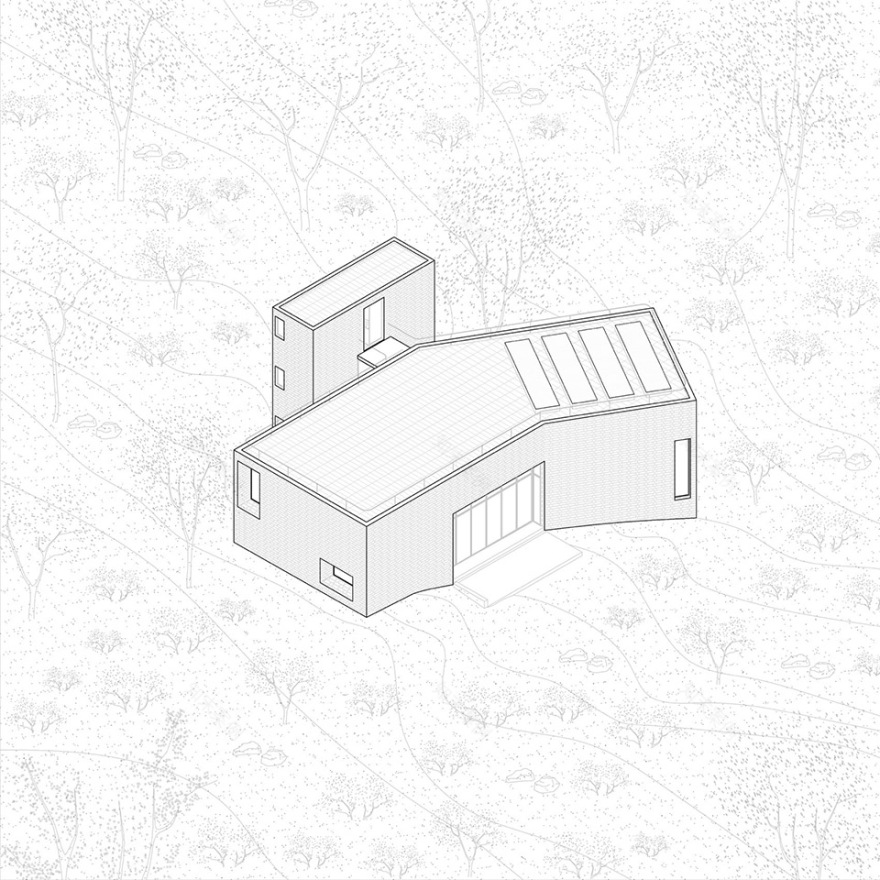
山的高度与森林的无序共同定义了建筑的形态。砖的色彩与质感强化了其几何体的性格。一个巨大的、安静的空间在天窗引入的阳光之下展开,使人得以从内部望见天空,拿起画笔,并在其中改变空间。建筑作为围合:一个在自然光中汇聚并激发创造的空间。几何由两个相互叠合、嵌套的长方体构成,形成一个能够随时间转变的整体体量。一种纯粹的几何,以克制的材料建造,与森林共存。这个空间如同一张巨大的空白画布,在上方光线的进入下,成为思想、思考与创作发生的场所。艺术家是其中的主角。
The height of the mountain and the irregularity of the forest define the form. The colour and texture of the brick reinforce the character of its geometry. A large, silent space beneath the sunlight entering through the skylights allows one, from within, to see the sky, take up the brush, and transform the space. Architecture as enclosure: a space that gathers and enables under natural light. The geometry is composed of two rectangular prisms that overlap and interlock, forming a single volume capable of transformation over time. A pure geometry, built from austere materials in coexistence with the forest. The space, like a large blank sheet, becomes, under the light entering from above, the place of ideas, thought, and creative work. The artist is the protagonist.
▼项目概览,overall view© Javier Agustín Rojas

▼顶视图,top view© Javier Agustín Rojas

场地 在椰子树与角豆树之间
The Place Between the coconut tree and the carob tree
胡安·何塞·坎布雷(Juan José Cambre)的工作室位于阿根廷科尔多瓦省普尼亚山谷(Punilla Valley)洛斯科科斯(Los Cocos)这一小型山地城镇,海拔1200米。基地处于当地被称为“沼泽”的区域,是小镇中较低的地带,被两条山地水道穿过,尽管它们通常是干涸的,但仍形成了独特的环境条件。该区域生长的原生植被在整个地区具有鲜明特征,在山地语境中塑造出一种独特的景观。项目的植入源于对场地的前期识别:在森林中找到一处自然的空地,使建筑、艺术与自然能够共存。仿佛它一直就在那里,位于椰子树与角豆树之间。两条基本的布局轴线与红砖体量的对向边缘相吻合,从而巩固其在地形中的嵌入关系。
Juan José Cambre’s atelier is located in the Punilla Valley, in the small mountain town of Los Cocos, Córdoba Province, Argentina, at 1,200 meters above sea level. The site lies in an area locally known as the swamp, a lower sector of the town crossed by two mountain watercourses which, although usually dry, generate a particular environmental condition. The native vegetation that develops in this part of the site is distinctive within the region, shaping a singular landscape within the mountain context. The insertion of the program arises from a prior recognition of the place, identifying a natural clearing in the forest where architecture, art, and nature can coexist. As if it had always been there, between the coconut tree and the carob tree. Two fundamental layout axes coincide with the opposite edges of the red brick volume, consolidating its implantation in the terrain.
▼建筑位于椰子树与角豆树之间,the building is located between coconut trees and acacia trees© Javier Agustín Rojas

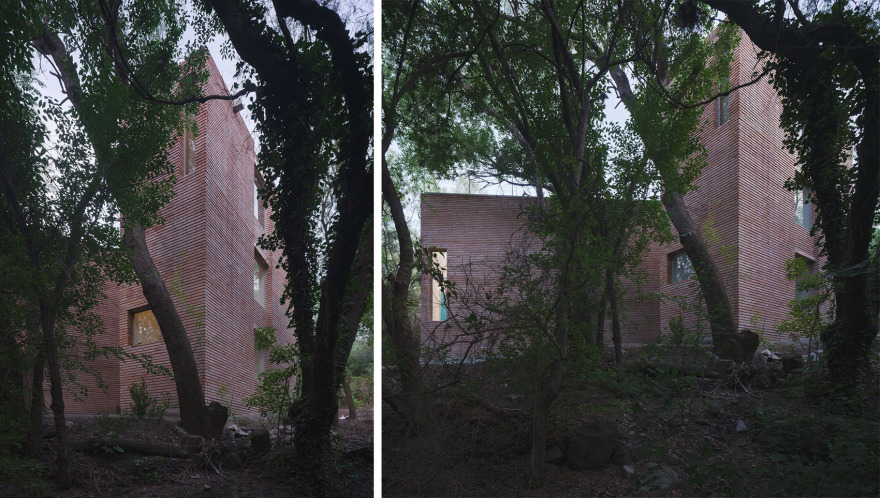

▼建筑与环境,architecture and nature© Javier Agustín Rojas

形式与空间策略
加与减
Form and Spatial Strategy
Addition and subtraction
两个矩形围绕一个固定点向内旋转,包裹景观,并生成室内与室外之间的自然过渡。从其叠合的减法中,生成第二个相切的体量。这个脱离主体的体量容纳设备与交通系统,与主空间独立运行。它的加入构成入口,并通过“分离与连接”的操作,塑造出一条可多重解读的路径,通向中央体量。同时,它也提供通往可步行屋顶的平台,与地面层连接,并延伸至可俯瞰普尼亚山谷及周边山脉的高处视野。居住空间的概念在运动中展开:通过离开再进入、下行再上升,不断重构与外部环境的关系。开窗系统遵循这一逻辑——窗即“向外观看”的原型。通过减法进行观看:自然在空间中以节奏性的方式被不断框取与显现。
▼分析图,analysis diagram© Esteras Perrote
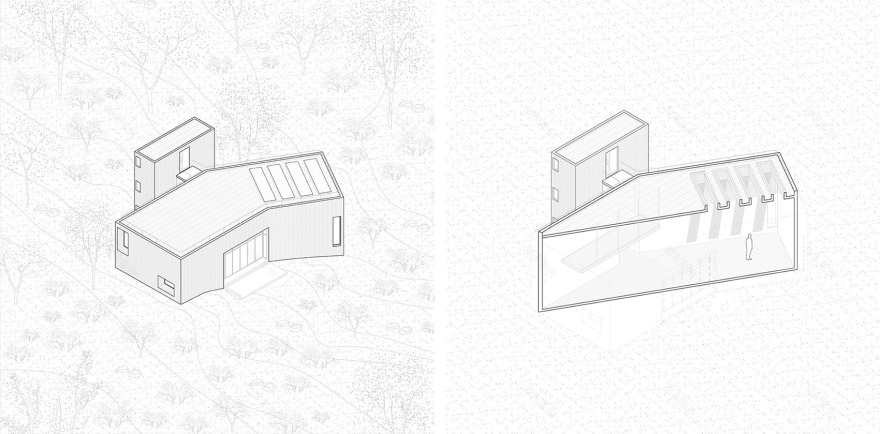
Two rectangles rotate inward from a fixed point, embracing the landscape and generating a natural transition between interior and exterior. From the subtraction of their overlap emerges a second, tangential volume. This detached volume houses services and circulation systems, operating independently from the main space. Its addition configures the entrance and, through the act of separating and uniting, constructs a path that offers multiple readings of the central volume. It also provides access to the walkable terrace, connecting the ground plane with an elevated plane open to views of the Punilla Valley and the surrounding mountain range. The idea of lived space unfolds through movement: exiting to re-enter, descending and ascending, constantly redefining the relationship with the exterior. The windows respond to this logic, the window as the archetype of looking outward. Subtracting to see: nature is framed in a rhythmic sequence throughout the space.
▼入口,entrance© Javier Agustín Rojas

▼后部入口,rear entrance© Javier Agustín Rojas


项目
在纸张、绘图与色彩之间
The Project
Between papers, drawings, and colours
为艺术家设计工作室,需要理解必要的技术条件,使生产与构思不被空间形态所限制,而是被其支撑。主空间围绕一个朝东的工作平面组织,空间沿南北向展开,高度为5米。其进深为宽度的两倍,以确保足够的临界观看距离。构成这一10米长矩形的墙体被作为连续的支撑界面,用于序列性与并置性的创作活动。选择在天空之下绘画、在白墙之间让形体与色彩生成的构想,先于引入天顶采光这一技术决策。在一个封闭空间中,当墙体承担起创作支撑的角色时,均匀稳定的顶光成为确保中性与连续性的关键。长墙两端设置的两个竖向矩形开口,既组织并分隔不同的工作区域,也实现南北向的穿堂通风,以优化作品的干燥过程。与生产空间相融合,居住—工作一体化的功能被整合在一个体量中:一个容纳厨房、储物与长工作台的矩形空间,并在其上方设置开放式夹层作为卧室,俯瞰下方的双层高主空间。
Designing a studio for an artist requires understanding the technical conditions necessary so that production and ideation are not constrained by spatial composition but instead supported by it. The main space is organized around a work plane oriented east, running north–south, with a height of 5 meters. Its depth doubles its width, ensuring an adequate critical viewing distance. The walls completing this 10-meter-long rectangle function as support surfaces for serial and simultaneous production. The intention of painting under the sky, between white walls that contain forms and colours, precedes the technical decision to introduce zenithal light. In a closed space where walls assume the role of working support, uniform and constant overhead lighting guarantees neutrality and continuity. Two vertical rectangular openings at the ends of the long walls organize and separate the work areas while also enabling north–south cross ventilation to optimize the drying process. Integrated with the production area, the live-work program coexists within a single volume: a rectangular space that contains the kitchen, storage, and a long worktable, and incorporates an open mezzanine above that functions as a bedroom overlooking the main double-height space.
▼折叠玻璃门,flooding glazing facade© Javier Agustín Rojas
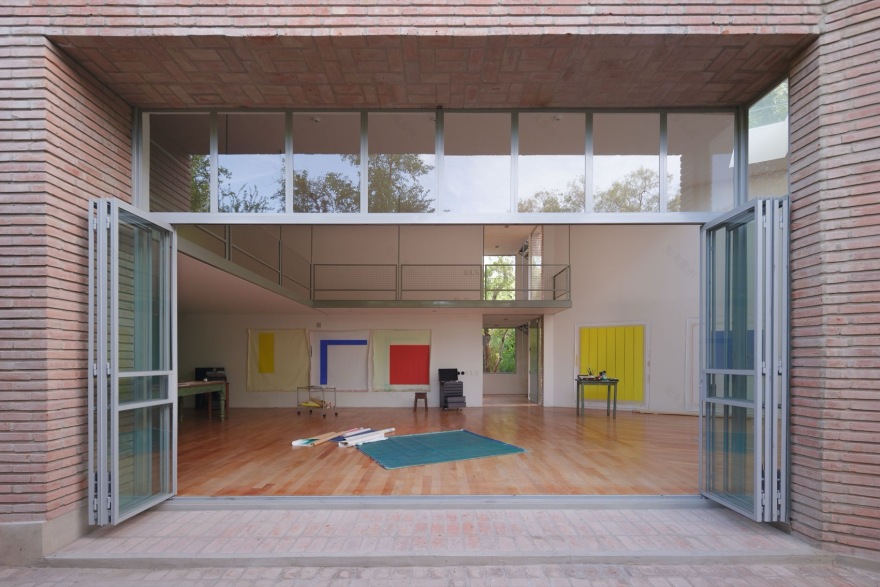
▼工作室内部,interior of the atelier© Javier Agustín Rojas

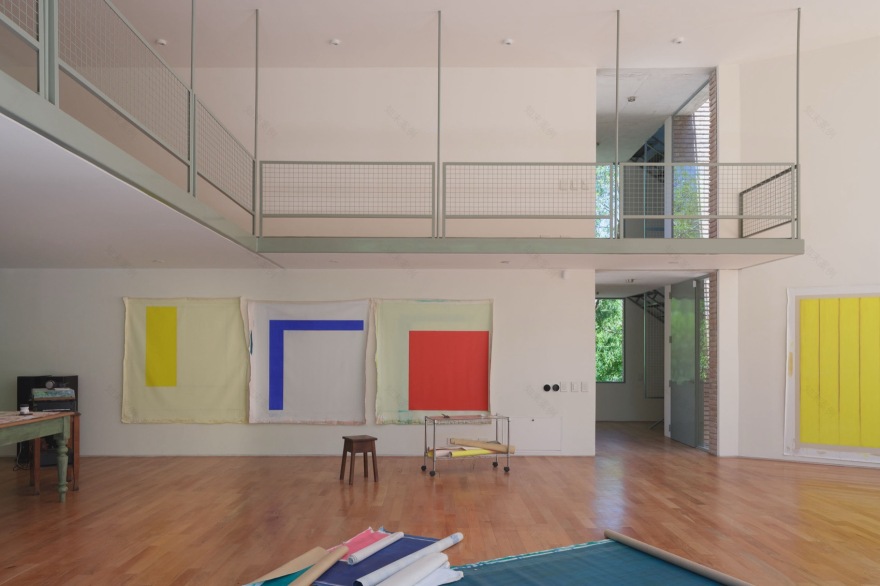
▼入口细部,details of the door© Javier Agustín Rojas

材料构成
物质的重量与空间的轻盈
Material Composition
The weight of matter and the lightness of space
源自地域、植根于工艺与传统的乡村住宅及其夯土墙体,构成了一种在材料与环境层面都具有可持续性的原型。对于在自然环境中建造与居住之“重量”的思考,使得土——被转化为砖——成为建筑与景观之间共存关系的一种实践。砖的红色与群山的绿色形成对比,并随着时间、日照、湿度、水分与岁月流逝而不断变化。室内的白色将墙体转化为画布,逐渐被色彩占据,使空间始终保持一种持续生长、不断转化的状态。地面完全采用天然木材铺设;生活与工作区域之间的过渡通过木地板铺装方向的变化来体现,并与整体几何的旋转相呼应。栏杆、木作构件与交通系统则由不同类型与截面的金属结构完成,在构造方式、表面处理与色彩上均呈现出清晰的层次关系。
Native to the place, rooted in craft and tradition, the rural dwelling and its adobe walls serve as a materially and environmentally sustainable archetype. Reflection on the weight of building and inhabiting a natural environment finds in earth, transformed into brick, an act of coexistence between architecture and landscape. The red of the brick contrasts with the green of the mountains and continuously transforms according to time of day, sunlight, humidity, water, and the passage of time. Inside, white turns the walls into canvases gradually occupied by colour, maintaining a continuous, living space in constant transformation. The floor is entirely made of natural wood; the transition between living and working areas is expressed through a change in the orientation of the boards, coinciding with the geometric rotation of the whole. Railings, carpentry elements, and circulation systems are resolved through metal structures of varying types and sections, articulated both in their configuration and in their finishes and colours.
▼展厅,gallery© Javier Agustín Rojas

▼天窗,skylights© Javier Agustín Rojas


▼细部,details© Javier Agustín Rojas

自然智能 舒适与可持续性
Natural Intelligence
Comfort and sustainability
被动式策略塑造了室内环境:交叉通风与具备热惯性的承重墙能够储存并释放热量,其厚度与保温性能调节气候变化。空间的体量与高度通过开口与朝向的研究进行组织,从而实现可控的热增益并减少热量流失。可持续性也被理解为一种生产性的决策:使用本地材料可减少运输与环境负担,同时促进就业并维系传统工艺作为一种生活方式。为尽可能减少对生态系统的干扰,建筑被置入森林中的自然空地之中,避免砍伐原生植被。作为最后的处理,水通过灌溉系统回归土地,在大面积原生植被中完成循环,构成一个闭合的生态过程。
Passive strategies shape the interior environment: cross ventilation and thermal mass walls that retain and transmit heat, while their thickness and insulation mediate climatic variations. The mass and height of the space are articulated through the study of openings and orientation, enabling controlled thermal gains and minimizing heat loss. Sustainability is also understood as a productive decision. Working with locally sourced materials reduces transportation and environmental impact, while fostering employment and sustaining traditional crafts as a way of life. To interfere with the ecosystem as little as possible, the building was placed within a natural clearing of the forest, avoiding the removal of native species. As a final gesture, water returns to the ground through irrigation in large beds of native vegetation, completing the cycle.
▼屋顶夜景,night view of the rooftop© Javier Agustín Rojas

▼夜景,night view© Javier Agustín Rojas

▼区位图,location© Esteras Perrote

▼一层平面图,ground floor plan© Esteras Perrote

▼二层平面图,upper floor plan© Esteras Perrote
▼屋顶平面图,roof plan© Esteras Perrote

▼立面图,elevations© Esteras Perrote


▼剖面图,section© Esteras Perrote

Name of the Work: Atelier Cambre
Project: Esteras Perrote – Architecture O5ice
Authors: Lucía Esteras, Gonzalo Perrote
Execution: Esteras Perrote – Architecture O5ice
Client: Juan José Cambre
Location: Los Cocos, Córdoba, Argentina
Project Year: 2023
Construction Year: 2024–2025
Photography: Javier Agustín Rojas




南京喵熊网络科技有限公司 苏ICP备18050492号-4知末 © 2018—2020 . All photos and trademark graphics are copyrighted by their owners.增值电信业务经营许可证(ICP)苏B2-20201444 苏公网安备 32011302321234号
苏公网安备 32011302321234号客服
消息
收藏
下载
最近