

创作上传
VIP
收藏下载
登录 | 注册有礼
查看完整案例

收藏

下载

分享

翻译
mitsuki
Completion | feb. 2022
Principal use | bar
Project Area | 72.56m2
Location | KYOTO JAPAN
Architect | AtSpace Architects


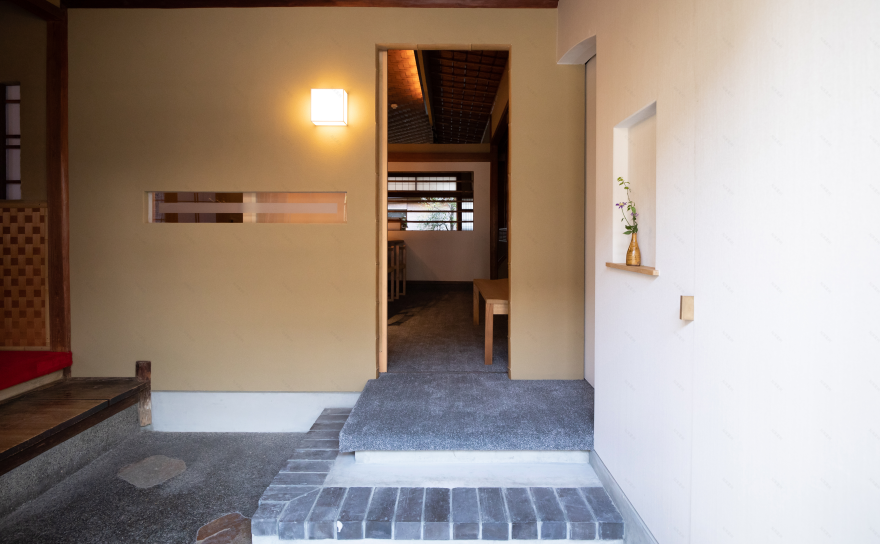




The project is a renovation of a sukiya-style architecture that used to be a Japanese restaurant with the main building, guest house, and kitchen building. After the business closed down a few years ago, the guest house was converted into a small Japanese hotel while the kitchen building took in a tenant and was converted into a restaurant. For this project, the main building that remained untouched was renovated into a café/bar to offer light meals and a library lounge that the hotel guests could also use. The facility aims to educate visitors about traditional culture through workshops on Japanese cultures and by offering information to tourists.
The one-story main building has an eight-tatami-mat front room and a twelve-tatami-mat back room that were joined to be used as one hall, a grand entrance shared with the guest house in the back, and a waiting room by the entrance, all characterized by its elaborate sukiya-style design. The main scope of the renovation was the front room and main entrance where high-quality decorative elements could be seen everywhere. The front room is adorned with an ajiro-tenjo (woven-splint-wood ceiling), single-slope ceiling made of small dressed lumber, plastered mud walls, and nageshi (a horizontal piece of timber), while the entrance is adorned with reeded circular funazoko-tenjo (ceiling shaped like the bottom of a boat) and squared bamboo lattice windows.
At the beginning of the design process, we decided to refer to the joint pieces including the polished-log lintels and nageshi, as the basis of design and preserve the upper part of the existing interior including the ceiling. We aimed to adhere to the Japanese style that emphasizes horizontal lines, and simultaneously realize a floor plan that accommodates future changes of use within the limited space.
The tatami-covered room that traditionally requires taking off the shoes was converted into a café/bar with a counter where guests can keep their shoes on. In the design process, the heights of the floor and openings were carefully designed to correct the discrepancies with the existing joint pieces. Walls replaced fusuma (sliding doors) to divide the two tatami rooms distinctly, giving each room different use while maintaining the grace and spaciousness of the former hall. Similarly in the entrance, rooms were added as required, the upper and lower interior elevation were treated separately referencing the joint materials, and the composition of the ceiling and entrance were preserved as much as possible.
In contrast to the clean and open hall, we committed ourselves to create a private ambiance in the bar lounge. The bar counter is placed referencing the axis connecting the waiting room and okuniwa (a garden in the back of the house), avoiding directly facing the kitchen. It gently nudges the users to notice the disproportionality of the seatings and connection to the back room. The openings between the rooms also break the symmetry of the hall to create a closed space, and while connecting the elements of the entrance, seating, and tokonoma (alcove for display) to the guests it also divides their sense of space.
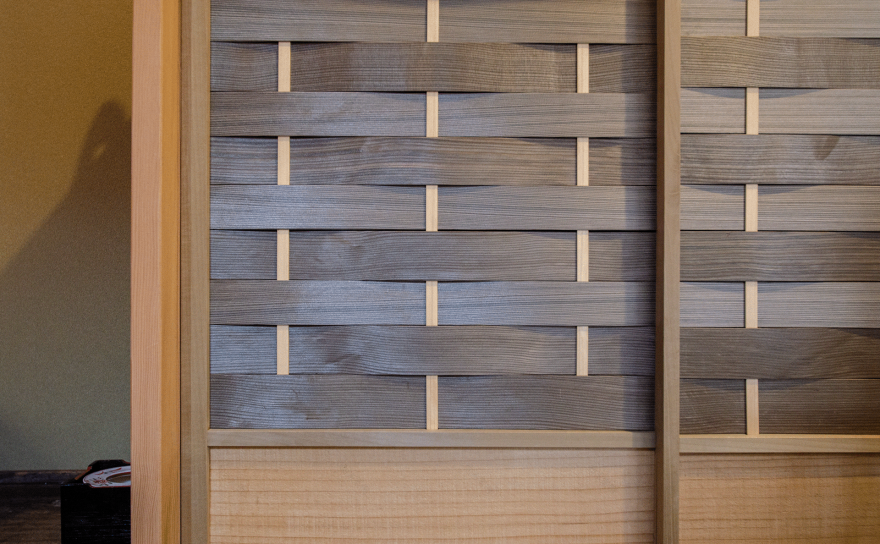
In mixing the old with the new, we strived to design a soft presence against the existing natural materials and handicrafts. Carpets and cloths were used for finishes to create an uneven surface with low reflection despite their industrial origin. At the same time, it is a nod toward the act of "weaving" found in the symbolic ajiro-tenjo. The countertop is created by a woodcraft artist, where inlay work was applied to the joints between the different types of wood combined.
Legal clearance was one of the essential issues in renovating an existing non-conforming wooden building. Based on the fire code review, we decided to avoid installing mechanical equipment that would affect the other buildings. Instead, we decided to meet the window requirement by designing effective openings. The openings were designed referencing the transition of the façade and cityscape, considering various conditions such as preserving the exterior and ensuring safety. Thus the existing conditions do not restrict the type of business the architecture accommodates. The decision was based on the prospect to increase the utility value by leaving room for sequential renovations that would further establish the correlation between the buildings.
南京喵熊网络科技有限公司 苏ICP备18050492号-4知末 © 2018—2020 . All photos and trademark graphics are copyrighted by their owners.增值电信业务经营许可证(ICP)苏B2-20201444 苏公网安备 32011302321234号
苏公网安备 32011302321234号客服
消息
收藏
下载
最近