

创作上传
VIP
收藏下载
登录 | 注册有礼
查看完整案例

收藏

下载

分享

翻译
Architects:Mauricio Ceballos X Architects
Area:250m²
Year:2022
Photographs:Rafael Gamo
Category:Houses
City:Santa María del Oro
Country:Mexico

Text description provided by the architects. The project is located in the serene community of Santa María del Oro, Nayarit, a remote municipality with limited resources and infrastructure, situated next to a lake formed in the crater of a volcano. This fragile ecosystem, born of geological forces, demands exceptional environmental sensitivity, as any pollution threatens the delicate balance of this unique body of water. The site presents significant physical challenges—a steep slope, a narrow street-facing facade, and a limited budget—that require innovative solutions capable of working with these conditions rather than opposing them. The reality of building in an isolated municipality involved engaging with local construction capabilities and community values, generating opportunities for respectful collaboration that enrich local perspectives instead of imposing external design criteria incompatible with regional skills and resources.


The most determining elements of the site are five ancestral trees that stand as guardians, whose presence required an architectural attitude of respect rather than elimination. These giants established non-negotiable conditions that defined the design approach, forcing the built volume to adapt to the existing vegetation rather than replace it. The steep topography allows the house to integrate into the slope, becoming almost invisible from certain viewpoints and minimizing its visual impact on the landscape and views of the lake. This combination of complex terrain, ecological sensitivity, a constrained budget, and reverence for the existing trees created a challenging design problem, where conventional approaches would prove insufficient, requiring innovative strategies that balance environmental protection, community respect, cultural expression, and architectural ambition.
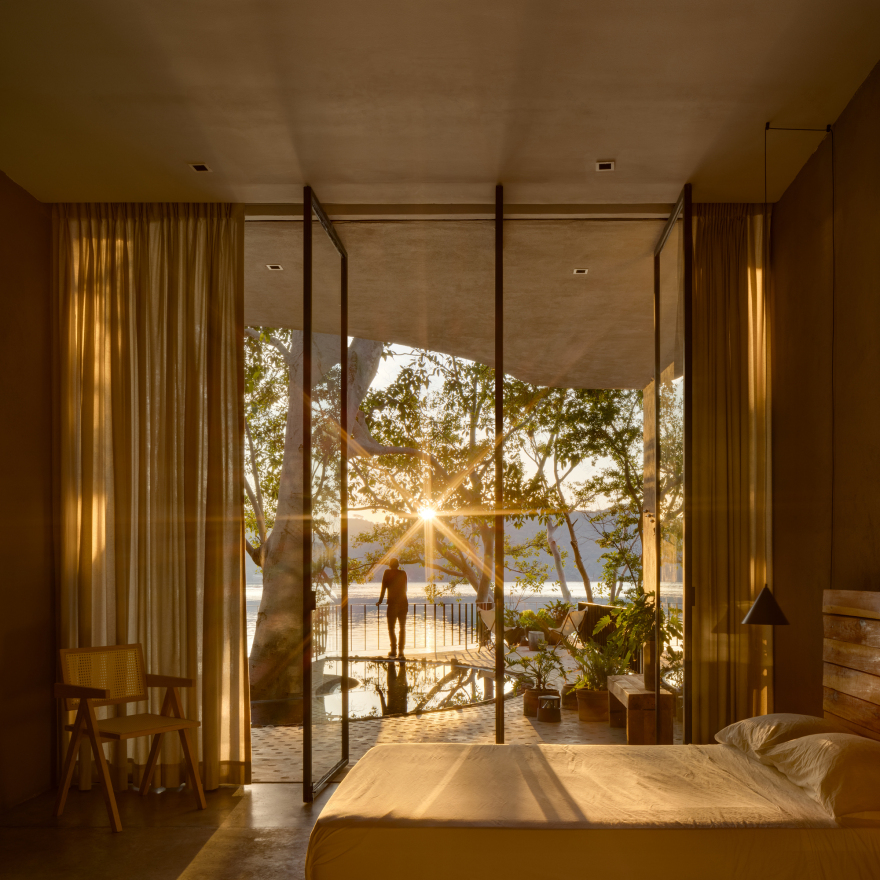
The design philosophy focuses on the harmonious coexistence of nature, community, and architectural innovation, understanding construction as an act of environmental and cultural care rather than domination over the landscape. Circular forms are subtracted from the built volume to honor the ancestral trees, allowing them to intertwine with the house and establishing a formal language that directly responds to the natural characteristics of the site. The volume of the house is completely hidden in the slope, leaving only the terraces visible that coexist with native vegetation and open towards the lake, resulting in architecture that discreetly integrates into the landscape rather than imposing itself monumentally. This strategy of concealment and integration demonstrates respect for the delicate ecosystem while offering intense spatial experiences for those inhabiting spaces carved into the hillside instead of perched upon it.


The principles of sustainability and decarbonization are integrated into the essence of the project, minimizing the ecological footprint through comprehensive environmental strategies. The reduction of concrete and masonry usage prioritizes the employment of locally sourced stones with low installation impact and high durability, demonstrating that material containment and regional sourcing can generate both environmental and economic benefits. Rainwater harvesting and filtration systems help conserve water resources, while the separation of black and stormwater enables treatment through biodigesters and filtration before infiltration into absorption wells that promote oxygenation and prevent lake contamination. The use of energy-efficient equipment and LED lighting reduces energy demand, while a green roof camouflages the building in its surroundings and provides thermal insulation, favoring passive climate control strategies. Future installation of solar panels on an adjacent plot with better solar exposure is planned, illustrating a phased implementation in line with the budget. These integrated strategies result in a home that operates with a light environmental footprint, despite its sensitive location.

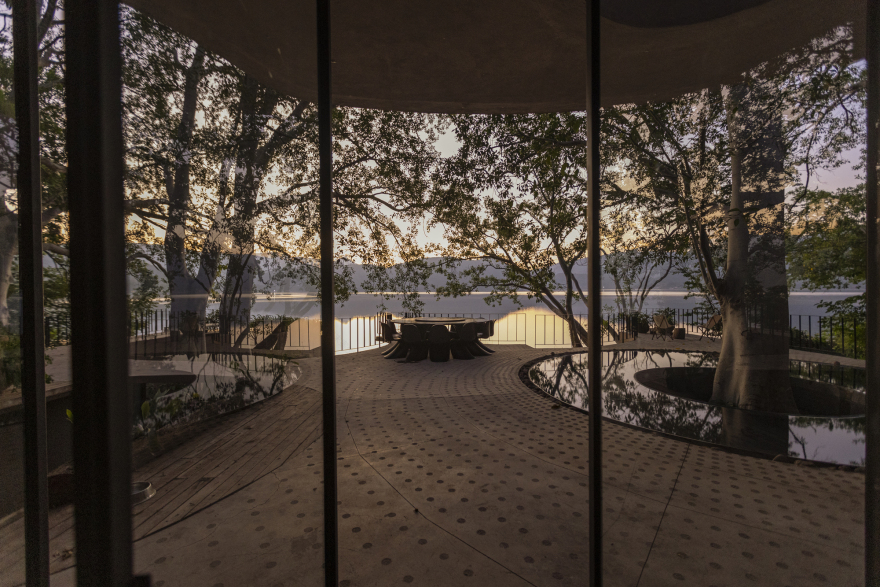
The programmatic organization is deliberately kept simple—three bedrooms, a central social space, and a large terrace with a circular pool—allowing architecture to focus on environmental integration and spatial quality rather than functional complexity. Access is achieved through a 20-meter staircase designed to integrate with the terrain, diverting rainwater through separations between prefabricated cylindrical concrete steps, which simultaneously function as infrastructure, sculptural gesture, and water management device. Natural lighting and cross ventilation are achieved through the strategic arrangement of interior courtyards around the existing trees, illuminating common areas and bedrooms and taking advantage of the region's favorable climate to reduce reliance on mechanical systems.
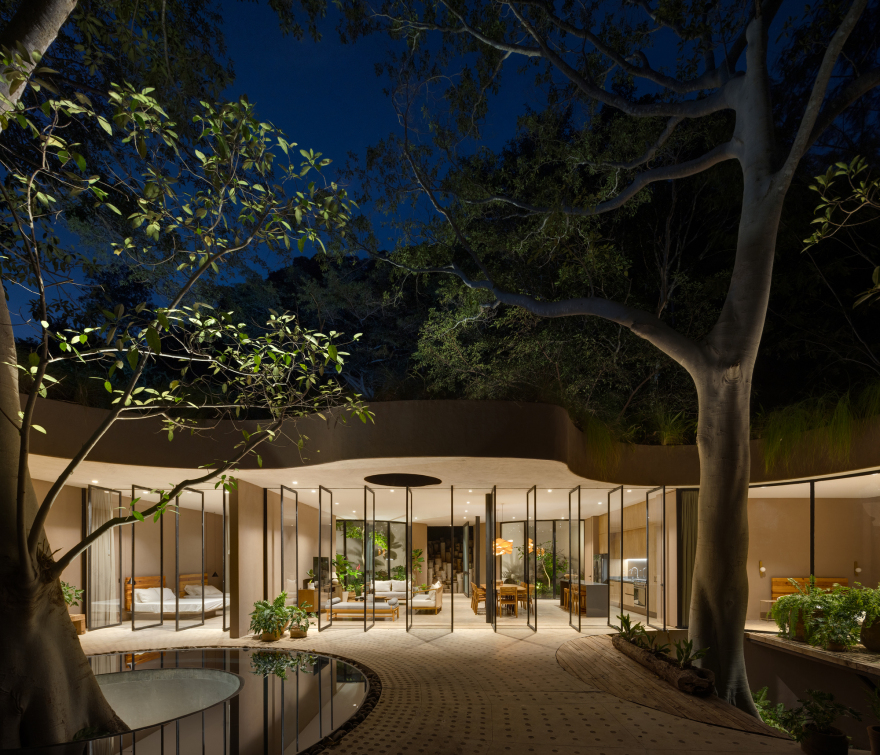
The material and color palette is inspired by the earthy landscapes of Nayarit, using brown and beige tones in the finishes to celebrate Mexican heritage from a contemporary perspective. Native tropical gardens are developed in terraces and interior patios, achieving integration with the natural context through vegetation that aligns with the local ecology. The furniture incorporates volcanic stone evoking the geothermal origins of the site, as well as new and recycled woods from construction formwork, demonstrating principles of circular economy and connections with local materials. These decisions create spaces that tell stories of tradition and evolution, where each environment becomes a canvas expressing the fusion between ancestral knowledge and contemporary innovation. The result transcends mere construction to exemplify how architecture can protect fragile ecosystems, respect local communities, and elevate human experience through collaboration, sustainability, and design innovation, grounded in humanistic values that recognize that people drive good design and that architects have the responsibility to create better spaces while caring for natural, cultural, and social environments.

Project gallery




南京喵熊网络科技有限公司 苏ICP备18050492号-4知末 © 2018—2020 . All photos and trademark graphics are copyrighted by their owners.增值电信业务经营许可证(ICP)苏B2-20201444 苏公网安备 32011302321234号
苏公网安备 32011302321234号客服
消息
收藏
下载
最近