

创作上传
VIP
收藏下载
登录 | 注册有礼
查看完整案例

收藏

下载

分享
“深度个性化居住”是栖斯在住宅设计中的长期命题,是将场地条件与居住需求深度结合的设计策略。在该住宅中,栖斯用九段阵列窄墙为空间个性与居住需求建立了锚点,完成形式与功能的互构。
“Deeply Personalized Living” is a long-term theme pursued by QISI in residential design. It is a design strategy that deeply integrates site conditions with residential needs. In this residence, QISI employs nine arrays of narrow walls to establish anchors for spatial individuality and residential demands, thus accomplishing the mutual construction of form and function.
▼空间概览-灵活的起居厅,Overview of the flexible living area © 吕晓斌
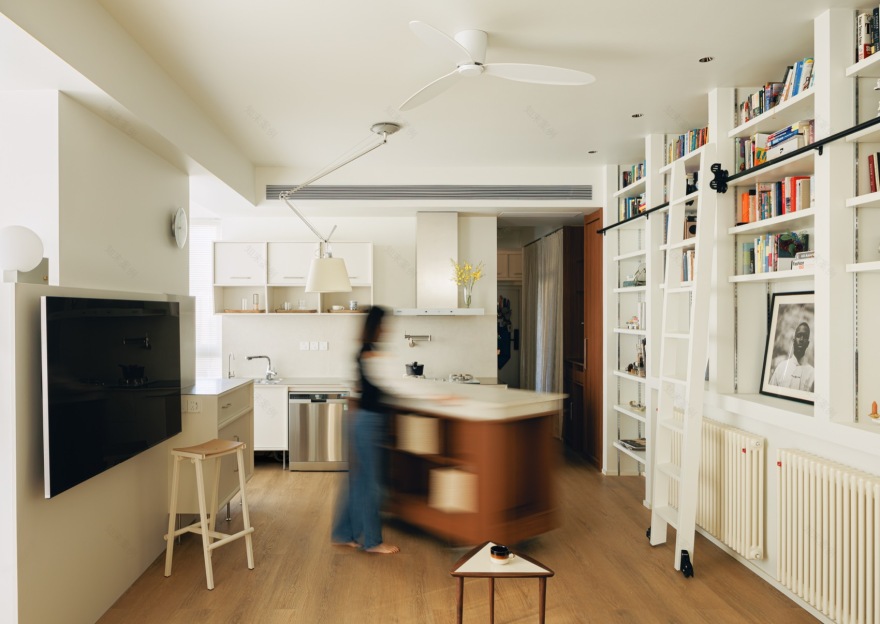
▼餐厅看向卧室,The view from cooking area to bedroom © 吕晓斌

该户型为东西向长条形空间。栖斯将卫生间、衣帽间以及卧室分别布置在东西两侧并适当压缩空间,为中部留出开阔的起居厅。此处将承载居住人生活、工作、社交功能,并提供多元场景。高净高、少梁化的原始结构,进一步强化了空间的开敞与整体感,为功能置入与个性表达奠定基础。
This unit features an east-west oriented long and narrow layout. QISI positioned the bathroom, walk-in closet, and bedroom on the eastern and western ends respectively, with appropriately scaled-down dimensions, creating a generous living area at the center. This central zone accommodates the resident’s daily life, work, and social activities, supporting diverse living scenarios. The original structure with high ceiling height and minimized beams further enhances the openness and integrity of the space, laying a solid foundation for functional integration and personalized expression.
▼书桌看向卧室,The view from desk to bedroom © 吕晓斌

▼卧室看向起居厅,The view from bedroom to living room © 吕晓斌

居住人对鞋、箱、杂物收纳、书籍收纳,以及临时留宿客人等多重需求,自然地汇集于户型北侧的完整墙面。栖斯以九段阵列式窄墙在北墙划分出不同的功能单元。窄墙之间的横向置物层板通过金属立柱与层板托固定。层板间距可根据物品尺寸灵活调整。在高效利用空间的同时,避免了整面墙做满柜子带来的压抑感。材质与形体的变化也进一步增加了空间层次与细节质感。
▼ 轴测图,Axonometric drawing © 栖斯设计

The resident’s diverse needs—including storage for shoes, luggage, miscellaneous items and books, as well as temporary guest accommodation—naturally converge on the full wall on the northern side of the unit. QISI employs nine arrayed narrow walls to divide the north wall into distinct functional units. The horizontal storage shelves between the narrow walls are fixed with metal columns and shelf brackets. The spacing between shelves can be flexibly adjusted according to item dimensions. This approach achieves efficient spatial utilization while avoiding the sense of oppression caused by full-wall cabinetry. Variations in materials and forms further enhance spatial layering and detailed texture.
▼入口过道,Entrance aisle © 吕晓斌

▼ 从入口延伸至起居厅的阵列窄墙,Arrayed narrow walls extending from the entrance to the living room © 吕晓斌

窄墙如同建筑原生结构一般,以规整的阵列逻辑构建出空间的基本秩序,成为了生活的背景。其中,起居厅内高达 3 米的书墙,是阵列窄墙的核心节点。它以强烈的视觉张力将居住人的生活志趣外化为空间形态,是住宅个性最直接的载体。
The narrow walls, much like the original building structure, establish the fundamental spatial order through a rigorous array logic, serving as a backdrop for daily life. At the heart of this arrayed narrow-wall system stands the 3-meter-tall bookshelf wall in the living area, acting as its focal point. With strong visual tension, it externalizes the resident’s lifestyle and interests into spatial form, making it the most direct expression of the residence’s individuality.
▼烹饪区看书墙,The view from cooking area to bookshelf wall © 吕晓斌

▼书墙与爬梯,Bookshelf wall and climbing ladder © 吕晓斌


▼活动岛台看向书墙,The view from movable kitchen island to bookshelf wall © 吕晓斌

栖斯通过可移动式中岛增加起居厅的灵活性。摇臂吊灯可以跟随中岛灵活的移位。
QISI enhances the flexibility of the living area with a movable kitchen island. The swing-arm pendant light can shift flexibly along with the island.
▼活动中岛演示,Movable kitchen island demonstration © 吕晓斌

▼书桌看起居厅,The view from desk to living room © 吕晓斌

固定家具通过金属脚抬起,以更加轻盈的姿态融入空间。
Fixed furniture is elevated by metal legs, integrating into the space with a lighter presence.
▼被金属脚抬起的柜体,Cabinetry elevated by metal legs © 吕晓斌

▼橱柜细节,Detail of the cabinet © 吕晓斌


书桌边设置了下翻床,可以通过布帘围合出临时睡眠区。
A Murphy bed is installed beside the desk, which can be enclosed by curtains to form a temporary sleeping area.
▼布帘围合的临时睡眠区,Temporary sleeping area enclosed by curtains © 吕晓斌

▼下翻床和布帘细节,Detail of the murphy bed and curtain© 吕晓斌

▼阳台概览,Overview of the balcony © 吕晓斌

▼卧室概览,Overview of the bedroom © 吕晓斌

除了书桌,中岛和阳台也能坐、卧、停留。开放空间下的小区域组团带给居住人不同的体验。栖斯希望这些生活中的微小变化点与刺激点能给本身从事创意工作的居住人带来积极影响。
In addition to the desk, the kitchen island and balcony also provide spaces for sitting, resting and lingering. These small clustered zones within the open space offer the resident diverse living experiences. QISI hopes that these subtle changes and stimulating moments in daily life will positively influence the resident, who works in a creative field.
▼平面图,Floor plan © 栖斯设计

项目名称:书墙公寓
项目类型:住宅室内设计
设计方:栖斯设计
项目设计:2025
完成年份:2025
设计团队:主创:陈茜茜、傅翀。团队成员:单仁杰、蒋剑兰
项目地址:上海市
建筑面积:80㎡
摄影版权:吕晓斌
合作方:施工:舍来装饰
客户:个人业主
材料:瓷砖、木饰面、乳胶漆
品牌:小火柴瓷砖、大喜木作
Project name:Bookshelf Wall Apartment
Project type:Residential interior design
Design:Qisi Design
Design year:2025
Completion Year:2025
Leader designer & Team:Leader designer :Chen Xixi、Fu Chong.Team:Shan Renjie,Jiang Jianlan
Project location:Shanghai
Gross built area: 80㎡
Photo credit: Lv Xiaobin
Partner: Construction: Shelai
Clients:Individual
Materials:Ceramic tile,Wood veneer,Emulsion paint
Brands:Chai Lab,Daxi Custom Woodworking
南京喵熊网络科技有限公司 苏ICP备18050492号-4知末 © 2018—2020 . All photos and trademark graphics are copyrighted by their owners.增值电信业务经营许可证(ICP)苏B2-20201444 苏公网安备 32011302321234号
苏公网安备 32011302321234号客服
消息
收藏
下载
最近