

创作上传
VIP
收藏下载
登录 | 注册有礼
查看完整案例

收藏

下载

分享
有花呢喝处小院位于大理州巍山彝族回族自治县古城区东南角。主屋为与邻家共用的土木结构主楼中的西侧一跨空间,场地东南侧原有一层砖混结构空间清理后,在上层加建客房空间,实现一层经营与日常活动,二层休息居住的功能需求。
The courtyard sits in the southeast corner of Weishan Ancient City, Dali. The main house occupies the western bay of a shared timber-and-earth building. We cleared an old brick-and-concrete structure on the southeast side and added a new guest room above it. This vertical zoning separates the ground-floor commercial space from the upper living area.
▼项目鸟瞰,aerial view of the project©刘国威

“有花呢喝处”是巍山彝族腊罗巴语,为“VI LOO nu ku”(意为那个有花的地方)。业主致力于民族学研究及民族手工艺品收集制作,希望将巍山彝族腊罗巴支的文化故事融入整个空间中。
▼巍山彝族(腊罗巴支)文化与空间叙事,The Culture and Spatial Narratives of the Yi People (Laluoba Branch) in Weishan County©边缘计划建筑工作室

“Youhua Ne Hechu” translates to “VI LOO nu ku” in the local Laluo dialect, meaning “That Place Where Flowers Bloom.” The owner is dedicated to ethnological research and local crafts. The core vision is to weave the cultural narrative of the Yi people into the entire space.
▼露台西南望,Looking southwest from the terrace©刘国威

▼露台看主楼,Looking towards the main building from the terrace©刘国威

修复
Restoration
由于小院空置时间较长,屋顶瓦面破损,披檐椽子已经部分朽断,由本地瓦匠团队从新更换椽子,使用本地红泥土加稻草及石灰传统方式翻新瓦顶。
▼原始照片,original photos©边缘计划建筑工作室

The long-vacant courtyard suffered from broken roof tiles and decayed rafters. A local mason team replaced the rafters. The tiled roof was fully restored using a traditional mix of local red clay, straw, and lime.
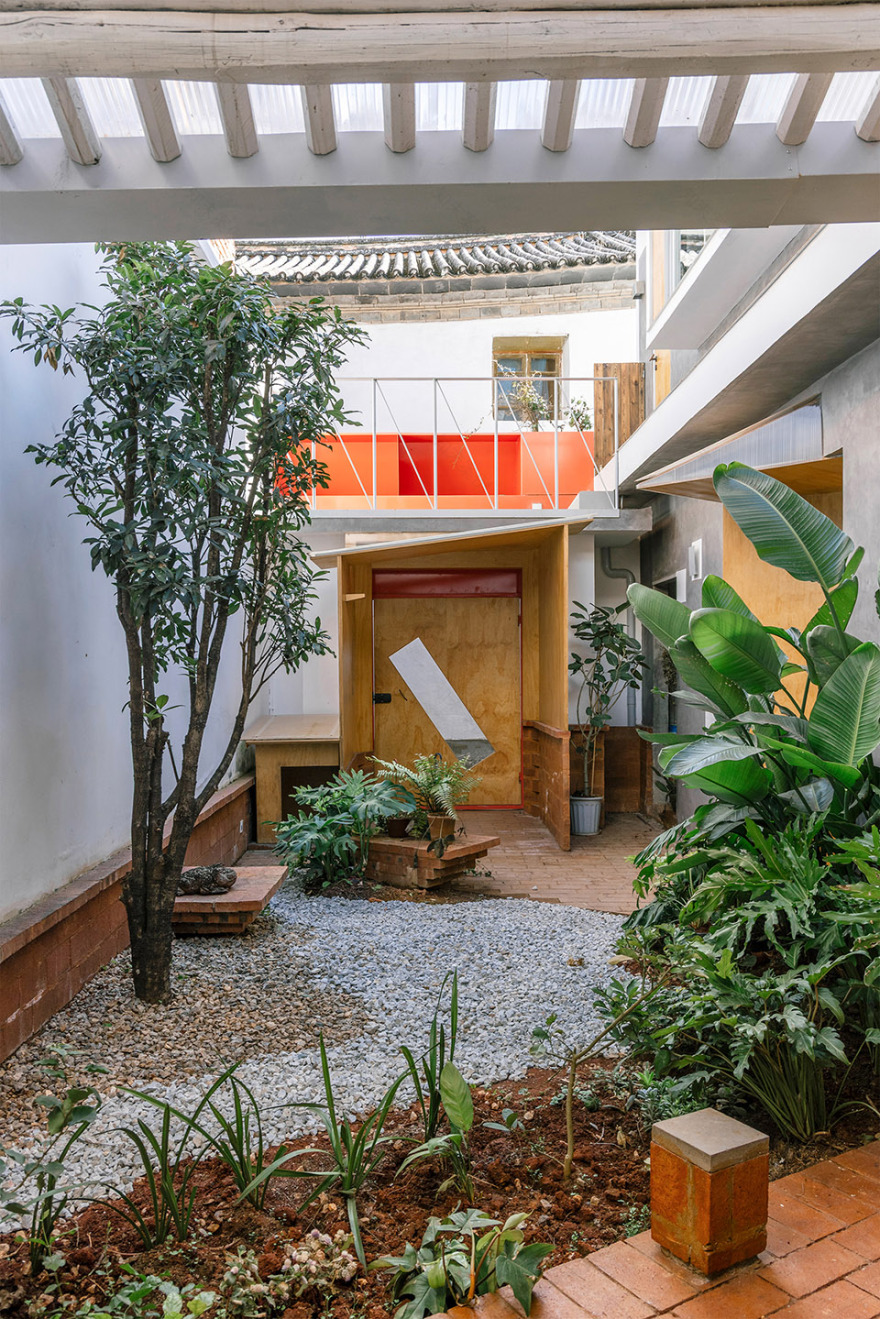
▼修复后的庭院,courtyard after renovation©刘国威


小院东南侧原有一层砖混结构空间清理及局部拆除后,做钢结构局部加固,用以支撑二层新增建筑。▼新空间拆解图,new space axonometric©边缘计划建筑工作室

After partially demolishing the old brick-and-concrete volume on the southeast, local steel reinforcement was applied. This structural upgrade now supports the newly added upper floor.
▼局部加固的结构,local steel reinforcement was applied©刘国威


引光
Daylighting
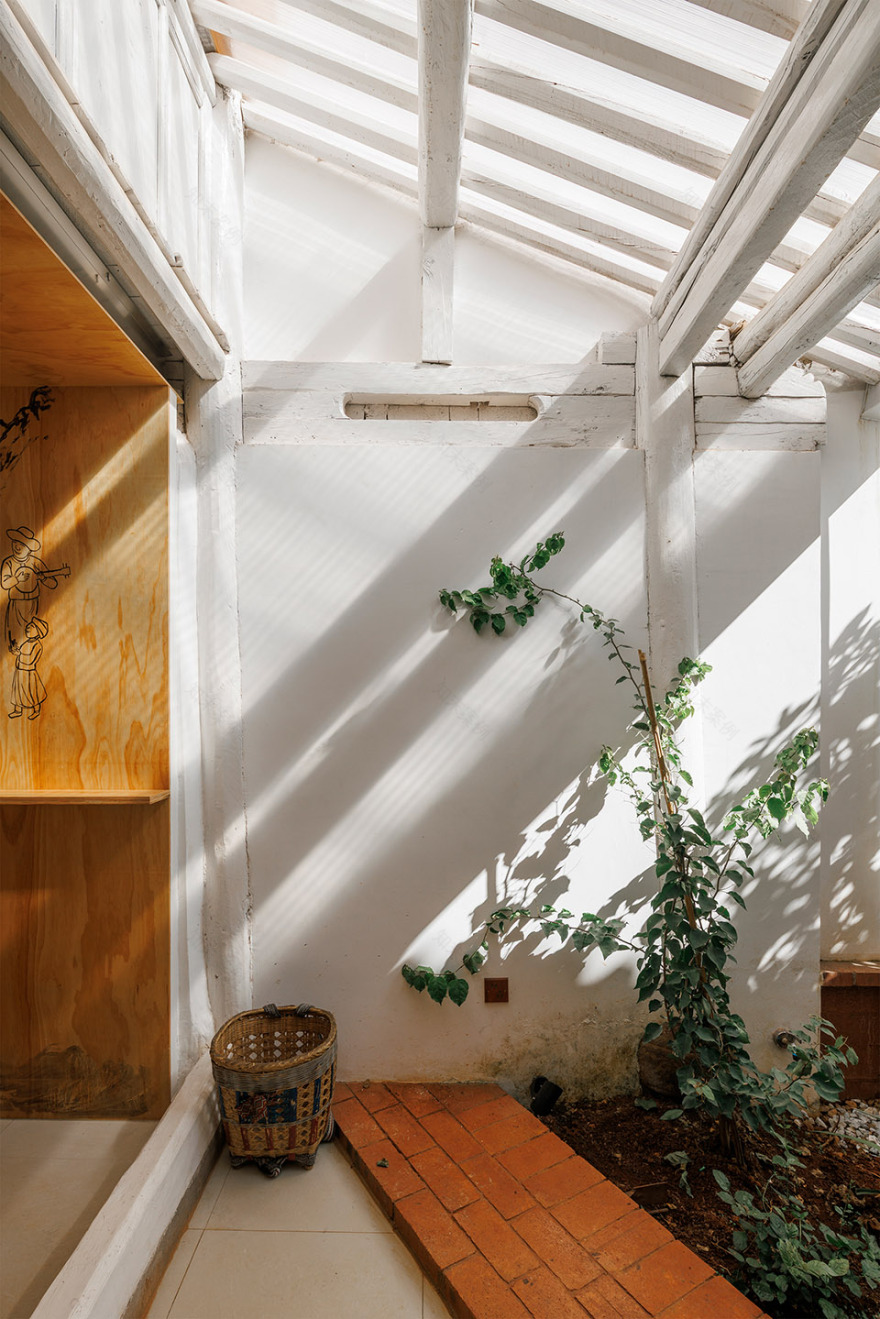
小院被四面的邻里房屋围合,采光较差。为了改善采光,在主楼屋顶北面打开一道口子,同时拆除一段一层顶面北侧木楼板,让阳光可以从二层渐入一层,照亮小院最深处;从新铺设的主楼一层披檐不再盖瓦,而是改为pc板,避雨的同时增加一层的采光;小院东南侧二层新增客房,会遮挡西面的光线,为此西面开长条高窗,在不影响卧室使用的同时,让光也能从西面穿过卧室照入庭院。
▼施工期间光的记录,documentation of lighting during the construction©边缘计划建筑工作室

Enclosed by neighbors, the site lacked natural light. To fix this, we created an opening on the north roof of the main building and removed a section of the ground-floor ceiling. Sunlight now cascades down to the deepest part of the courtyard. The new eaves on the ground floor swapped traditional tiles for polycarbonate (PC) sheets. This keeps the rain out while letting the light in. The new upper guest room naturally blocked western sunlight. We countered this by opening a ribbon window high on the west wall. Light now passes through the bedroom into the courtyard below, without compromising privacy.
▼光线透过一层披檐,Light passes through a layer of eaves©刘国威

空间组织
Spatial Organization
串联与打开是小院的空间组织核心,通过添置“亭”“廊”“厅”“桥”等空间元素,组织动线丰富空间,连通各空间区域,同时面向内庭院敞开,让光线、气息自由流通,二层新架半开敞的桥屋,将新增的二层客房与主楼相连;
“Connecting” and “Opening” drive the spatial layout. We inserted specific architectural elements: the Pavilion, the Corridor, the Hall, and the Bridge. These elements organize circulation, link different zones, and open fully to the inner courtyard, allowing light and air to flow freely. A new semi-open bridge-house on the second floor links the guest room directly to the main building.
▼添置“亭”“廊”“厅”“桥”等空间元素,inserted specific architectural elements: the Pavilion, the Corridor, the Hall, and the Bridge©刘国威


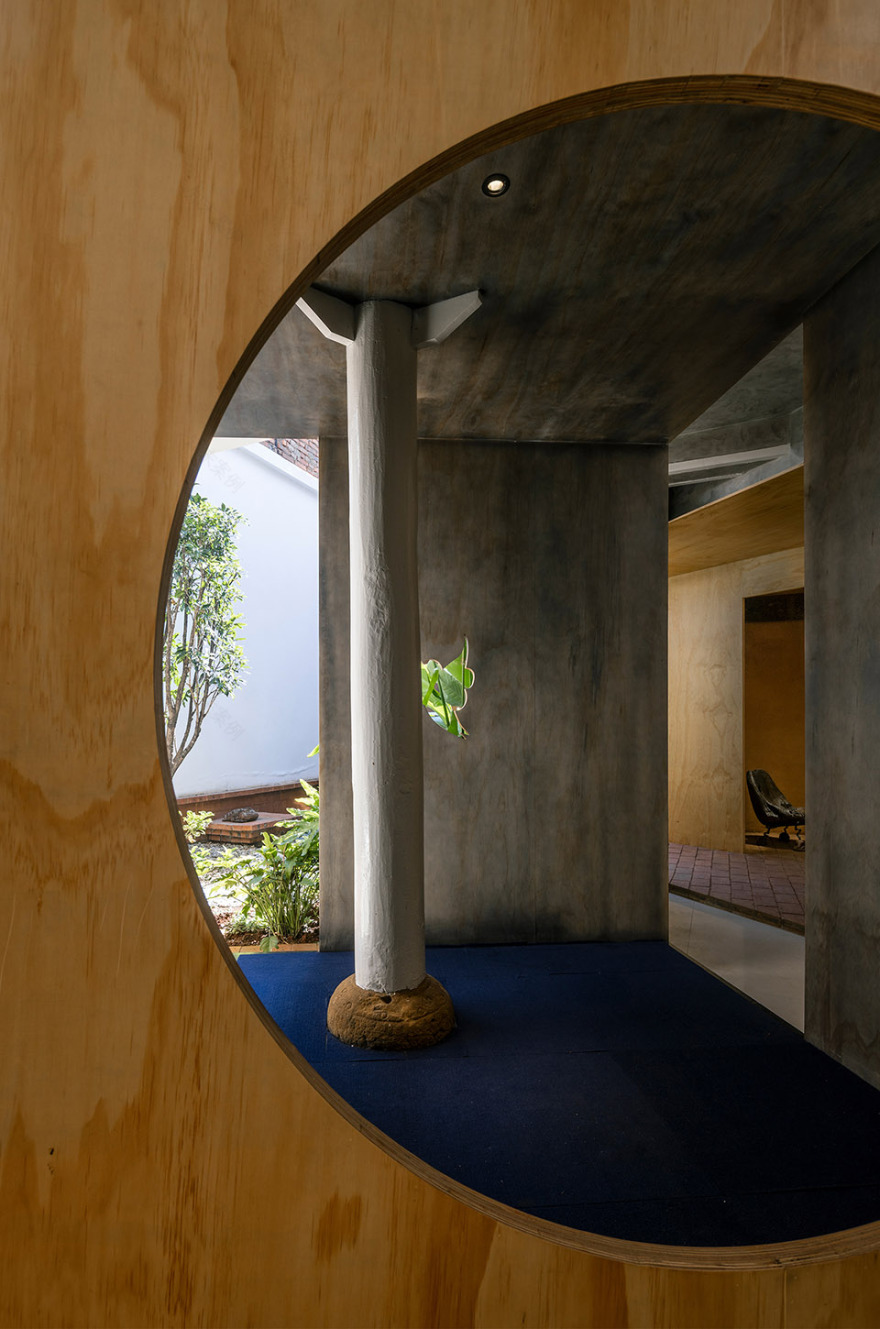
▼圆洞探柱,Round hole column©刘国威
▼顺廊回看入口,Looking back along the corridor at the entrance©刘国威
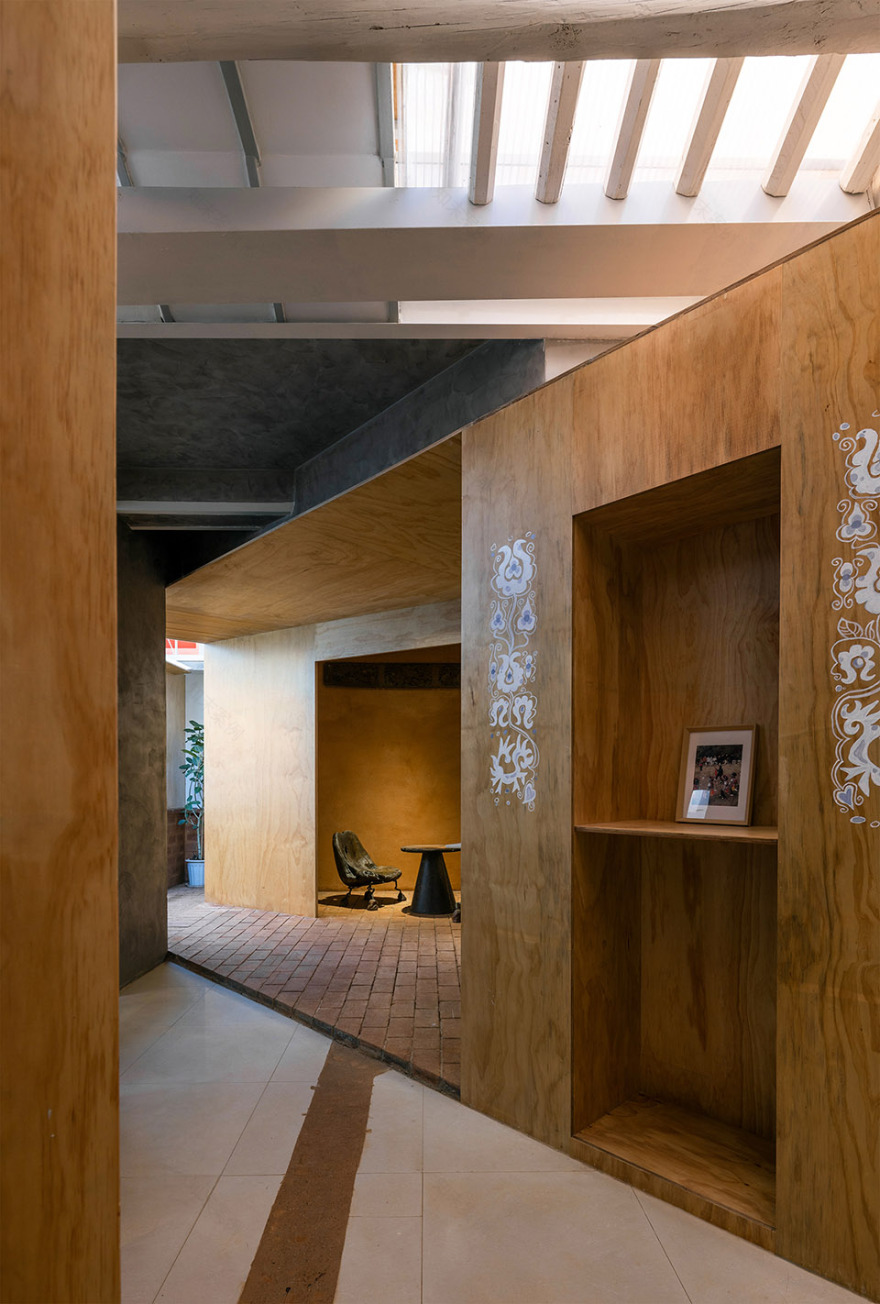
组织空间的同时融入巍山彝族文化叙事,进门亭是迎客献茶一个短暂停留缓存的区域,左转接廊,运用镜面金属及镜子,加强空间延伸感,述说彝族人乐观的生死观,灵魂不灭;挨着的是柱亭,亭中框住一颗主屋的前檐柱,亭内黑墙白柱,强调柱的存在感,暗喻彝族人对“柱”的崇拜。
Cultural narratives shape the spaces. The Entrance Pavilion is a buffer zone to welcome guests with tea. Turning left into the Corridor, mirrored metal and glass expand the spatial depth. This mirrors the Yi people’s optimistic view on life, death, and the immortal soul. Next is the Pillar Pavilion, which frames an original eave pillar of the main house. Black walls contrast with the white pillar inside, highlighting its presence and honoring the Yi people’s traditional pillar worship.
▼向上与圆洞,Upward and the Round Hole©刘国威
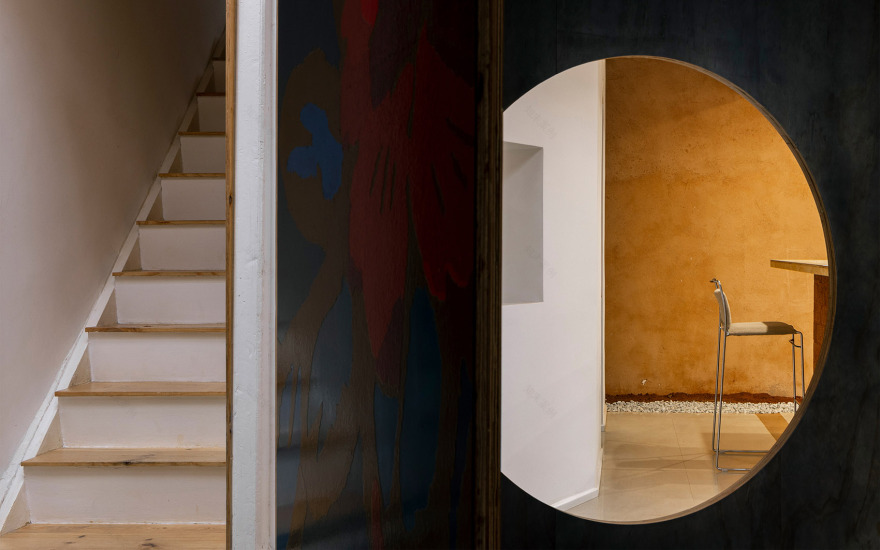
▼柱亭里,Inside the pavilion©刘国威
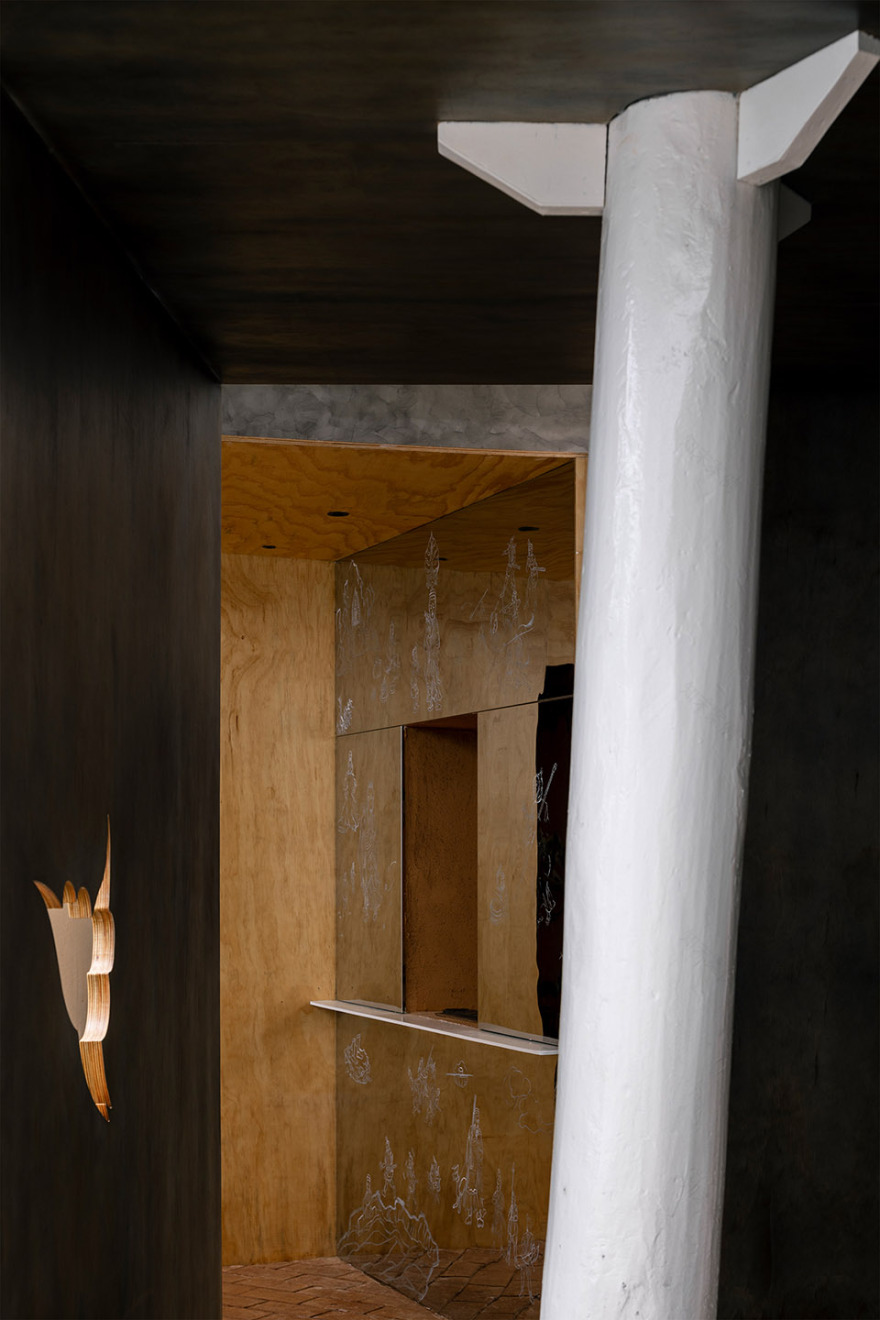
▼柱亭朝向庭院的开口,The opening of the pavilion facing the courtyard©刘国威

色彩与花
Colors and Flowers
巍山彝族人多依山而居,就近使用山石木建房,传统民居土木结构为主,本地生土呈现深红或赭石色,一层空间铺地与墙裙使用本地清水红砖砌筑,砖缝用细沙、水泥与红色土泥浆混合勾平,墙面也运用本地红土混合材料抹面。
▼巍山彝族村落,The Yi Villages of Weishan©边缘计划建筑工作室

Historically living near mountains, the Yi people build with local stone and wood. Traditional houses feature timber-and-earth structures. The local raw earth carries a distinct deep red or ochre hue. The ground floor paving and wainscot are built with local fair-faced red bricks. The joints are smoothed with a slurry of fine sand, cement, and red earth. The walls are also finished with a local red earth composite.
▼客厅东望,Looking east from the living room©刘国威

▼桥口北望,Looking north from the bridge entrance©刘国威

▼桥窗,the bridge window©刘国威

▼重门与桥,the bridge and door©刘国威

▼桥口回望,Looking back from the bridge entrance©刘国威
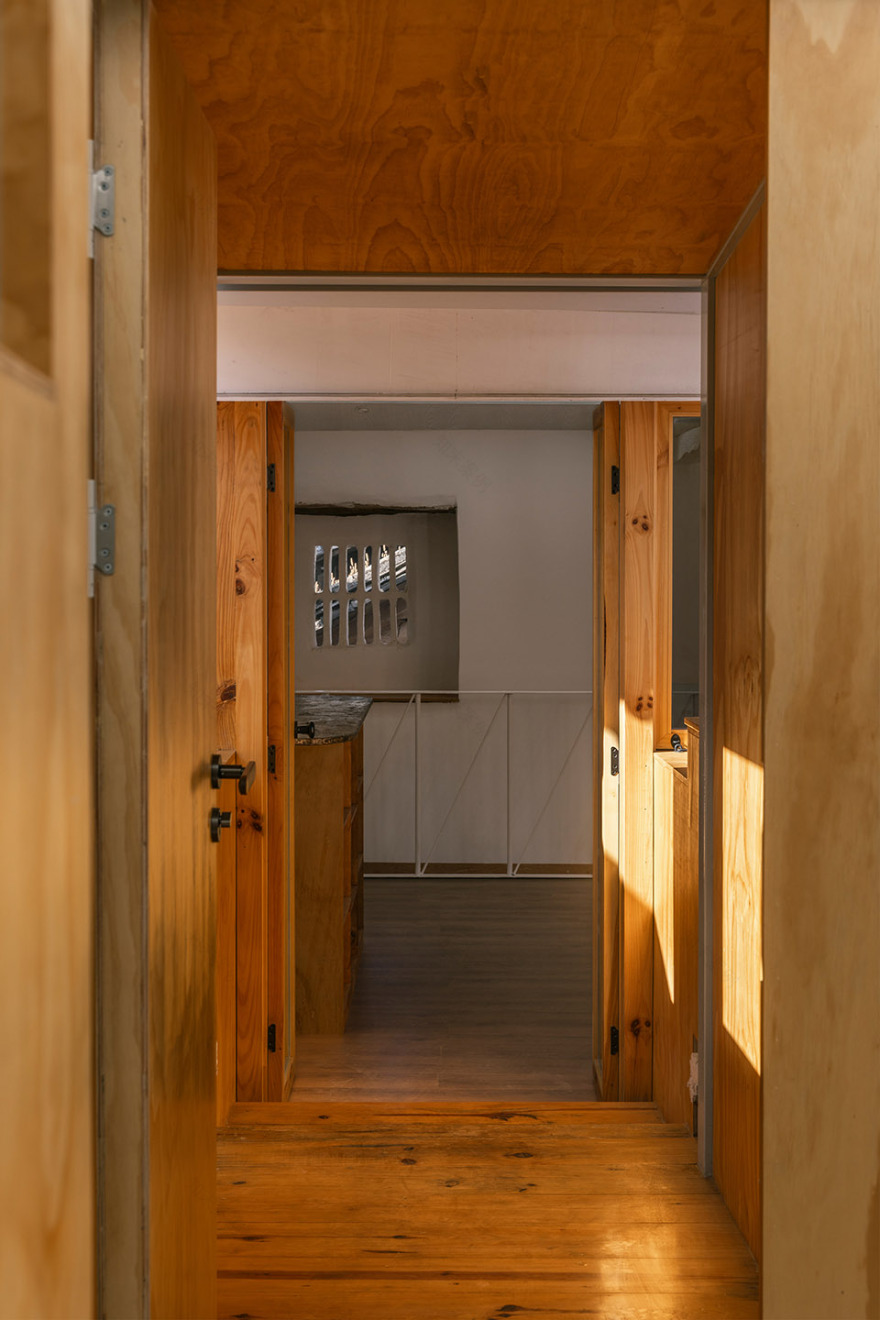
▼卧室,bedroom©刘国威

▼楼廊,corridor©刘国威

▼客厅,living room©刘国威

柱亭入口有一面大“花”墙,由大漆制作而成,取自彝族服饰上的图案;朝向庭院的木墙上裁出“飞鸟”图案花窗,“飞鸟”也同样来自彝族图式。▼飞鸟穿梭于“有花的那个地方”,The birds fly back and forth in the “place with flowers”©边缘计划建筑工作室

At the Pillar Pavilion entrance stands a large “flower” wall. Finished in traditional lacquer, its patterns are drawn from Yi clothing. A “flying bird” window is cut into the wooden wall facing the courtyard. This motif, too, is rooted in Yi iconography.
▼夜景,night view©刘国威

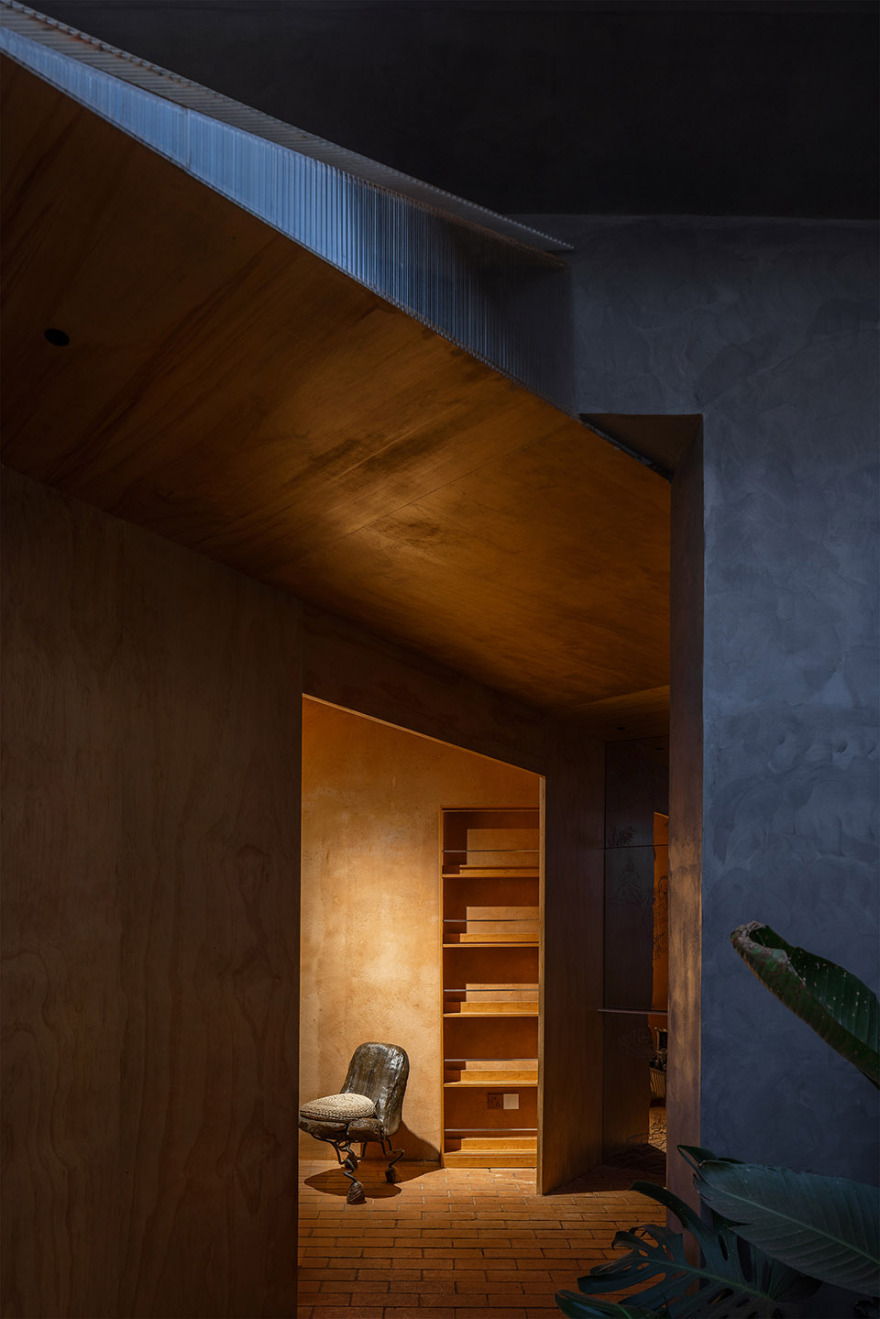
▼大漆墙画“花”制作,Production of the lacquer wall painting “Flowers” ©边缘计划建筑工作室

项目名称:有花呢喝处小院
项目类型:商业建筑/居住建筑
设计方:边缘计划建筑工作室
项目设计:2024年5月
完成年份:2026年3月
设计团队:陈曦,刘苏旸,姚晨,杨寅鹏,和圣莲
项目地址:云南省,大理白族自治州,巍山彝族回族自治县
建筑面积:140㎡
摄影版权:边缘计划建筑工作室,刘国威
客户:商队集市Karvon Saroy
材料:胶合板,聚碳酸酯板
Project name:”VIgorous bLOOms” Courtyard
Project type:Commercial Building / Residential Building
Design:Edge Architects
Design year:2024-05
Completion Year:2026-03
Leader designer & Team: Xi Chen, Suyang Liu, Chen Yao, YinPeng Yang, ShengLian He
Project location:Weishan Yi and Hui Autonomous County, Dali Bai Autonomous Prefecture, Yunnan Province
Gross built area: 140㎡
Photo credit: Edge Architects,Guowei Liu
Clients:Karvon Saroy
Materials:Plywood, Polycarbonate Panels


南京喵熊网络科技有限公司 苏ICP备18050492号-4知末 © 2018—2020 . All photos and trademark graphics are copyrighted by their owners.增值电信业务经营许可证(ICP)苏B2-20201444 苏公网安备 32011302321234号
苏公网安备 32011302321234号客服
消息
收藏
下载
最近