

创作上传
VIP
收藏下载
登录 | 注册有礼
查看完整案例

收藏

下载

分享
在某些地域中,生活围绕着水而展开,光线透过枝叶筛落,植被决定着空气流动的方式。
There are territories where life organizes itself around water, where light filters through branches, and vegetation determines the way the air moves.
▼项目概览,Overall of the project © Onnis Luque

▼鸟瞰,aerial view © Onnis Luque


▼顶视,top view© Onnis Luque


▼项目外观,Exterior of the project © Onnis Luque

在这样的景观之中,建筑并不试图加以主导,而是学习环境彼此交织的方式——如同红树林中水与土地的共生。从这一逻辑出发,本项目由此生成:作为这种节奏的自然延续,承袭其开启、庇护与引导流动的方式。
In these landscapes, architecture does not seek to impose itself, but rather to learn from the way the environment intertwines—from the way water and earth coexist, as they do in a mangrove. From this logic, this project emerges: as a natural extension of that rhythm, adopting its way of opening, sheltering, and guiding movement.
▼项目局部外观,Partial exterior of the project © Onnis Luque


进入住宅需穿行于两个体量之间,它们共同构成一道初始的私密界面。越过这一门槛后,访客进入一处庭院,并在此首次看到主立面。从这一刻起,住宅向其内部空间展开,将生活的重心置于围绕庭院与花园展开的日常之中。
Access to the house occurs between two volumes, which together form an initial layer of privacy. Passing through this threshold, the visitor enters a courtyard from which the main façade is revealed for the first time. From that point on, the house opens toward its interior spaces, placing emphasis on life around its own patios and gardens.
▼庭院,patios© Onnis Luque


▼泳池,swimming pool© Onnis Luque

随后,住宅通过不同标高逐步展开,由外部楼梯相互连接。这些高差伴随行进路径,使空间得以渐次呈现,并在移动过程中不断提供变化的视角。
From there, the house unfolds across different levels connected by exterior stairways. These shifts in elevation accompany the path and allow the space to reveal itself gradually, offering shifting perspectives as one moves through it.
▼外部楼梯,exterior stairways © Onnis Luque

体量的构成由前伸与回收的几何体塑造,仿佛住宅正向环绕其周边的两种景观延展自身边界:一侧是丛林的密度,另一侧是海洋的存在。这种双重地平线之间的张力,通过体量的朝向及其对环境的回应得以显现。
The volumetric composition is shaped by bodies that project and retract, as if the house were extending its limits toward the two landscapes that surround it: toward the density of the jungle and toward the presence of the sea. This tension between both horizons becomes evident in the way the volumes orient themselves and respond to their environment.
▼花园,garden © Onnis Luque


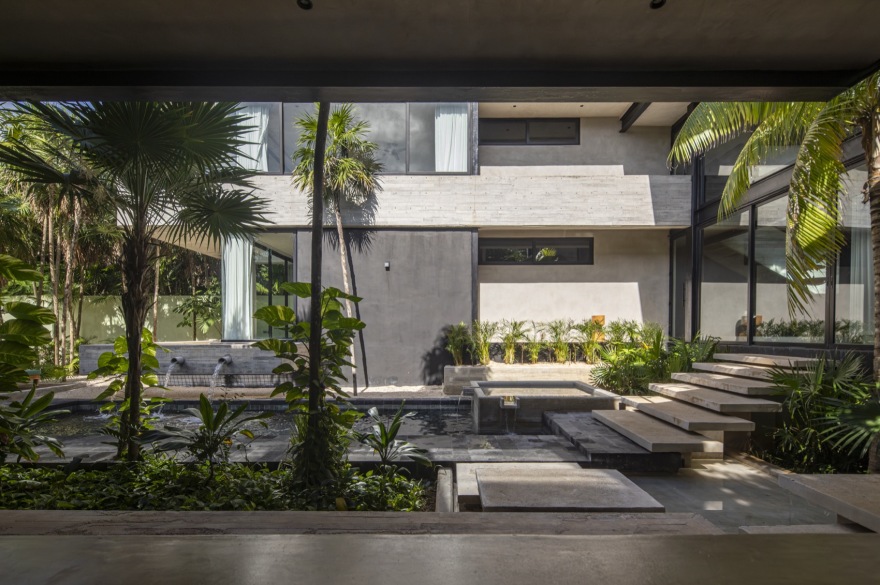
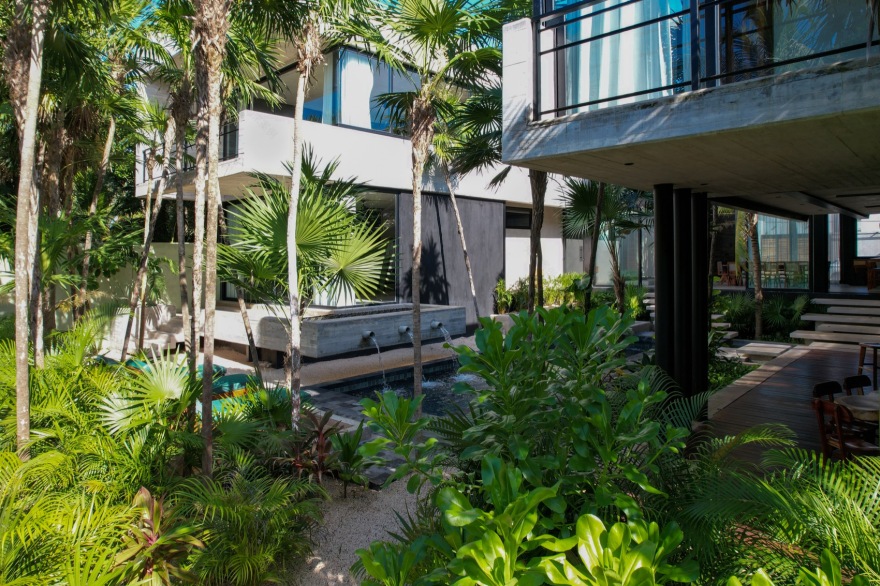
项目的核心是一处狭长而明确的主庭院,它为内部立面遮挡阳光,并调节公共空间的气候。围绕这一空隙,客厅、餐厅、厨房与露台依次展开,水体与植被始终相伴。从进入的那一刻起,这些元素便为整个空间体验定下基调,营造出一种由自然积极塑造居住方式的氛围。
At the heart of the project lies the main courtyard—long and deliberate—that protects the interior façades from the sun and regulates the climate of the social areas. Around this void, the living room, dining room, kitchen, and terrace are arranged, alongside the constant presence of water and vegetation. From the moment one enters, these elements set the tone for the journey and sustain an atmosphere in which the natural world actively shapes the act of inhabiting.
▼主庭院,main courtyard © Onnis Luque


在上层,卧室被布置为既可面向内部庭院,也可眺望周边更广阔的景观。在这里,近处的植被与远处的海平线同时呈现,形成一种融合亲密性与开阔感的场所感知。
On the upper level, the bedrooms are positioned so they can open their views both to the interior patios and to the wider horizons surrounding the house. From there, the nearby vegetation and the distant line of the sea appear simultaneously, offering a perception of place that blends intimacy with expansiveness.
▼望向主庭院,look into the main courtyard © Onnis Luque

▼望向内部庭院,look to the interior patios © Onnis Luque

屋顶层设置了一处带有火坑的露台以及一座附加水池,作为高处的观景节点。从此处,一座玻璃穹顶通向客厅与餐厅的通高空间,使自然光穿过水面,并在墙面投射出不断变化的光影。这种光影的交织贯穿一整天的空间体验,唤起流动与通透在居住中的重要性。
On the rooftop, a terrace with a firepit and an additional pool offer an elevated point for contemplation. From there, a glass dome opens onto the double height of the living and dining room, allowing natural light to pass through the water and cast shifting reflections upon the walls. This interplay of light and shadow accompanies the house throughout the day, recalling the importance of movement and transparency in the experience of inhabiting it.
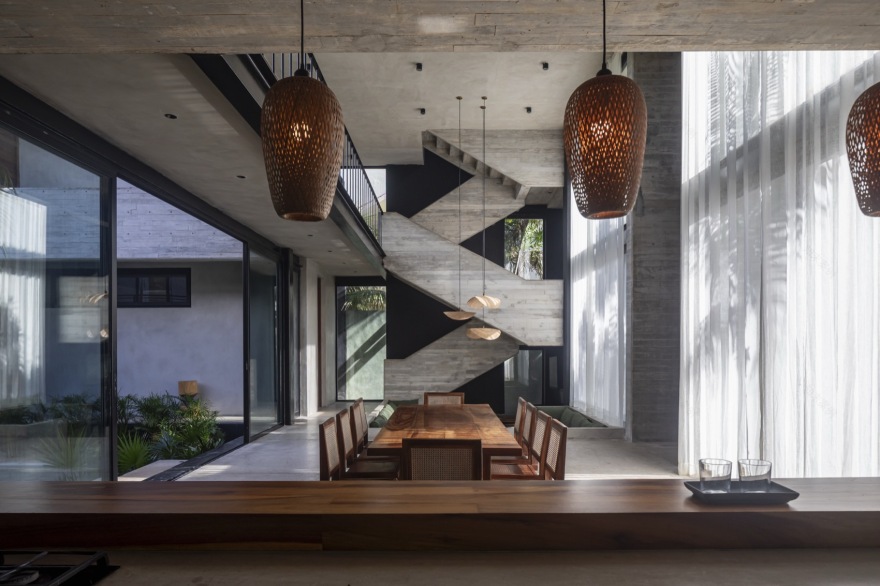
▼餐厅,dining room© Onnis Luque


▼客厅与餐厅的通高空间,the double height of the living and dining room© Onnis Luque

▼光影,light and shadow© Onnis Luque

▼屋顶,rooftop © Onnis Luque


▼水池,pool © Onnis Luque

材料的选择回应气候条件与低维护需求:采用适应热带气候的混凝土,既构成结构,也定义建筑的性格,并辅以黑色钢材与取自场地的木材以引入温度。在其相对中性的背景之下,植被的绿色得以凸显并成为空间的主角。在这一体系的中心,是主楼梯——一件雕塑般的混凝土构件,其贯穿各层的路径唤起了一种被当代转译的前西班牙几何意象。
Finally, the materiality responds to the climate and to the need for low maintenance: a tropicalized concrete that defines both the structure and the character of the house, paired with accents of black steel and site-harvested wood that bring warmth. In its neutrality, the concrete allows the green of the vegetation to stand out and become the protagonist. At the center of this ensemble appears the main staircase, a sculptural concrete piece whose path through the different levels evokes the geometry of a pre-hispanic motif reinterpreted for the present.
▼主楼梯,main staircase © Onnis Luque


因此,这座住宅最终回归其最初的生成逻辑:水、光与植被之间的亲密共生,通过一种静默的平衡关系,自然渗透于每一个空间之中。
Thus, the house ultimately adopts the same logic that inspired its origin: an intimate coexistence between water, light, and vegetation, sustained by a silent equilibrium that naturally permeates every space.
▼首层平面图,ground floor plan © Di Frenna Arquitectos

▼二层平面图,first floor plan © Di Frenna Arquitectos

▼屋顶平面图,roof plan © Di Frenna Arquitectos

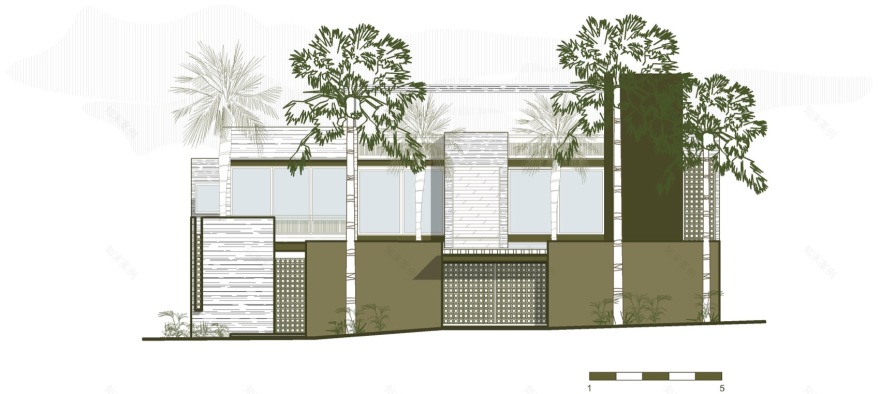
▼立面,elevation© Di Frenna Arquitectos
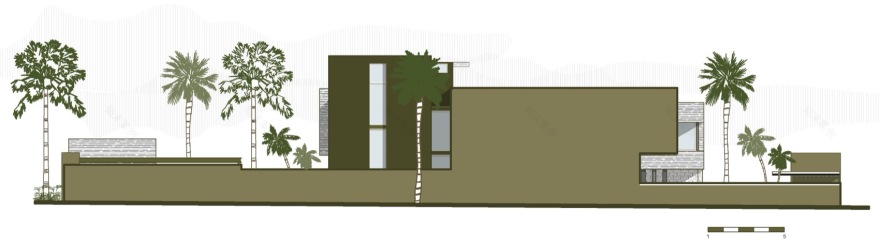

▼剖面,section © Di Frenna Arquitectos


General Information
• Project Name: Casa Vihara
• Architecture Firm: Di Frenna Arquitectos
• Social Media: Instagram Facebook
• Office Location: Namibia 201, Colinas de Santa Fé, 28017 Colima, Col., Mexico
Project Details
• Construction Start Date: September 20, 2020
• Completion Date: January 18, 2025
• Built Area: 634.00 m2
• Location: Tankah, Tulum, Quintana Roo
• Design Team: Matia Di Frenna Müller, Arch. Omar Anguiano de la Rosa
Photography
• Photographer Credits: Onnis Luque
• Photographer Email:


南京喵熊网络科技有限公司 苏ICP备18050492号-4知末 © 2018—2020 . All photos and trademark graphics are copyrighted by their owners.增值电信业务经营许可证(ICP)苏B2-20201444 苏公网安备 32011302321234号
苏公网安备 32011302321234号客服
消息
收藏
下载
最近