

创作上传
VIP
收藏下载
登录 | 注册有礼
查看完整案例

收藏

下载

分享

翻译
Architects:ZHUBO DESIGN
Area:2400m²
Year:2024
Photographs:ACF
Lead Architects:Feng Guochuan
Category:Kindergarten
Design Team:Gong Xiaowen, Yin Yipeng, Wang Zhongshu, Xie Yao, Zeng Zhiwei, Li Mengyao, Wei Ningxin, Kang Jianzhang, Zhou Cairen, Hu Yueming, Huang Xiaoying, Li Bin, He Baohua, Bao Chun, Zeng Yiheng, Wu Tangchong
Engineering:Zhubo Design Co., Ltd
Landscape:Bian Selong Design
Clients:Shenzhen Futong Xinguang Real Estate Development Co., Ltd.
City:Shenzhen
Country:China

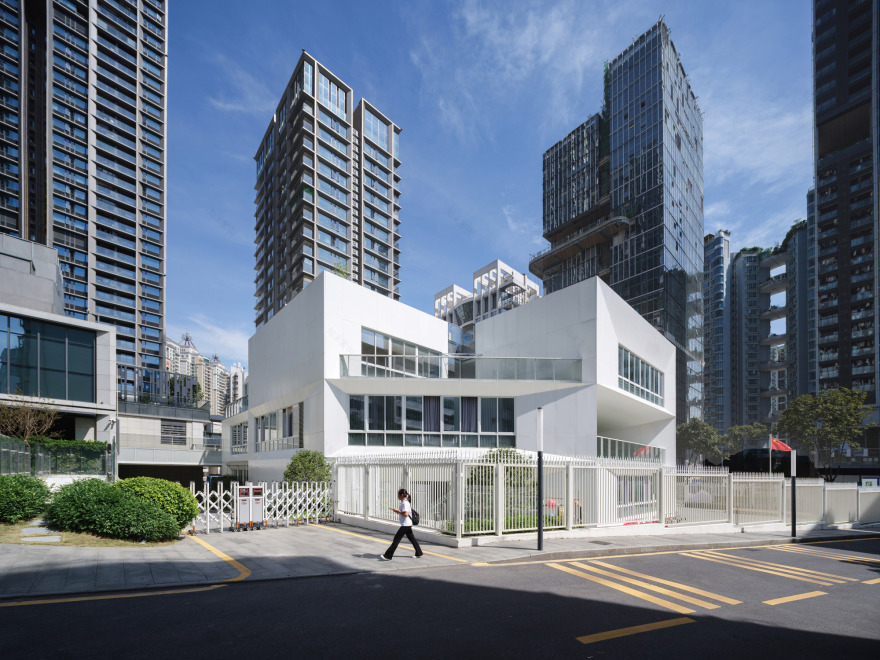
Text description provided by the architects. The project is located at the corner of a super high-rise project site on the south side of the golf course in Futian District, Shenzhen. The site available for construction is very limited, and there is not much extra space after accommodating the basic functions. Although the kindergarten is small in size, we still hope to create a simple and interesting space for the children.We believe that a kindergarten should be a "small world, small universe" for children, rather than a "prison" for keeping them. But how can we fit a "small universe" into such a small kindergarten?


We thought of an ancient symbol - the cross. The ancient Romans believed that the structure of the universe, when simplified to its essence, was a cross, representing the four most fundamental directions perceived by humans. 1,600 years later, Descartes invented the Cartesian coordinate system, quantifying the entire world. The Cartesian coordinate system can also be regarded as a cross; China has a similar idea. The eight trigrams point to eight directions, which is formed by rotating a cross 45 degrees and superimposing it to create a crosshatch, thereby describing the directions of the world.


Therefore, we also adopted the cross as the basic framework of the space to process a standard floor, and each floor was rotated 45° like twisting a Rubik's Cube and stacked together. Due to this rotation, the simple replication relationship between each floor became rich and diverse, generating a visual effect of alternating virtual and real on the exterior, as well as some "corner" spaces. Thus, different space types such as the first floor's elevated floor, the second floor's balcony, the third floor's terrace, and the roof were derived.
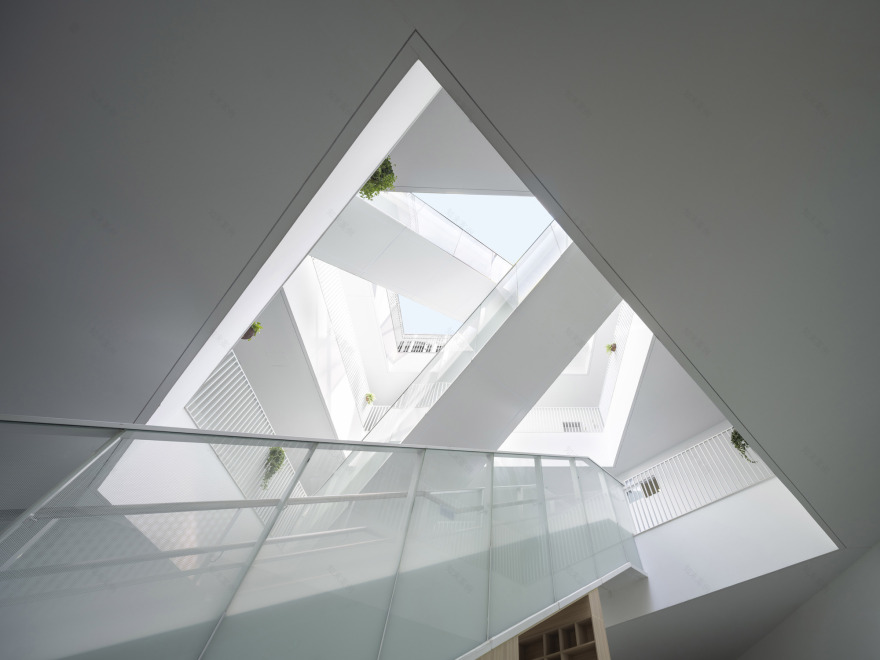

While the internal structure, although each floor is the same when viewed separately, due to the rotation of the orientation between each floor, a feeling of both similarity and difference was produced. The views outside the classrooms on different floors are different, and the staircase crossing the atrium also constantly changes its orientation, forming different dialogue relationships with the corridor, further enriching the internal experience of the building and even bringing some small challenges in spatial orientation to the children.

The city space where children live their daily lives, especially in residential buildings, basically replicate spatial relationships layer by layer; even though some kindergartens have exaggerated shapes and bright colors from the outside, the spatial structure of each floor is still monotonous and repetitive. The original intention of our design is to break this monotony through a rotating action, create a simple and rich world for children with the seemingly simplest physical language and pure white colors, subtly change their solid understanding of the laws of things, and let them gain a more open perspective from spatial experience.

This open spatial relationship can be achieved by simply using a cross-shaped space through layer-by-layer rotation and superposition. But this simple cross space is a link to ancient wisdom that spans the differences between East and West and spans thousands of years. The above is the little mystery we hide in this little kindergarten.

Project gallery




南京喵熊网络科技有限公司 苏ICP备18050492号-4知末 © 2018—2020 . All photos and trademark graphics are copyrighted by their owners.增值电信业务经营许可证(ICP)苏B2-20201444 苏公网安备 32011302321234号
苏公网安备 32011302321234号客服
消息
收藏
下载
最近