

创作上传
VIP
收藏下载
登录 | 注册有礼
查看完整案例

收藏

下载

分享
与很多美丽的岭南乡镇一样,在大沥盐步,人与河的联系是人居环境中重要的一环,是传统场地精神的灵魂。如今,盐步涌的赛龙舟、龙船互访活动已延续六百多年,是堪比春节的盛事。端午期间观者云集,海外侨胞也纷纷回乡,彰显出强大的社会凝聚力。上世纪乡镇企业快速发展,厂房与街区紧密交织,却挤占河道、隔断了人居与水岸的有机联系。城市更新的重要意义,正是在微观层面修复这种关系,起到 “活血化瘀” 的作用。
Like many picturesque towns in the Lingnan region, the connection between people and rivers in Yanbu, Dali Town is a crucial element of the living environment and the soul of the site’s traditional spirit. The dragon boat races and mutual dragon boat visits along the Yanbu River have been maintained for more than 600 years—grand events comparable to the Spring Festival. During the Dragon Boat Festival, throngs of spectators gather, and overseas Chinese return to their hometowns one after another, reflecting strong social cohesion. With the rapid development of township enterprises in the last century, factories and urban blocks became closely intertwined. However, they encroached on the river channels and severed the organic connection between human habitation and the waterfront. The significance of urban renewal lies precisely in restoring this connection at the micro level, functioning as a “blood circulation activation” to invigorate the area.
▼盐步老龙(中国现存最古老的龙舟,可追溯至1432年),Yanbu Old Dragon Boat (The oldest existing dragon boat in China, dating back to 1432)© 竖梁社

盐步老龙1432片区系列改造项目正推动盐步大涌堤岸老城更新,2025年6月25日在南海区文旅产业高质量发展推进大会上作为区域文旅产业重点发展街区被正式推介。该项目2022年11月启动,以全国最长寿龙舟“盐步老龙”(最早可追溯至明朝宣德七年,即1432年)为文化内核,规划以“盐步九章”为框架,打造“一涌两街五园十三景”,构建集办公、娱乐、休闲、观光于一体的城产人文融合项目。作为大沥镇盐步城市更新示范区的中心项目,项目涉及四个片区、占地约950亩,改造面积约65亩。盐步粮食加工厂、盐步酒厂是项目重要节点。
▼盐步涌酒厂旧况,Former State of Yanbu Distillery Along Yanbu River© 竖梁社
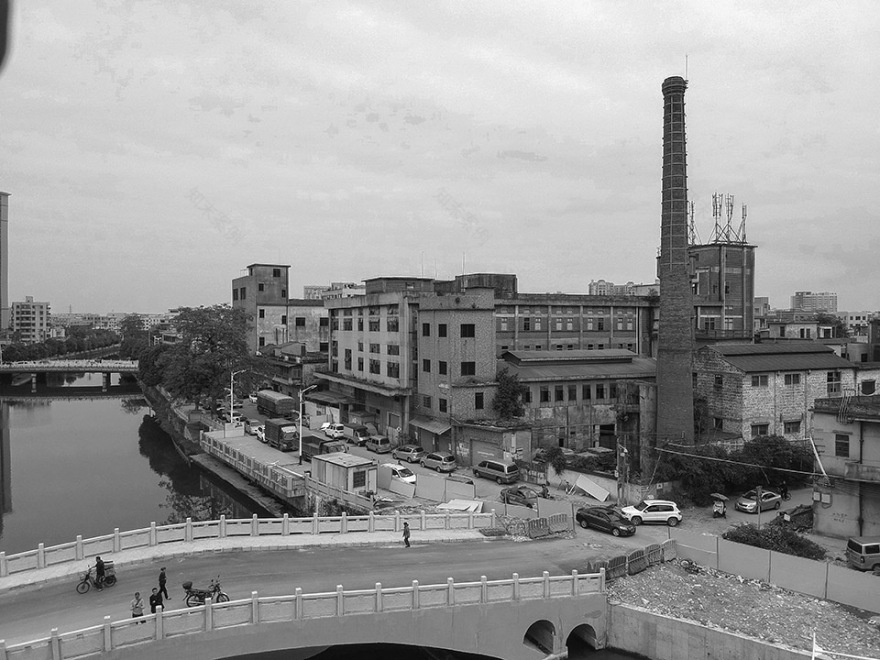
The series of renovation projects in the Yanbu Old Dragon 1432 Zone is advancing the urban renewal of the old town along the embankment of the Yanbu River. It was officially presented as a key development block for regional cultural and tourism industries at the Conference on High-Quality Development of Cultural and Tourism Industries in Nanhai District on June 25, 2025. Launched in November 2022, the project takes the Yanbu Old Dragon Boat—China’s oldest existing dragon boat, whose history can be traced back to the 7th year of the Xuande reign in the Ming Dynasty (i.e., 1432)—as its cultural core. Guided by the framework of “Nine Strategies of Yanbu,” it aims to create a layout of “One River, Two Streets, Five Parks, Thirteen Scenic Spots,” building an urban-industrial-cultural project that integrates office, entertainment, leisure and sightseeing functions. As the central project of the Yanbu Urban Renewal Demonstration Zone in Dali Town, it covers four zones with a total area of approximately 950 mu (about 63.3 hectares) and a renovation area of around 65 mu (about 4.3 hectares). The Yanbu Grain Processing Factory and Yanbu Distillery are key nodes of the project.
▼盐步涌龙舟赛,Yanbu Dragon Boat Race©吴嗣铭

场地本身提供了契机:酒厂搬迁后留下的工业构筑与滨水岸线,是嵌入密集城区的稀缺公共资源。设计的核心问题意识由此确立——不是改造一座工业遗存,而是以工业遗存为支点,撬动乡镇的公共空间转型。
The site itself presents a unique opportunity: the industrial structures left behind after the distillery’s relocation, together with the waterfront, form scarce public resources embedded in a densely built urban area. This has defined the core design awareness: rather than merely renovating an industrial heritage site, the project uses such relics as a pivot to drive the transformation of public space in the township.
▼工业遗存的空间转型(改造过程),Spatial Transformation of Industrial Heritage (Renovation Process)© 竖梁社

历史维度:历史脉络与空间识别
Historical Dimension: Historical Context and Spatial Identification
场地所在的“省佛通衢”,是明清时期广州(省城)与佛山之间的重要陆路通道,见证了岭南地区数百年的商贸往来与文化交流。这条古道不仅是货物的运输线,更是人员、信息与生活方式流动的载体。它塑造了沿线聚落的性格:开放、包容、善于谈吐。酒厂的建立改变了水岸的界面关系:围墙立起,驳岸硬化,水与城之间形成物理与心理的双重屏障。设计的任务不是创造新的景观,而是恢复被阻断的公共生活。
▼滨水界面的梳理(前后对比),Reorganization of the Riverfront Interface (Before & After) © 竖梁社
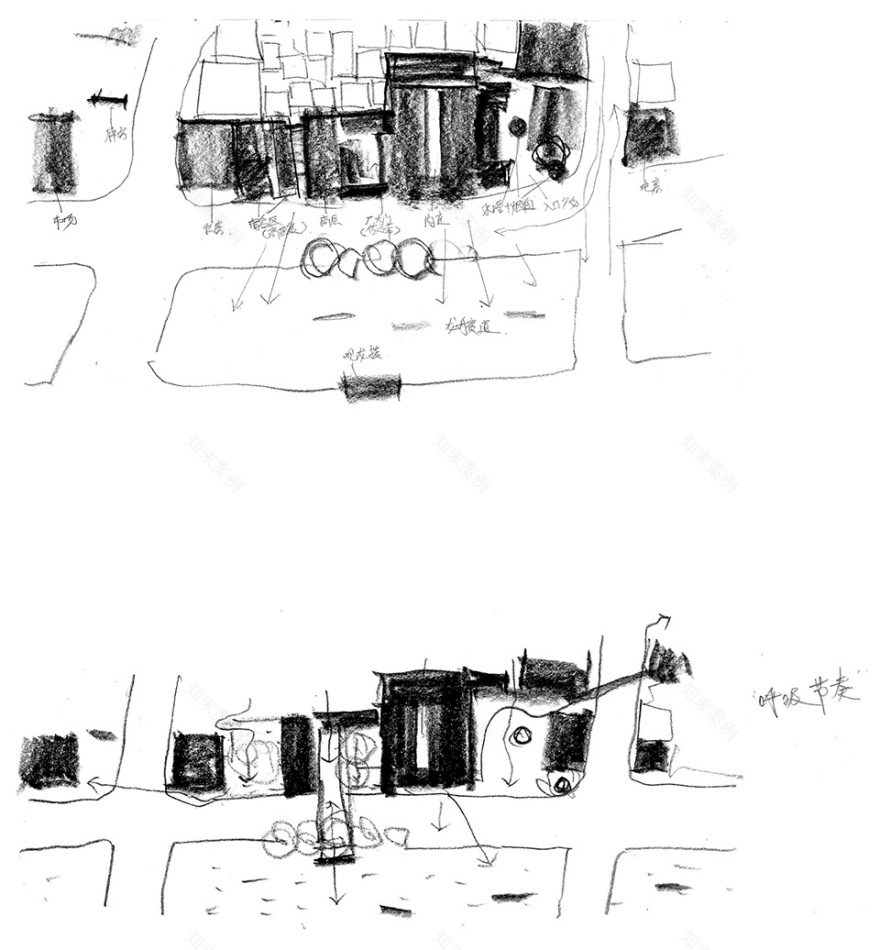
The site is located along the Shengfo Thoroughfare, a vital overland route between Guangzhou (the provincial capital) and Foshan during the Ming and Qing dynasties. It has witnessed centuries of commercial and cultural exchanges in the Lingnan region. This ancient road is not merely a route for goods transportation, but also a carrier of the flow of people, information and lifestyles. It has shaped the character of the settlements along this thoroughfare: open, inclusive and communicative. The establishment of the distillery altered the waterfront interface: walls were erected, the revetment was hardened, thus forming both physical and psychological barriers between the water and the town. The goal of the renovation design is not to create new landscapes, but to restore the public life that was cut off.
▼“大刀阔斧”与“绣花功夫”并行,Combination of Bold Renovation and Meticulous Craftsmanship©吴嗣铭

受水系与工业布局影响,城镇呈现典型的线性空间格局,缺乏足够大的核心空间。设计必须放弃对单一核心的执念,转向去中心化的空间策略——通过多流线组织、多场景营造,让公共空间分散嵌入密集城区。这正是“好逛的设计”的内在逻辑:不是用一个广场容纳所有人,而是用无数个小场景吸引人一直走下去。▼生成过程分析,Process Analysis of Formation© 竖梁社

Constrained by the water system and industrial layout, the town features a typical linear spatial structure without a sufficiently large core space. The design must abandon the obsession with a single core space and adopt a decentralized spatial strategy—by organizing multiple circulation routes and creating diverse scenarios, to embed public spaces into the dense urban fabric. This is the inherent logic behind a “pleasant-to-wander” design: not to gather everyone in a single square, but to draw people onward through numerous small scenes.
▼公共空间的留白,The blank space in public spaces©吴嗣铭

场地保留的三座工业构筑——烟囱、水塔、冷却塔——构成强有力的三角天际线。在龙舟赛道的视线分析中,这三座构筑恰好位于最佳观赛视域内。工业遗存与传统文化线索在此叠合,指向一种新的空间可能:将“被看的对象”转化为“观看世界的窗口”,将生产的遗迹转化为生活的背景。
▼烟囱、树木和旧砖瓦的保留,Retention of the Chimney, Trees and Old Bricks and Tiles© 竖梁社

Three preserved industrial structures on the site—a chimney, a water tower, and a cooling tower—form a distinct triangular skyline. In the viewing analysis of the dragon boat race course, these three structures lie exactly within the optimal viewing zone. Industrial heritage and traditional cultural elements (such as dragon boat racing) intersect here, opening up new spatial possibilities: turning “objects to be viewed” into “windows to view the world” and transforming production relics into backdrops for daily life.
▼烟囱、水塔、冷却塔构成的天际线(改造过程),Skyline Formed by the Chimney, Water Tower and Cooling Tower (Renovation Process)© 竖梁社

空间策略:大刀阔斧与绣花功夫
Spatial Strategy: Bold Renovation and Meticulous Craftsmanship
01 滨水公共空间的重构
01 Reconfiguration of Waterfront Public Space
在城市设计的层面上,我们首先把封闭的厂房区切开,疏导从街区到河岸的小街小巷,改进机动车流线与停车设施,来重新连接人与水。▼老街巷的新生,Revival of Old Alleys©竖梁社

At the urban design level, we first broke through the enclosed factory area, smoothed the small lanes and alleys leading from the blocks to the riverbank, and improved the motor vehicle circulation and parking facilities to reconnect people with the water.
▼老街巷的新生,Revival of Old Alleys©吴嗣铭

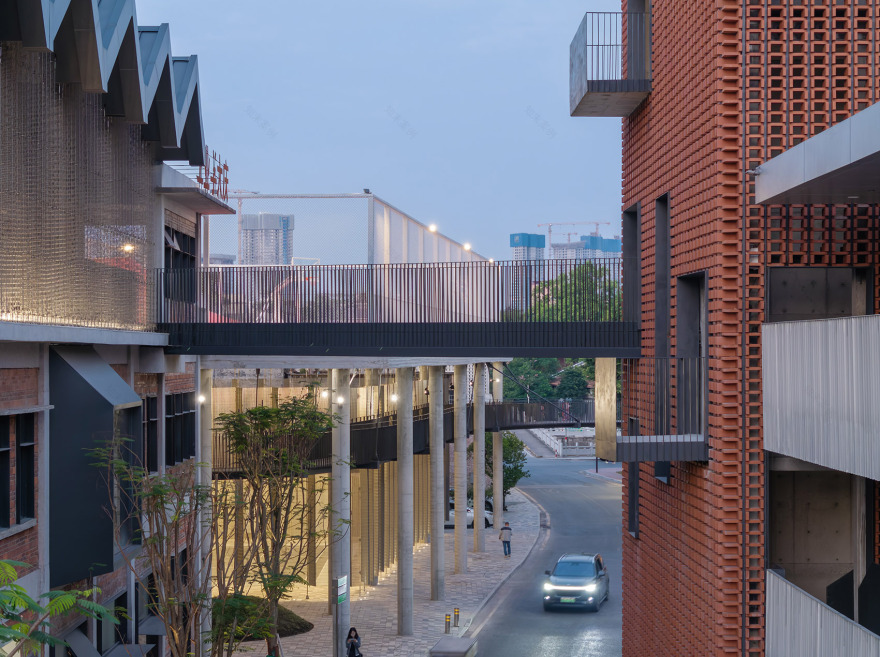
我们重新设计了从盐步直街到海傍路的断面,首层建筑适当退让,留出更多人行空间,并通过大台阶将游人自然地从商业老街引导至沿江的立体步行街,领略江上清风。这样不仅创造了多首层的商业空间,也在龙舟盛事时为村民提供了更优质的观看空间。
We redesigned the section from Yanbu Zhijie Street to Haibang Road. The ground floors of the buildings are appropriately set back to reserve more pedestrian space, and wide steps naturally guide visitors from the old commercial street to the riverside elevated pedestrian walkway, allowing them to enjoy the cool breeze by the river. This not only creates multi-level ground-floor commercial spaces, but also provides villagers with better viewing areas during the grand dragon boat events.
▼沿江露台与立体步行系统,Riverside Terraces & Elevated Pedestrian System©吴嗣铭

以此步行街为线索,串起了很多高质量、各有特色的公共空间:有讲述旧厂历史的酒园、提供一片绿荫的山园、时尚活泼的运动公园、老房子坡屋顶上的观景台,还有各种口袋公园、灰空间、商业外摆区等。这些公共空间的加入,使得原有过于致密的肌理得到透气的机会。在800余米的步行体验中,人们将经历虚实交替的空间节奏,不断发现转角的惊喜。整个街区就像一块内部多孔的海绵,能够吸纳更多样的活动。
Taking this pedestrian walkway as the main thread, we have strung together a series of high-quality and distinctive public spaces: the Distillery Garden that narrates the history of the old factory, the Hill Garden that provides a stretch of green shade, the trendy and lively Sports Park, viewing platforms on the sloped roofs of the old buildings, as well as various pocket parks, gray spaces, and commercial outdoor seating areas. The addition of these public spaces has allowed the originally overly dense urban fabric to “breathe”. During the 800-meter walking route, people will experience a spatial rhythm of alternating solid and void, constantly discovering surprises around every corner. The entire block is like a sponge with internal pores, capable of absorbing a more diverse range of activities.
▼各有特色的公共空间,Distinctive Public Spaces©吴嗣铭

02 空中步道系统
02 Skywalk System
空中步道的选址基于双重逻辑:一是龙舟赛道的视线模拟,二是“好逛”的动线设计。我们分析端午观赛的需求,确定最佳观赛点,并以轻质连廊串联。
The location of the elevated walkway is based on dual logics: first, the sightline simulation of the dragon boat race track, and second, the “pleasant-to-wander” circulation design. We analyzed the viewing needs during the Dragon Boat Festival, identified the optimal viewing spots, and connected them with lightweight skybridges.
▼空中平台系统,Elevated Platform System©吴嗣铭

步道系统刻意避免单一环线,形成多岔路、多停留、多转折的体验。这正是去中心化设计的核心——不预设唯一的目的地,让路径本身成为目的地。
▼连廊串联空中步道系统,Corridors connecting the aerial walkway system©竖梁社

The walkway system deliberately avoids a single loop, creating an experience with multiple branches, stopping points and turns. This is precisely the core of decentralized design—not presupposing a single destination, but allowing the path itself to become the destination.
▼多层次的步道系统,Multi-Level Pedestrian Walkway System©吴嗣铭

03 公共空间的留白
03 The “Void” of Public Space
在密集建成区中,空间是需要留白的。我们拆除若干质量较差、遮挡视线的建筑,将腾退出的空地转化为水波纹广场、瓦园与运动场地。
In a densely built-up area, space requires intentional voids. We demolished several low-quality buildings that obscured views, and converted the vacated land into Water Ripple Square, Tile Garden, and sports spaces.
▼公共空间的留白,The “Void” of Public Space©吴嗣铭


这些空间尺度不大,但嵌入街巷肌理之中,成为居民日常可达的“口袋公园”。拆除留下的旧砖瓦被装入金属笼网成为“砖笼”幕墙,或立砌成“瓦园”步道。材料的循环利用既是可持续的策略,也是记忆的延续——让曾经属于工业生产的砖瓦,重新服务于公共生活。
These spaces are modest in scale, yet embedded in the street fabric, serving as easily accessible “pocket parks” for residents. The old bricks and tiles left from demolition are enclosed in metal gabions to form “brick cage” curtain walls, or laid vertically to create walkways in the Tile Garden. The recycling of materials is not only a sustainable strategy but also a continuation of memory—allowing the bricks and tiles that once supported industrial production to now function in public life.
▼公共空间的留白,The “Void” of Public Space©吴嗣铭
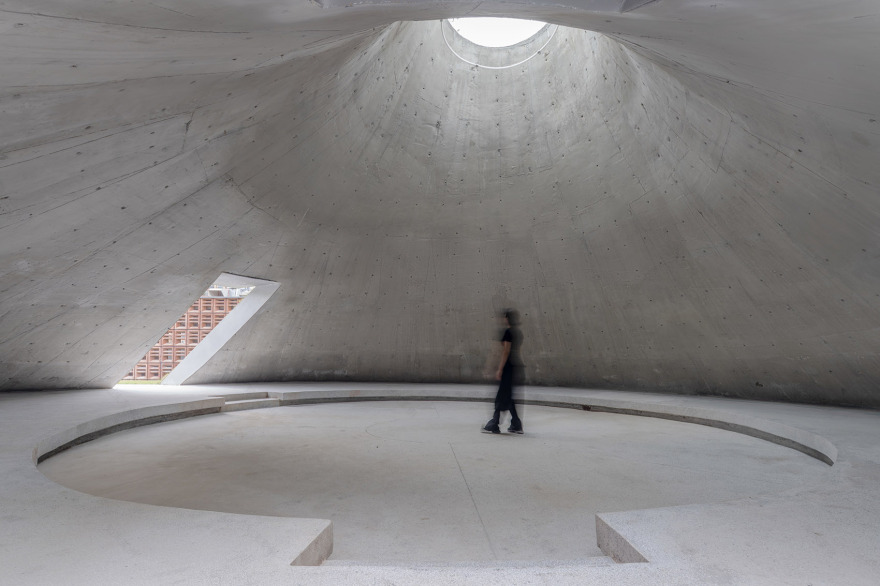
▼各有特色的公共空间,Distinctive public spaces©吴嗣铭

04烟火墟市:流量时代的商业逻辑
04 Bustling Market: Commercial Logic in the Era of Visitor Flow
沿河界面的改造我们提出“AB面”的空间策略:A面临水,采用现代陶砖与折叠门窗,形成通透的商业界面;B面朝向街巷内部,保留斑驳老墙、木质传送带,成为空间的精神内核。
For the renovation of the riverside interface, we proposed an “AB-side” spatial strategy: Side A faces the water, adopting modern ceramic tiles and folding doors and windows to form a transparent commercial frontage; Side B faces inward toward the streets and alleys, preserving the weathered old walls and wooden conveyor belts as the spiritual core of the space.
▼通透的商业界面,Transparent Commercial Frontage©吴嗣铭
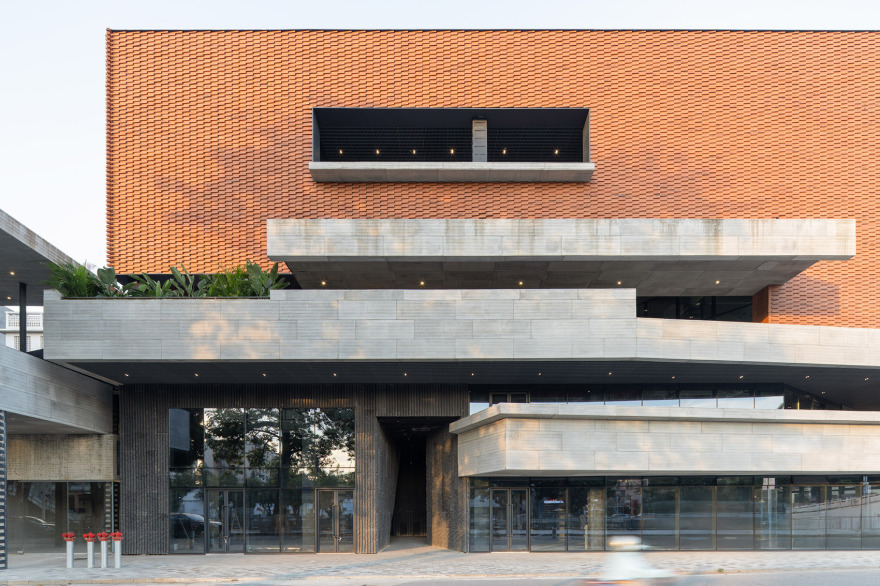
这是另一个我们精心权衡的要点——公共福利与商业利益的边界。毫无疑问,商业是本项目中不可或缺的一环,但商业行为往往带有侵占公共资源的本能。近年来,各地兴起的“公园式商业”为我们提供了诸多启示与借鉴,让我们有信心做好这一平衡。
There is another key point we have carefully weighed: the boundary between public welfare and commercial interests. There is no doubt that commerce is an indispensable part of this project, but commercial activities often have an inherent tendency to encroach on public resources. In recent years, the rise of “park-like commercial space” in various regions has provided us with ample inspiration and references, giving us confidence in striking this balance.
▼向内的精神场域,The Inward Spiritual Field©吴嗣铭

我们在很多沿江的步行空间都做了放大,推演它们作为商业外摆空间的使用场景,从步行距离、商店界面到座椅扶手细节等都有体现。
We have expanded many of the riverside walking spaces, simulating their usage scenarios as commercial outdoor seating areas. This is reflected in details ranging from walking distances and shopfront interfaces to seating and handrail designs.
▼沿江的步行空间,Riverside Pedestrian Spaces©吴嗣铭

此外,在几处口袋公园的处理上,我们引入了“山”的原型,不仅是为了与“水”形成意象上的趣味呼应,更重要的是保持空间的“异质化”。例如,地面在这里是倾斜的,步行者能感受到身体重心的变化——这构成了核心体验的一部分。商业经营者必须为此专门设计场景,而不能凭借惯性将其转化为标准的商业空间。
▼山园的空间设计(改造过程),The spatial design (renovation process) of the mountain garden©竖梁社

Furthermore, in the treatment of several pocket parks, we introduced the prototype of “hills” not only to create an interesting echo with “water” in imagery, but more importantly, to maintain the “heterogeneity” of the space. For instance, the ground here is sloped, allowing pedestrians to feel a change in their center of gravity—which constitutes part of the core experience. Commercial operators must therefore specifically design scenarios for these spaces, rather than converting them into standardized commercial spaces out of habit.
▼山园的空间设计,Spatial Design of Hill Garden ©吴嗣铭

这也是公园式商业以及各种所谓新消费场景的迷人之处。在流量为王的时代,商业空间的核心竞争力是让人愿意停留的公共空间。设计刻意模糊商业动线与公共动线的边界:当人们愿意在这里坐下、聊天、发呆,消费便自然而然地发生。
This is also the charm of park-like commercial spaces and various so-called new consumption scenarios. In an era dominated by visitor flow, the core competitiveness of commercial spaces lies in public spaces that make people willing to stay. The design deliberately blurs the boundary between commercial circulation and public circulation—when people are willing to sit, chat, and linger here, consumption occurs naturally.
▼商业动线中的可停留空间,Stayable Spaces Within Commercial Circulation©吴嗣铭

在“公园+主理人+商业”的新商业模式引领下,这种创新的商业运营模式,将历史文化街区与现代商业相结合,为区域发展注入源源不断的活力。商业与公共空间的“碰撞与融合”,最终指向同一种愿景:让公共生活在这里发生,让商业成为公共生活的自然结果,而非目的。
Guided by the new business model of “Park + Host + Commerce”, this innovative commercial operation model integrates historical and cultural blocks with modern commerce, injecting a steady stream of vitality into regional development. The “collision and integration” of commerce and public space ultimately points to the same vision: to let public life unfold here, and to make commerce a natural outcome of public life, rather than its purpose.
▼历史文化街区与现代商业相结合,Integration of Historic and Cultural Blocks with Modern Commerce©吴嗣铭

05 “一栋一策”的差异秩序
05 Differential Order Through “One Building, One Strategy”
在整体的建筑风貌上,很多城市综合体乃至城市旧街区更新的做法,是通过统一风格强化自身的整体性。而我们认为这是需要具体问题具体分析的:过于统一的风格,往往是规划者从俯视视角出发的武断,是自我意识的过剩。对一个街区的印象,远远看去只需一秒,而置身其中行走、体验,却值得花上一天。原有乡镇厂房与传统街区的无缝镶嵌,化整为零,其实是一种生存智慧,这个过程中产生的很多混沌、偶然甚至矛盾,也是一种独属于此地的气质,是值得我们珍惜的。因此,我们拒绝统一的立面风格,坚持以步行体验为核心标准,采用微改造与新旧结合的方式,精心恢复红砖、水刷石、混凝土等原有立面的基本风貌,并做出自己的演绎。▼原有混沌的厂房,Original Chaotic Factory Complexes© 竖梁社

In shaping the overall architectural style, many urban complexes and even old urban block renewals rely on a unified style to enhance their own integrity. We hold that this requires a case-by-case analysis: excessive stylistic uniformity often stems from the arbitrariness of planners from a top-down perspective and an overabundance of self-awareness. It takes only one second to form an impression of a block from a distance, but it is worth spending a full day walking through and experiencing it firsthand. The seamless integration of former town factories with traditional urban blocks, breaking the whole into parts, is in itself a form of survival wisdom. Much of the chaos, contingency, and even contradictions arising in this process also form a unique temperament specific to this place, which is worth cherishing. Therefore, we rejected a one-size-fits-all facade style and adhered to taking pedestrian experience as the core criterion. Adopting the approach of gentle micro-renovation and integration of old and new elements, we carefully restored the basic style of the original facades—including red brick, washed stone, and concrete—and presented our own interpretation of them.
▼旧厂房立面微改造,Micro-Renovation of Old Factory Facades©吴嗣铭

▼新建的机械停车库,New Mechanical Parking Garage©吴嗣铭

针对不同建筑状况,我们制定了分类改造菜单:对保留完好的老建筑以清洗修缮为主;对质量一般的建筑,进行局部立面置换,让红砖与高透玻璃对话,混凝土墙与耐候钢并置;临时建筑拆除后原址新建,以当代语言介入。
We developed a classified renovation menu tailored to different building conditions: for well-preserved old buildings, we focused primarily on cleaning and renovation; for buildings of moderate quality, we carried out partial facade replacement, allowing red brick to dialogue with high-transparency glass and concrete walls to coexist with weathering steel; for temporary buildings, we demolished them and built new ones on the original sites, intervening with contemporary architectural language.
▼旧厂生产痕迹的保留与转译,Preservation and Translation of Production Traces in Old Factories©吴嗣铭

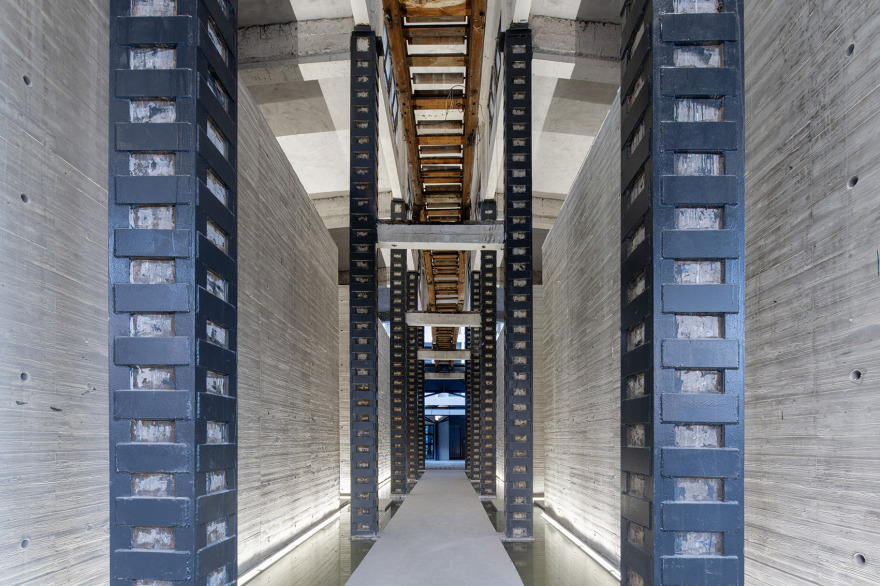
材料碰撞遵循统一的色谱逻辑——以灰调为基底,以陶土色与银灰色为点缀,使多样性的背后仍有一以贯之的秩序。这一策略源自对城镇演化规律的认知:差异是其固有属性,设计应使其“可读”,而非抹平。最后的体验,其实更接近一次现代空间的“游园”。我们希望能保持原有街区风貌的灵活多样,又能满足现代商业空间对个人需求的关照。
Material interactions follow a unified chromatic logic—with gray tone as the base, accented by terracotta and silver gray—so that there remains a consistent order behind the diversity. This strategy comes from an understanding of the laws of urban evolution: difference is its inherent attribute, and design should make it “legible” rather than eliminate it. The overall experience is actually closer to a “park tour” in a modern space. We aim to preserve the flexible and diverse features of the original neighborhood, while meeting the personal needs of modern commercial spaces.
▼差异化带来的空间体验,Spatial Experience Brought About by Differentiation©吴嗣铭

结语
Conclusion
我们希望项目落成后,龙舟依然在端午划过。但更重要的是那些日常:老人在烟囱下的舞台上下棋,年轻人在空中步道上慢跑,孩子在水波纹广场的陶砖上嬉戏,情侣在瓦园挑出的平台上坐着看日落。咖啡店的外摆区坐满了人,买咖啡需要排队,但没有人着急——反正有水景可看,有步道可逛。
We hope that after the project’s completion, dragon boats will still surge past during the Dragon Boat Festival. But more importantly, we value the everyday scenes: elders playing chess on the stage under the chimney, young people jogging on the elevated walkways, children playing on the terracotta tiles of the Water Ripple Square, and couples sitting on the overhanging platforms of the Tile Garden watching the sunset. The outdoor seating area of the café is full; people wait in line for coffee, but no one is in a hurry—after all, there are waterscapes to admire and walkways to wander.
▼酒厂沿街的日常,Daily Life Along Distillery’s Street©吴嗣铭

这是设计之初的愿景:让一座缺乏公共空间的乡镇,开始拥有公共生活。我们无法提供一个大公园,但可以在密集城区中挖掘无数个小场景;我们无法创造一个单一的中心,但可以用多流线、多节点的去中心化设计,让场地变得“好逛”;我们无法强制消费发生,但可以创造让人愿意停留的空间,让消费自然而然地生长。这是一场“大刀阔斧”与“绣花功夫”并行的实验。当五百岁的老龙有了新的观众席,当工业遗存成为生活的背景,当人们在街巷转角总能遇见一处可以坐下的地方——答案已然浮现。
This was our vision at the outset of the design: to enable a town lacking public space to embrace public life. We cannot provide a large park, but we can explore and create numerous small scenes within the dense urban area; we cannot create a single center, but we can adopt a decentralized design with multiple circulation routes and nodes to make the site pleasant to wander; we cannot force consumption to occur, but we can create spaces where people are willing to stay, enabling consumption to grow naturally. This is an experiment that combines bold and decisive renovation with meticulous craftsmanship. As the 500-year-old dragon has gained new spectators, as industrial relics have become a backdrop for daily life, and as people can always find a place to sit around every street corner—the outcome has revealed itself.
▼夜景,night view©吴嗣铭

▼盐步老龙1432片区系列改造,The renovation series of the 1432 area of Yanshu Old Dragon©竖梁社
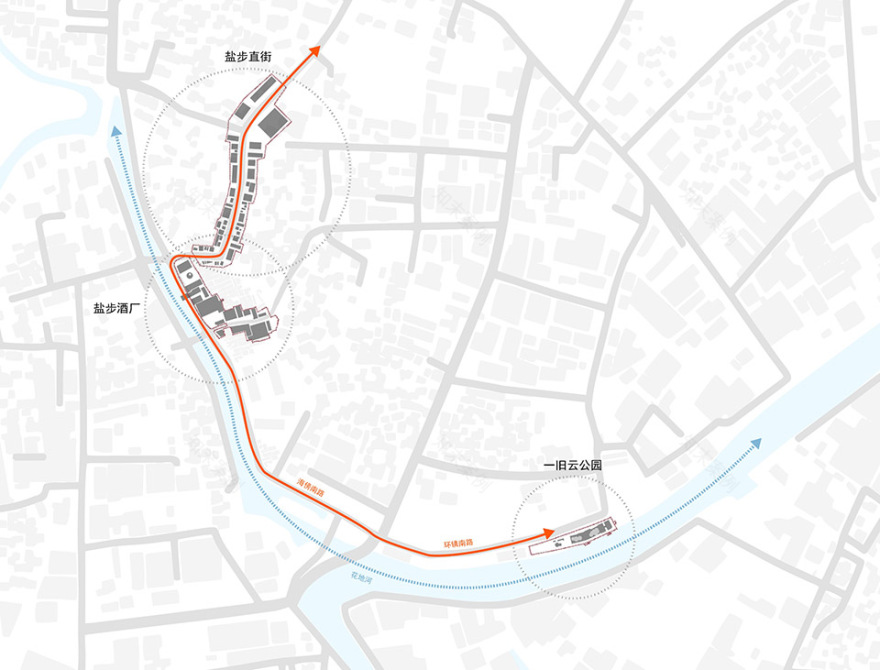
▼项目改造后总平面图,Final layout plan after project renovation©竖梁社

▼5.6仓南立面图,Front View of Warehouse©竖梁社

▼1、2仓墙身大样图,drawing of the wall structure©竖梁社

项目名称:南海大沥“盐步1432”盐步粮食加工厂、酒厂改造
项目类型:建筑、景观
设计方:广州市竖梁社建筑设计有限公司
项目设计:2023.3-2024.3
完成年份:2025.10
主持建筑师:朱志远、宋刚、钟冠球;
设计团队:项目负责人:林海锐、黄文轩;建筑、景观、室内一体化设计:段旭乾、李佩佳、朱凯耀、赵航、林东燕、蔡雅倩、Frank Ouyang(实习)
项目地址:佛山市南海区大沥镇海傍南路
建筑面积:24410㎡(盐步粮食加工厂13843㎡;盐步酒厂10567 ㎡)
摄影版权:吴嗣铭
合作方:深化设计:广州市钢砼建筑设计院有限公司(粮食加工厂)、晟艺建筑设计工作室(酒厂)、田源集设计工作室(景观)
施工单位:佛山市城市建设工程有限公司(粮食加工厂) ,广东洋艺建设有限公司(酒厂)
客户:佛山市南海区大沥镇一四三二产业投资有限公司
Project name:Nanhai Dali “Yanbu 1432” Yanbu Grain Processing Plant & Distillery Renovation
Project type:Architecture, Landscape
Design:Atelier cnS
Design year:2023.3-2024.3
Completion Year:2025.10
Leader designer & Team:
Design Direction:Zhiyuan Zhu, Gang Song, Guanqiu Zhong
Project Director: Hairui Lin, Huang Wenxuan
Design Team: Duan Xuqian, Li Peijia, Zhu Kaiyao, Zhao Hang, Lin Dongyan, Cai Yaqian, Frank Ouyang (Intern)
Project location:Haibang South Road, Dali Town, Nanhai District, Foshan City
Gross built area: 24,410 m² (Yanbu Grain Processing Plant: 13,843 m²; Yanbu Distillery: 10,567 m²)
Photo credit: Siming Wu
Partner:Construction Drawings:Atelier cnS-S&C design , Shengyi Architecture Design Studio, Tianyuanji Design Studio
Construction Contractor:Foshan Urban Construction Engineering Co., Ltd. (Grain Processing Plant); Guangdong Yangyi Construction Co., Ltd. (Distillery)
Clients: Foshan Nanhai District Dali Town 1432 Industrial Investment Co., Ltd.


南京喵熊网络科技有限公司 苏ICP备18050492号-4知末 © 2018—2020 . All photos and trademark graphics are copyrighted by their owners.增值电信业务经营许可证(ICP)苏B2-20201444 苏公网安备 32011302321234号
苏公网安备 32011302321234号客服
消息
收藏
下载
最近