

创作上传
VIP
收藏下载
登录 | 注册有礼
查看完整案例

收藏

下载

分享
在城市更新与轨道交通建设持续推进的背景下,地铁站点早已不只是交通节点,也逐渐成为连接城市空间、市民生活与复合功能的重要界面。杭州地铁学院路站项目,正是在这样的背景下展开的一次设计回应。
Against the background of continuous urban renewal and rail transit development, metro stations have long been more than just traffic nodes. They have gradually become important interfaces connecting urban space, public life, and mixed-use functions. The Hangzhou Metro Xueyuan Road Station project is a design response under such context.
▼建筑鸟瞰,Aerial View of the Building © 直角建筑摄影

项目为学院路站F出入口上盖附属用房,位于杭州市西湖区学院路与文二路交叉口东南侧,处于杭州老城中心区较为成熟的居住板块之中。依托地铁2号线与新建10号线换乘站的区位条件,场地具备便捷的对外交通联系,也因此具有更强的城市公共属性。
▼场地区位分析,Site Location Analysis © gad

As an ancillary building above Exit F of Xueyuan Road Station, the project is located on the southeast side of the intersection of Xueyuan Road and Wen’er Road, Xihu District, Hangzhou, in a mature residential area in the old city center of Hangzhou. Relying on its location as an interchange station of Metro Line 2 and the newly built Line 10, the site enjoys convenient external transportation connections and thus has stronger urban public attributes.
▼地铁站F出口鸟瞰,Aerial View of Metro Exit F© 直角建筑摄影

01 向城市街角展开
01 Opening Up to the Urban Corner
基于街角区位与场地特征,方案以架空与悬挑作为主要设计手段,在有限体量中主动让渡部分地面空间,尽可能释放城市界面。建筑并不以封闭、饱满的方式占据场地,通过体量切割、边界退让与局部悬挑,形成与街道、行人和周边环境的互动关系,也为商业展示与停留活动预留出更具吸引力的界面与场所。
▼形体生成分析,Form Generation Analysis© gad

Based on the corner location and site characteristics, the scheme adopts overhead and cantilever structures as the main design methods. Within the limited volume, it voluntarily gives up part of the ground space to release the urban interface as much as possible. Instead of occupying the site in a closed and massive manner, the building forms an interactive relationship with streets, pedestrians and the surrounding environment through volume cutting, boundary setbacks and partial cantilevers, and also reserves more attractive interfaces and places for commercial display and public activities.
▼地铁出入口,Metro Entrance & Exit © 直角建筑摄影

02 复合界面的整合
02 Integration of Composite Interfaces
在本项目中,地铁出入口、上盖物业与城市空间三者的协同,是整体策略形成的关键。建筑采用单栋布局,顺应基地条件沿东西向展开。作为学院路站F出入口上盖的附属用房,项目承担地铁自持、对外整租的运营需求,因此在组织方式上强调高效、清晰与灵活。面对有限的可用面积,设计一方面尽可能提升整体效率,另一方面通过建筑形体与界面的处理,缓解狭长用地带来的局促感。
In this project, the coordination of metro exit, TOD property and urban space is the key to the formation of the overall strategy.The building adopts a single-block layout and stretches east-west in response to the site conditions. As an ancillary building above Exit F of Xueyuan Road Station, the project undertakes the operational needs of metro self-use and external leasing, so it emphasizes efficiency, clarity and flexibility in organization. Faced with the limited usable area, the design maximizes overall efficiency on the one hand, and alleviates the sense of constraint brought by the narrow and long land through the treatment of architectural form and interface on the other hand.
▼建筑立面与道路关系,Building Facade and Road Relationship © 直角建筑摄影

四层设置屋顶露台,布置露天咖啡吧与绿化区域,在满足复合业态需求的同时,也为使用者提供更具停留感与开放性的场所体验。目前,项目整体已由服装品牌seei专衣整租运营,从实际运营来看,建筑较好地兼顾了品牌展示、动线流畅与业态落地的需求。
The 4th floor is equipped with a rooftop terrace with an open-air café and green areas, which not only meets the needs of mixed business formats, but also provides users with a more lingering and open place experience. At present, the whole project has been leased and operated by the clothing brand SEEI. From the perspective of actual operation, the building well balances brand display, smooth circulation and business implementation.
▼立面,Facade© 直角建筑摄影
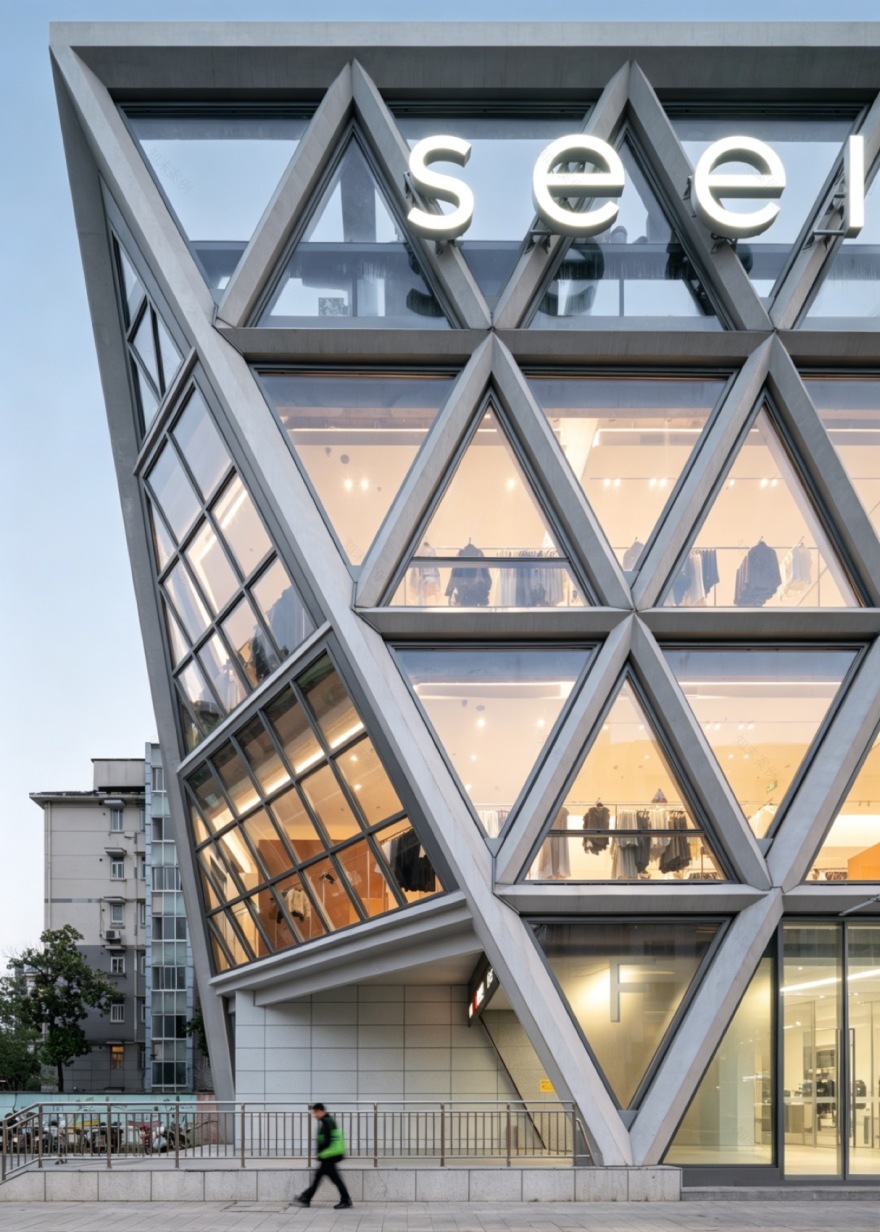
▼室内商业出入口,Interior Commercial Entrance © 直角建筑摄影

03 结构逻辑的显现
03 Manifestation of Structural Logic
为了回应建筑形体与空间组织的整体逻辑,项目采用了外骨骼式结构体系。这一策略并非单纯的形式表达,而是同时回应了空间与城市两个层面的需求:一方面,结构直接参与建筑形象与空间秩序的生成,实现结构、功能与空间的统一;另一方面,外骨骼体系为局部悬挑提供了直接支撑,使建筑得以在有限场地内主动退让地面空间,将更多街角界面释放给城市与行人。这种一体化的处理方式,使建筑在尺度上更完整,在视觉上更清晰,也让街角空间呈现出更强的连续性、渗透性与整体感。
In response to the overall logic of architectural form and spatial organization, the project adopts an exoskeleton structural system. This strategy is not a mere formal expression, but responds to the needs of both space and city at the same time: on the one hand, the structure directly participates in the formation of architectural image and spatial order, realizing the unification of structure, function and space; on the other hand, the exoskeleton system provides direct support for partial cantilevers, enabling the building to voluntarily retreat the ground space in a limited site and return more street corner interfaces to the city and pedestrians. This integrated treatment makes the building more complete in scale and clearer in vision, and also makes the street corner space present stronger continuity, permeability and integrity.
▼建筑西南角,Southwest Corner of the Building © 直角建筑摄影
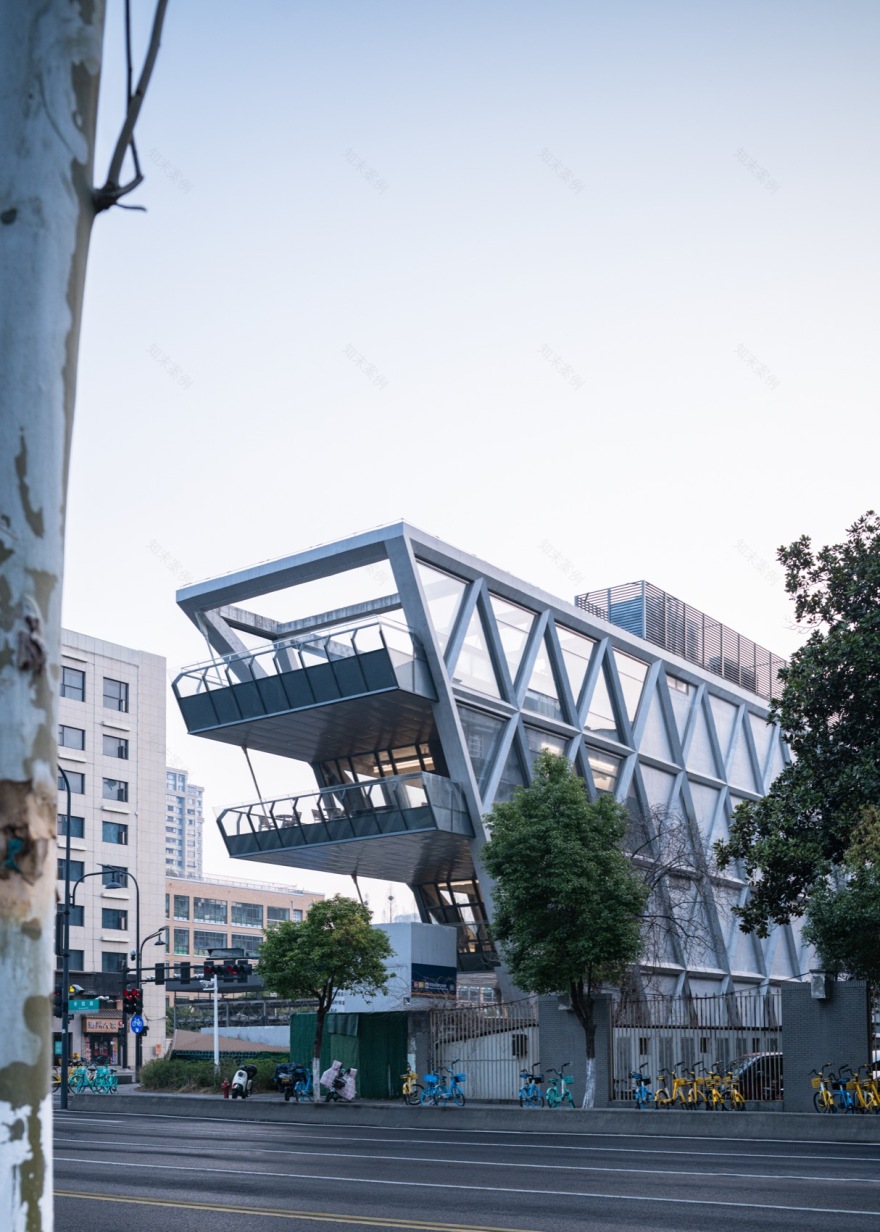
04 回归真实的建造表达
04 Return to Authentic Construction Expression
在建筑气质的塑造上,项目希望传达的是一种克制、真实且完整的设计态度。相较于依赖装饰性语言去强化视觉效果,设计团队更关注材料本身的特性,以及结构与空间被真实呈现的方式。因此,项目选择以清水混凝土作为主要建筑材料。它所呈现出的朴素、沉静与克制,与整体设计理念相契合,也避免了过多附加饰面的介入,使建筑能够尽可能接近“一次成型”。在室内外一体化设计的基础上,结构以近乎裸露的方式被保留下来,结构受力逻辑、空间秩序与材料质感共同构成了建筑语言。与此同时,光影也成为塑造空间的重要媒介。随着时间变化,光线在结构、界面与材料表面流动,使空间获得更细腻的层次感,也进一步强化了建筑本身的秩序与节奏。
In shaping architectural temperament, the project hopes to convey a restrained, authentic and complete design attitude. Rather than relying on decorative language to enhance visual effects, the design team pays more attention to the characteristics of materials themselves and the way structure and space are truly presented. Therefore, fair-faced concrete is selected as the main building material. Its simplicity, calmness and restraint are in line with the overall design concept, and avoid excessive additional finishes, enabling the building to be as close to “one-step forming” as possible. Based on the integrated interior and exterior design, the structure is retained in an almost exposed manner. The structural stress logic, spatial order and material texture together constitute the architectural language. At the same time, light and shadow have also become an important medium for shaping space. As time changes, light flows on the surface of structures, interfaces and materials, giving the space a more delicate sense of hierarchy, and further strengthening the order and rhythm of the building itself.
▼建筑室内(seei专衣),Interior (SEEI Flagship Store)© 直角建筑摄影

杭州地铁学院路项目,并不试图以夸张姿态成为城市中的“异质存在”,而是希望通过克制的体量、清晰的结构逻辑与真实的材料表达,在复杂而有限的场地条件下,为城市街角提供一种更开放整体的空间回应。它既服务于交通系统的现实需求,也尝试在地铁上盖这一复合场景中,建立建筑、功能与城市之间更加紧密的联系。
The Hangzhou Metro Xueyuan Road project does not attempt to become a “heterogeneous existence” in the city with an exaggerated attitude. Instead, it hopes to provide a more open and integrated spatial response for urban corners under complex and limited site conditions through restrained volume, clear structural logic and authentic material expression. It not only serves the practical needs of the transportation system, but also attempts to establish a closer connection between architecture, function and the city in the composite scenario of metro TOD.
▼地下二层平面图、一层平面图、标准层平面图,Basement Floor 2 Plan、Ground Floor Plan、Typical Floor Plan© gad

▼剖面图,Sectional Drawing © gad

项目名称:杭州地铁三期工程学院路站点上盖物业设计
详细地址:浙江省杭州市学院路与文二路交叉口东南侧
类型:公共建筑
设计时间:2019
建成时间:2025
用地面积:704㎡
建筑面积:2071㎡
容积率:1.73
业主:杭州市地铁集团有限公司
设计单位:gad杰地设计
建筑设计:吴寿清/王晓夏/左云豪/李明/宿也/胡思成
技术设计:(结构)汪光满(设备)钱子俊/王扬/季明星
摄影:直角建筑摄影/吴寿清
Project Information
Project Name: TOD Property Design of Xueyuan Road Station, Phase III of Hangzhou Metro Project
Address: Southeast side of the intersection of Xueyuan Road and Wen’er Road, Xihu District, Hangzhou, Zhejiang Province
Type: Public Building
Design Time: 2019
Completion Time: 2025
Site Area: 704 m²
Building Area: 2,071 m²
Floor Area Ratio: 1.73
Client: Hangzhou Metro Group Co., Ltd.
Design Firm: gad
Architectural Design Team:Wu Shouqing / Wang Xiaoxia / Zuo Yunhao / Li Ming / Su Ye / Hu Sicheng
Technical Design Team:(Structure) Wang Guangman(MEP) Qian Zijun / Wang Yang / Ji Mingxing
Photography: Right Angle Image / Wu Shouqing

南京喵熊网络科技有限公司 苏ICP备18050492号-4知末 © 2018—2020 . All photos and trademark graphics are copyrighted by their owners.增值电信业务经营许可证(ICP)苏B2-20201444 苏公网安备 32011302321234号
苏公网安备 32011302321234号客服
消息
收藏
下载
最近