

创作上传
VIP
收藏下载
登录 | 注册有礼
查看完整案例

收藏

下载

分享
项目概况
Project Overview
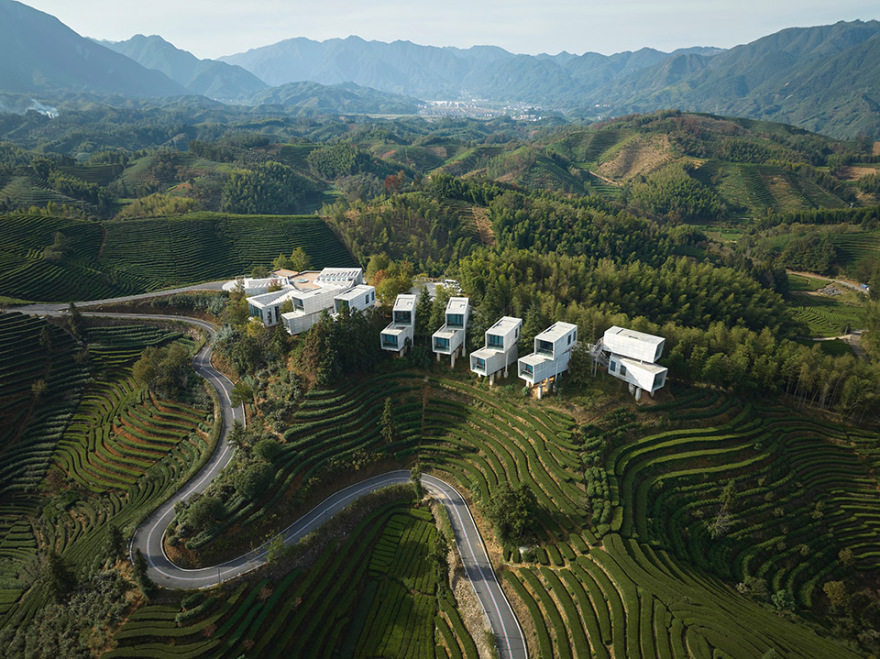
项目位于浙江省丽水市遂昌县大柘镇柘溪上村,坐落在万亩茶海中的一处山顶高地。基地所在山脊南北狭长,南端较缓,北侧渐陡,东向山谷开敞,西侧贴近竹林与杉树林。四百年光阴流转,汤显祖在遂昌落笔成《牡丹亭》,将此地山川灵秀凝为千古文韵。如今,万亩茶海之上,一片悬停的“叶子”,低声轻诉“人在山阴道上行,春云处处生”天人合一的诗意栖居。
The project is located in Zhexi Shang Village, Dazhe Town, Suichang County, Lishui City, Zhejiang Province, perched on a mountaintop highland amid a ten-thousand-mu tea sea. The site ridge is long and narrow north–south: gentle at the southern end, gradually steeper northward, open to the valley on the east, and adjacent to bamboo and fir forests on the west. Over four centuries, Tang Xianzu wrote The Peony Pavilion in Suichang, crystallizing the landscape’s grace into timeless literary charm. Today, a hovering “leaf” above the tea sea whispers the poetic dwelling of unity between man and nature.
▼万亩茶海上悬停的“叶子”,A hovering “leaf” above the ten-thousand-mu tea sea ©解构视觉

▼山川灵秀的诗意栖居,Poetic dwelling amid the graceful mountains and rivers ©解构视觉
轻触策略
Light Touch Strategy
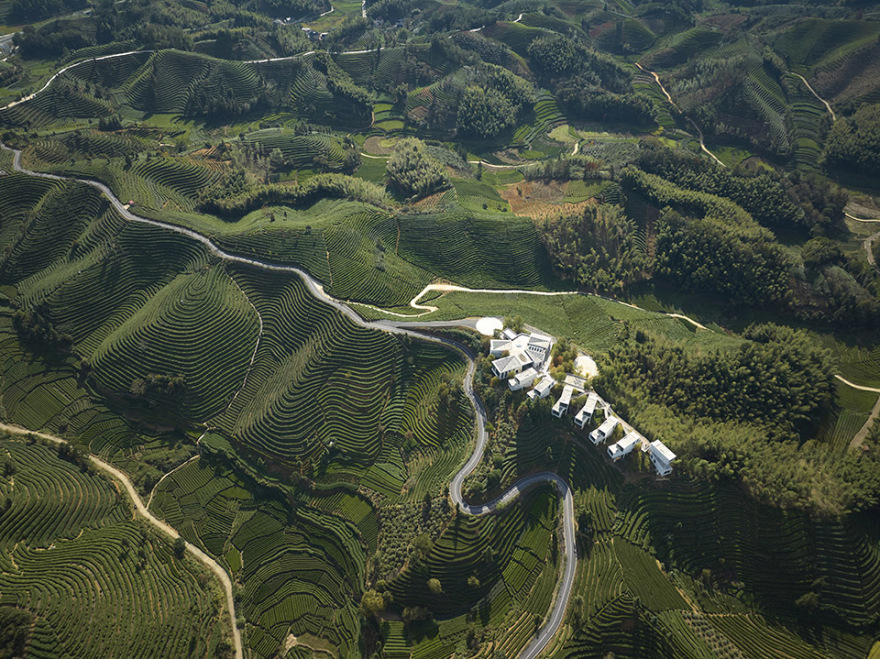
建筑避免以完整体量压向山体,而是沿着山脊边缘展开,通过收拢,拆分和架空,形成一组轻轻停驻在茶海之上的客房与公共空间。从鸟瞰上看,蜿蜒的步行栈道与分散的客房单元脉络清楚,整体像一片停在茶海褶皱之上的叶子。建筑贴着山势生长,落位轻盈,把山谷,茶田与树林的原有层次留给场地本身。
Rather than imposing a full volume onto the mountain, the building stretches along the ridge edge. Through contraction, splitting and elevation, it forms guest rooms and public spaces that lightly rest above the tea sea. From above, the winding elevated walkway and scattered guest units read clearly like a leaf resting on the folds of the tea fields. The building grows with the terrain, light on the land, preserving the original layers of valleys, tea plots and woods.
▼轻触场地,隐于山林,Light touch on the site, hidden in the mountains and forests ©解构视觉
功能展开
Functional Layout
主入口与公共活动区布置在南端相对平缓的位置,将客房沿北侧更曲折的山体依次排开。这样的布置很直接——平地承担到达、接待与停留,坡地留给居住、沉浸与观景。公共区靠近道路,形成项目在山顶上的第一个落点。客房区则逐渐退入树林,把人慢慢带向茶海深处。
The main entrance and public zone occupy the gentler southern end, while guest rooms line the more contoured northern slope. Flat ground serves arrival, reception and gathering; sloped ground is for living, immersion and viewing. The public area sits near the road as the project’s first mountaintop landmark. Guest wings recede into the woods, drawing visitors deeper into the tea sea.
▼漫入茶海深处,Wandering deep into the tea sea ©解构视觉

▼背靠竹林,面向茶海,Backed by bamboo forests, facing the tea sea ©解构视觉

漂浮建构
Floating Construction
面对坡地上落地面极少的问题,项目采用钢结构架空的方式组织客房,使建筑尽量离开地面。这样既减少了土方开挖,也尽可能保住原有的茶田、灌木和树丛,让树林还是树林,草地还是草地。漂浮感自然出现——它来自结构搭建方式,也来自对场地尺度和边界的克制。
▼漂浮在茶田上,Floating above the tea fields ©解构视觉

设计雕琢
Design Refinement
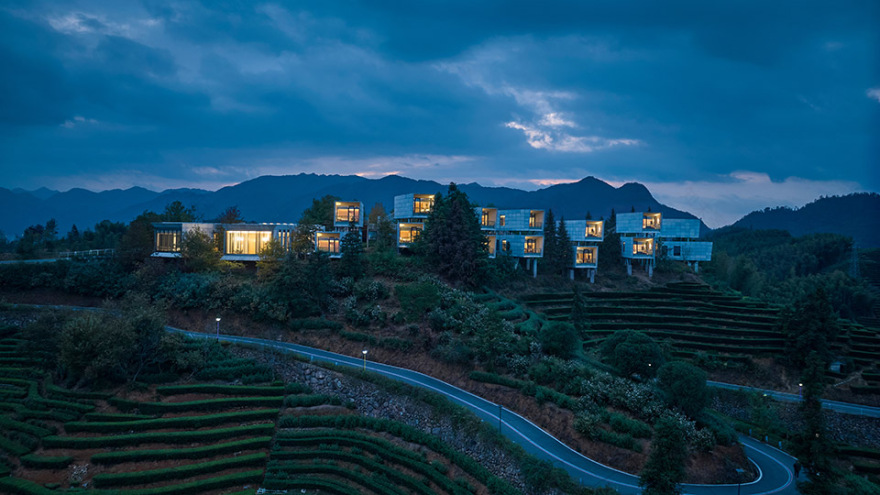
客房被拆分为多个独立单元,两层上下叠放,体块彼此脱开并适当错动。这样的处理贴合山脊蜿蜒的走向,也让建筑的体态更轻盈,更容易穿插进树林。面向茶海的方向,体块向外挑出阳台和观景窗,让建筑在保持简洁轮廓的同时,把不同高度,不同方向的景观都收入居住空间。
Guest rooms are split into independent units, stacked two stories high, with volumes separated and slightly staggered. This follows the ridge’s curve, lightens the building’s presence, and lets it weave into the woods. Toward the tea sea, volumes cantilever balconies and view windows, framing landscapes at varying heights and angles while keeping a clean profile.
▼错叠与悬挑,Staggering and cantilevering ©解构视觉

空中路径
Aerial Path
一条架空的步行栈道沿山体蜿蜒起伏,将公共区与客房串联起来。栈道被放置在一层与二层之间的中间高度,到达上下层客房都只需半层楼梯。原本难处理的高差,被转成一次轻盈的空中漫步。原本只是交通的路径,也因此成为感受山风,树影与茶海的过程。这条栈道像树叶的叶脉,把分散的单体组织成一个完整而轻薄的整体。
An elevated pedestrian walkway winds along the mountain, linking public areas and guest rooms. Set midway between the first and second floors, it requires only half a flight of stairs to reach either level. Challenging elevation changes become a light aerial stroll. What was merely circulation becomes an experience of mountain breeze, tree shade and tea sea views. Like a leaf’s vein, the walkway weaves scattered volumes into one cohesive, lightweight whole.
▼空中漫步的栈道,Walkway for a stroll in the air ©解构视觉

大堂点睛
Lobby Highlight
拾级而上,步履渐缓,从室外的开阔天光中,缓缓步入大堂。圆形天井与水幕庭院相映成趣,悄然诉说着东方哲学——脚边水幕庭院如月映幽潭,静纳天地倒影;头顶圆形天井若日悬苍穹,倾泻流转天光。阴阳相济,虚实相生,将天地人共生的哲思,藏进这方寸之间。恰如《周易》所云“仰则观象于天,俯则观法于地”。大堂,酒店空间序列的起点,也为公共空间的重点,是为大堂点睛。
Ascending gently, visitors step from open daylight into the lobby. A circular patio complements a water-curtain courtyard, embodying Eastern philosophy: the water court below mirrors heaven and earth like a moon in a quiet pool; the circular skylight above pours down light like the sun in the sky. Yin and yang balance, void and solid interplay, embedding the philosophy of heaven–earth–human symbiosis in this compact space. As The Book of Changes notes: “Looking up, we observe the signs of heaven; looking down, we model the ways of earth.” As the start of the hotel’s spatial sequence and core of public space, the lobby is the project’s defining moment.
▼晨曦中的大堂吧,Lobby bar in the morning light ©解构视觉

▼餐厅,Restaurant©解构视觉


▼暮色下的入口空间,Entrance space at dusk ©解构视觉

▼水幕庭院,Water-curtain courtyard ©解构视觉

茶海浸润
Immersed in the Tea Sea
建筑藏而非露,漂浮于茶山褶皱间,与茶垄蜿蜒、林影浅淡相融,无刻意雕琢。远观隐于葱茏,近嗅则木石肌理浸着茶芬。风穿林叶,光影轻移,建筑与茶山、树林本就浑然一体,不分彼此。清晨沿茶山慢跑,白天在室外采茶,傍晚看茶海起伏,夜里归憩于客房。人居其中,步步皆与茶山相依。
Concealed rather than prominent, the building floats among the tea-mountain folds, blending with winding tea ridges and soft tree shadows without overstatement. Seen afar, it hides in greenery; up close, its wood-and-stone texture carries tea fragrance. Wind stirs leaves, light shifts softly, and the building merges completely with the mountain and woods. Morning jogs along tea slopes, daytime tea picking, dusk views of rolling tea seas, night rest in guest rooms — every step ties life to the tea mountain.
▼茶田上的客房,Guest rooms floating above the tea fields ©解构视觉
▼客房内部,Guest rooms interior©解构视觉

东方哲思
Eastern Philosophy
客房的阳台、天窗,大堂的天窗和天井,茶室、餐厅通透的落地窗,把茶海,山谷与星辰引入室内。空中路径通过折叠分置的客房,将茶海、竹林与人融为一体。建筑没有复杂装饰,真正被强调的,是人与天地万物始终不断的联系。白天,层层茶田与林海进入视线;夜晚,山顶开阔的星空落入房间。营造出以茶海为枕、引星辰入梦的心境。物我界限消融,只剩人与天地合一。
Guest-room balconies and skylights, lobby skylights and patios, and floor-to-ceiling windows in tea rooms and restaurants draw the tea sea, valleys and stars indoors. The aerial path merges tea sea, bamboo groves and people via folded, separated guest volumes. Free of elaborate ornament, the building emphasizes the enduring bond between humans and nature. By day, layered tea fields and forest vistas unfold; by night, the mountaintop starry sky fills the rooms. It creates a mood of resting on the tea sea and dreaming with the stars, dissolving the boundary between self and nature, leaving only unity between man and heaven and earth.
▼枕茶入梦,物我消融,Sleeping with the tea as a pillow, dissolving the self and the world ©解构视觉
后记
Postscript
项目以尊重自然,顺应地形为前提,在狭长山脊上完成了一次尽量克制的建造尝试。建筑以更轻的方式进入茶海,把起伏的地形,原有的树林和开阔的山谷视野保留下来,也把度假,亲子,办公等多种使用方式安置在同一条架空的山地路径之中。作为一座停驻在茶海之上的漂浮酒店,它更像是对场地的一次轻触。
Rooted in respect for nature and conformity to terrain, the project is a restrained construction experiment on a narrow ridge. The building touches the tea sea lightly, preserving undulating terrain, original woods and open valley views, while accommodating vacation, parent-child activities and office use along one elevated mountain path. As a floating hotel resting above the tea sea, it is nothing more than a gentle caress to the site.
▼一层平面图,First level floor plan ©中国联合工程有限公司

▼二层平面图,Second level floor plan ©中国联合工程有限公司

▼顶层平面图,Roof plan ©中国联合工程有限公司

▼剖面图,Section ©中国联合工程有限公司

项目名称:茶海之上,漂浮酒店——遂昌县柘溪上村农旅融合项目
项目地址:浙江省丽水市遂昌县
设计单位:中国联合工程有限公司
设计内容:建筑
项目设计:2021
完成年份:2022
项目主创:姜传鉷
建筑设计:万正宏、张红霞、余磊、李志刚、倪良荣
结构设计:端木雪峰、潘弼浩
电气设计:周涛、殷皓健
给排水设计:沈嘉辰、郭健捷
建筑面积:1336m2
项目摄影:解构视觉

南京喵熊网络科技有限公司 苏ICP备18050492号-4知末 © 2018—2020 . All photos and trademark graphics are copyrighted by their owners.增值电信业务经营许可证(ICP)苏B2-20201444 苏公网安备 32011302321234号
苏公网安备 32011302321234号客服
消息
收藏
下载
最近