

创作上传
VIP
收藏下载
登录 | 注册有礼
查看完整案例

收藏

下载

分享
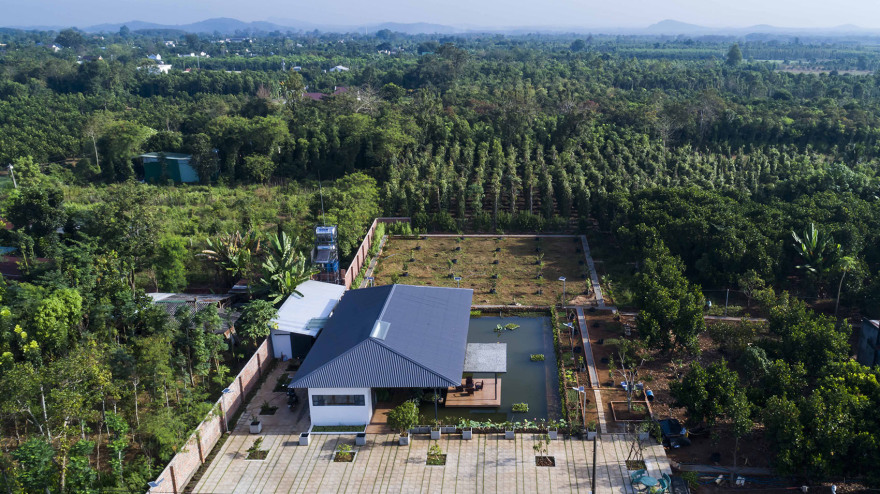
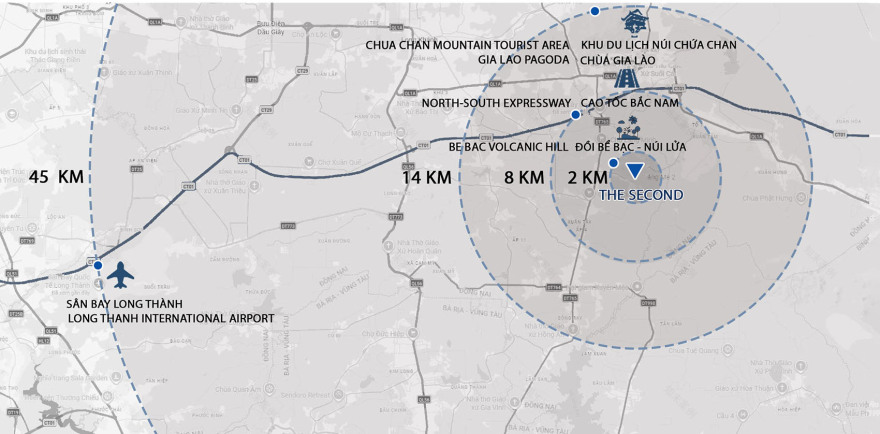
“第二农居”标志着我们与业主共同探索与发展农居(Farmstay)模式旅程的第一步。项目位于越南东南部的同奈省,距离在建中的隆城国际机场约55公里,距离南北高速公路约8公里,距离嘉劳寺—珠禅山旅游区约20公里。当地的年轻居民亲切地将这一地区称为“Lang Me City”。业主是一位“新一代”农民,他将大量科学与技术研究应用于农业生产,与传统农业方式存在显著差异。因此,在项目开发阶段,我们与其紧密合作,共同探讨水循环、能源效率以及住宅如何与周边果园与水塘协同运作。我们规划了一种功能布局,使居住、休闲与农业活动得以无缝融合。
The Second Farmstay marks the first step in our journey to research and develop the Farmstay model alongside the homeowner. The project is located in Dong Nai — Southeast Vietnam — approximately 55 km from the under-construction LONG THANH INTERNATIONAL AIRPORT, 8 km from the NORTH-SOUTH EXPRESSWAY, and 20 km from the CHUA CHAN MOUNTAIN TOURIST AREA – GIA LAO PAGODA. Local young residents fondly refer to this area as “Lang Me City.” The homeowner is a “new generation” farmer who applies extensive scientific and technical research to agricultural production, differing greatly from traditional methods. Therefore, during the development phase, we collaborated closely to discuss water circulation, energy efficiency, and how the house functions in harmony with the surrounding orchards and pond. We planned a functional layout that seamlessly integrates accommodation, relaxation, and agricultural activities.
▼项目鸟瞰,exterior view © Hiroyuki Oki
在越南东南地区,大多数家庭依赖机井取水用于农业生产,这一方式几乎已耗尽地下水资源。近年来,水位常常不足以支持持续灌溉。因此,我们优先设置蓄水水塘,以确保果园拥有稳定的水源。水从井中抽取后储存于池中,再分配至花园。基于这一策略,我们打造了一个多功能水塘:既用于灌溉,也承担景观与微气候调节的作用。此外,池中还种植水生蔬菜,为家庭提供洁净食材,同时自然净化水质。业主还养殖适量鱼类,以丰富日常饮食并招待远道而来的客人。
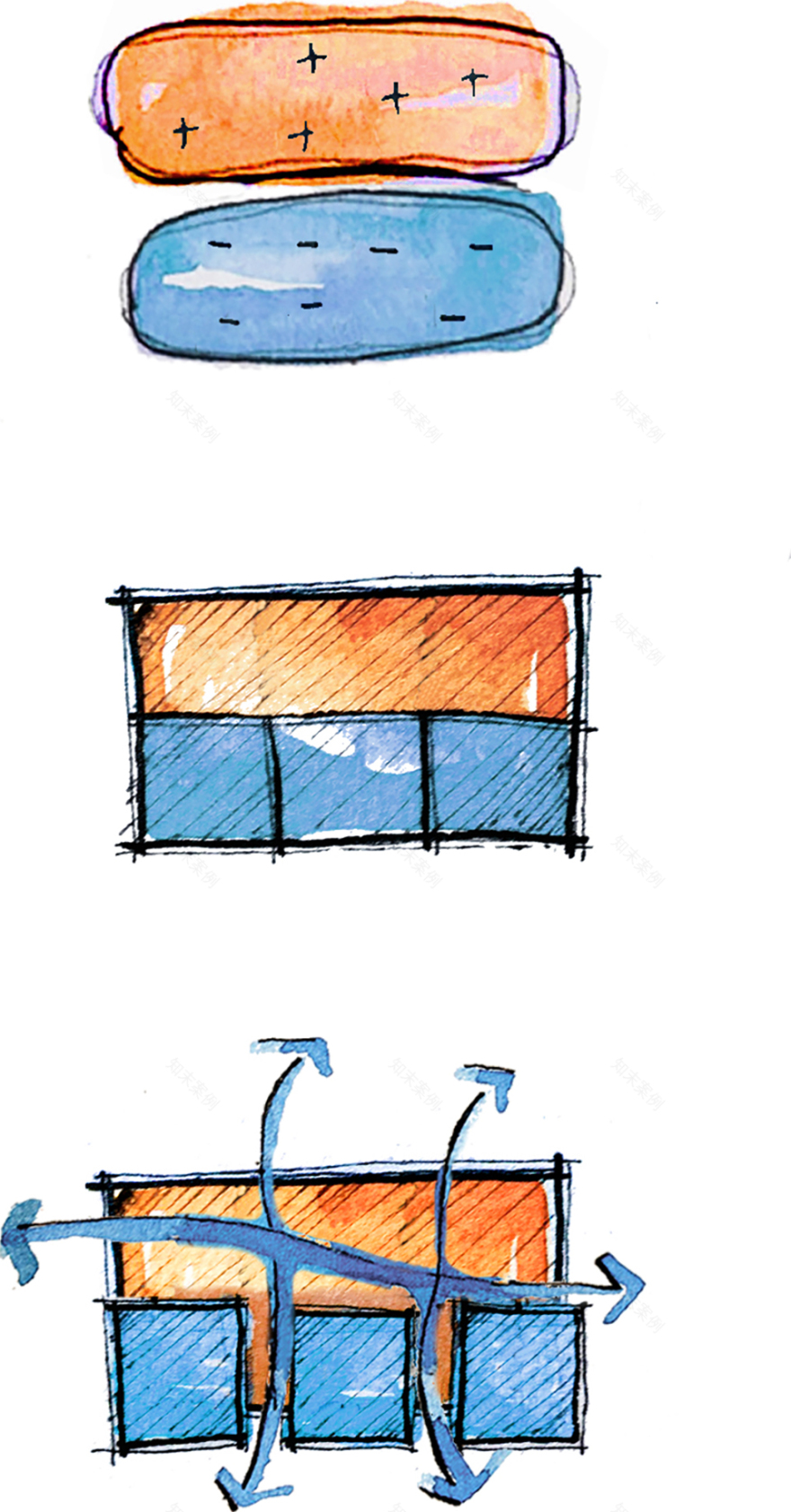
▼气候策略分析,climatic strategy diagram © CTA | Creative Architects
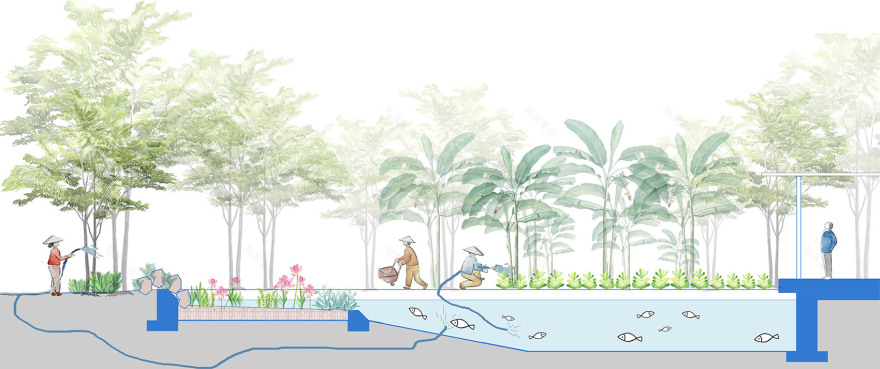
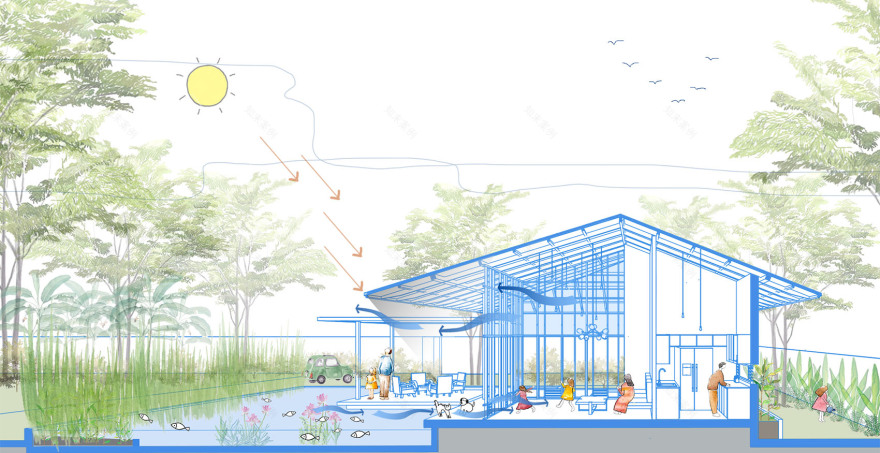
In the Southeast region, most families rely on boreholes for agriculture, a process that has nearly exhausted groundwater resources. In recent years, water levels have often been insufficient for continuous irrigation. Consequently, we prioritized a water storage pond to ensure a steady supply for the fruit orchard. Water is pumped from the well, stored in the pond, and then distributed to the garden. Taking advantage of this, we created a pond that serves multiple purposes: irrigation, landscaping, and microclimate regulation. Additionally, the pond is used to grow aquatic vegetables—providing clean food for the family while naturally filtering the water. The owner also raises a moderate amount of fish to diversify daily meals and welcome guests from afar.
▼项目外观,exterior view © Hiroyuki Oki
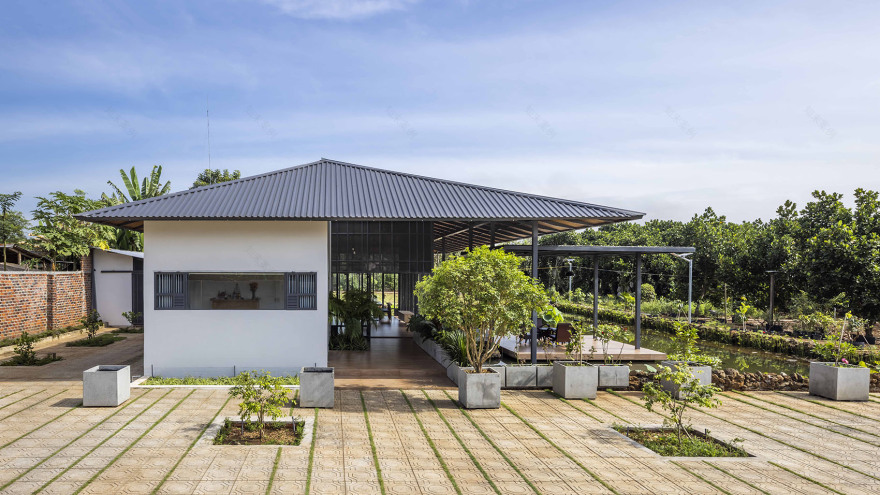
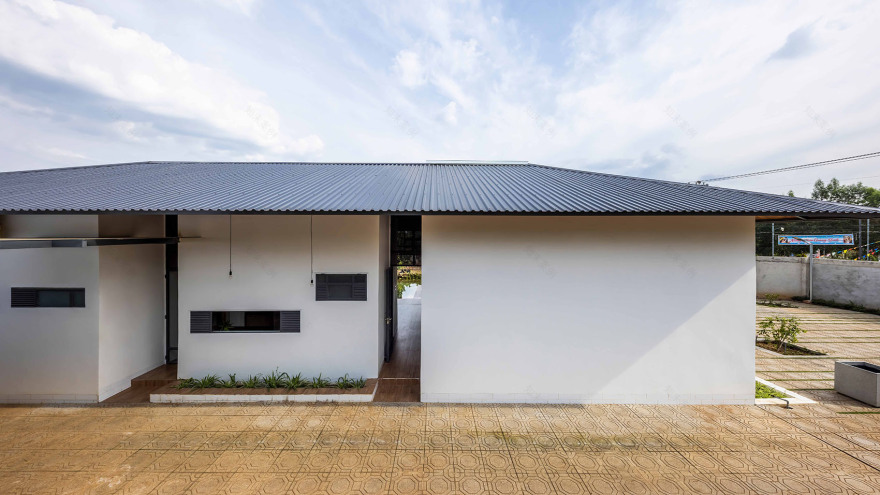
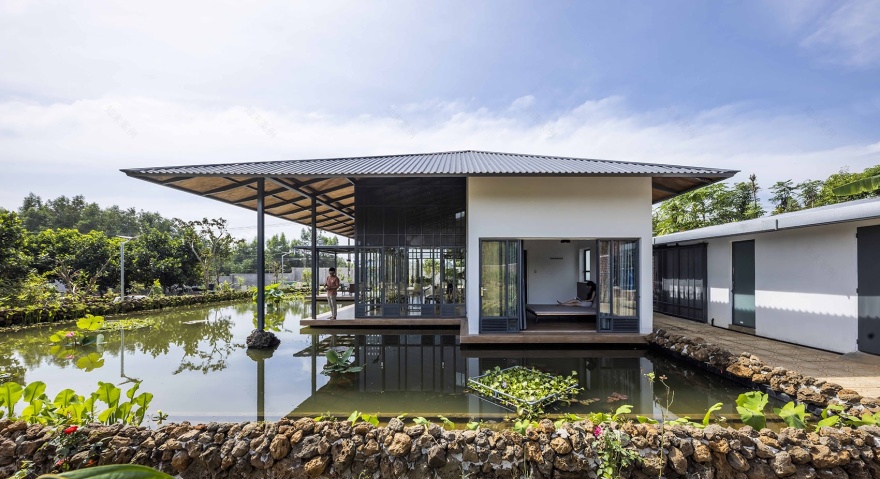
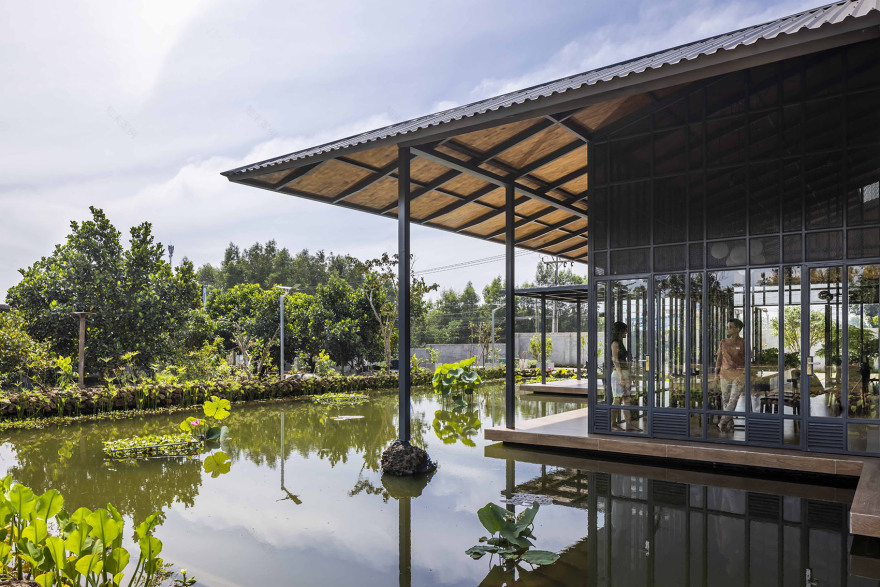
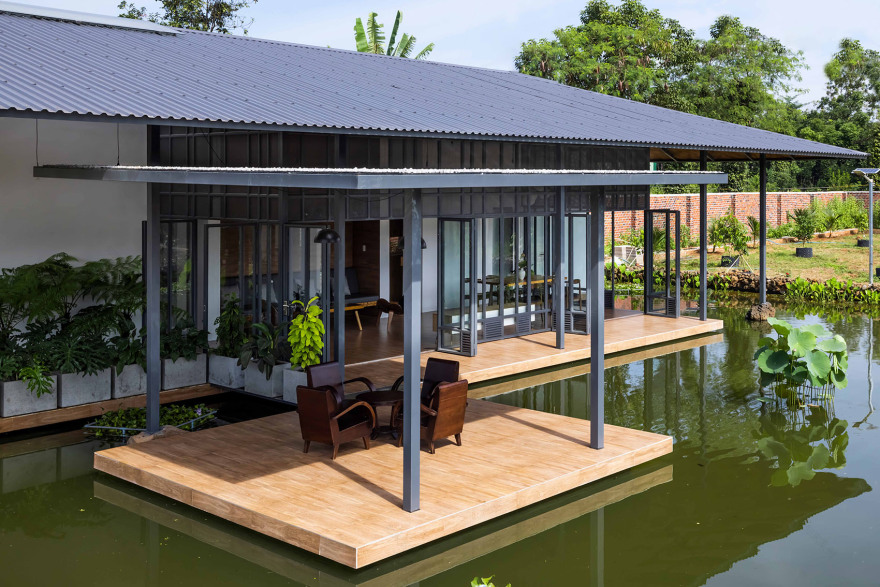
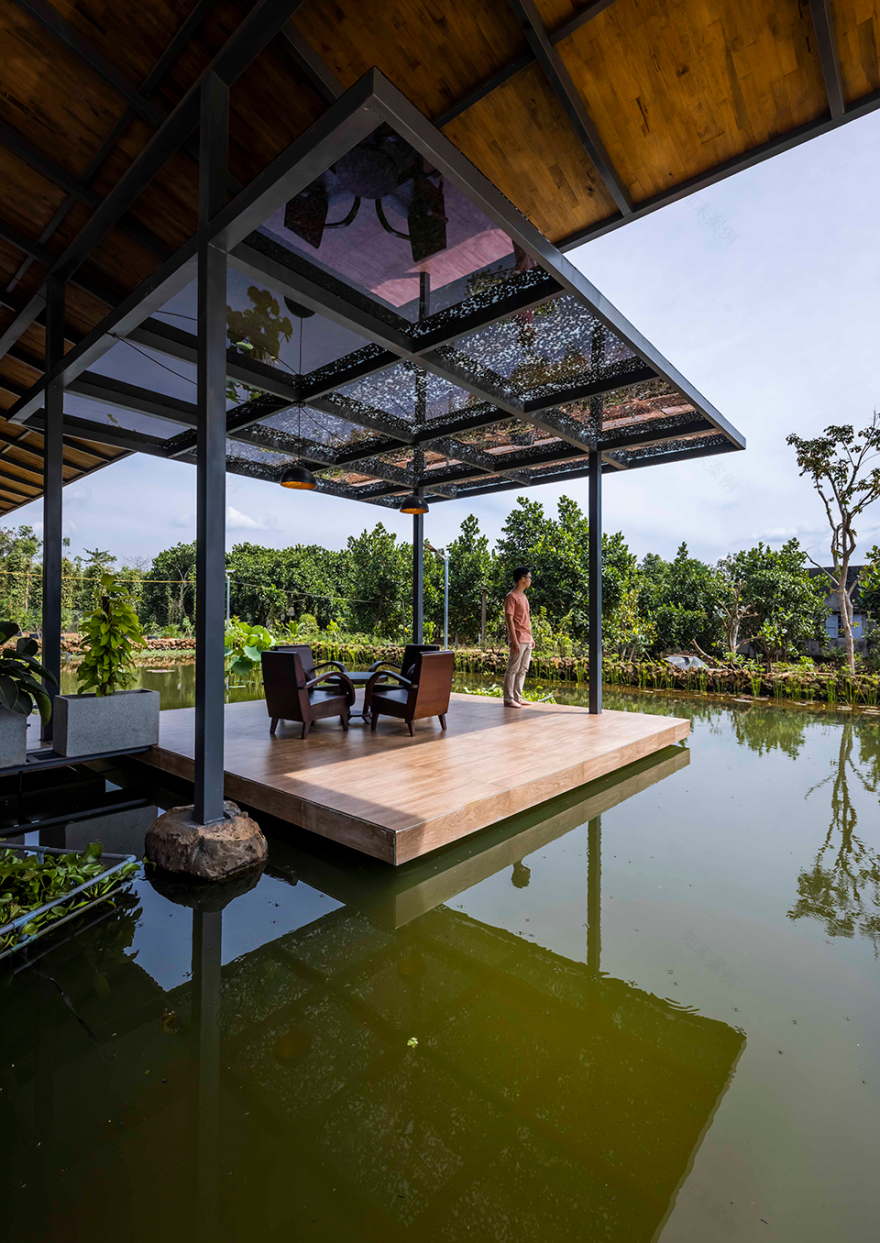
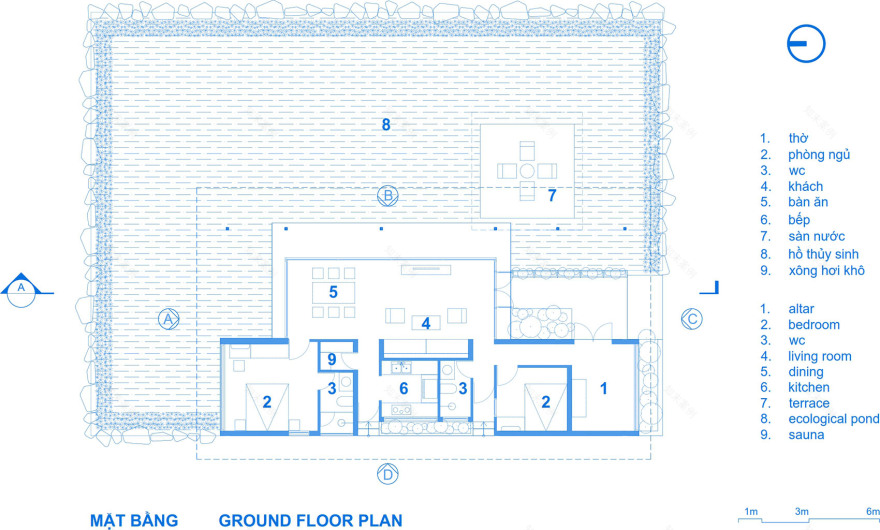
住宅在空间上被清晰划分为两个部分。私密区域由实体体块构成,包括祭祀空间、卧室、厨房、卫生间及桑拿房,并集中布置于一侧,从而将完整的水塘景观留给公共空间,如起居区、餐桌与门廊。在乡村地区,当邻里来访时,人们通常会坐在门廊上喝茶聊天,而不是进入起居室。起居室更多用于家庭重要事件或节庆活动。因此,我们在水塘中央设置了一个小型茶空间,为人们在闲暇时提供一个置身水景中的私密聚会场所。在日常生活中,起居室则作为家庭共享空间,家人每晚在此一起看电视。
▼概念草图,concept sketch © CTA | Creative Architects
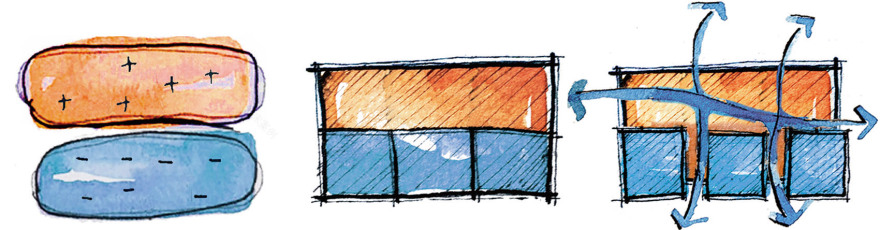
The house is clearly divided into two parts. The private areas consist of solid blocks: the altar room, bedrooms, kitchen, toilets, and sauna, all arranged to one side. This leaves the entire view of the pond for common spaces such as the living area, dining table, and porch. In rural areas, when neighbors visit, they often sit on the porch to drink tea and chat rather than entering the living room. The living room is typically reserved for important family events or holidays. Thus, we arranged a small tea area in the middle of the pond, providing a private space for people to gather amidst the water landscape during leisure time. On a daily basis, the living room serves as a communal space where the family gathers to watch TV every evening.
▼鸟瞰水塘,pond aerial view © Hiroyuki Oki
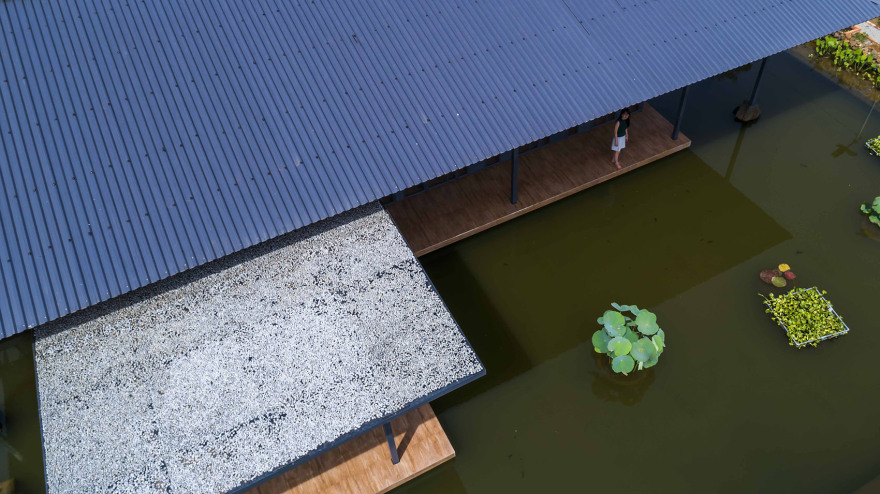
▼水塘与茶空间,pond and tea area © Hiroyuki Oki
▼水景中的聚会场所,gathering space amidst the water landscape © Hiroyuki Oki
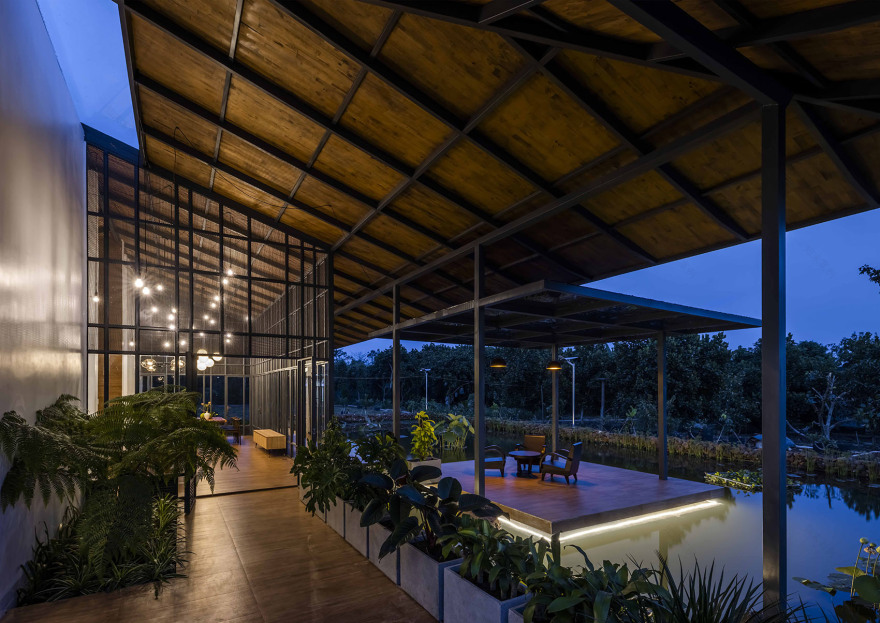
▼门廊空间,veranda space © Hiroyuki Oki
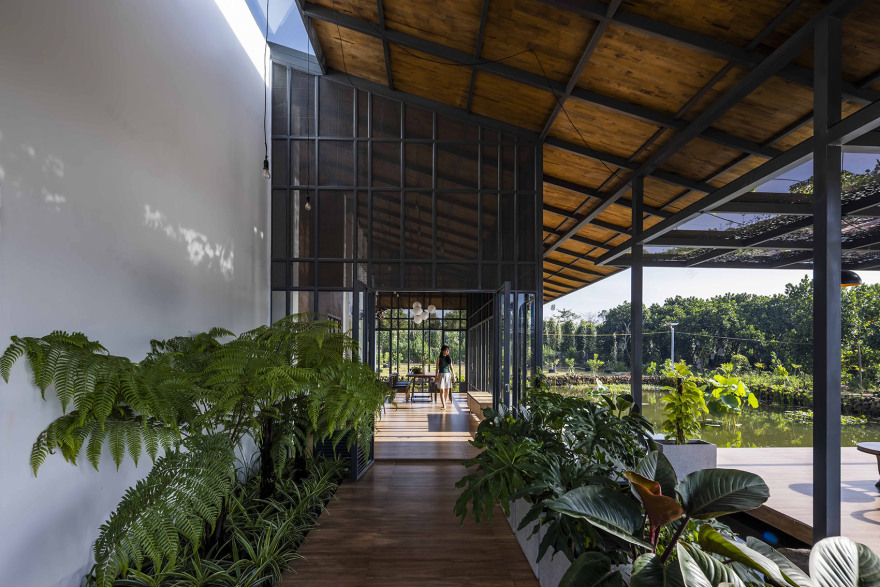
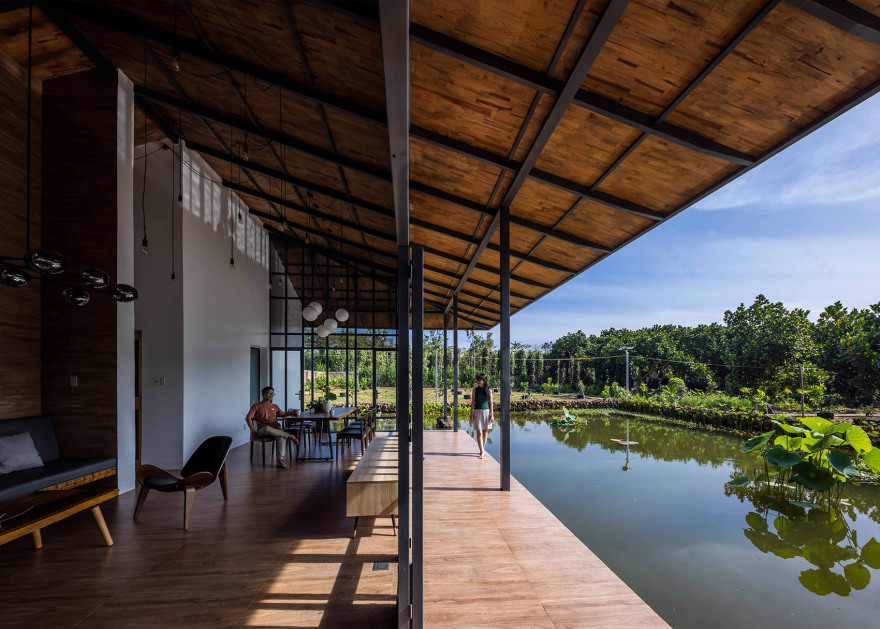
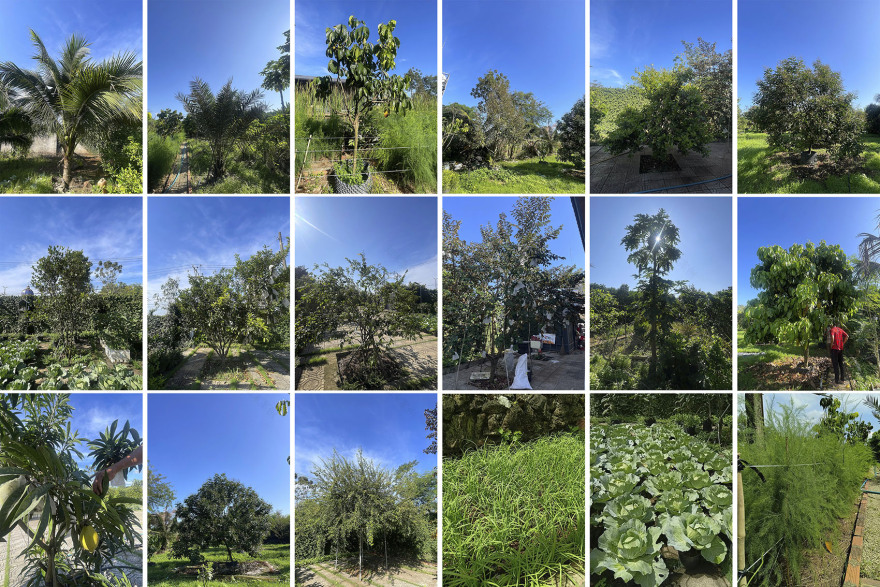
周边花园种植了多种可食用蔬菜与果树,使家庭基本实现自给自足,仅需偶尔前往市场丰富饮食种类。
The surrounding garden is filled with various edible vegetables and fruit trees, enabling a nearly self-sufficient lifestyle with only occasional trips to the market to vary the meals.
▼花园种植,garden planting © CTA | Creative Architects
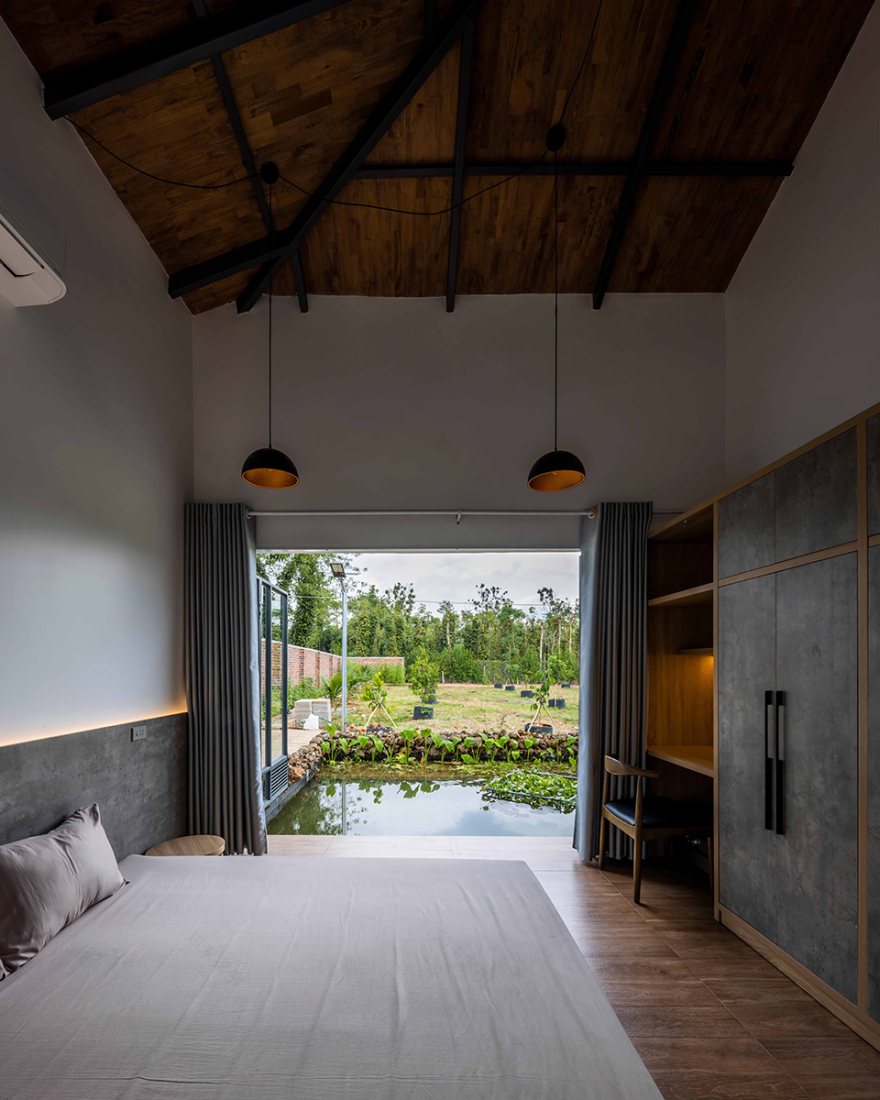
在探索建立可持续且自给自足的农居生活方式的同时,我们也在研究逐步实现低排放建造的施工策略。经过多年的行业实践,我们意识到传统建造方式对环境造成了极大的负面影响:从材料开采、水泥生产、砖块烧制到运输及施工过程本身,均会产生大量碳排放。“第二农居是我们在预制化住宅解决方案研究中的首个实践原型,我们将其暂时称为‘半预制’项目。在私密功能体块中,我们采用传统建造方式,由三个简洁的粉刷砖体单元构成。这些体块彼此分离,其间隙经过策略性设计,以增强通风效果,并促进来自水池方向的对流气流进入室内。”
Beyond researching the establishment of a sustainable and self-sufficient lifestyle for a farmstay, we also explore construction solutions to gradually move towards a minimum emission building process. After years in the industry, we have realized that traditional construction has a very negative impact on the living environment: from material extraction, cement production, and brick firing to transportation and the building process itself—all of which release a massive amount of emissions. “The Second is the first practical prototype in our research on prefabricated housing solutions. We tentatively refer to it as a ‘semi-prefabricated’ project. For the private functional blocks, we applied traditional construction methods with three simple painted brick units. These blocks are physically separated, with the gaps between them strategically designed to enhance ventilation and facilitate convection airflow from the pond into the house.”
▼开放向景观的卧室,bedroom open to landscape © CTA | Creative Architects
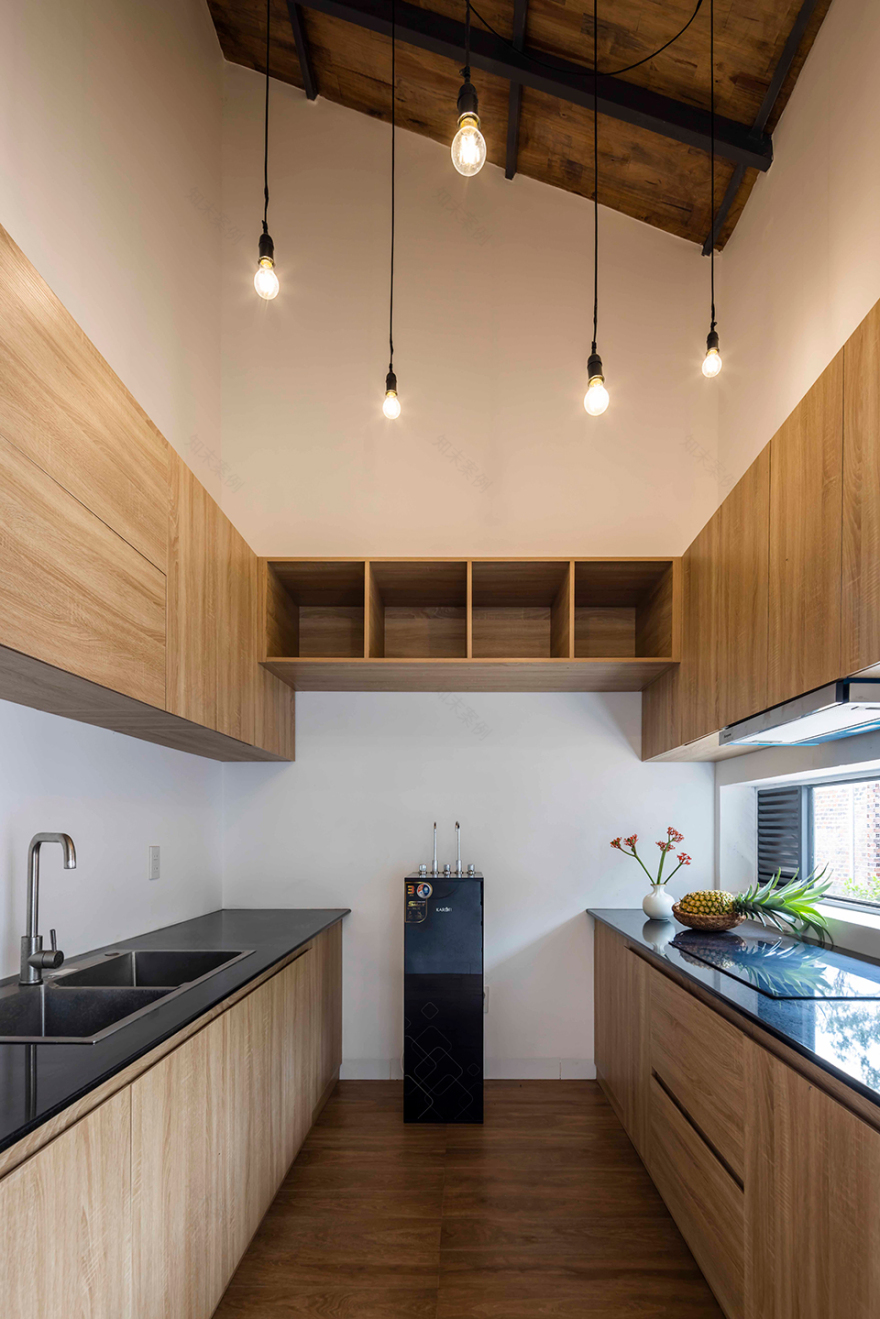
▼厨房,kitchen © CTA | Creative Architects
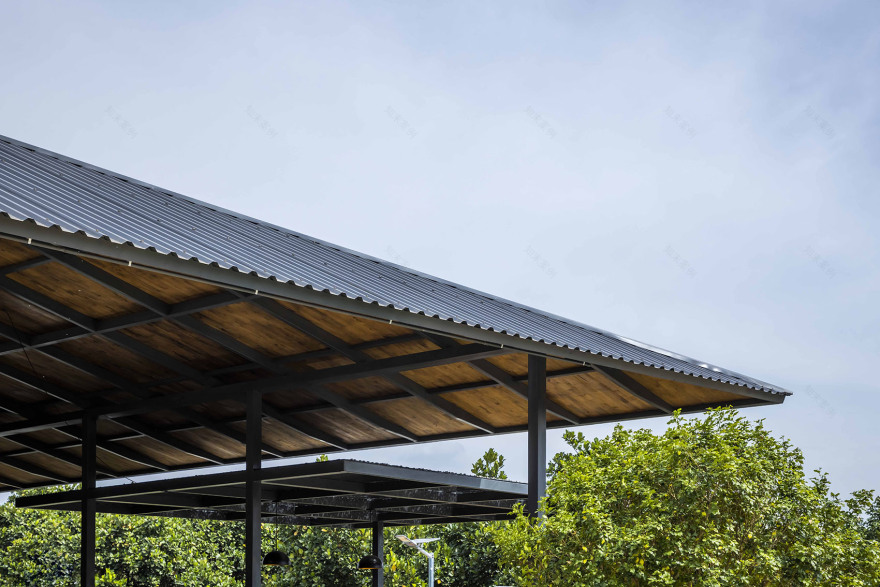
在公共空间及屋顶系统中,我们尝试采用预制镀锌钢结构框架,上部覆盖保温PU屋面板,下部则以自然木质吊顶收边完成。公共区域的外围护结构由穿孔金属板、钢结构框架与预制玻璃共同构成。这一系统在提供防护的同时,解决了自然通风与采光问题,并确保景观视野的通透性不被遮挡。屋顶向水池方向延伸,以减少直射阳光对玻璃门的影响。上述一系列策略旨在构建一个适应越南东南部炎热干燥气候的建筑体系,同时在可持续与自给自足的农居模式下,尽可能降低人类对环境的影响。
For the common spaces and the roofing system, we experimented with a prefabricated galvanized steel frame. This is covered with insulated PU roofing sheets on top, and finished with a natural wood ceiling underneath. The entire building envelope of the common area is composed of perforated metal sheets, steel frames, and prefabricated glass. This solves the problem of natural ventilation and lighting while providing protection without obstructing the panoramic view of the landscape. The roof is also designed to extend toward the pond to reduce the impact of direct sunlight on the glass doors. All these solutions aim to create a structure that adapts to the hot and dry climate of Southeast Vietnam, while minimizing human impact on the environment in line with a sustainable, self-sufficient farmstay model.
▼屋顶细部,roof detail © Hiroyuki Oki
此外,该项目也是5G建造体系的首次实地测试。这是一种新一代模块化预制建造解决方案,强调“五个减少”:降低复杂性;减少劳动力;缩短工期;降低成本;减少排放。在第二农居中,项目仍停留在半预制阶段,总投资约为15亿越南盾(约合58,800美元)。项目完成后,我们持续优化并将“5G建造体系”应用于后续实际项目。如果该项目在今天全面应用5G技术,总投资将仅约为10亿越南盾(约合39,200美元),可节省25%至30%的预算,即约4亿越南盾(约合15,255美元)。
Furthermore, the project is the first field test of the 5G CONSTRUCTION SOLUTION — a next-generation modular prefabricated solution featuring “5 Reductions”: Reduced complexity; Reduced labor; Reduced time; Reduced cost; Reduced emissions. With The Second, the project remained at a semi-prefabricated level with a total investment of approximately 1.5 billion VND (around 58,800 USD). Following its completion, we continue to refine and apply the 5G Construction Solution to subsequent. If The Second were to apply the full 5G technology today, the total investment would only be around 1 billion VND (around 39,200 USD) – saving 25-30% of the budget, equivalent to approximately 400 million VND (around 15,255 USD).
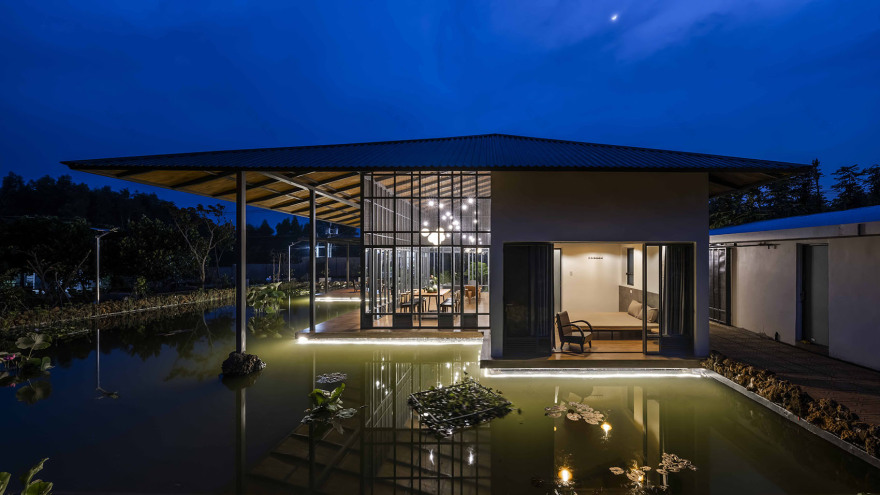
▼项目外观夜景,exterior night view © Hiroyuki Oki
▼门廊夜景,veranda night view © Hiroyuki Oki
▼区位图,location map © CTA | Creative Architects
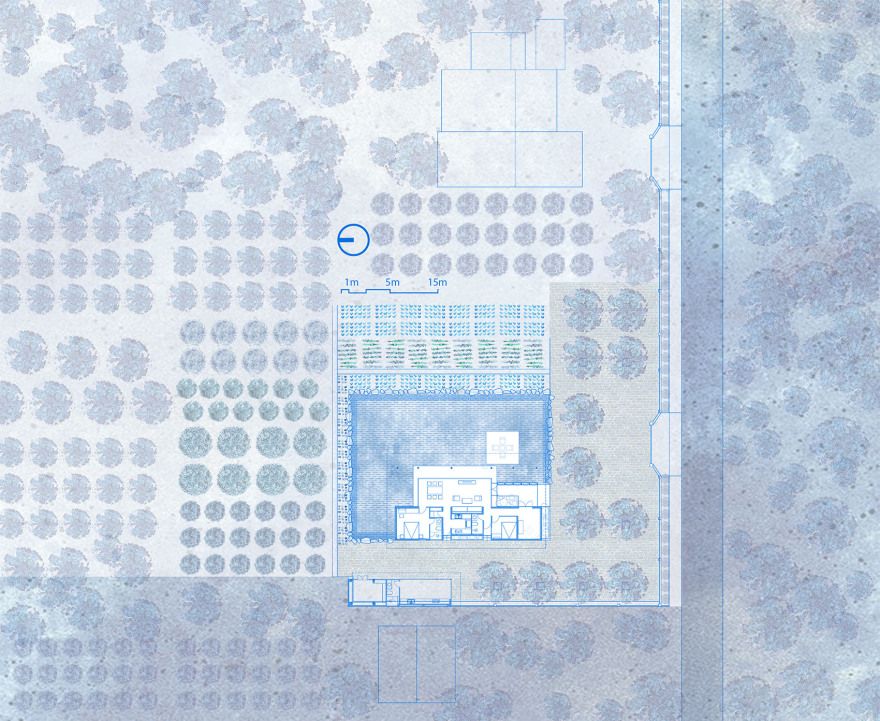
▼总平面图,site plan © CTA | Creative Architects
▼首层平面图,ground floor plan © CTA | Creative Architects
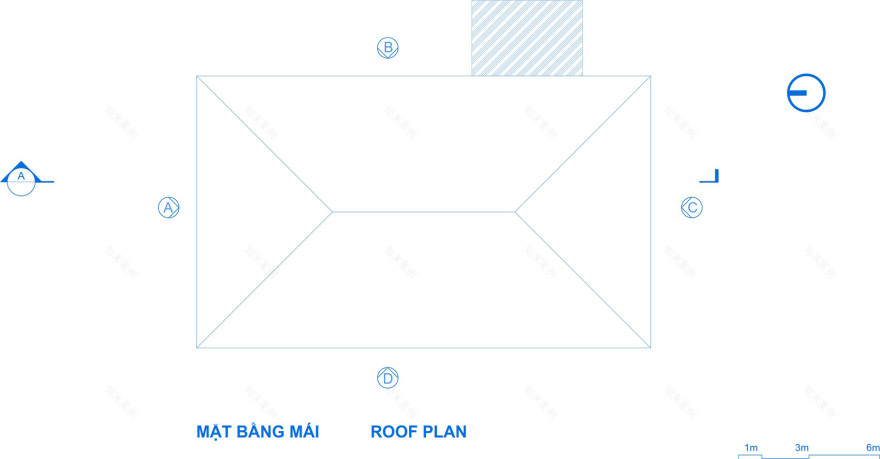
▼屋顶平面图,roof plan © CTA | Creative Architects
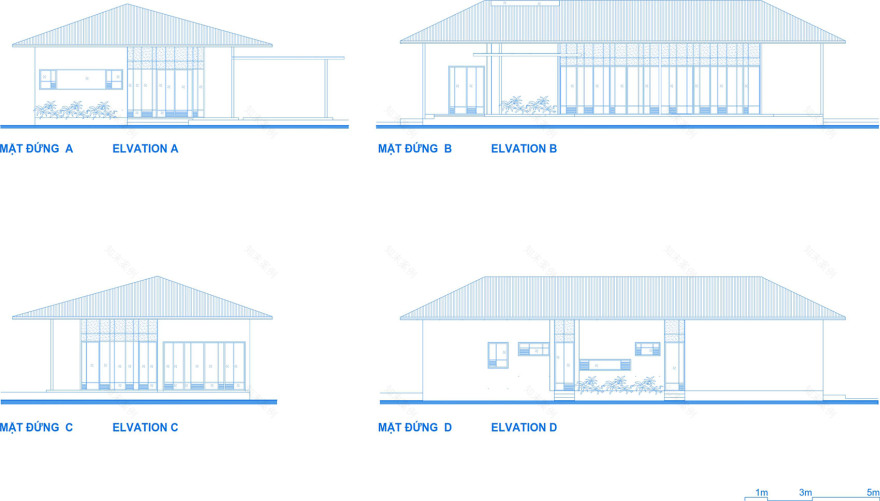
▼立面图,elevation © CTA | Creative Architects
南京喵熊网络科技有限公司 苏ICP备18050492号-4知末 © 2018—2020 . All photos and trademark graphics are copyrighted by their owners.增值电信业务经营许可证(ICP)苏B2-20201444 苏公网安备 32011302321234号
苏公网安备 32011302321234号客服
消息
收藏
下载
最近