

创作上传
VIP
收藏下载
登录 | 注册有礼
查看完整案例

收藏

下载

分享

翻译
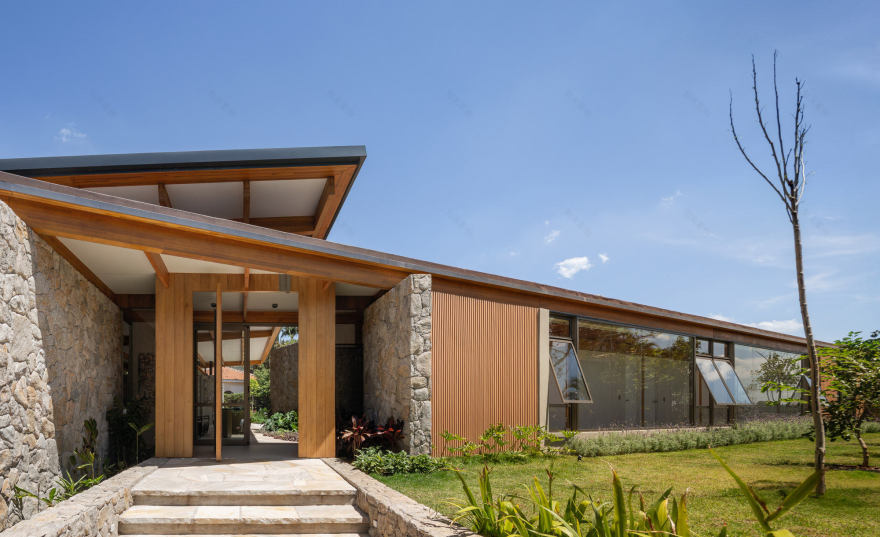
MA House sits on a sloping site in Atibaia, Brazil, where Estúdio Rossi Arquitetos shapes a permanent house around the terrain, family routines, and a long-standing connection to the region. Designed in 2025, the residence balances an open, communal upper level with a more technical base below, using two timber pavilions, a central courtyard, and a clear circulation sequence to keep the house both practical and closely tied to the landscape.
About MA House
MA House takes its form from a steep residential site in Atibaia and from the routines of a family that already knows the region well. Designed as a permanent residence, the house treats topography not as an obstacle to overcome but as the basis for its layout, circulation, and relationship to the landscape.
A reinforced concrete base absorbs the level changes and holds the most technical parts of the program, including the garage, service areas, and a workshop. The lower level gives the house a grounded edge, enclosed by retaining walls and planes clad in moledo stone, whose irregular surface follows the terrain and helps screen the building from the street. Two separate staircases clarify movement from the start: one is social and tied to the garden, the other more discreet and service-oriented.
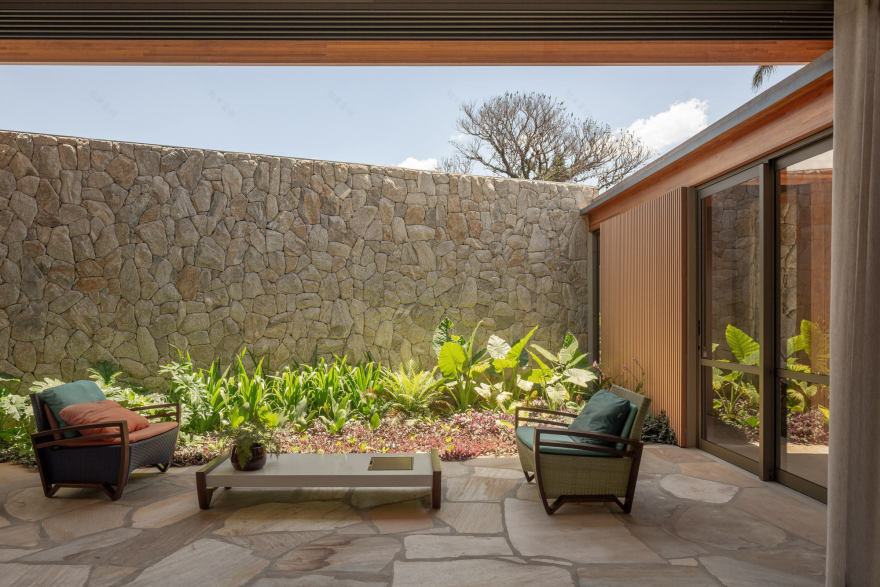
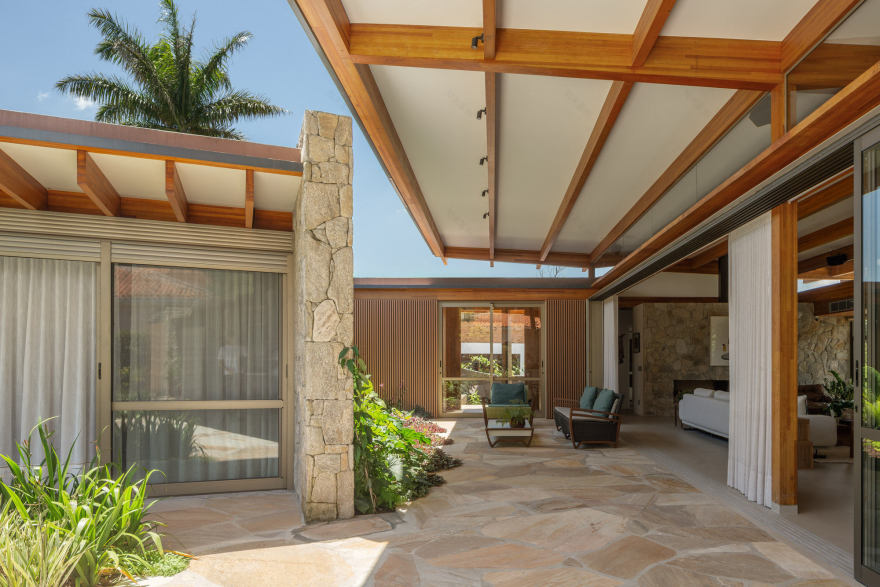
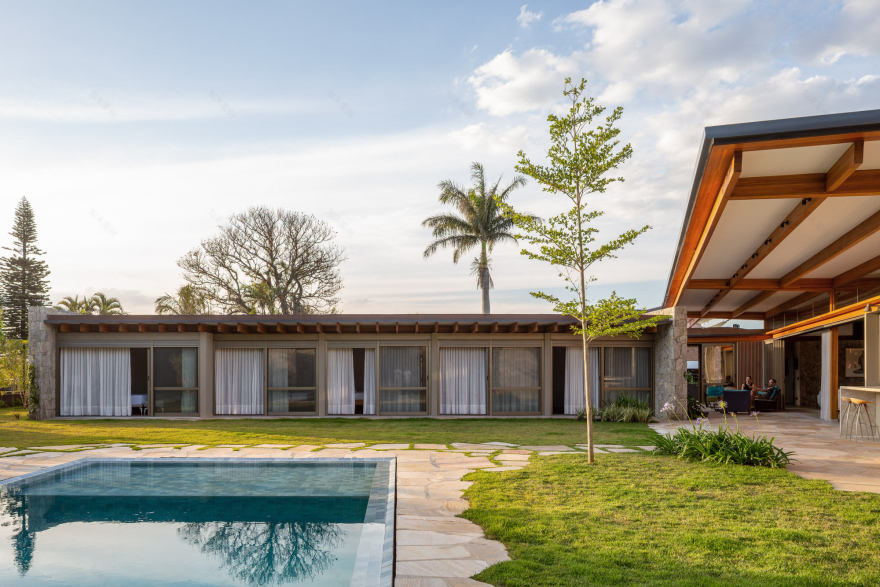
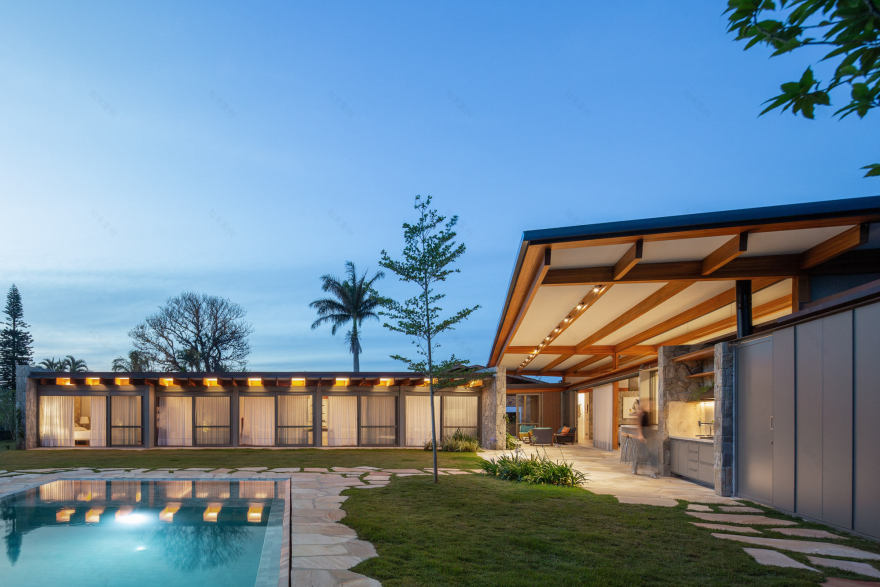
Above this platform, the house breaks into two pavilion-like volumes. One contains the social rooms; the other holds the private quarters. Their placement responds to the trapezoidal plot, with the social pavilion aligned to the access road and the bedroom wing rotated along the site’s diagonal. That shift creates varied exterior spaces between the buildings and gives the composition its strongest spatial moment: a central courtyard that structures arrival, movement, and views.
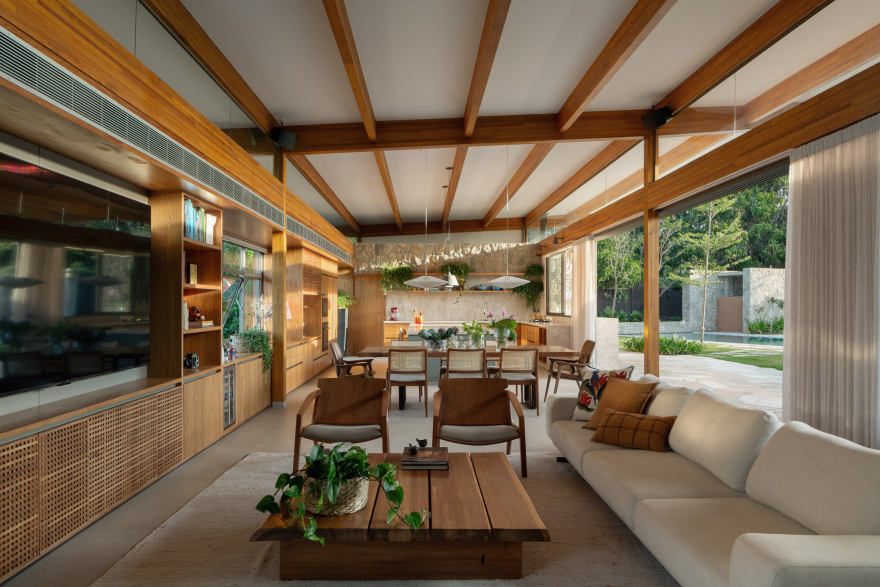
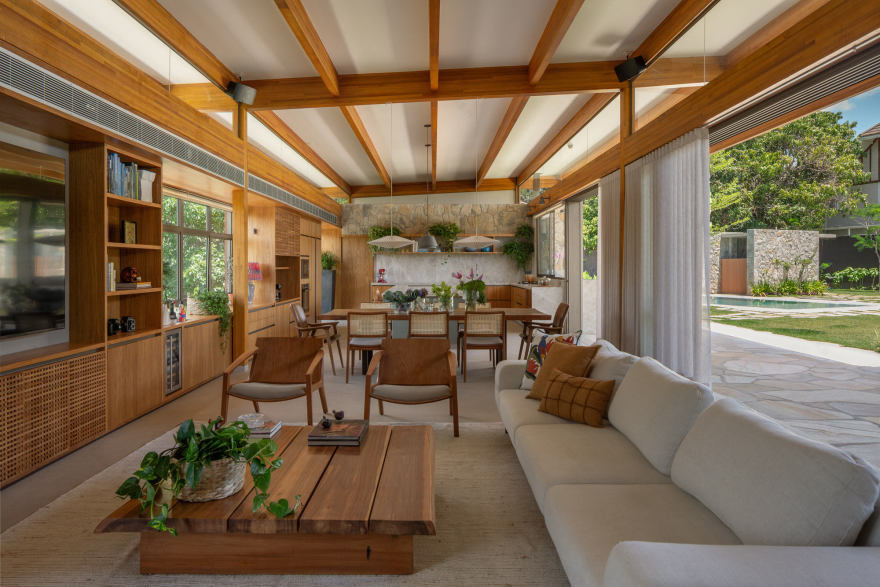
The pavilions share the same timber system but differ in profile. Both are built in glued laminated timber made from certified eucalyptus, using a prefabricated grid of columns and beams that supports large openings and a clear structural rhythm. The social pavilion has a pitched roof that lifts the ceiling and brings more air and light into the main living areas. The private pavilion is flatter and calmer in silhouette. A connecting roof plane links the two and marks the point where circulation tightens before opening again toward the courtyard.
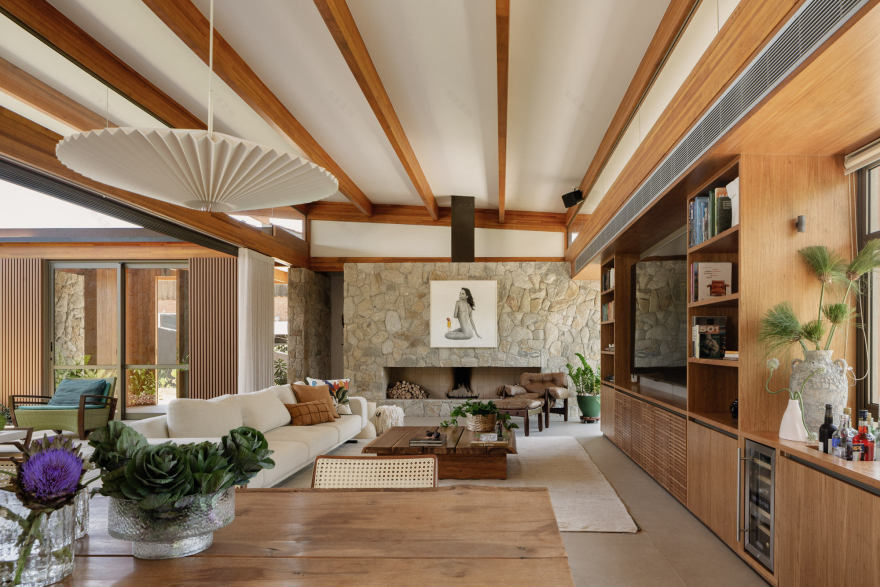
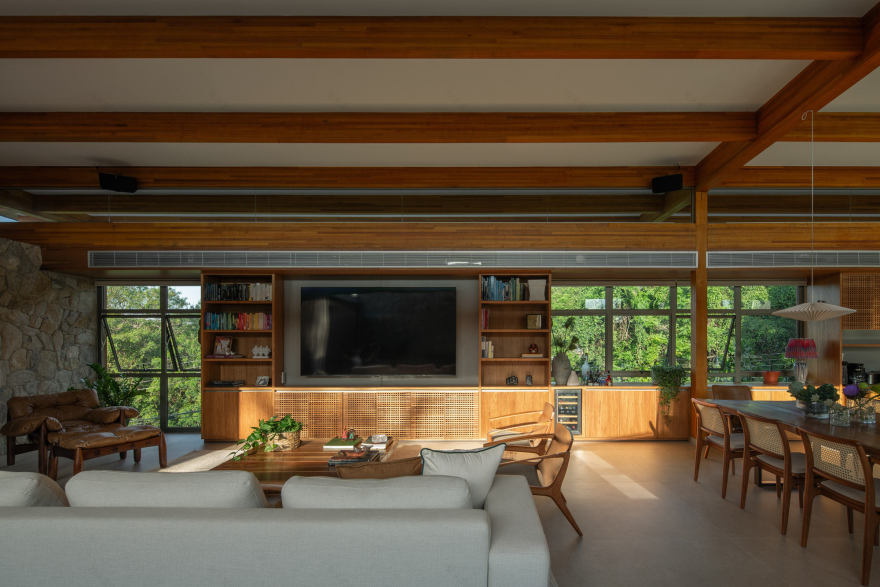
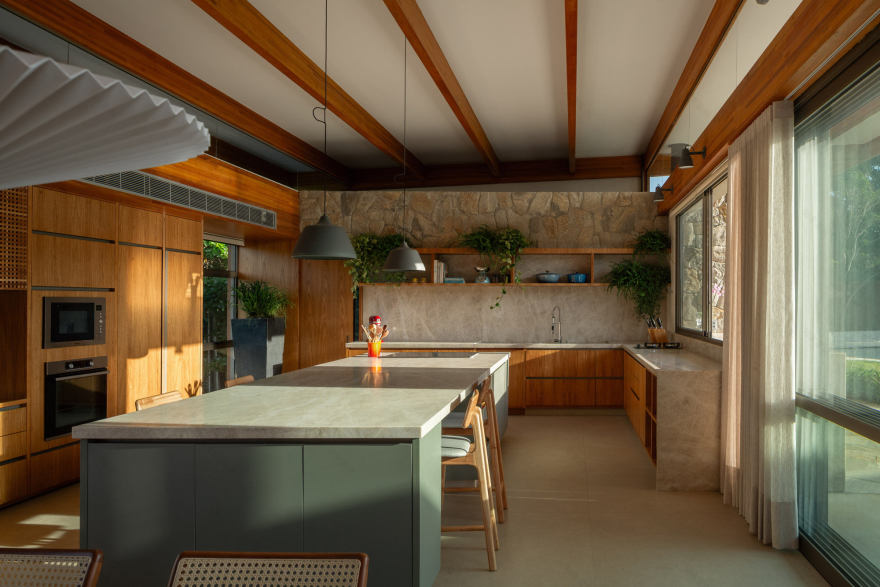
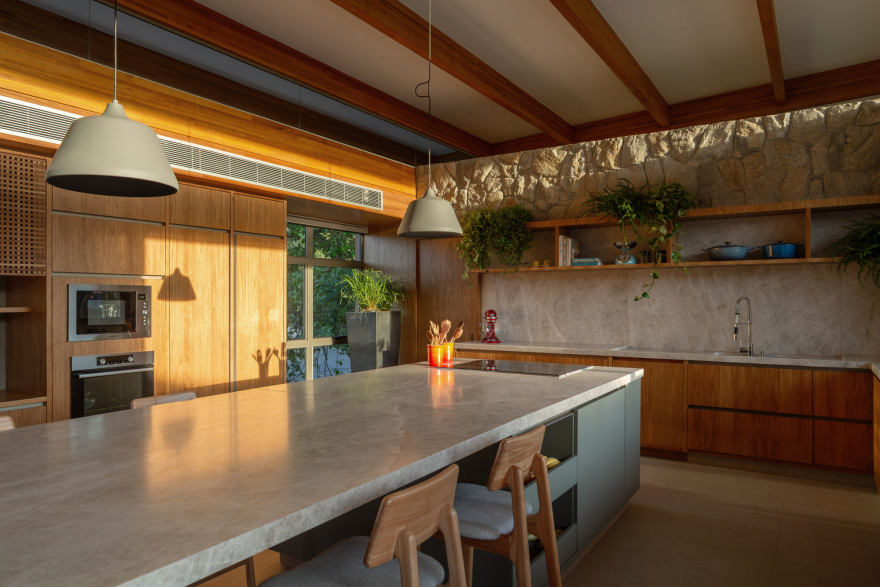
Inside the social pavilion, living room, dining area, and kitchen read as one continuous space. A long run of wood millwork ties the room together, combining storage and display functions while keeping the plan visually ordered. On one side, modular panels balance privacy and outlook toward the street. On the other, large sliding glass panels retract to extend the room onto the veranda and toward the pool.
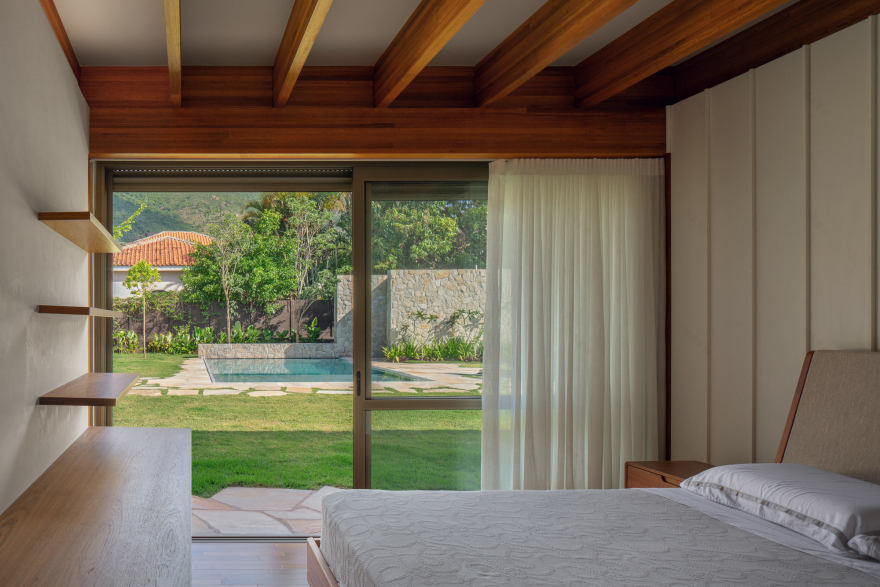
Material choices stay close to the building’s structure. Wood cabinetry echoes the exposed timber frame, while stone appears at the base, along the end walls of the pavilions, and across outdoor surfaces. São Tomé quartzite continues from the veranda to the garden paths and pool surround, strengthening the sense that the house is assembled as a sequence of connected exterior and interior grounds rather than a set of sealed rooms.
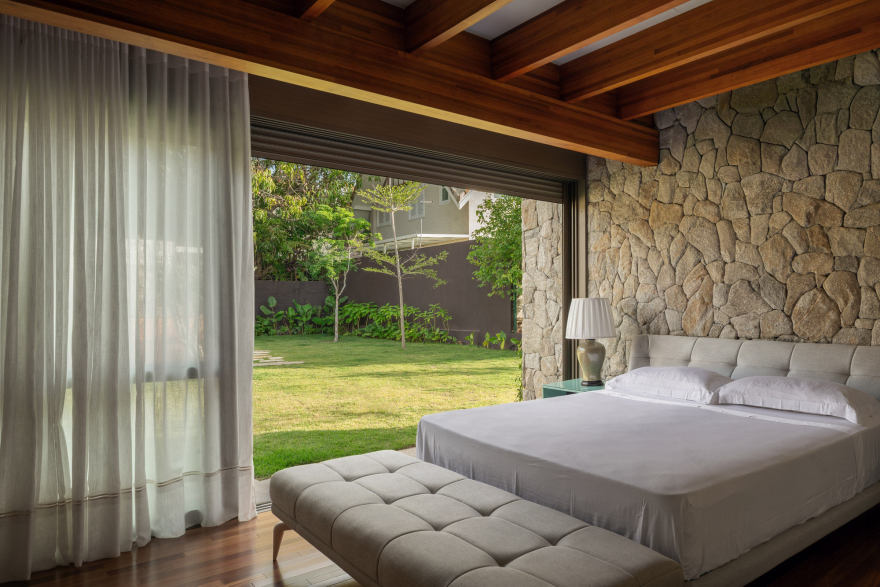
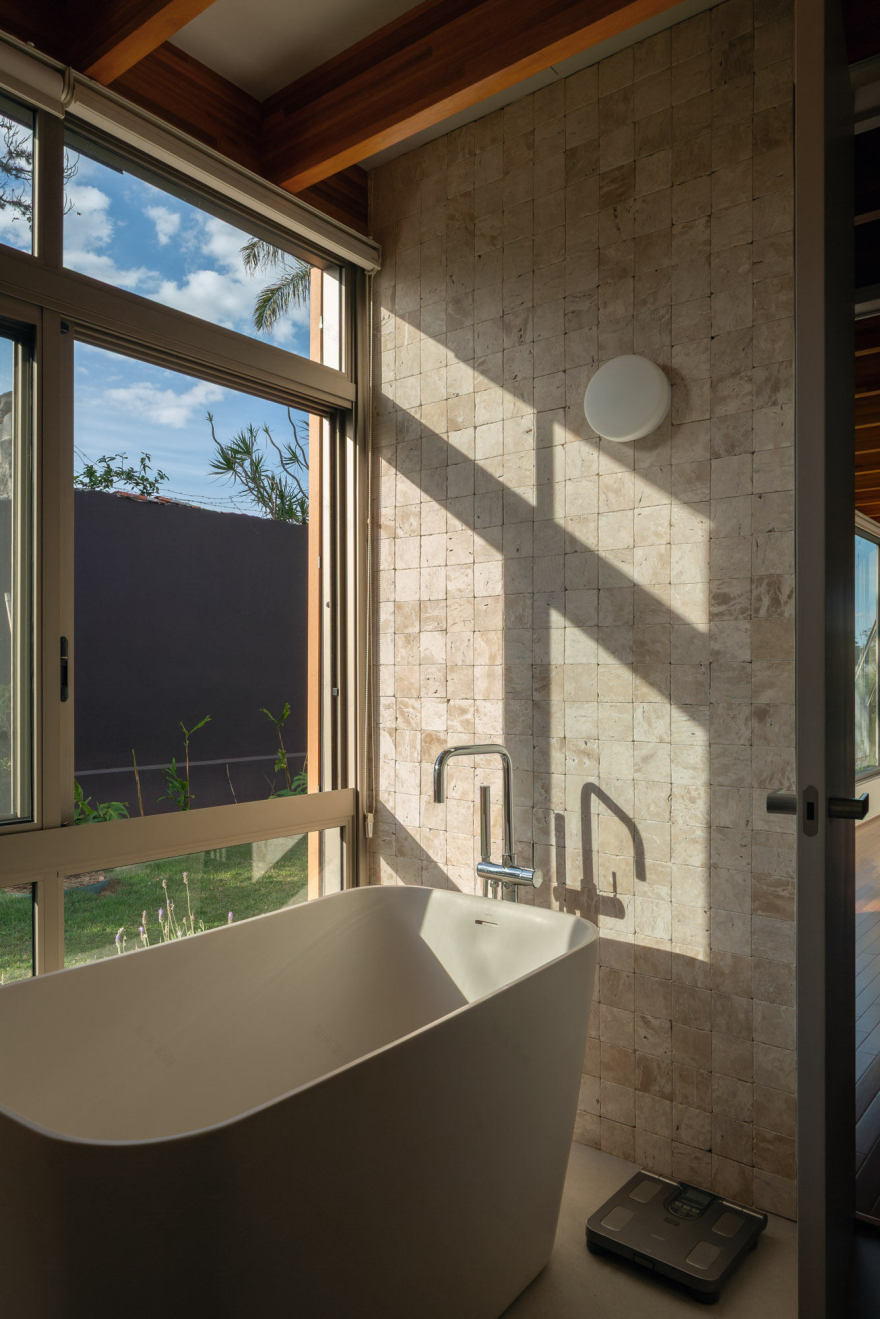
The private pavilion contains five en-suite bedrooms. Its access corridor works as a glazed gallery, bringing daylight deep into the plan and keeping the garden present during everyday movement through the house. In the bedrooms, exposed timber, stone-clad headboard walls, and wood floors maintain the same restrained material palette. Floor-to-ceiling windows face the courtyard, while the bathrooms continue the use of natural stone, including travertine mosaic on the walls.
南京喵熊网络科技有限公司 苏ICP备18050492号-4知末 © 2018—2020 . All photos and trademark graphics are copyrighted by their owners.增值电信业务经营许可证(ICP)苏B2-20201444 苏公网安备 32011302321234号
苏公网安备 32011302321234号客服
消息
收藏
下载
最近