

创作上传
VIP
收藏下载
登录 | 注册有礼
查看完整案例

收藏

下载

分享
项目概况
Project Overview
项目区位:殷墟位于中国河南省安阳市,是中国商朝(约公元前1600年至公元前1046年)后期的都城遗址,是中国历史上第一个文献可考、并为考古学和甲骨文所证实的都城遗址。
历史文化:1928年,殷墟共出土800余片有字甲骨以及铜器、陶器、骨器等多种文物。2006年,殷墟作为世界文化遗产列入《世界遗产名录》。甲骨文、青铜器、宫殿遗址等都是殷墟文明的物质遗存,坚实地奠定了中华历史的开端,是世界古文明的瑰宝。
景观设计:延续建筑设计“殷墟宝鼎,破土而出”的场景感,结合“探索殷墟文化历史之旅”的景观设计概念,重点打造引导游客探寻殷墟文明的景观空间,营造辽阔、大气的空间场域。
Project Location: Yinxu, located in Anyang, Henan Province, China, is the site of the late Shang Dynasty capital (approximately 1600 to 1046 BCE). It is the first capital site in Chinese history to be documented in literature and verified through archaeology and oracle bone inscriptions.
Historical and Cultural Background: In 1928, over 800 inscribed oracle bones and various artifacts such as bronzeware, pottery, and bone tools were unearthed at Yinxu. In 2006, Yinxu was inscribed as a World Heritage Site. The material remains of Yinxu civilization, including oracle bone script, bronze artifacts, and palace ruins, firmly establish the origins of Chinese history and are treasures of ancient world civilizations.
Landscape Design: Continuing the architectural design theme of “Yinxu Cauldron, Emerging from the Earth,” the landscape design concept is centered on “Explore the Cultural and Historical Journey of Yinxu”. The focus is on creating landscape spaces that guide visitors to explore the Yinxu civilization, fostering a vast and majestic spatial atmosphere.
▼夜幕下的中轴广场与入口空间,Central plaza and entrance space at dusk © 映尺摄影工作室

设计策略
Design Strategy
展现历史文化:空间格局设计抽象提取了殷墟宫殿遗址的中轴对称设计,并与殷墟王陵遗址的“十字型”平面格局对应,并在景观的各空间节点和细部设计上融入了殷墟的历史和文化故事的展示。满足使用功能:场地设计满足博物馆的机动车停车、非机动车停车、消防疏散、设备用房遮蔽等使用功能需求,同时需要兼顾博物馆园区游客参观服务、大面积集散场地,户外表演及休憩等多使用场景需求。营造空间氛围:景观空间以建筑为中心,将建筑喻作一尊宝鼎,以极简草坡的设计手法凸显“殷墟宝鼎”考古破土而出的态势。开阔的场域感与场地周边的密林,西侧河对岸的殷墟博物馆旧馆,东北部的城市建设形成反差,展现殷墟博物馆新馆的气势与风范。
▼项目总平面图,Site plan © 华南理工大学建筑设计研究院有限公司+映尺摄影工作室

Display of Historical and Cultural Stories: The spatial layout design abstractly extracts the central axis symmetry of the Yinxu Palace ruins and corresponds to the “cross-shaped” plane layout of the Yinxu Royal Tomb ruins. This design integrates the display of Yinxu’s history and cultural stories into various spatial nodes and detailed aspects of the landscape. Functional Requirements of the Museum: The site design meets the functional requirements of the museum, including motor vehicle parking, non-motor vehicle parking, fire evacuation, and equipment room concealment. Additionally, it accommodates multiple usage scenarios such as visitor services within the museum park, large gathering spaces, outdoor performances, and rest areas. Creation of Spatial Atmosphere for Tourists: The landscape space centers around the building, metaphorically treating it as a precious cauldron. Using minimalist grass slope design techniques, it highlights the archaeological emergence of the “Yinxu Cauldron.” The open field contrasts with the dense surrounding forest, the old Yinxu Museum across the river to the west, and urban development to the northeast, showcasing the grandeur and style of the new Yinxu Museum.
▼远景下的博物馆整体形态,Overall view of the museum in the landscape © 映尺摄影工作室

色彩提取:Color Extraction
青铜器、甲骨都是殷墟出土的核心文物,是非同寻常的关于商代晚期文化传统的证据。
青铜器——司母戊鼎重832.84千克,是目前已知中国古代最重的青铜器。
建筑设计以司母戊鼎为灵感,外观方正对称,主色调为青铜色。
甲骨是商朝用于记录占卜内容的龟甲及兽骨的总称。
景观设计则提取甲骨的暖黄色调为主色调。
Bronze Artifacts and Oracle Bones: Bronze artifacts and oracle bones are core relics unearthed from Yinxu, serving as extraordinary evidence of the cultural traditions of the late Shang Dynasty.
Bronze Artifacts: The Simuwu Ding, weighing 832.84 kilograms, is the heaviest known ancient Chinese bronze artifact. The architectural design is inspired by the Simuwu Ding, featuring a square and symmetrical appearance with bronze as the primary color.
Oracle Bones: Oracle bones, used in the Shang Dynasty for divination, are primarily turtle shells and animal bones. The landscape design extracts the warm yellow tones of the oracle bones as the main color scheme.
▼色彩分析,Color analysis © 华南理工大学建筑设计研究院有限公司+映尺摄影工作室

元素提取:Element Extraction
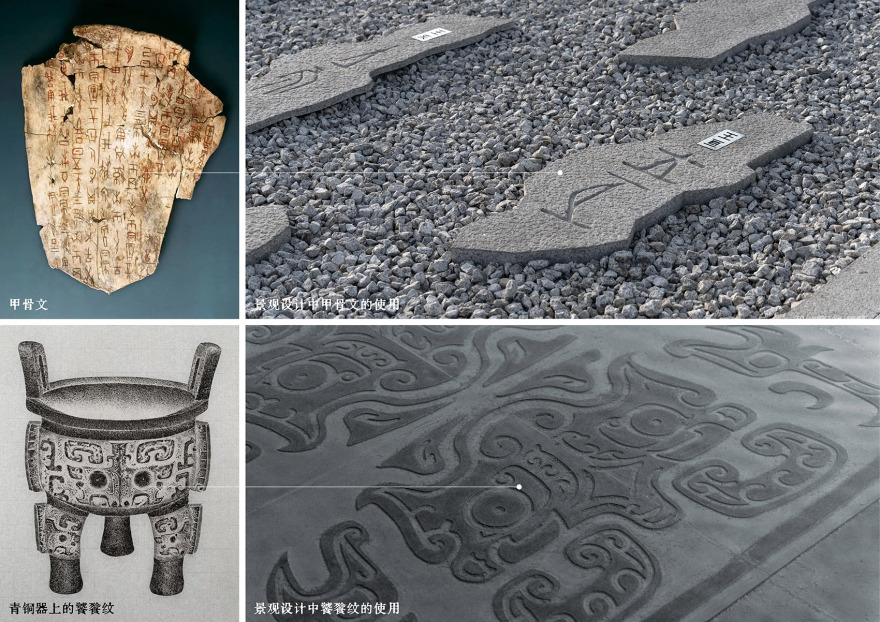
甲骨文是3600年前汉字体系成熟的代表,单字数量已逾4000字,是还原殷商历史的直接史料。饕餮纹又称兽面纹,是青铜器表面常见的花纹之一,代表了青铜器装饰图案的最高水平。景观细部设计中融合表现甲骨文、饕餮纹等,表现殷墟文化精粹。
Oracle Bone Script: Representing the maturity of the Chinese writing system 3,600 years ago, oracle bone script includes over 4,000 characters and serves as direct historical evidence of the Shang Dynasty. Taotie Patterns: Also known as beast face patterns, taotie patterns are common decorative designs on the surface of bronze artifacts, representing the pinnacle of bronze decoration. The detailed landscape design incorporates elements such as oracle bone script and taotie patterns to express the essence of Yinxu culture.
▼元素提取,Element extraction © 华南理工大学建筑设计研究院有限公司+映尺摄影工作室
中轴空间
Central Axis Space
中轴空间是游客进入殷墟博物馆新馆的主入口步道,南北长约200米,融合四大历史故事形成引导游客的参观路线,也从主入口开始铺垫古文明的探索氛围。景观中轴分别表现殷墟文明起源的故事、商朝朝代更迭的故事、祭祀文化的故事及纹样艺术的故事,将洹河流域文明、殷墟文化符号等融入到景观设计中,增强景观空间的文化性、故事性、趣味性。
▼中轴空间,Central axis space © 华南理工大学建筑设计研究院有限公司+映尺摄影工作室

The central axis space serves as the main entrance walkway for visitors entering the new Yinxu Museum. Stretching approximately 200 meters from north to south, it integrates four significant historical stories to guide visitors along their tour route, setting the stage for an exploration of ancient civilization right from the entrance. The landscape along the central axis illustrates the origin story of Yinxu civilization, the dynastic changes of the Shang Dynasty, the rituals and sacrificial culture, and the pattern art. By incorporating the civilization of the Huan River Basin and the cultural symbols of Yinxu into the landscape design, the space enhances its cultural richness, narrative quality, and overall appeal.
▼夜景中的建筑立面与中轴空间关系,Facade and central axis spatial relationship at dusk © 映尺摄影工作室

1、殷墟文明起源的故事:
1、Story of the Origin of Yinxu Civilization
中轴空间的起点是游客进入参观的主入口,开端提炼殷墟文明起源的故事,以地面石材雕刻的形式表现孕育殷墟文明的母亲河——洹河,模拟其西出太行山、东入古黄河的空间格局,让游客在参观过程中了解殷墟文明的起源故事。▼纹理分析,Texture analysis © 华南理工大学建筑设计研究院有限公司+映尺摄影工作室

The central axis space begins at the main entrance where visitors start their tour. This starting point distills the story of the origin of Yinxu civilization, depicted through ground stone carvings that represent the mother river of Yinxu civilization—the Huan River. The carvings simulate the river’s journey from the Taihang Mountains in the west to the ancient Yellow River in the east. This design allows visitors to learn about the origin story of Yinxu civilization as they progress through their visit.
▼中轴步道上的地景雕刻细部,Landscape carving detail along the central axis © 映尺摄影工作室

2、商朝朝代更迭的故事:
2、Story of the Dynastic Changes of the Shang Dynasty
中轴空间的第二处节点以甲骨文形式展现商王世系表,结合现代注解向游客讲述殷商帝王及朝代更替的故事。▼节点分析,Node analysis © 华南理工大学建筑设计研究院有限公司+映尺摄影工作室
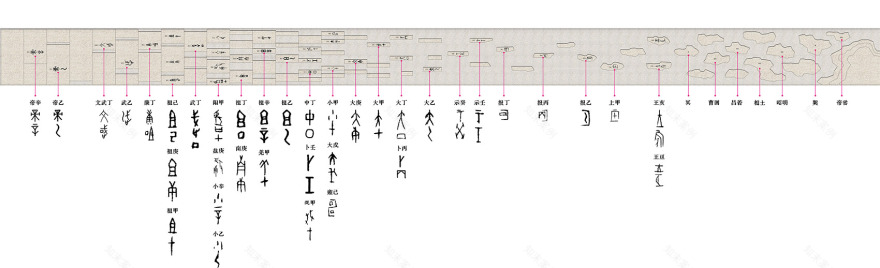
The second node in the central axis space presents the lineage of Shang kings in the form of oracle bone script, combined with modern annotations to narrate the stories of the Shang emperors and the dynastic transitions to visitors.
▼游客行走中的入口界面,Entrance interface with visitor movement © 映尺摄影工作室

根据游客参观顺序,由远及近排版商王世系表,表达殷墟文明的历史演进。平面构成形式由散到聚、由具象甲骨形状到抽象的历史拼图,象征着殷墟对古文明的考古发掘出来的片段,逐渐融合形成了殷墟的完整历史版图和故事。开阔的景观空间为户外空间的灵活使用及旅游高峰期大量游客的疏散提供便利。
Following the order of the visitor’s tour sequence, the lineage of Shang kings is arranged from distant to near, illustrating the historical progression of Yinxu civilization. The layout transitions from scattered to clustered forms, evolving from the concrete shapes of oracle bones to an abstract historical mosaic. This symbolizes the archaeological fragments unearthed from Yinxu, gradually merging to form a complete historical map and narrative of the Yinxu civilization. The open landscape space facilitates the flexible use of outdoor areas and provides convenience for the dispersal of large numbers of visitors during peak tourism periods.
▼人物尺度下的入口界面与空间秩序,Entrance interface and spatial order with human scale © 映尺摄影工作室

商王世系表的呈现采用石材篆刻甲骨文对照现代汉字注解的方式,增强了文化细节的可识别性及历史的沧桑感。中轴区域采用大区的铺装石材,但对石材质感做了不同的处理,突出故事线的表现力和中轴步行空间的引导性。
The lineage of Shang kings is presented using stone carvings of oracle bone script alongside modern Chinese annotations. This approach enhances the recognizability of cultural details and conveys the sense of historical depth and antiquity. In the central axis area, large paving stones are used extensively. However, the texture of the stones is treated differently to emphasize the narrative power of the story and to guide pedestrian movement within the central axis walkway.
▼铺装中的甲骨文刻字细部,Oracle bone script carvings within paving © 映尺摄影工作室

3、祭祀文化的故事:
3、Story of Ritual Culture
地面精美的雕刻来自于殷墟祭祀文化的代表礼器——司母戊鼎,抽象提取其表面装饰纹样,讲述殷商祭祀文化的故事。
The exquisite ground carvings are derived from the representative ritual vessel of Yinxu’s culture—the Simuwu Ding. The surface decoration patterns of the Simuwu Ding are abstractly extracted and used to tell the story of ritual culture in the Shang Dynasty.
▼纹样铺装中的行走路径与人流活动,Pedestrian movement along patterned paving © 映尺摄影工作室

古祭祀文化在殷商社会生活中占有重要地位。司母戊鼎是商王为祭祀其母亲而铸造的礼器,其独特的造型、瑰丽的纹饰、精湛的工艺,代表中国古代青铜器发展史上的第一个高峰。中轴空间的第三处节点着眼于殷墟祭祀文化的代表礼器——司母戊鼎,将其精美的表面纹饰具象的雕刻在广场铺装上,展现殷墟文物的细节之美。
Ancient ritual culture held a significant place in the social life of the Shang Dynasty. The Simuwu Ding, a ceremonial vessel cast by a Shang king to honor his mother, stands out with its unique shape, splendid decorations, and exquisite craftsmanship, marking the first peak in the history of Chinese bronze artifacts. The third node in the central axis space focuses on this representative ritual vessel of Yinxu’s culture—the Simuwu Ding. The intricate surface decorations of the Simuwu Ding are meticulously carved into the plaza’s paving stones, showcasing the detailed beauty of Yinxu artifacts.
▼夕阳下的广场细部与材质肌理,Plaza detail and material texture under sunset light © 映尺摄影工作室

4、纹样艺术的故事:
4、Story of Pattern Art
中轴空间的第四处节点为建筑入口前的镜面水景。纯净的水面倒映出建筑及天空的影像,柔和建筑的边界。池底的纹样细节选取殷墟出土文物最典型的四种饕餮纹样,展现殷墟古文明的艺术成就和传说寓意。
The fourth node of the central axis space is the water feature in front of the architecture. The water surface reflects the image of the building and the sky, softening the edges of the architecture. The pattern details on the pool bottom select the four most typical Taotie patterns unearthed from the Yinxu Ruins, showcasing the artistic achievements and legendary implications of the ancient Yinxu’s civilization.
▼水面与步道交织的空间界面,Interwoven interface of water surface and walkway © 映尺摄影工作室

饕餮纹样图案庄严对称,神秘且寄喻古代的传说故事,是青铜器装饰图案中最优秀的美学作品之一。每一种纹样都是古代图形文化的高度抽象和艺术展现。
The Taotie pattern design is solemnly symmetrical, mysterious, and imbued with ancient legends. It is one of the most excellent aesthetic works in the decorative patterns of ancient bronzewares. Each pattern is a highly abstract and artistic representation of ancient graphic culture.
▼镜面水景中的纹样细部表达,Pattern details within reflective water surface © 映尺摄影工作室

考古发掘的故事:The Story of Archaeological Excavation
1928年,中国考古队对殷墟进行第一次试掘,共出土800余片有字甲骨以及铜器、陶器、骨器等多种文物。迄今为止,殷墟考古工作已开展近百年。石凳风化剥落的一角显露出精美的纹饰,象征随着殷墟考古发掘工作的开展,宝贵的远古文明一点点重见天日、显露真容的故事。
In 1928, the Chinese archaeological team conducted the first trial excavation at the Yinxu site, unearthing more than 800 inscribed oracle bones as well as various artifacts such as bronze ware, pottery, and bone tools. To date, archaeological work at Yinxu has been ongoing for nearly a century. A corner of a stone bench, weathered and eroded, reveals intricate decorations. This symbolizes the story of how, through the continuous archaeological efforts at Yinxu, the precious ancient civilization gradually sees the light of day and reveals its true form.
▼仿青铜纹饰的石材肌理表达,Stone texture inspired by bronze ornamentation © 映尺摄影工作室

雨水生态措施
Stormwater Management Strategies
结合建筑周边草坡的排水方向,场地设计了下凹绿地及溢流管收集雨水,缓解降雨情况下形成的的地表径流,减低了场地排水对附近河道的影响。
Integrating the natural drainage patterns of the grass slopes surrounding the building, the site has been thoughtfully designed with depressed green spaces and overflow pipes to effectively manage stormwater. These features mitigate surface runoff during precipitation events, thereby minimizing the impact of site drainage on the adjacent river systems.
▼雨水滞留草地与场地生态界面,Stormwater-retaining lawn and ecological ground interface © 映尺摄影工作室

植物设计融合历史文化 Integrating Historical and Cultural Narratives into Planting Design
在设计中,每一种在地植物的精心挑选,都隐喻着一个传说或典故,让场地的一草一木都可以述说历史的故事。设计打造“春季桃李花开,夏季桑林成荫,深秋白蜡洒金,冬季白雪皑皑”的四时之景,为游客提供打卡美景的同时,也成为游客挖掘殷墟传说故事的线索。
In this design, each carefully selected native plant represents a legend or historical anecdote, allowing every element of the landscape to tell a historical story. The design creates a picturesque seasonal tableau with “peach and plum blossoms in spring, shaded mulberry groves in summer, golden ash leaves in late autumn, and a blanket of snow in winter.” These scenes not only provide beautiful spots for visitors but also serve as clues to uncovering the legends of Yinxu.
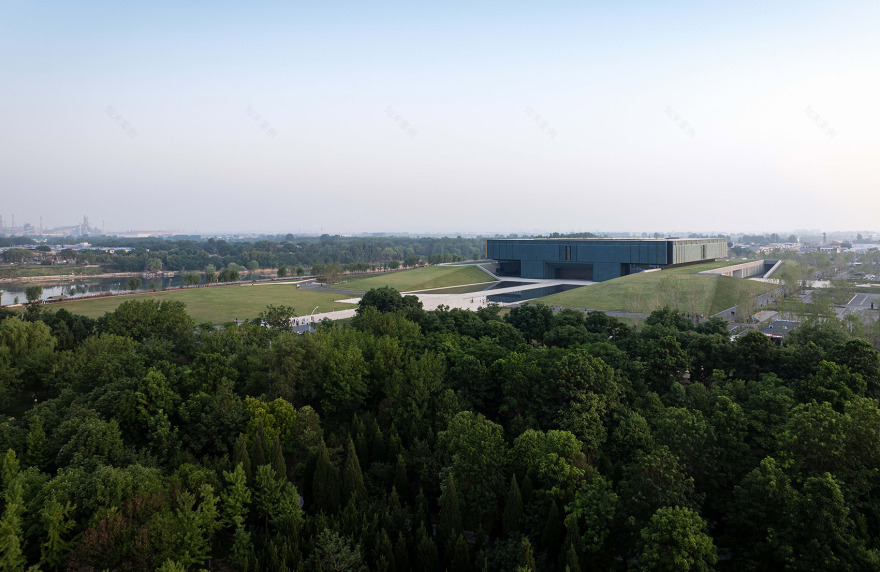
▼建筑与周边林地及河道的关系,Relationship between the building, woodland, and river © 映尺摄影工作室
设计中选择的桑树就是启发于“汤祷桑林”的历史典故。典故“汤祷桑林”讲述:成汤灭夏后,天下久旱不止,巫师长祈无果,说需用活人祭祀,于是成汤决定在桑林村亲自祈雨。在成汤即将被橙火烧死之际,突然天降大雨。又例如,中国种植李树的历史悠久,最早可以追溯到殷商时期,殷墟出土的甲骨文中已有“李”字,项目中栽植桃李林于东侧,并以树牌标识的形式解释文化渊源。通过这些赋予历史文化涵义的植物,不仅打造了有场景感的生态美景,也为游客带来了深刻丰富的文化体验。
The choice of mulberry trees in the design is inspired by the historical anecdote of “Tang Praying in the Mulberry Forest.” This tale recounts that after Tang overthrew the Xia Dynasty, a prolonged drought plagued the land. Despite the shaman’s long prayers, no rain came, and it was suggested that a human sacrifice was needed. Tang decided to pray for rain himself in the village of the Mulberry Forest. Just as flames were about to consume him, a sudden downpour extinguished the fire. Take another example: the history of cultivating plum trees (Li) in China is long and storied, dating back to the Yin-Shang period. Oracle bone inscriptions unearthed from Yinxu already contain the character “李” (Li). In the project, a peach and plum grove is planted on the east side, with tree species signage explaining the cultural significance. By integrating these plants with historical and cultural meanings, the design not only creates an ecologically beautiful landscape but also provides visitors with a profound and enriching cultural experience.
▼项目鸟瞰,Aerial view of the project © 映尺摄影工作室

其他信息:
项目名称:安阳殷墟博物馆新馆景观设计
项目地点:中国,河南,安阳
设计总主持:何镜堂 院士
景观设计团队:华南理工大学建筑设计研究院有限公司 何镜堂院士团队 景观与规划工作室
建筑设计团队成员:吴中平、郑少鹏、黄瑜、孙阳、赵明哲、辛晓柯、蔡长泽、陈鹏、赵丹、杨骏威、徐志逸、林孟蓉、张春意、吴国明
景观设计团队成员:郑旸、黄灵杰、史梦霞、刘明朗、陶浩贤、李志昌、欧健聪、陈璧如(方案)、杨石泉、钟颖涛、李家文、谭鸿健、林宪詠、赵笑寒(施工图)
工作范围:概念+方案+扩初+施工图+现场技术指导
业主单位:安阳鑫鼎晟旅游咨询有限公司
标识设计团队:维唐设计(深圳)有限公司 标识设计团队成员:吴玮、李科、崔浩
泛光单位:深圳市光艺规划设计有限公司
建设单位:中国建筑一局(集团)有限公司
景观面积:约160,000㎡
设计时间:2020年-2023年
建造时间:2020年-2024年
摄影版权:映尺摄影工作室


南京喵熊网络科技有限公司 苏ICP备18050492号-4知末 © 2018—2020 . All photos and trademark graphics are copyrighted by their owners.增值电信业务经营许可证(ICP)苏B2-20201444 苏公网安备 32011302321234号
苏公网安备 32011302321234号客服
消息
收藏
下载
最近