

创作上传
VIP
收藏下载
登录 | 注册有礼
查看完整案例

收藏

下载

分享

翻译
Architects:Studio Ben Allen
Area:235m²
Year:2024
Photographs:French + Tye
Structural Engineer:Format
Main Contractor:Sprinks Construction
Category:Houses
Design Team:Ben Allen, Marco Nicastro, Tom Richardson
Library Joinery:Tim Gaudin
Interior Metalwork:Fish Fabrications
Interior Concrete:Concreations
Client:Tobi and James
City:Kent
Country:United Kingdom

Text description provided by the architects. In the entrance hall, visitors are met with a view of the stairs. The original setting out of the stairs was retained, but it was rebuilt in solid oak with the addition of sweeping, wider steps at the bottom to give a more generous approach. A small internal opening provides a snapshot view through the living room to the conservatory. Crossing the entrance hall, visitors are presented with an axial view through the library to the dining hall and kitchen. As they move along this axis, they pass into the cocktail library, a new space formed by the reconfigured circulation and at the new heart of the house. Shelves and seating areas are carved from an oblong or pill-shaped form. The materials are solid and veneer oak, naturally finished or washed with a blue stain on the inner curved surfaces. In one corner, a cocktail cabinet, concealed within the curved walls, gives the space the function of an entertainment space for the sociable owners. From this centre point is an axial view of the conservatory through the living room with the landscape beyond, framed by the library doors.


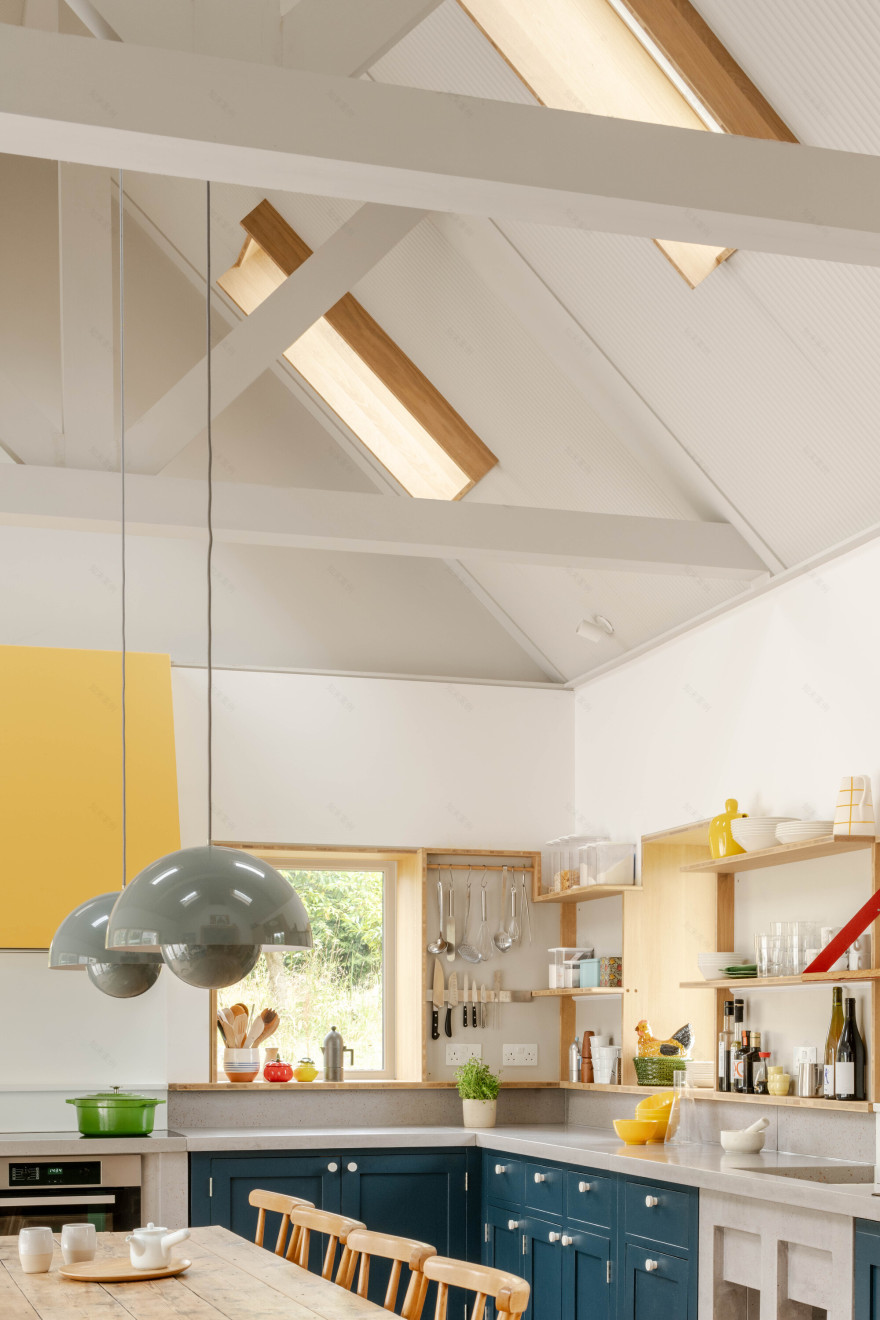
The kitchen is reimagined as a playful amalgam of a dining hall and pantry with an oversized cooker and hood as a reinterpretation of a traditional range and chimney. Like the cooker, the sink, which comprises a large enamel trough and backsplash, also sits on an outsized, pillared concrete base. The existing kitchen cabinets were redecorated, and a new concrete counter was added. The grey concrete is given a pinkish hue with the addition of brick fragments (using the same reclaimed bricks as the conservatory). A new door provides access to the west side of the garden and is framed with an oak vestibule. On the opposite side are two pairs of casement doors, framed with a timber portico and a central solid oak column, through which morning sun is emitted, and views to a large terrace on the east side are afforded. The terrace is framed by a timber pergola under which is an outdoor dining area. The pergola and the conservatory are one structure, connected via a pair of double doors.


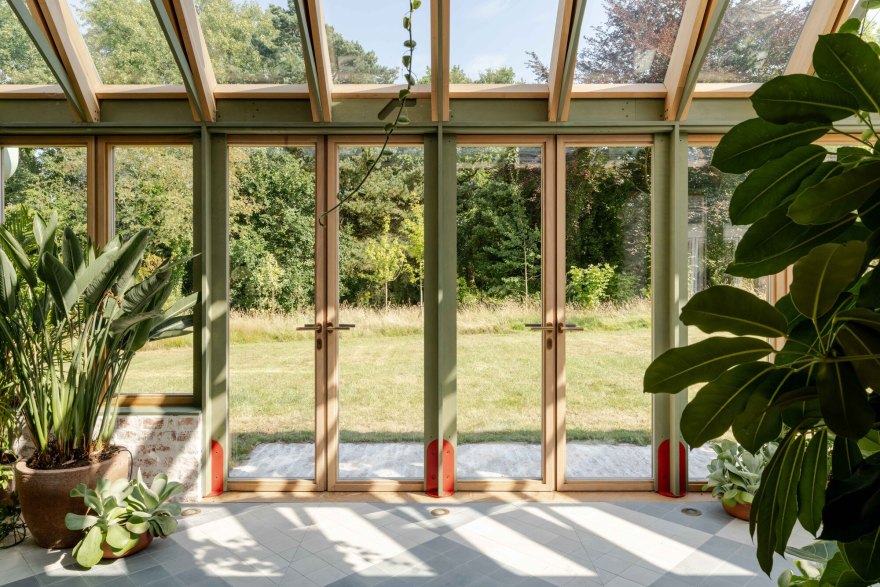
The conservatory, which can also be accessed via the living room, has a pitched roof supported with an array of scissor trusses that frame the view out to the pergola seating area beyond. The conservatory is built from CNC-cut timber, a specialism of the practice, which was supplied as a flat pack kit to the contractor to assemble. The materials are a mixture of green-stained birch plywood and oak (made from CNC-cut oak stave board, usually used for kitchen counters). The tiled floor pattern is generated from the column grid. Three pairs of oak pivoting doors give access to the pergola and garden. The conservatory walls and terrace paving are made from the same locally reclaimed bricks. As the client intends to use the conservatory as an exercise space, a red steel bar was added that spaces the space and can be used for a number of different exercises.


The pergola is based on the same column design and details as the conservatory roof, but is CNC cut from solid oak planks. A slatted bench is fixed to a brick stub wall, visually reinforcing the edge of the brick-paved terrace. On the first floor, the rooms have been reconfigured to reduce wasted circulation space and enlarge the master bedroom and study. From the latter, a Juliette balcony, which can be closed with a pair of shutters, opens onto the kitchen and dining area below to allow for easy communication between floors. The main bathroom is a simple, gridded tiled space with a roll-top bath. The space is animated with a number of elements, including a bespoke red bath spout and shower head, and a yellow shelf which matches the colour of the underside of the bath. A pillared green concrete washstand, with an enamel basin, is designed to form part of the same family of objects as the kitchen sink and oven.


On the same floor, the guest bedroom has a bespoke timber wall lining that doubles both as a headboard and as an integrated sliding window shutter. The en-suite shower room uses the same tiles as the main bathroom, but here with a red coloured grout. The yellow-framed shower cubicle and metal shelf mirror the yellow elements from the main bathroom as well as the choice of sustainable materials throughout. The project also involved significant thermal improvement of the house, the installation of a heat pump, battery, solar panels, and new heating and hot water systems. The result is a very significant improvement in energy consumption of the house, which frequently supplies energy back into the grid.

Project gallery






南京喵熊网络科技有限公司 苏ICP备18050492号-4知末 © 2018—2020 . All photos and trademark graphics are copyrighted by their owners.增值电信业务经营许可证(ICP)苏B2-20201444 苏公网安备 32011302321234号
苏公网安备 32011302321234号客服
消息
收藏
下载
最近