

创作上传
VIP
收藏下载
登录 | 注册有礼
查看完整案例

收藏

下载

分享

翻译
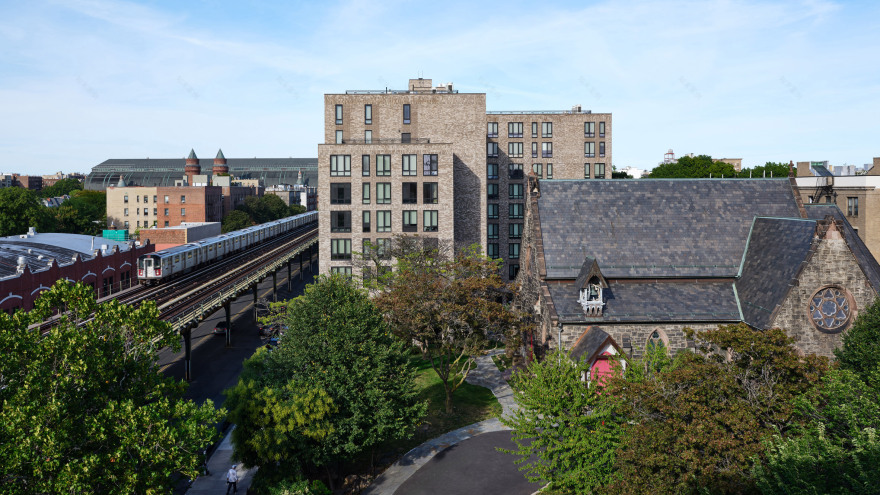
Local studio Dattner Architects has balanced new construction and historic preservation for the addition of social housing to a historic church campus in the Bronx, New York.
Located in the borough's Fordham neighbourhood, St James Terrace offers affordable housing combined with supportive spaces in a purpose-built building bookending a landmarked Episcopal church, whose gothic arches provide an important visual connection.
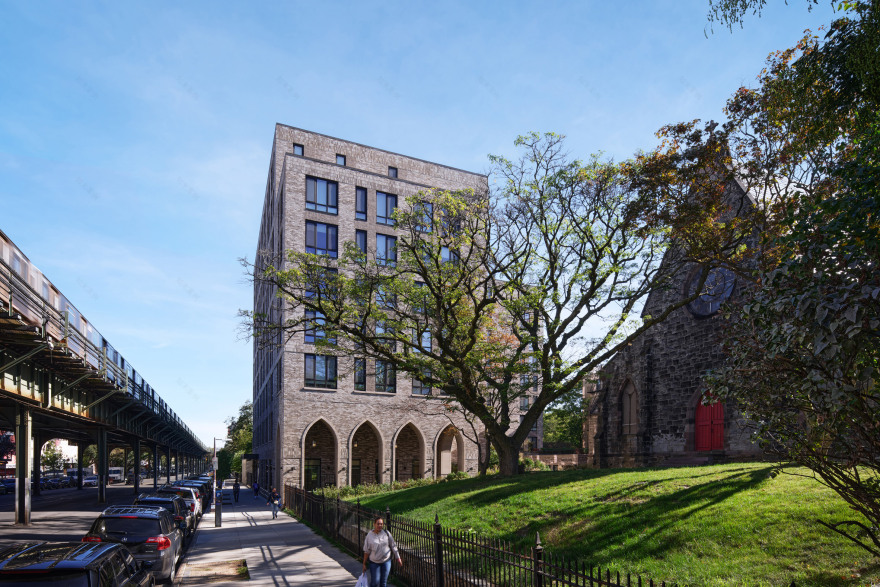
Dattner Architects has completed an affordable housing project in the Bronx
Long Island-based nonprofit Concern Housing tasked Dattner Architects with inserting a mixed-use residential building that wraps the western and southern edges of the site, where it helps define a new landscaped courtyard between it and historic St James Episcopal Church.
The studio responded with a nine-storey building that "dignifies" the 160-year-old church while working within the requirements of the city's Landmarks Preservation Commission (LPC).
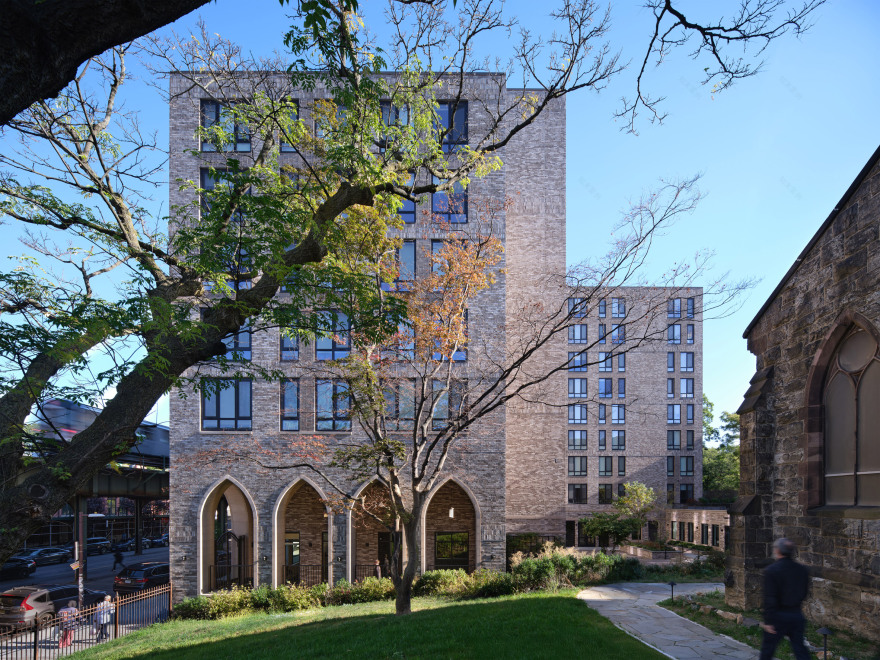
The building was informed by a neighbouring church
"The central challenge was that the site demanded two things that can feel contradictory: enough density to make the affordable housing financially viable, and enough restraint to satisfy the Landmarks Preservation Commission and honour a cherished neighbourhood institution," Dattner associate principal Rachel Ehrlich told Dezeen.
"The new building has its own presence and identity; it needed to be a dignified home for 102 households, not a mute backdrop for the church. Those goals are reconciled through a layered series of design decisions that work together," Ehrlich said.
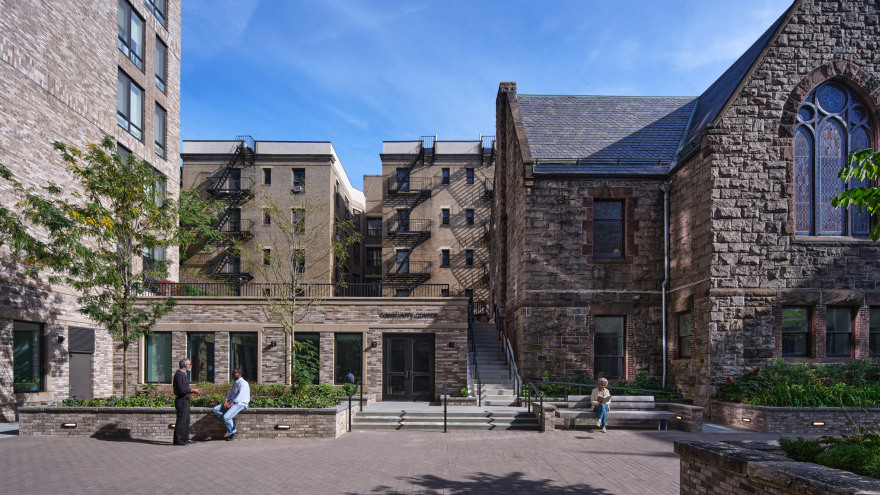
The residential building forms a new courtyard on the site
The updated programme stages both buildings around a cloistered courtyard that promotes health and sanctuary.
An arcade framed by a monumental single entry arch and formed by repeating arches at multiple scales fronts Jerome Avenue, lining a courtyard with recently redesigned landscaping meant to resemble an "English country church on a hill".
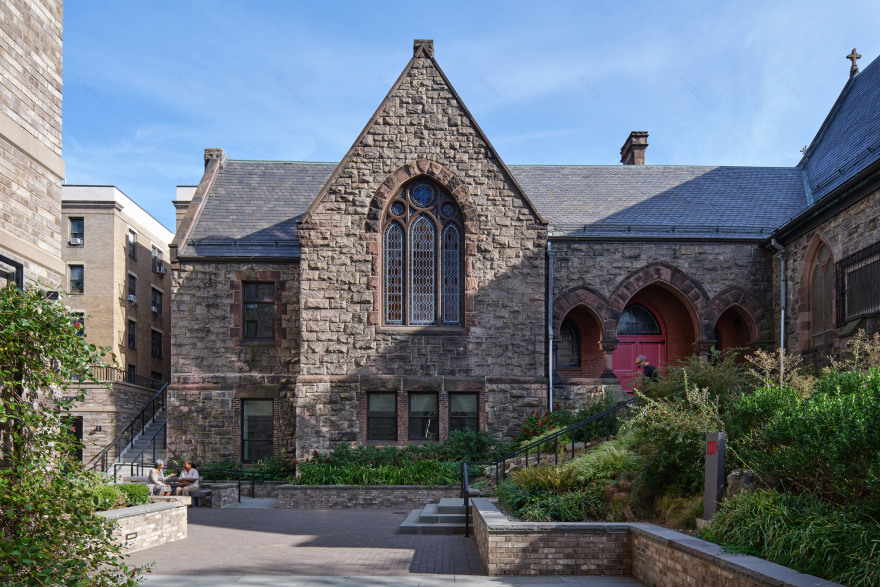
St James Episcopal Church is landmarked
According to the studio, the decision to include arches came through conversations with the LPC.
"The gothic arches, which the Landmarks Preservation Commission championed as a more direct reference to the church architecture, do the connective work: they frame the entry, animate the Jerome Avenue frontage, and most importantly, draw people through the building into the new courtyard beyond."
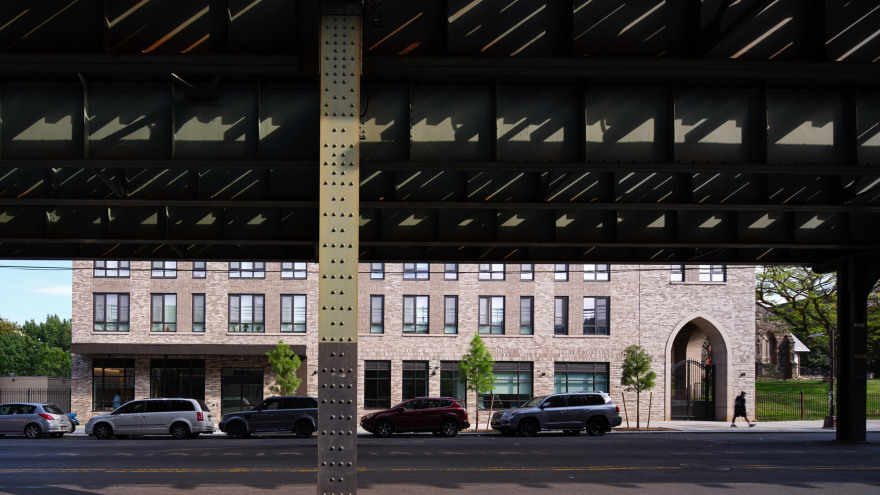
An arched entry leads into the site
A variety of brickwork was used to anchor the new building into the historic site.
"The brick material responds to that picturesque quality through deliberate craft: projected bricks and varied bond patterns animate the facade with light and shadow, creating a surface that has depth and character without attempting to imitate the historic masonry," Elrich said, noting the material's ability to unite the historic and contemporary.
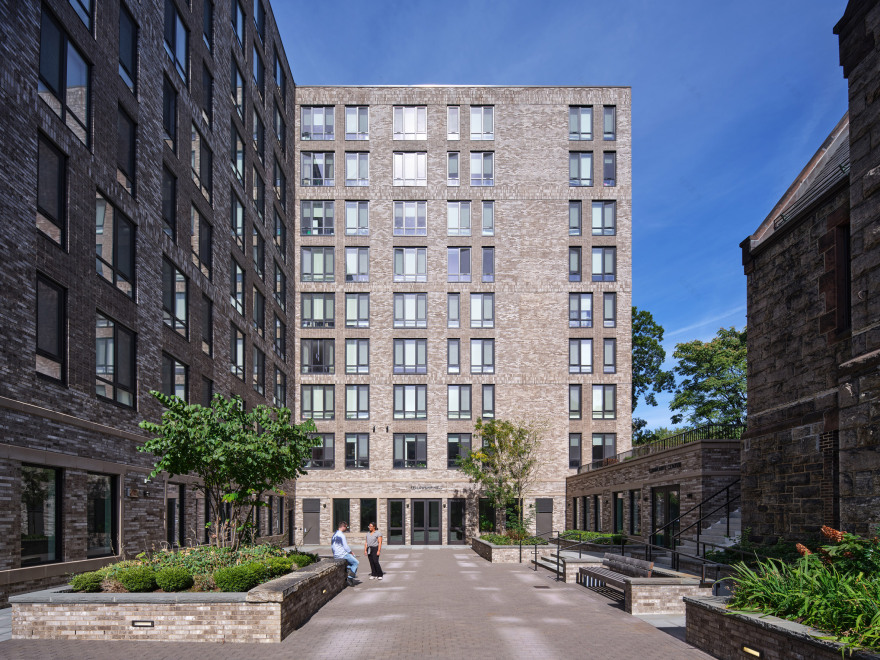
The new building is clad in brickwork
"The brick and precast palette is contemporary but calibrated to the tonal range and texture of the 1863 church, which is clad in rough-coursed gneiss," Ehrlich added.
The building's massing then subtly steps down to a single-storey community facility at the confluence of the church, its original Parish house, and the new courtyard, which replaces an underutilised car park.
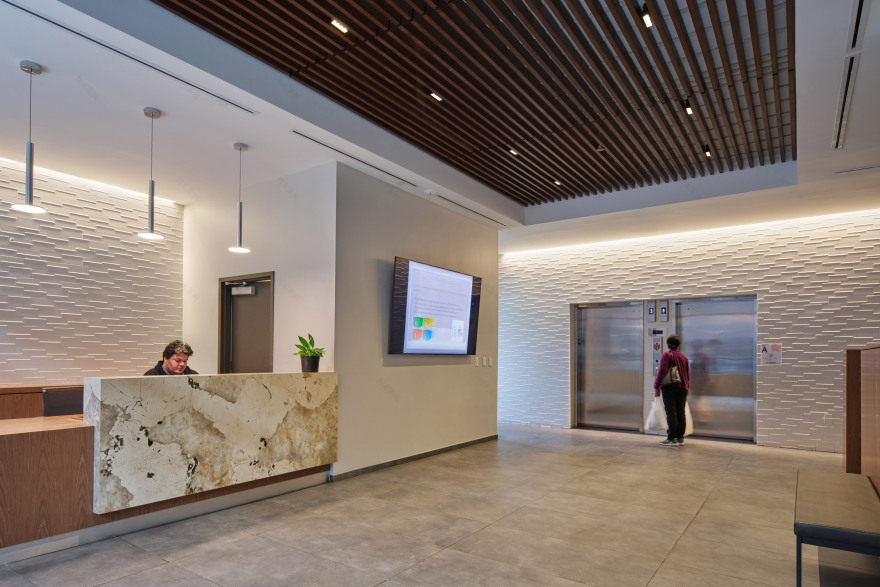
Interior spaces were designed to minimise disruptive sound
An exterior stair creates a deliberate visual break so the two buildings, which are connected through the community centre, can be read as "distinct objects rather than a single composition".
"A nine-story building next to an 1863 English country church is an inherently difficult adjacency," Ehrlich stated.
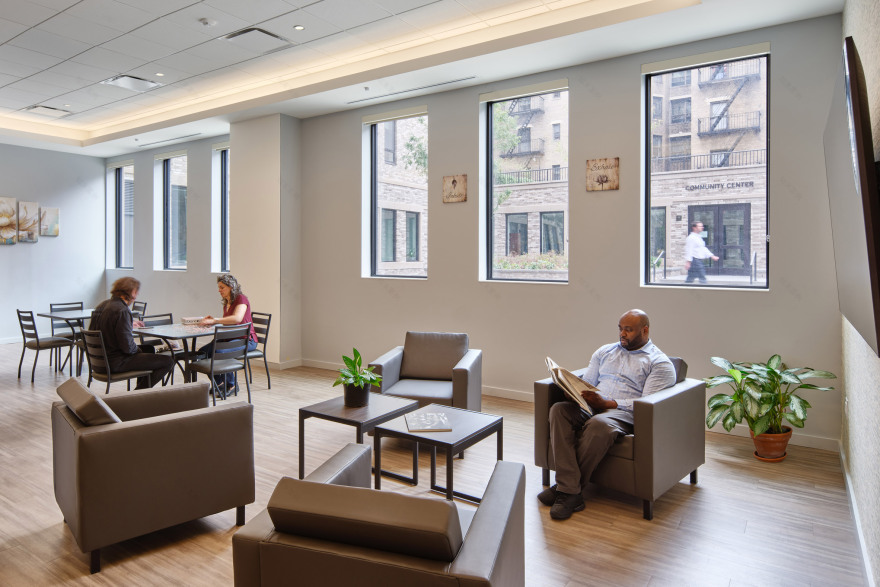
The new building connects to the church via a community space
"What resolved it was recognising that the new construction didn't need to minimise itself – it needed to create new ways to experience the historic church that simply didn't exist before."
"The new building and landscape replace all of that, and in doing so, give the church back its presence."
Interior residential spaces are designed to minimise intrusive noise and other sensory disruptions. The apartments have been air-sealed to compartmentalise ventilation, and each resident can independently choose heating or cooling year-round.
High-performance windows block disruptions from a nearby elevated subway line.
"We think about design as creating sensory boundaries," Ehrlich concluded.
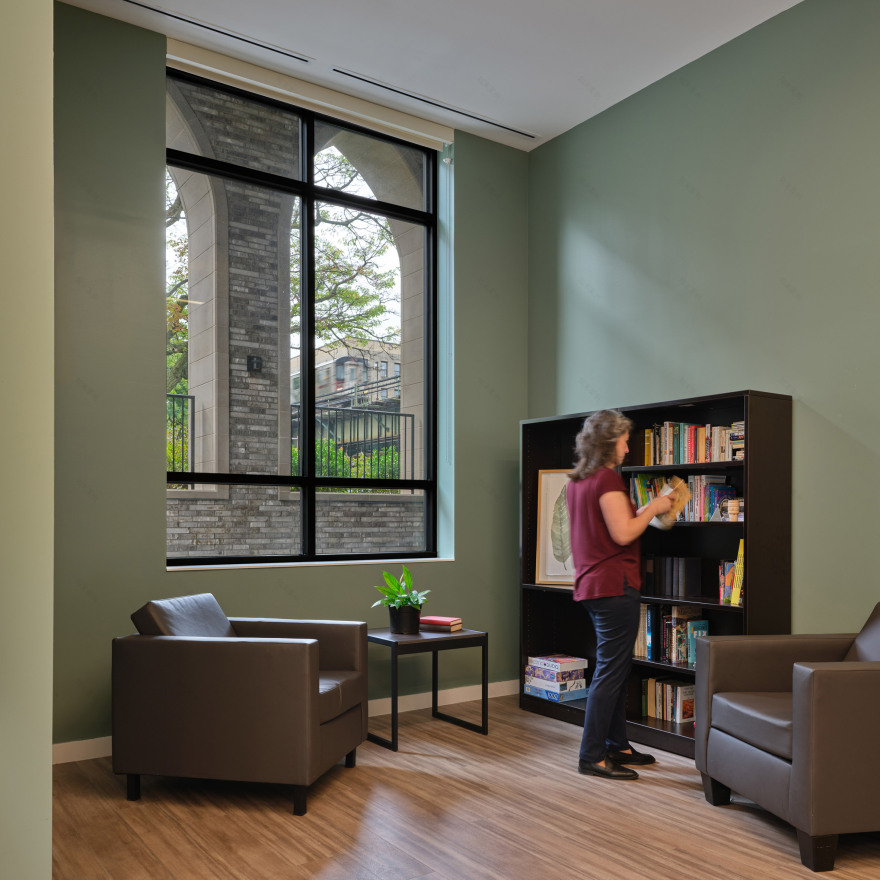
High-performance windows block the noise from the elevated train
Elsewhere in the Bronx, CetraRuddy has designed an 11-storey detention centre with stepped volumes clad in perforated metal screens and ground-level retail spaces.
The photography is by Chris Cooper/ArchExplorer
南京喵熊网络科技有限公司 苏ICP备18050492号-4知末 © 2018—2020 . All photos and trademark graphics are copyrighted by their owners.增值电信业务经营许可证(ICP)苏B2-20201444 苏公网安备 32011302321234号
苏公网安备 32011302321234号客服
消息
收藏
下载
最近