

创作上传
VIP
收藏下载
登录 | 注册有礼
查看完整案例

收藏

下载

分享
从2022年春天开始,VIA维亚景观的设计团队就开始进行漕溪路地铁站周边地区整体景观环境提升与更新的工作,并在同年7月完成了整体更新计划。该计划旨在以整体城市设计的方法建立更新框架,以渐进式更新的分期实施过程实现上海城市核心区景观洼地的功能转型,并结合以漕溪路地铁站内部与相邻地块建筑业态功能调整为基础的空间优化,实现整体地区复兴。到2023年底,我们设计的其中第一期项目“漕溪路口袋公园”1建成开放,而于2023年12月完成设计、2025年2月建成的“凯旋南路桥下空间更新:活力热点”(本项目)则是整体更新计划的第二期项目。▼区位图,Location map © VIA维亚景观
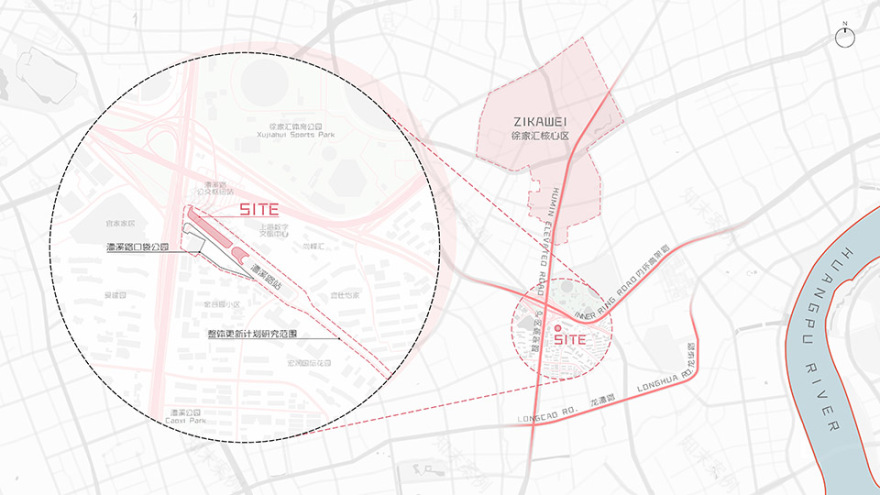
Beginning in the spring of 2022, our team commenced working on the comprehensive environmental improvement and renewal project for the surrounding Caoxi Rd. Metro Station area. The overall renewal plan had completed by July of the same year. The plan aims to establish a renewal framework through a holistic urban design approach, achieving functional transformation of a blighted area in Shanghai’s urban core through a phased, incremental implementation process, and realize overall regional revitalization by integrating spatial optimizations based on functional adjustments of the metro station’s internal space and its adjacent plots. At the end of 2023, “Caoxi Road Pocket Park” designed by our team was built as the first phase of the project. The second phase, “the Happy Spot under the Light Rail”, was designed by us in Dec 2023 and constructed by March 2025.
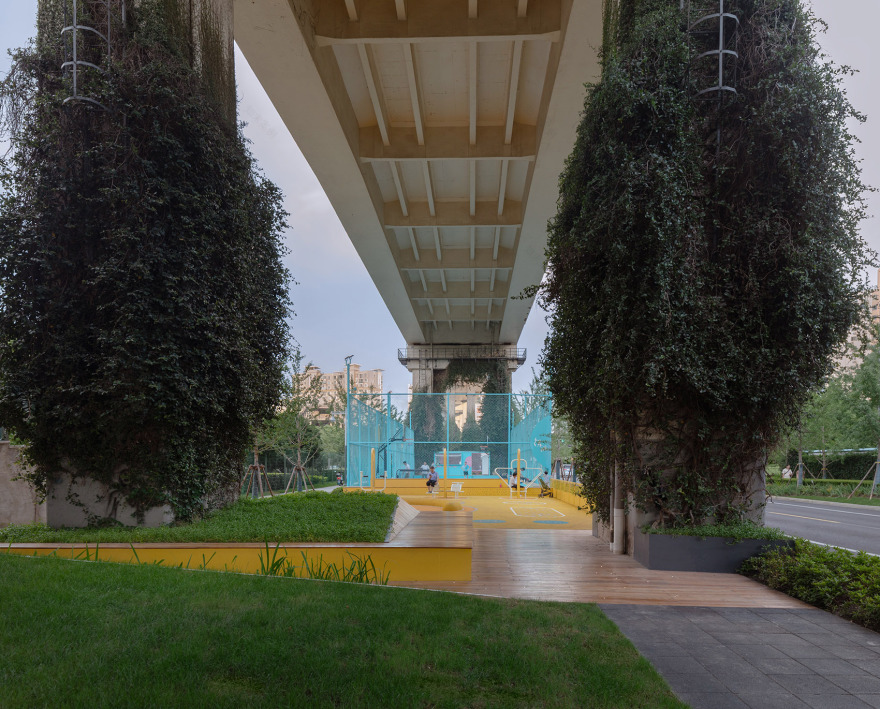
▼“活力热点”是轻轨高架桥下的明快色彩,Vibrant colors of the “Happy Spot” beneath the elevated light rail © 梁山
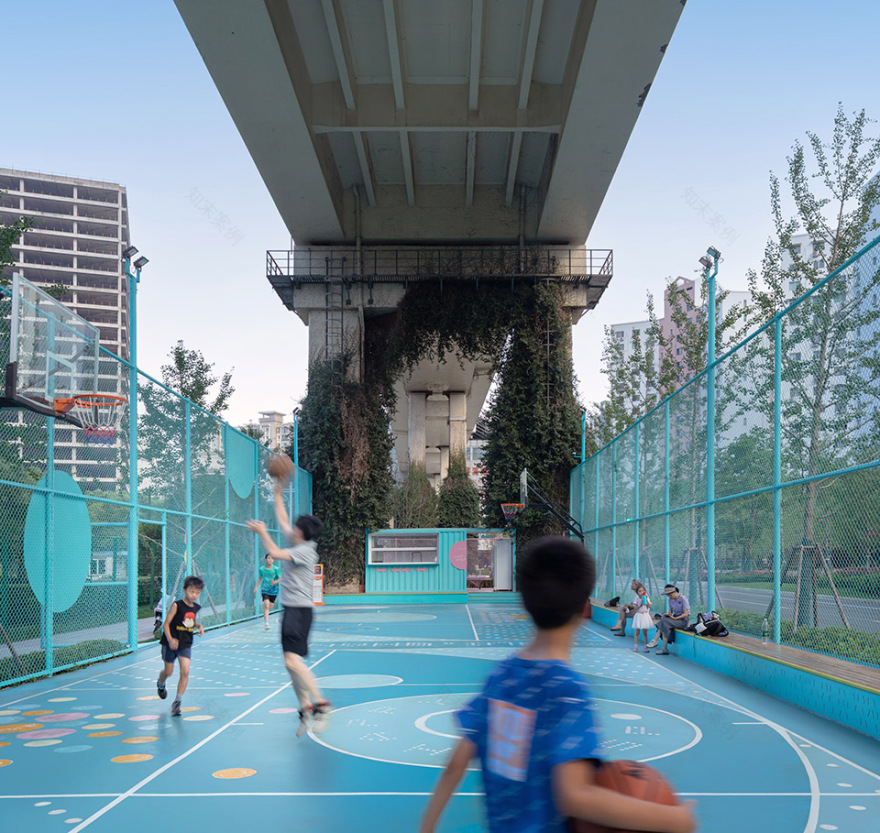
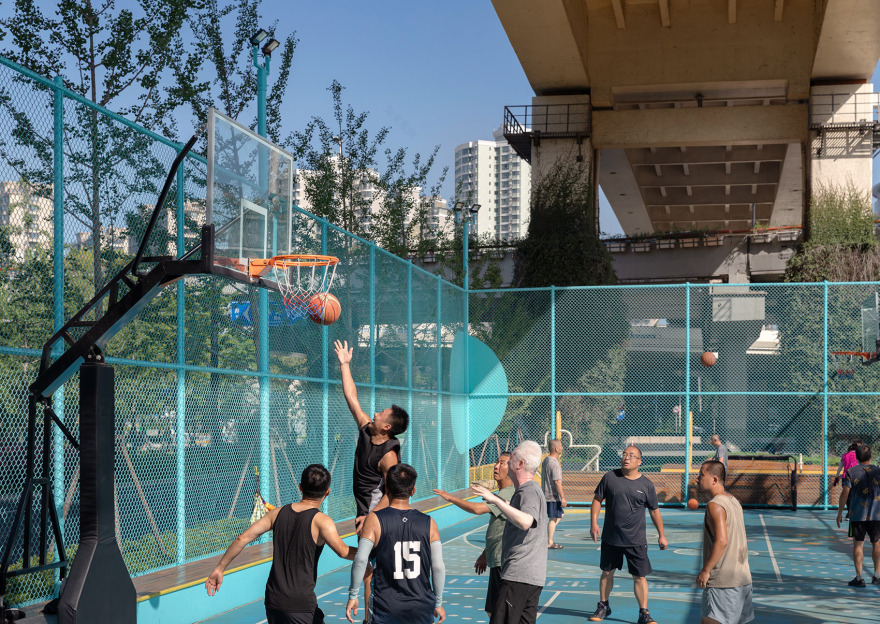
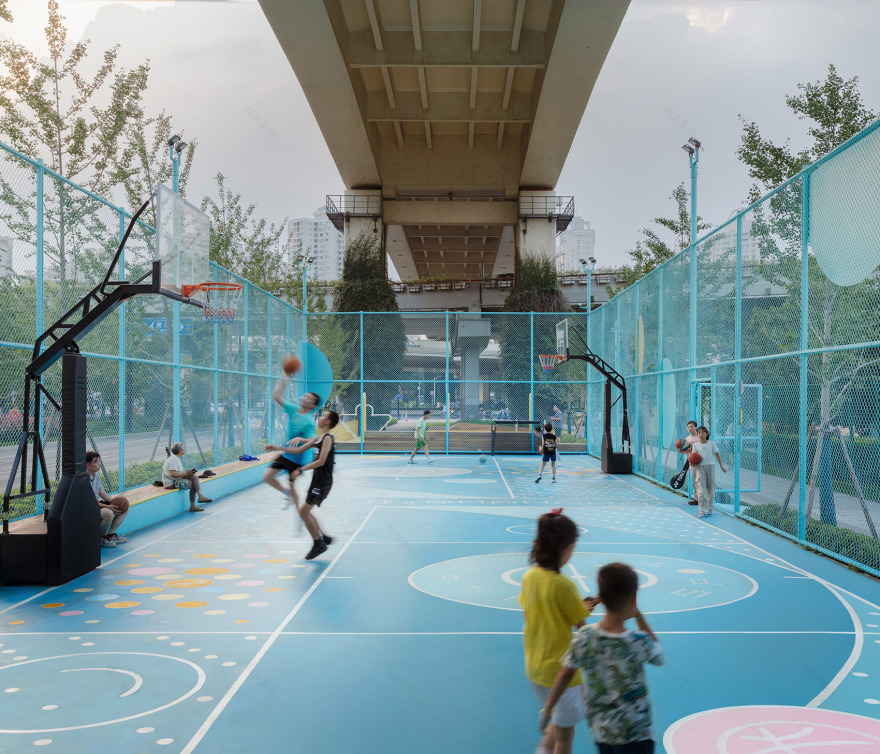
▼“活力热点”多功能运动场地内的篮球运动与市民休闲,Basketball activities and public leisure in the multi-functional sports field of the “Happy Spot” © 梁山
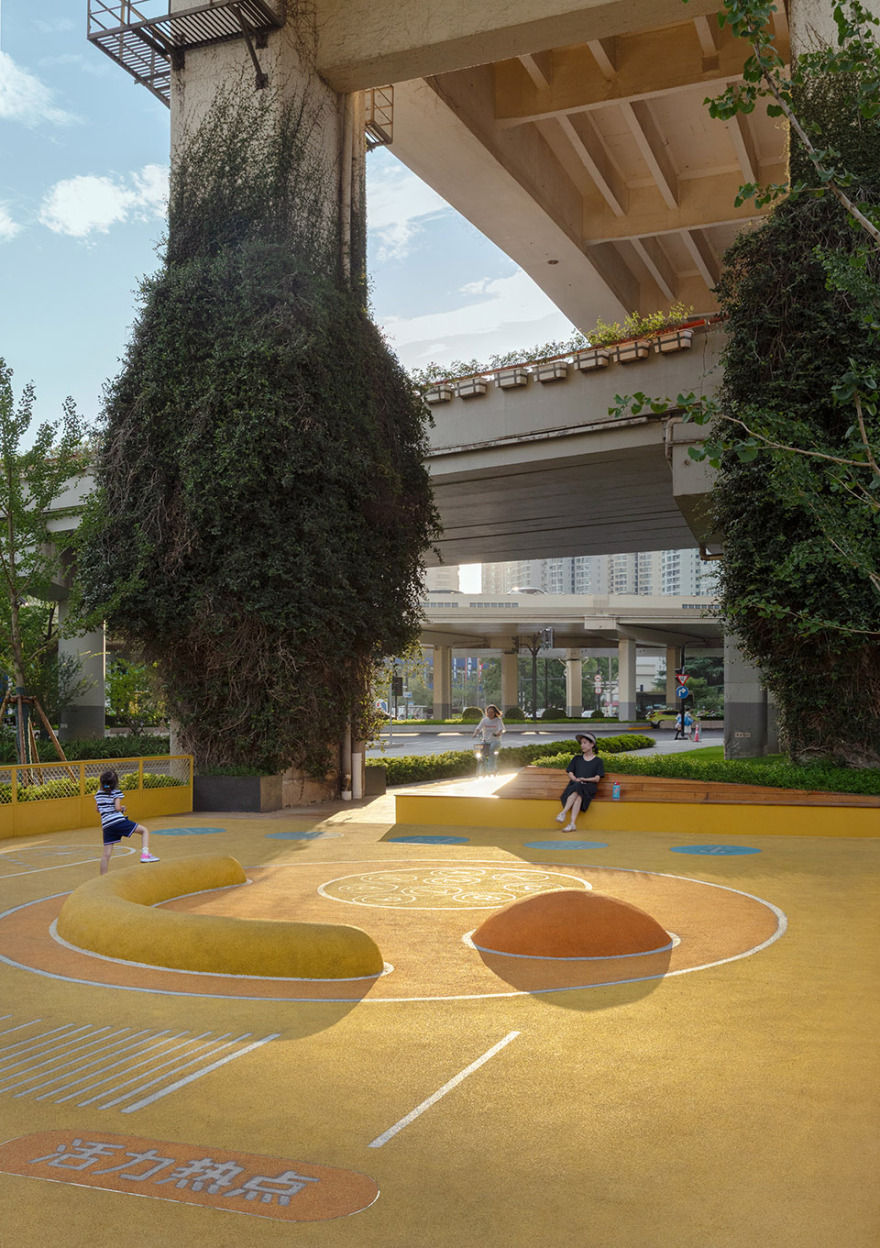
▼临近漕溪路的趣味休闲场地,Playful leisure space near Caoxi Road © 梁山
1. 空间变奏:城市缝隙中的色彩
Color Brings Vitality to the Space underthe Light Rails
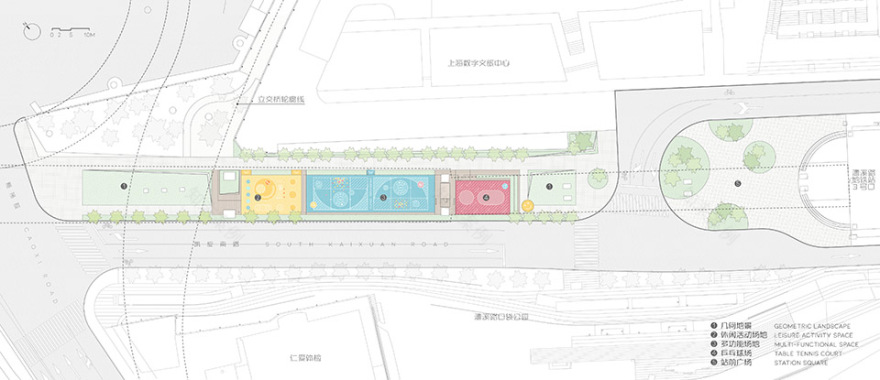
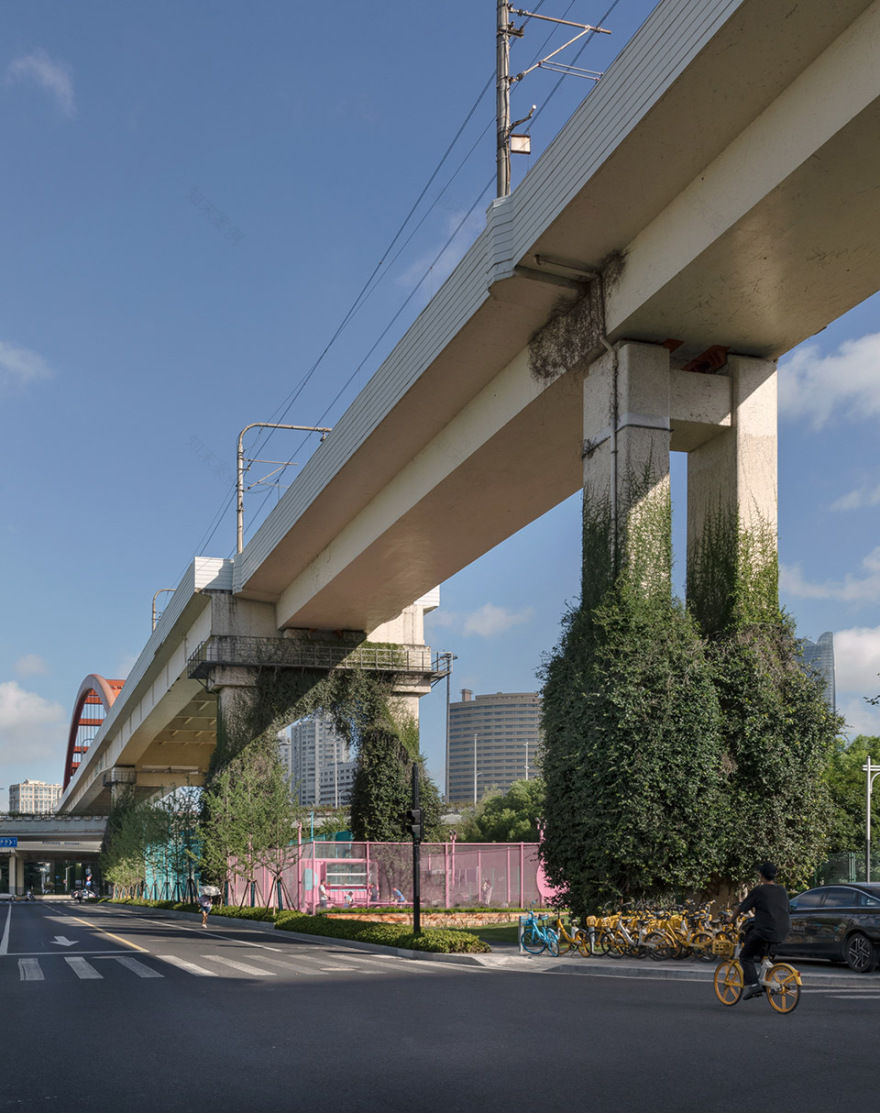
项目位于漕溪路、凯旋南路交叉口的凯旋南路上,东南侧紧邻上海地铁3号线漕溪路站。整个场地呈瘦长型(长200米、宽18~26米),完全位于3号线轻轨高架的正下方。项目西北端则在内环线高架、漕溪北路立交桥阴影下,现场感受较为压抑。改造前场地中传统的桥荫绿化更强化了这种城市缝隙中阴郁的感受,这不仅与徐家汇地区漕溪路沿线整体明快现代的城市风貌完全不匹配,也对本项目沿线日常通勤体验产生了负面影响。
▼总平面图,Master plan © VIA维亚景观
▼改造前现状,Site condition before renovation © VIA维亚景观
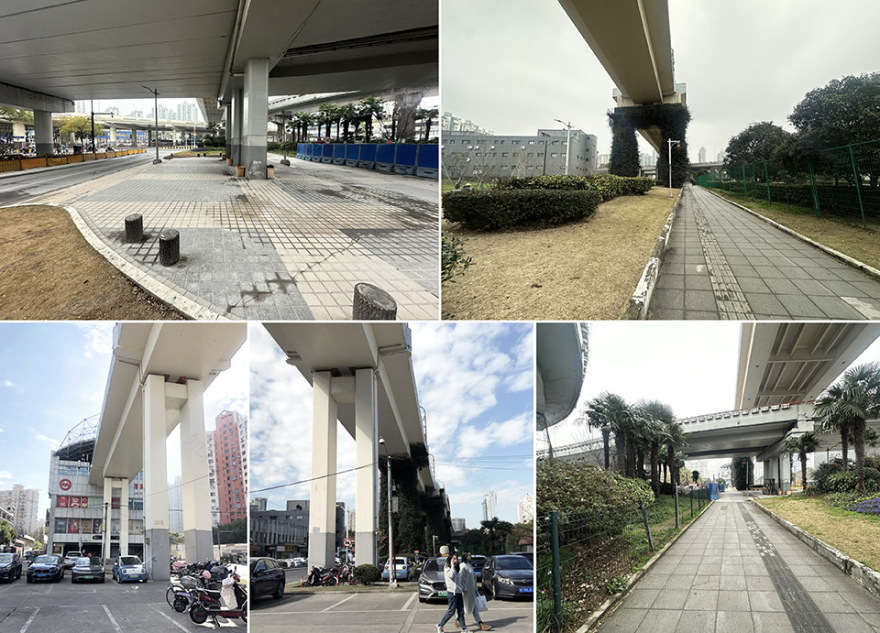
The project is situated on SouthKaixuan Road, at its intersection with Caoxi Road, with thesoutheastern side closely adjacent to Caoxi Road Station ofShanghai Metro Line 3. The entire site exhibits a slender, elongated form (200 m long and 18–26 m wide) and lies directly beneath the elevated viaduct of MetroLine 3. The northwestern end of the project is overshadowed by the Inner Ring Elevated Road and NorthCaoxi Road overpass, resulting in a notably oppressive on-site atmosphere. Before the renewal, the conventional bridge green screening within the site further accentuated this gloomy, interstitial urban condition. This appearance notonly stands in stark contrast to the overall bright, modern urban character along Caoxi Road in the Xujiahui area, but also negatively impacts the daily commuting experience along the project’s interfaces.
▼“活力热点”是繁忙城市缝隙中的空间变奏,The “Happy Spot” as a spatial variation within the busy urban gap © 孙轶家
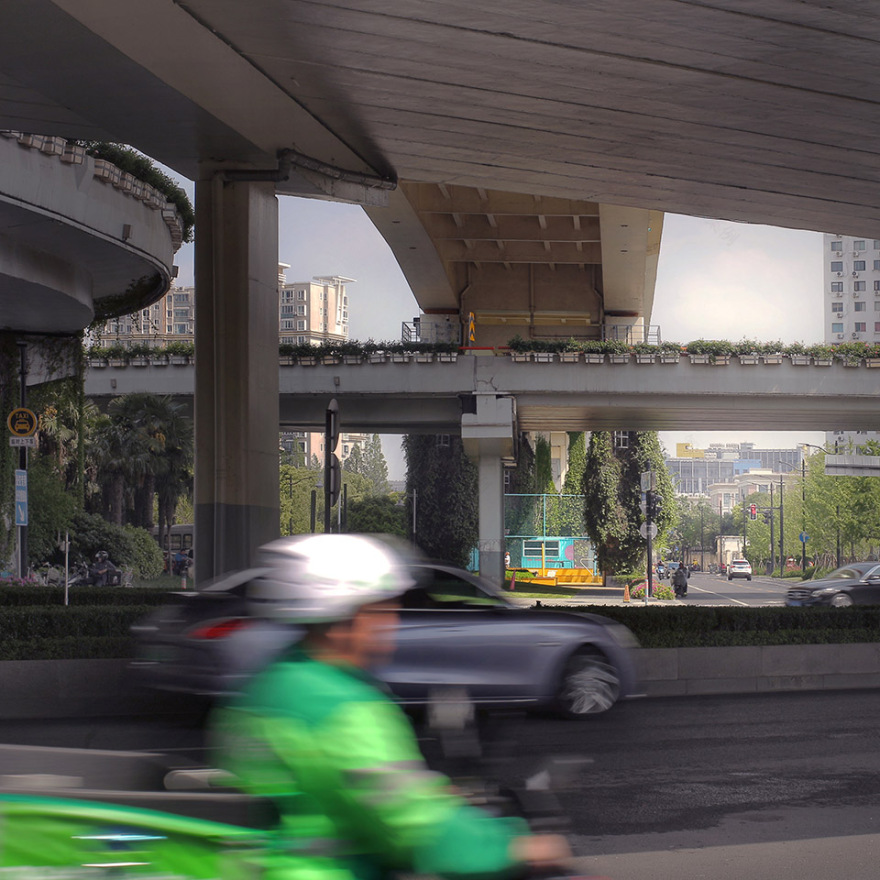
▼不同属性场地使用者的行为对话,Behavioral interactions among users of different spaces © 梁山
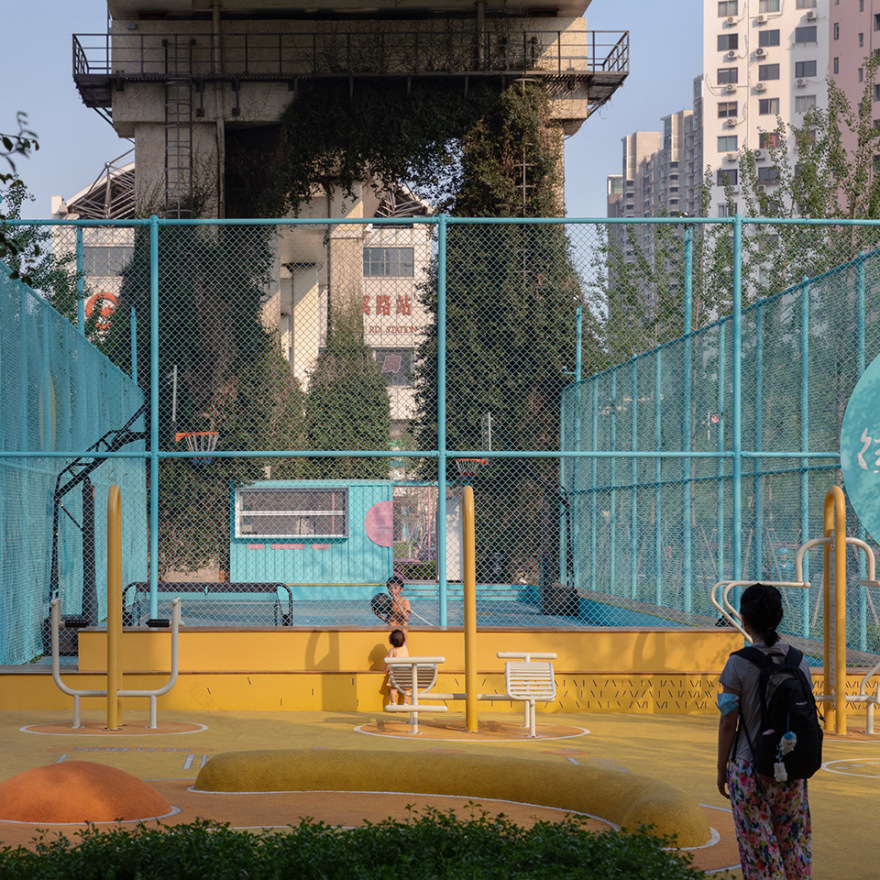
▼“活力热点”运动场地的彩色围网,Colorful fencing of the sports field in the “Happy Spot” © 梁山
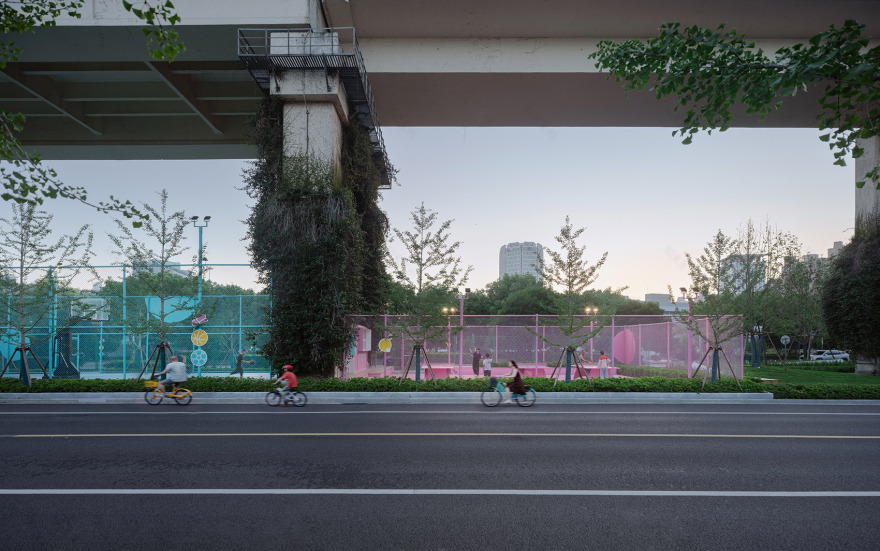
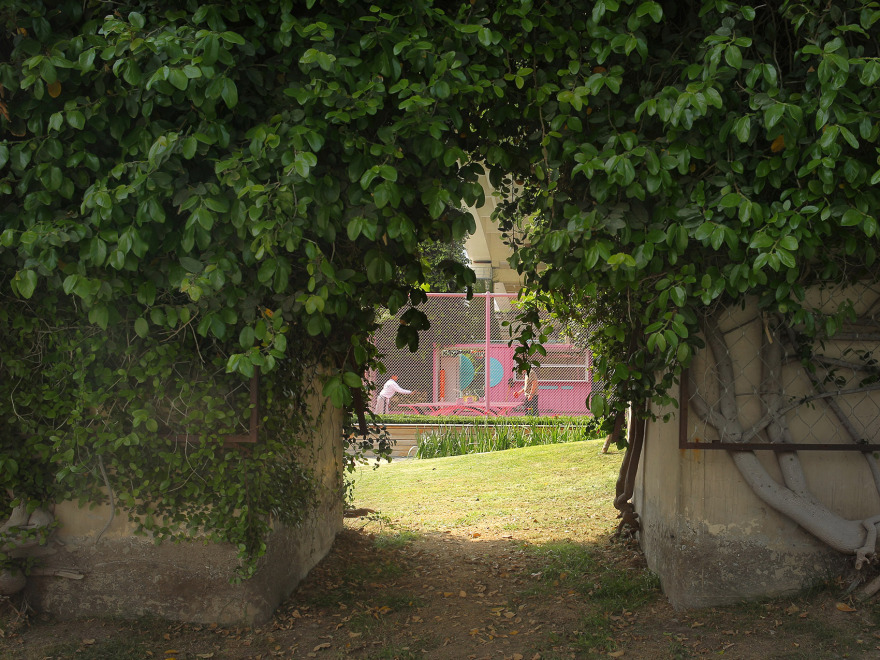
考虑到传统绿化、景观优化调整,对于桥下空间更新的效果并不理想,我们产生了以鲜明的色彩激活桥下空间的更新动机:以被多重桥下空间(轻轨高架桥下空间、内环线高架桥下空间、内环线下匝道桥下空间等)笼罩的城市缝隙中的一抹亮色,为繁忙的街头创造一种属于都市生活的空间变奏。
▼设计生成,Design generation diagram © VIA维亚景观
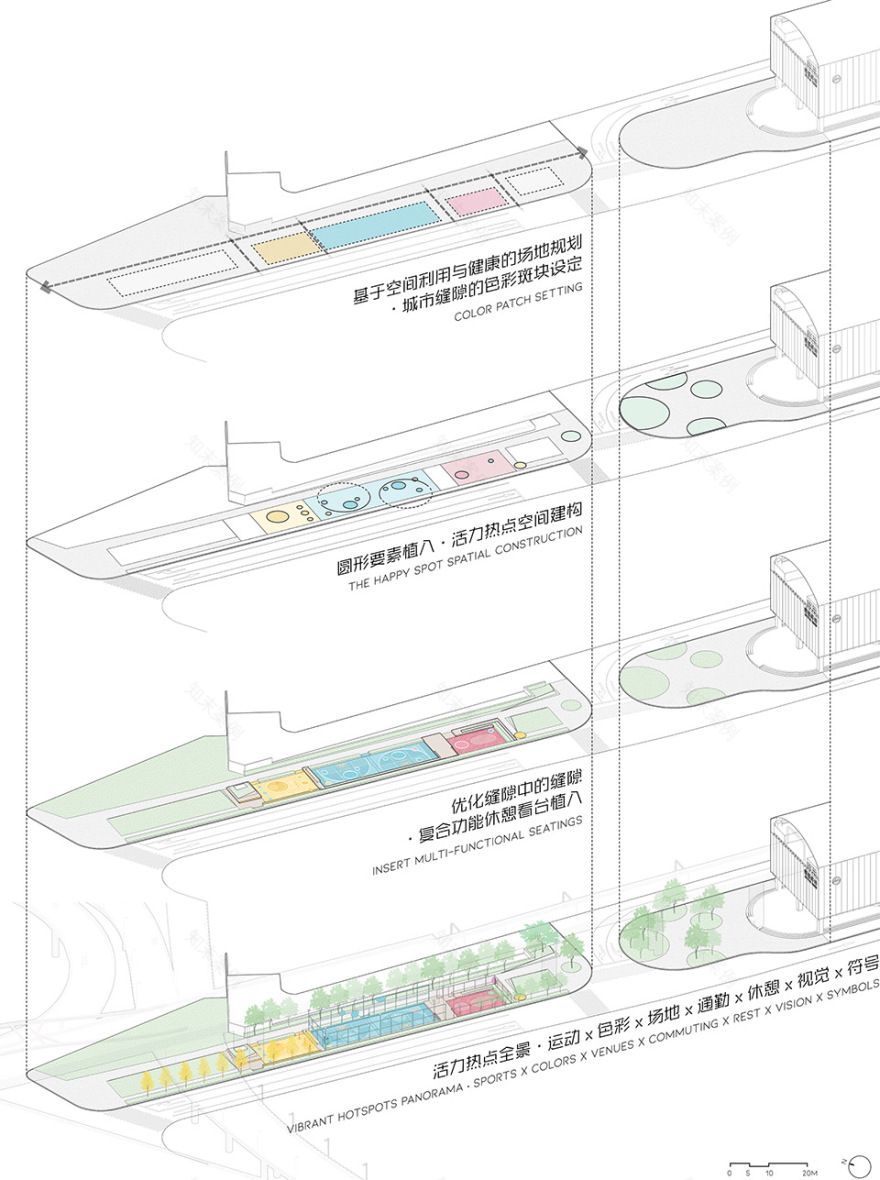
Given that conventional greening and landscape optimization proved unsatisfactory, we sought to revitalize this space through vibrant chromatic interventions. The intent is to introduce a bright accent within the urban interstices overshadowed by multiple undercroft spaces (including those beneath the light rail viaduct, the Inner Ring Elevated Road, and its descending ramp), thereby creating spatial variation of urban life amid the busy streets.
▼从凯旋南路南侧看向“活力热点”,View towards the “Happy Spot” from the south side of Kaixuan South Road © 梁山
▼城市缝隙中的趣味活动,Playful activities within the urban gap © 孙轶家
2. 活力热点:体育公园背面的社会需求
the Happy Spot near Xujiahui Sports Park
为明确场地更新的功能定位,我们进行了面向属地街道、周边社区居民的需求征询。结果令人大吃一惊,主要功能需求指向运动健身空间。要知道著名的徐家汇体育公园与项目场地直线距离不过300米,因此需求征询的结果在当时的我们看多少有点反常识的。但经过更深入的调研,我们找到了这些需求的合理性依据。首先,徐家汇体育公园并未完全的无界向城市界面开放(但设了多个出入口方便使用者进出),其中最近的12号口至本项目场地步行距离约为700米、步行时间约需10分钟,这对于项目场地周边的金谷园等小区居民而言并不算很近。其次,前往徐家汇体育公园必须穿越双向10车道的中山南二路(内环高架路下方城市主干路),这显然不会为步行或骑行前往者提供什么好的过程体验。第三,徐家汇体育公园内设置的多为经营性收费场地或室内运动项目,若本项目能为周边居民提供免费(或近似免费)、无需预约的小型多功能健身运动场地,这应该可以成为一种良性的补充,也可为原本阴郁的桥下空间植入全新的空间活力。
▼休闲娱乐场地详细设计图,Detailed design of the leisure and entertainment area © VIA维亚景观
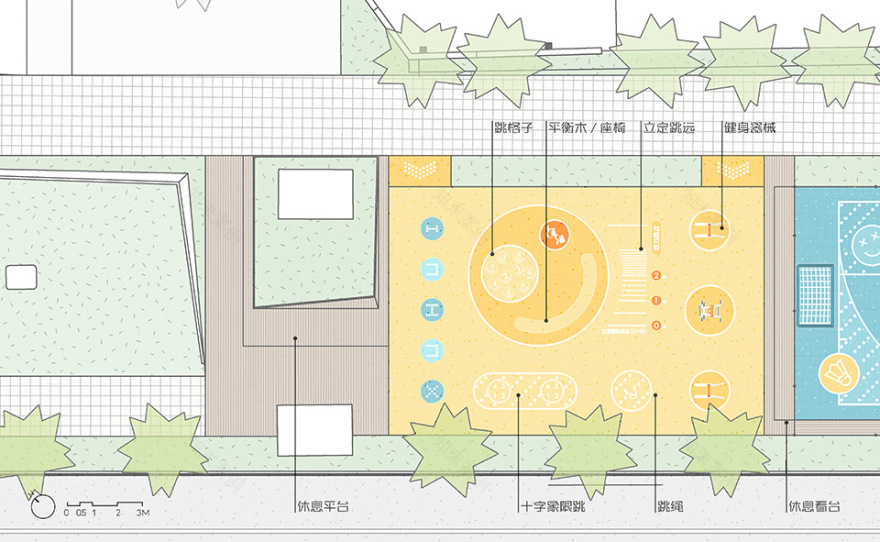
To determine the functional positioning of the site renewal, we conducted a need assessment targeting at the local community residents. The results were rather striking: the primary functional demand was for sports and fitness space. This result appeared to be counterintuitive at the time, given that the renowned Xujiahui Sports Park lies no more than 300 m straight from the project site. However, through more in-depth investigation, we identified the rational basis for these demands. First, Xujiahui Sports Park is not entirely open in an unbounded manner, although it provides multiple entrances for convenient access, the walking distance from the nearest Entrance No. 12 to the project site is approximately 700 m, requiring about a ten minutes’ walk, which is quite a distance for residents of neighboring communities such as Jinguyuan Community. Second, to reach Xujiahui Sports Park one has to cross South Zhongshan Second Road (a major urban thoroughfare beneath the Inner Ring Elevated Road), which has ten lanes of bidirectional traffic and offers a hardly pleasant walking experience for those traveling on foot or by bicycle. Third, most facilities within Xujiahui Sports Park are fee-charging or for indoor sports. Should this project provide local residents with small-scale, multi-functional fitness spaces that are free (or nearly free) which require no reservation, it would serve as a positive complement while simultaneously infusing new spatial vitality into the previously gloomy bridge undercroft space.
▼“活力热点”中的跨年龄段篮球运动,Cross-generational basketball activities in the “Happy Spot” © 梁山
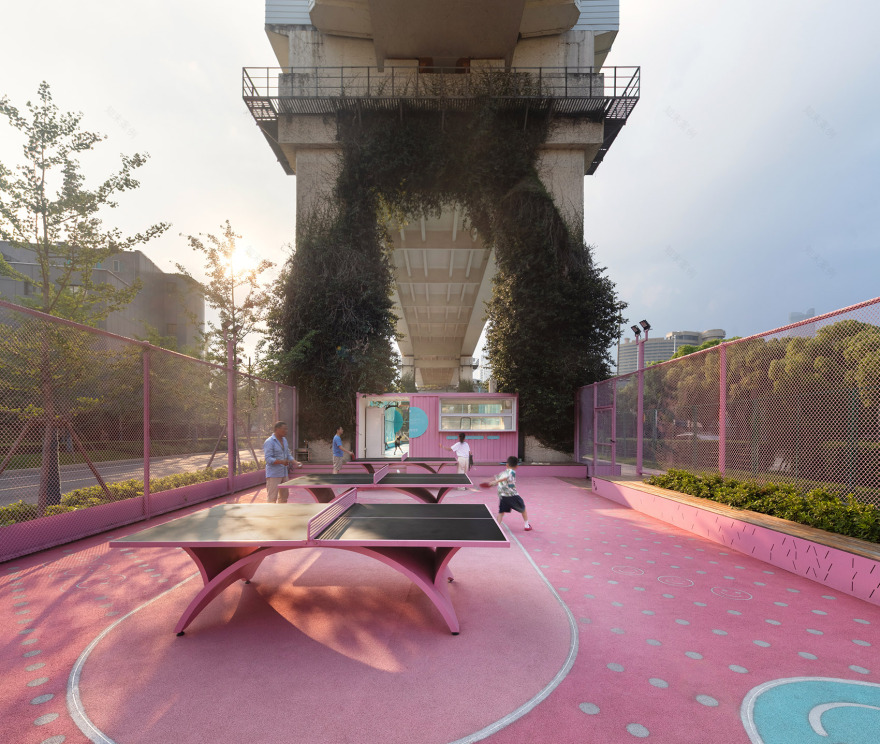
▼“活力热点”中的乒乓球场地与活动,Table tennis courts and activities in the “Happy Spot” © 梁山
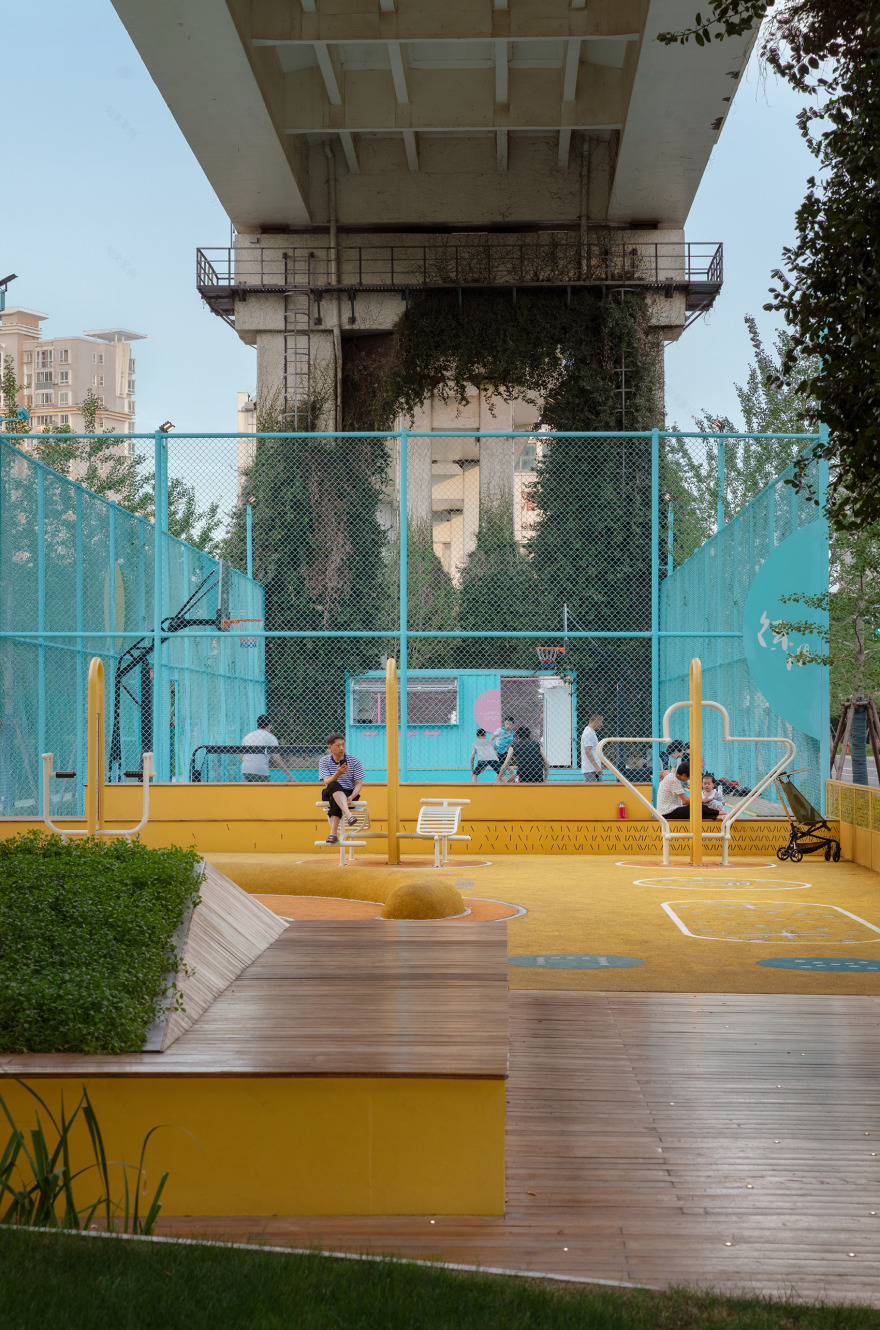
▼日落后的趣味休闲区,Leisure area after sunset © 梁山
经过进一步的需求征询与分析,我们最终选择了更便于周边居民随机发生的运动与活动类型植入项目场地,分别是:篮球、羽毛球、5人制足球、乒乓球、小型健身设施场地、趣味活动场地。▼多功能运动场地详细设计图,Detailed design of the multi-functional sports field © VIA维亚景观
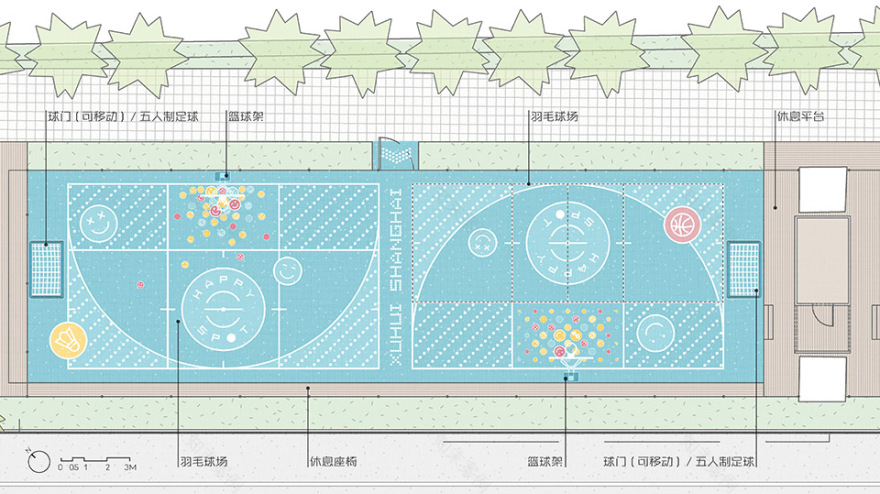
Through further needs assessment and analysis, we ultimately selected a set of activities for spontaneous use by surrounding residents. These include basketball, badminton, five-a-side football, table tennis, small-scale fitness equipment areas, and playzone.
▼夜间的乒乓球活动,Night-time table tennis activities © 梁山
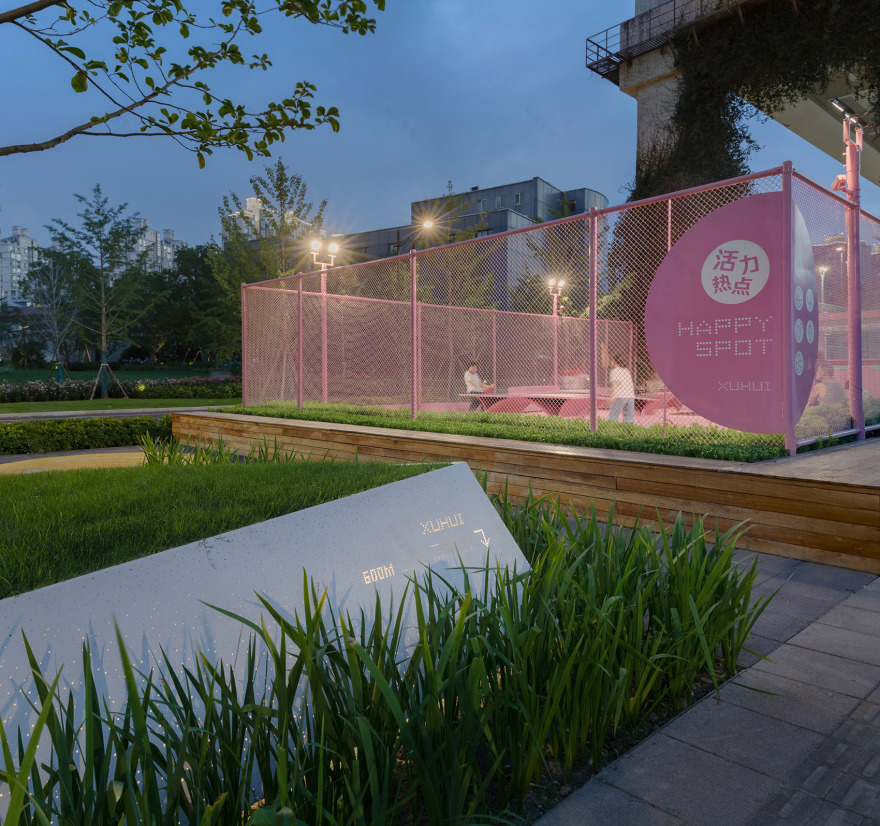
▼从漕溪路口袋公园看向“活力热点”,View towards the “Happy Spot” from Caoxi Road pocket park © 孙轶家
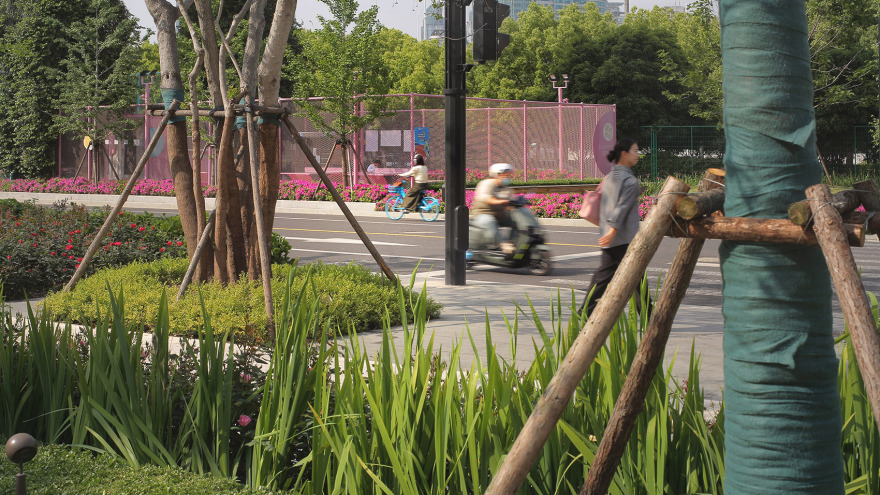
3. 空间格局:凯旋南路桥下空间更新的场地布局逻辑
Design the Happy SpotBased on the Concern for Health and Spatial Logic
尽管需求使然,我们依旧对在高架桥下建造运动健身空间、鼓励市民进行运动,是否会令使用者因为上方交通设施、机动车交通行为产生的粉尘、尾气、噪音而遭受健康危害而心存担忧。因此,在开展具体的设计之前,我们主动与地铁管理部门沟通,得到了没有明确证据证明轻轨运行时产生的电磁会对下方短时使用人群产生健康危害的答复。同时也了解到仅在车辆进出站时,轻轨轨道表面会存在因为电磁作用而产生的瞬时灰尘吸附,对下方人群影响极小。因此,本次更新设计的“健康格局”只需要尽可能将需要大运动量活动尽量远离存在明确污染源2的西侧内环高架路及其下匝道的下方区域即可基本达成。
▼乒乓球场地详细设计图,
Detailed design of the table tennis area © VIA维亚景观
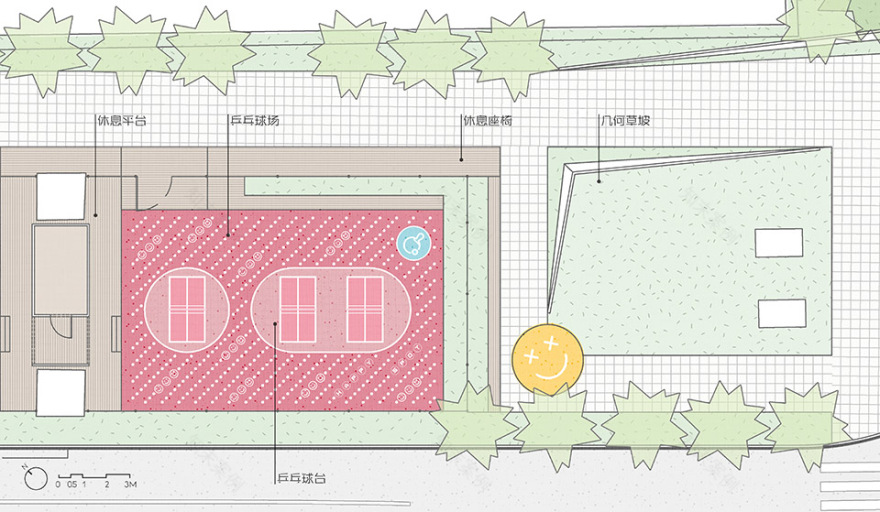
Despite the demand, we remained concerned about the feasibility of creating sports/fitness spaces and encouraging the use of the space beneath the elevated viaduct. This might expose users to health hazards resulting from dust, exhaust emissions, and noise generated by the overhead transit infrastructure and vehicular traffic. Accordingly, before initiating the detailed design, we proactively consulted the metro administration. The result shows no clear evidence of electromagnetic fields produced during light rail operation, which pose health risks to short - term users beneath the viaduct. We also learned that only during train arrivals and departures do the rail exhibit transient dust adsorption due to electromagnetic effects, whose impact on the space below is rather minimal. Consequently, the “health theme” of this renewal design could be substantially achieved simply by locating high - intensity physical activities as far as possible from the western side of the site, which lies directly beneath the Inner Ring Elevated Road and its descending ramp—areas where a clear pollution source2exists.
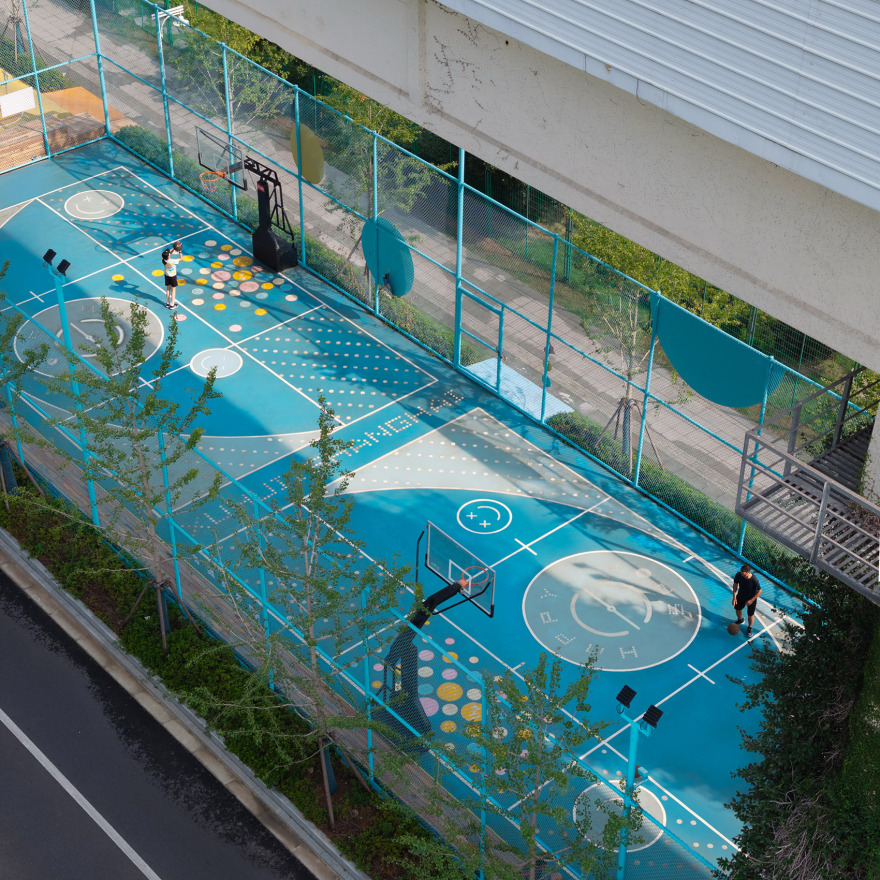
▼湖蓝色多功能运动区鸟瞰,Aerial view of the lake-blue multi-functional sports area © 梁山
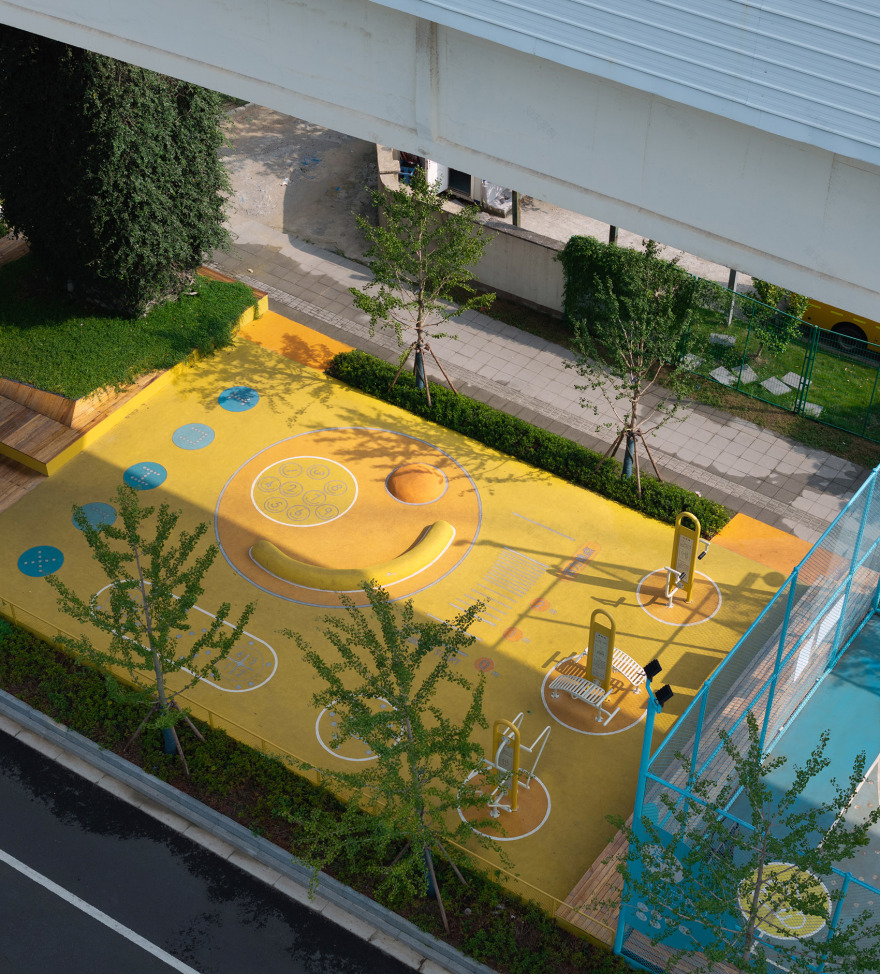
▼明黄色趣味休闲区鸟瞰,Aerial view of the bright yellow leisure area © 梁山
▼明黄色低围网是趣味休闲区的行为安全保障,Low yellow fencing ensuring safety in the leisure area © 梁山
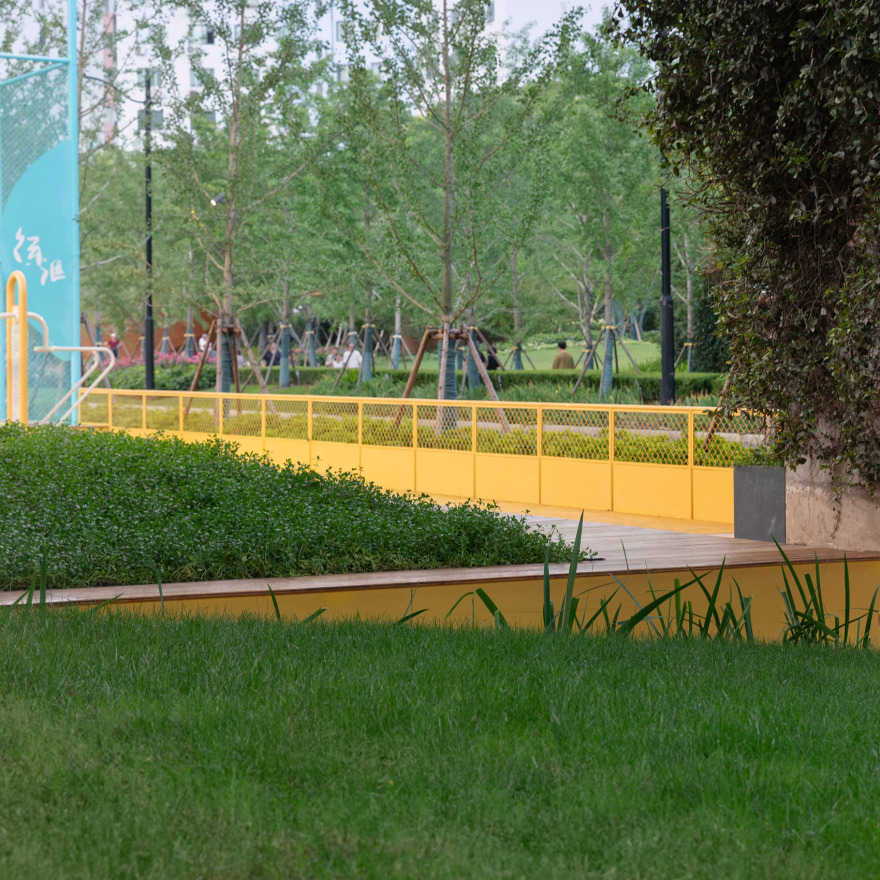
同时,通过对不同运动类型对于安全围网高低的需求、场地多功能复合利用可能的分析,将前述多个健身运动空间进行空间组合,得到了3个类型空间,分别是:将儿童趣味活动与健身设施结合于一处的“低围网区”;将篮球、羽毛球、5人制足球等运动融于整体多功能活动场地的“高围网区”;以乒乓球运动为主的“中围网区”。在随类赋彩的将3种明快色彩赋予这3个类型空间的基础上,恰当优化运动健身场地两侧的休闲停留空间与绿化景观、重构地铁3号线漕溪路站前广场景观后,凯旋南路桥下空间更新的“色彩格局”与总体“景观格局”就轻松的形成了。
Concurrently, through an analysis of the varying height requirements for safe netting for different sports and the potential of multi-functional use of the site, we spatially categorized the abovementioned fitness zones into three typological areas: a “low-barrier-netting zone,” where children’s play areas are integrated with fitness equipment; a “high-barrier-netting zone,” accommodating basketball, badminton, and five-a-side football within a unified multi-functional activity field; and a “mid-barrier-netting zone,” dedicated primarily to table tennis. Upon assigning three distinct bright colors to these typological zones in accordance with their functions, appropriately optimizing the resting/ waiting spaces flanked by the fitness area, as well as reconfiguring the forecourt landscape of Caoxi Road Station on Metro Line 3 were conducted. The “chromatic configuration” and the overarching “landscape layout” of the South Kaixuan Road Bridge Undercroft renewal were naturally established.
▼从“活力热点”望向漕溪路口袋公园,View from the “Happy Spot” towards Caoxi Road pocket park © 梁山
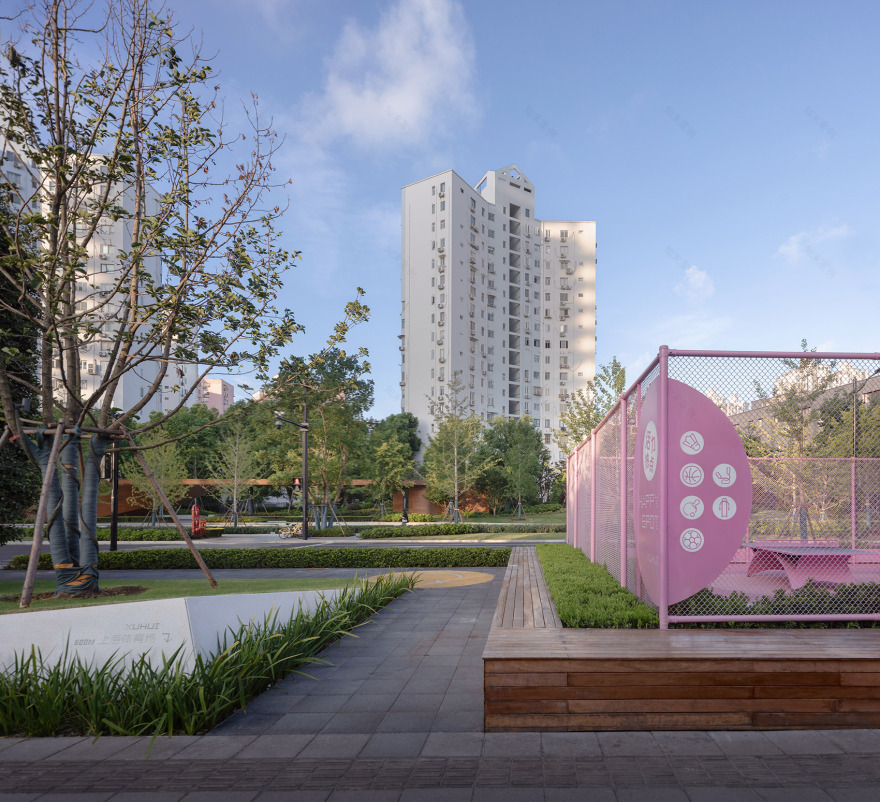
▼从漕溪路口袋公园看向“活力热点”,View towards the “Happy Spot” from Caoxi Road pocket park © 梁山
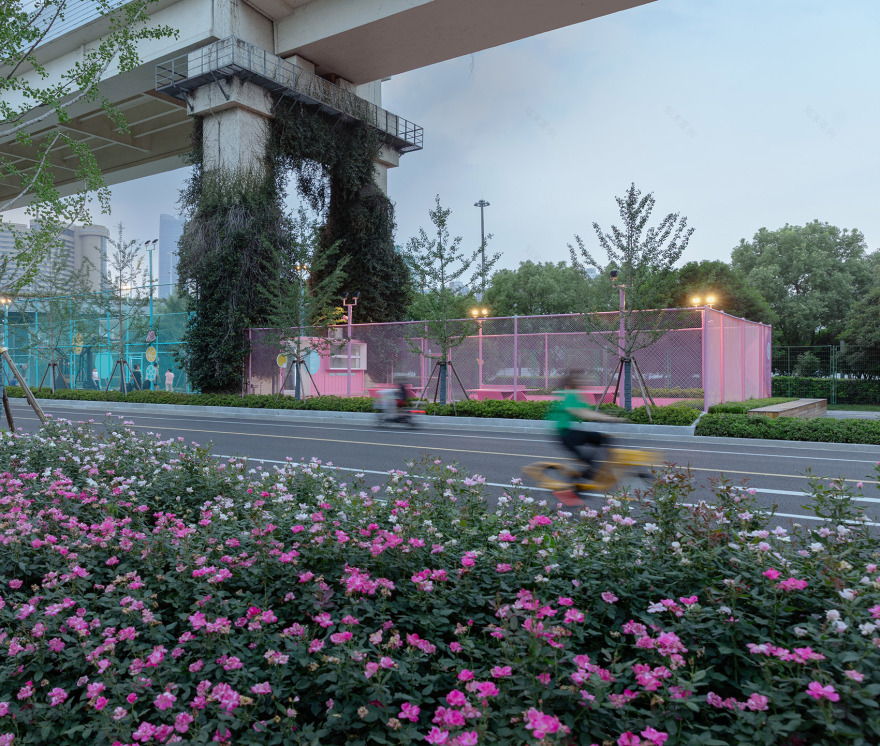
▼结合“活力热点”一并改造的地铁三号线漕溪路站3号口站前广场,Renovated forecourt of Exit 3, Caoxi Road Station on Metro Line 3, integrated with the “Happy Spot” © 梁山
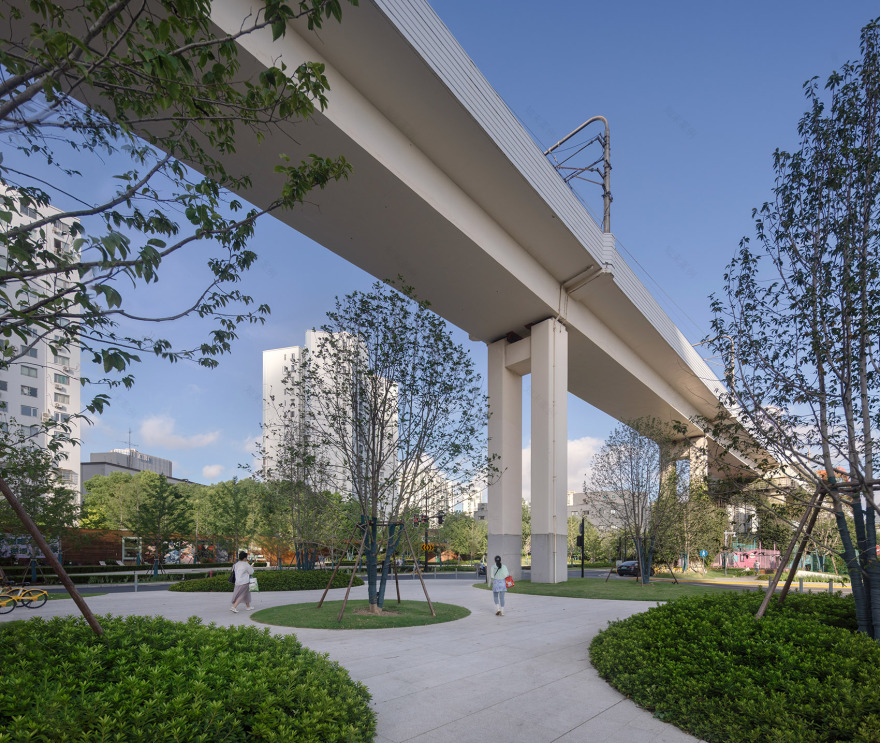
▼“活力热点”中多样活动同时呈现的趣味场景,Dynamic scenes of diverse activities in the “Happy Spot” © 梁山
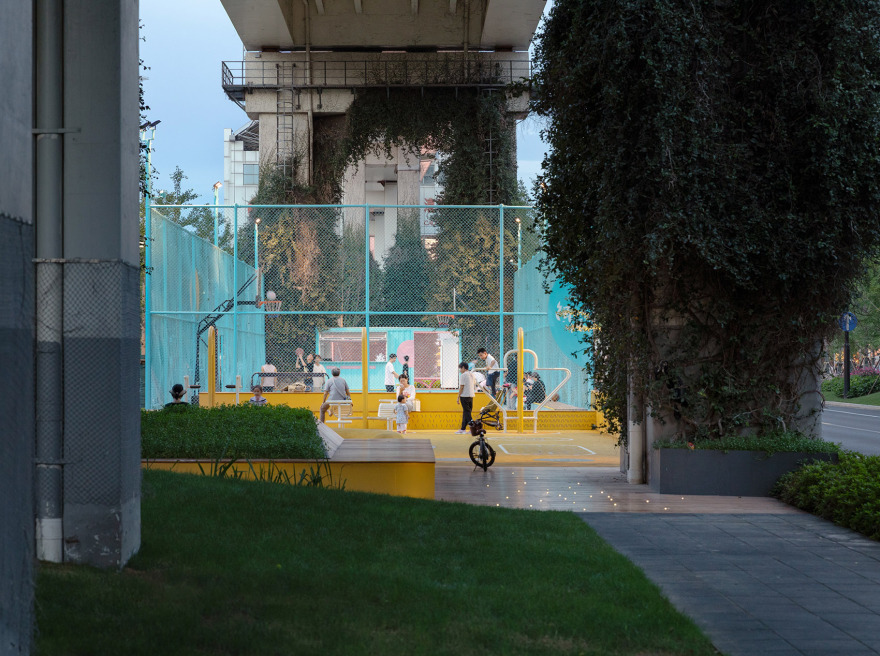
▼“活力热点”局部鸟瞰,Partial aerial view of the “Happy Spot” © 梁山
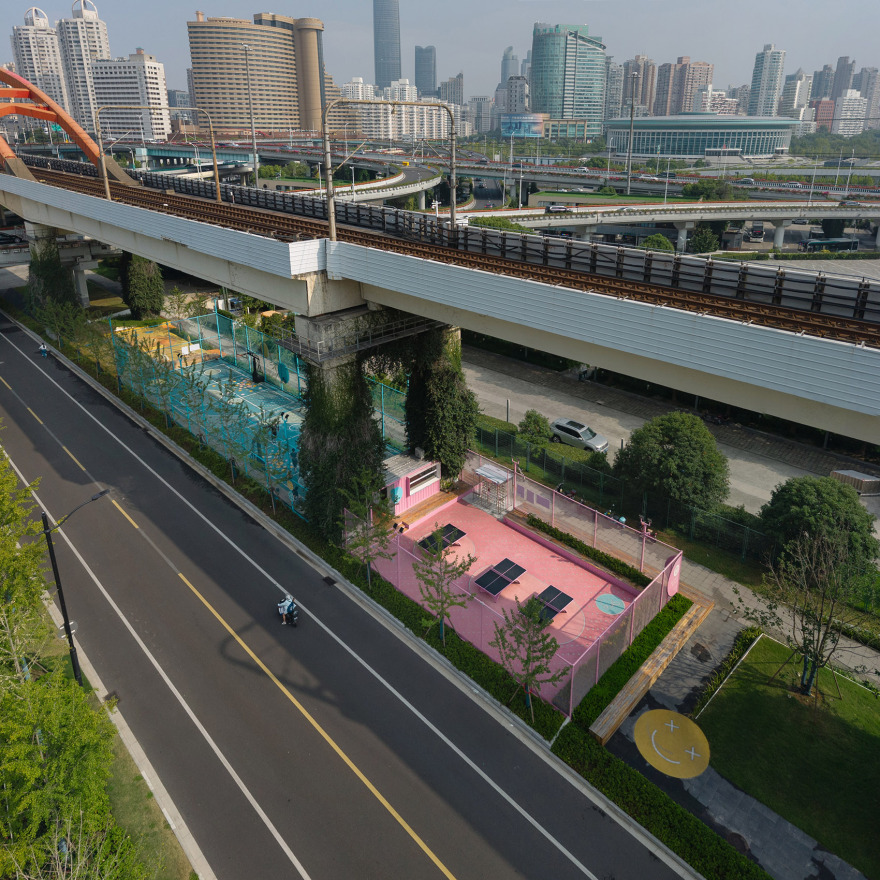
4. 环境表情:自然而然的快乐圆点
Environmental Expressions and Emojis of the Happy Spot
浅蓝色“高围网区”是整个项目中占地最大的场地,其中篮球场中的罚球区与三分线的圆形画线不仅是实际运动功能区域划分需要,也是最强烈的视觉识别图形。为求多个场地在视觉感知上的连续性与协调性,我们在“中围网区”的乒乓球桌放置位置空间限定、“低围网区”的健身设施放置位置限定与儿童趣味空间中延续使用了圆形以及与圆形相关的画线与地形设计,并以此作为本项目的视觉设计基础逻辑。此外,在个运动区内,我们继续以圆形相关画线为基础,进行该场地上的同色系色彩组合设计。让图形、色彩匹配功能的同时,使每一场地内的视觉体验丰富且具有趣味性,这是第二层次的视觉设计。其后,我们又进行了更小尺度的基于圆形的设计,这里包含了地面与围网上的场地功能标识,以及用于情绪表达的表情符号。在第三个层次的视觉设计中,我们则采用了跨功能区的撞色设计,以增强运动中快乐气氛的渲染与传达。最后,城市缝隙中的活力热点,如果可以在忙碌的高密度高强度城市生活中,为使用者提供哪怕只是短暂的健康活动、情绪释放与来自于多巴胺的快乐,在我们看来也是值得被书写的社会价值与公义。
Occupying the largest footprint of the entire project is the light-blue area designated for high-barrier-netting sports. Within this space, the circular markings of the free throw area and 3-pts line on the basketball court work not only as a necessary court lining of playing zones but also as the project’s most striking visual motif. To ensure visual continuity and coherence across various courts, we extended the uses of circular and circle-derived markings, along with corresponding topographic designs to the table tennis area in the mid-barrier-netting area, as well as fitness area and kids play area in the low-barrier-netting zone. In doing so, these circular forms became the foundational logic of the project’s visual identity. Within each sports area, we further applied circle-based markings as the basis for a monochromatic color scheme tailored to this specific court. Our design aligns graphic form and chromatic expression with functions, while rendering a rich and playful visual experience of each court, which constitutes the second tier of visual design. We further continued to rely on circular geometries for a smaller scale design. This time for functional signage on the ground / perimeter netting, as well as motion-conveying Emoji graphic. In the third tier, we adopted a strategy of color contrast across functional zones, aiming to heighten the atmosphere of joy and to amplify its communication during sports activities. Ultimately, if a vibrant hotspot within the urban interstice can offer healthy activities, emotional release, and the dopamine-driven pleasure even only fleetingly amidst the pressures of high-density, high-intensity urban life, we would regard such a result as a social value and public good worthy of documentation.
▼地面的图像与视觉设计是鼓励运动的环境表情,Ground graphics and visual design encouraging physical activity © 梁山
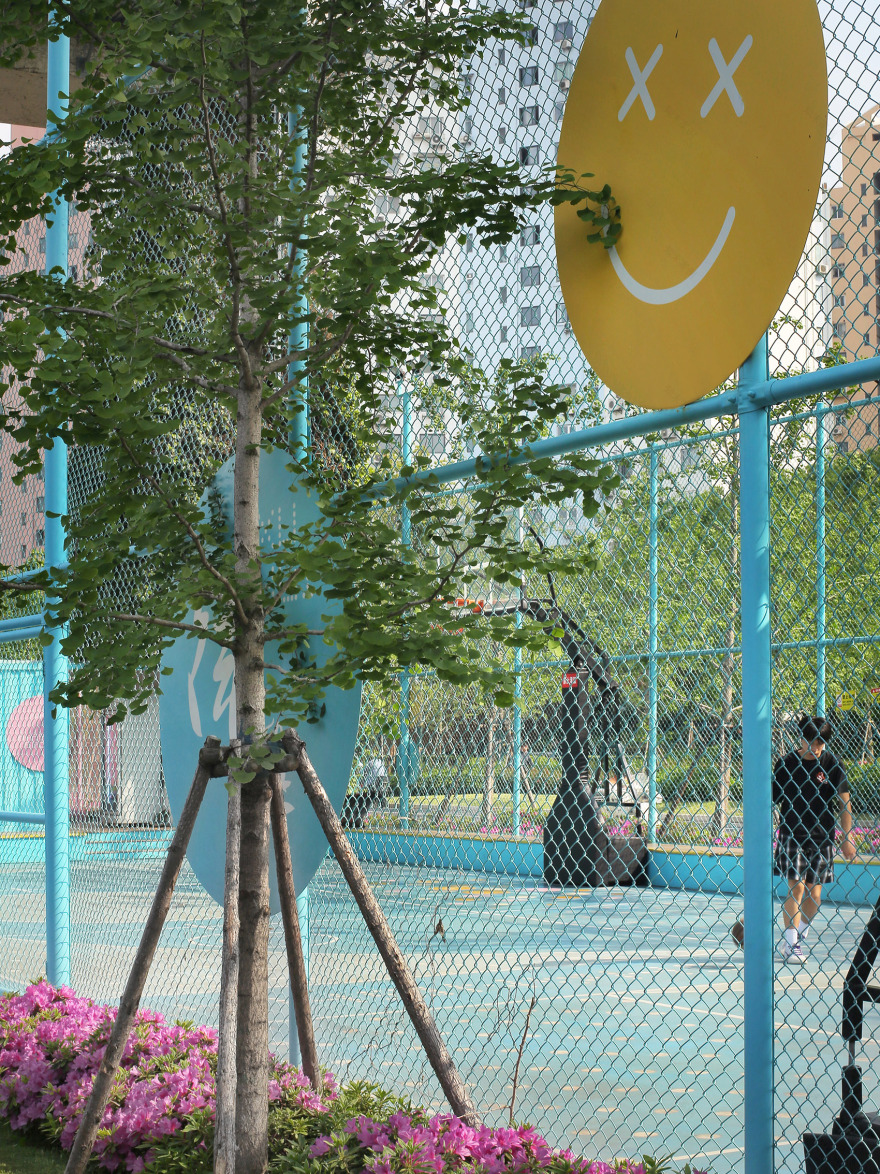
▼运动场地围栏上的表情符号,Emoticons on the sports field fencing © 孙轶家
注释:
[1] 参见VIA维亚景观以“漕溪路口袋公园”为题发表于各专业媒体的文章。
[2]根据公开信息,至2025年4月上海全市注册机动车总量不少于620万辆,而同期新能源汽车注册量约为180万辆,由此可以推算新能源车(含混动、增程、纯电等类型)占机动车保有总量的比例约为30%左右。根据这一结果,自带尾气排放的燃油车在上海依旧是机动车主流。而内环高架路及相关下匝道,由于交通拥堵时间较多,在其低速、怠速行驶过程中产生的尾气排放,对高架桥下方较长时间停留运动人群势必是存在健康风险的。
Notes:
[1] Details to be found in VIASCAPE design’s article “Caoxi Road Pocket Park” published on multiple professional media platforms.
[2] According to public information, by April 2025, the total number of registered motor vehicles in Shanghai will not be less than 6.2 million, while the registration of new energy vehicles during the same period is about 1.8 million. Therefore, it can be estimated that the proportion of new energy vehicles (including hybrid, extended range, pure electric, etc.) to the total number of motor vehicles is about 30%. According to this result, gasoline vehicles with built-in exhaust emissions are still the mainstream of motor vehicles in Shanghai. The inner ring elevated road and related off ramps, due to prolonged traffic congestion, generate exhaust emissions during low-speed and idle driving, which inevitably pose health risks to people who stay and exercise under the elevated bridge for a long time.
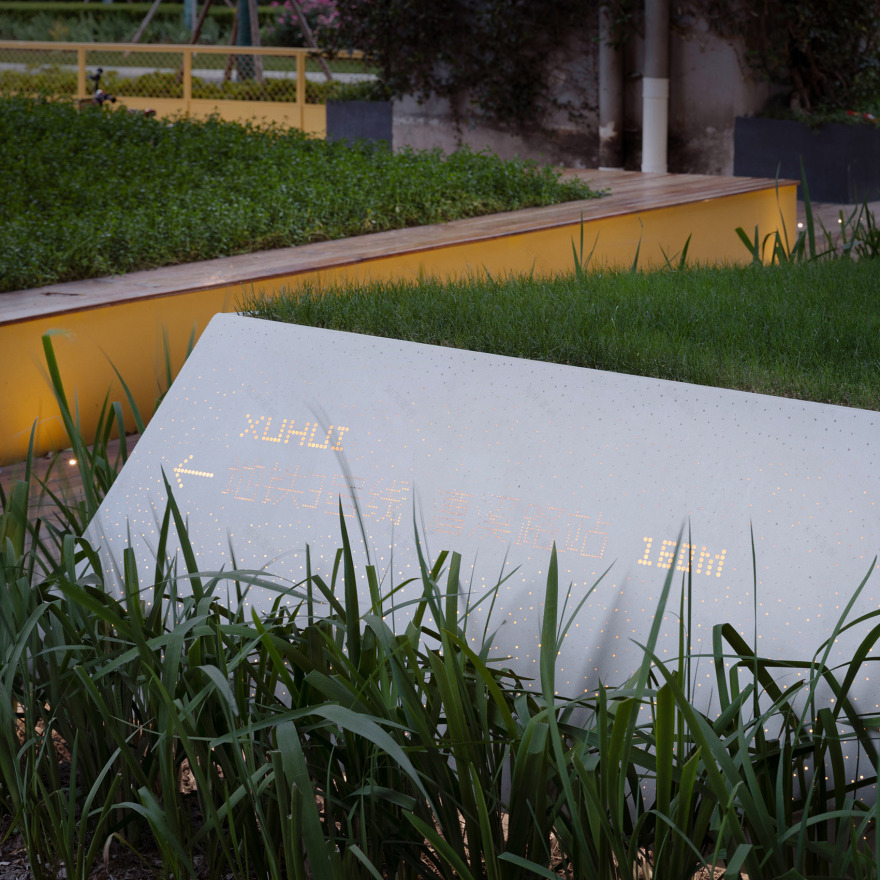
▼融入地区导视功能的透光混凝土绿化挡墙,Translucent concrete green wall integrating wayfinding functions © 梁山
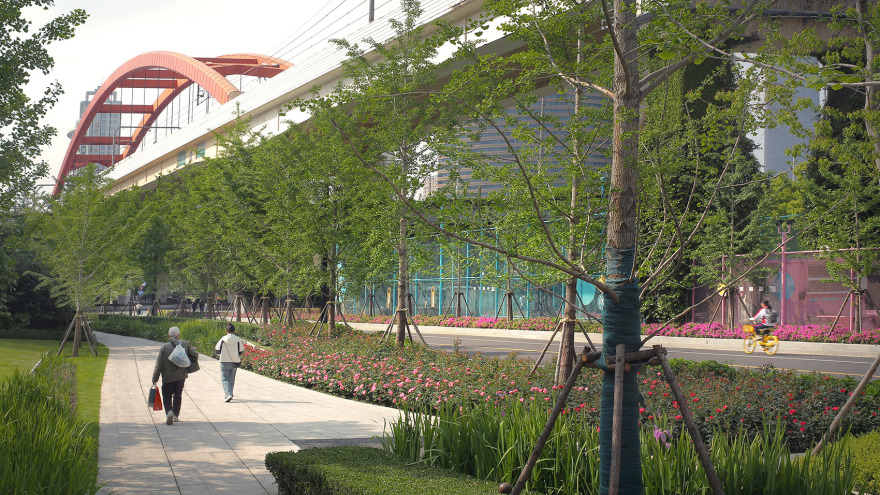
▼“活力热点”与早前建成的漕溪路口袋公园一起提升了地区景观,The “Happy Spot” and the previously built Caoxi Road pocket park jointly enhance the local landscape © 孙轶家
主要项目信息
项目名称:凯旋南路桥下空间-活力热点
设计单位:VIA维亚景观
主持设计师:孙轶家
设计团队:马丽、计雨薇、周密、孙轶家
设计时间:2023年12月
建成时间:2025年2月
景观面积:3540㎡
项目地址:上海市徐汇区凯旋南路
项目造价:人民币160万元
业主单位:上海市徐汇区绿化管理中心
指导单位:上海市徐汇区绿化和市容管理局、上海市徐汇区漕河泾街道办事处
施工单位:上海徐汇园林发展有限公司
施工图管理协作:上海园林绿化建设有限公司
标识字体授权:锐字潮牌字库
摄影师:梁山、孙轶家
撰文:孙轶家、顾沁祎
Project Information
Project: the Happy Spot under Light Rail
Design Firm: VIASCAPE design
Lead Designer: SUN Yijia
Design Team: MA Li, Ji Yuwei, ZHOU Mi, SUN Yijia
Design Time: Dec. 2023
Built Time: Feb. 2025
Design Area: 3540 SQM
Location: South Kaixuan Rd., Xuhui District, Shanghai
Cost: CNY 1,600,000.00
Client: Xuhui District Greening Administration
Supervisor: Xuhui District Greening and City Appearance Administration Bureau, Caohejing Sub-district Office, Xuhui District, Shanghai
Contractor: Shanghai Xuhui Landscape Development Co., Ltd
LDI: Shanghai Greening-Landscaping Construction Co., Ltd
Fonts for VI: REEJI types
Photographer: LIANG Shan, SUN Yijia
Article Author: SUN Yijia, GU Qinyi
南京喵熊网络科技有限公司 苏ICP备18050492号-4知末 © 2018—2020 . All photos and trademark graphics are copyrighted by their owners.增值电信业务经营许可证(ICP)苏B2-20201444 苏公网安备 32011302321234号
苏公网安备 32011302321234号客服
消息
收藏
下载
最近