

创作上传
VIP
收藏下载
登录 | 注册有礼
查看完整案例

收藏

下载

分享

翻译
Seven Canyons sits in Sedona, United States, where The Ranch Mine shapes a house around slope, views, and a tightly constrained site. Completed in 2024, the residence uses an H-shaped plan to split private and guest spaces while opening daily life to two courtyards. Its strongest move is not spectacle but control: a careful arrangement of stone, stucco, glass, and overhangs that keeps the desert close at hand.






About Seven Canyons
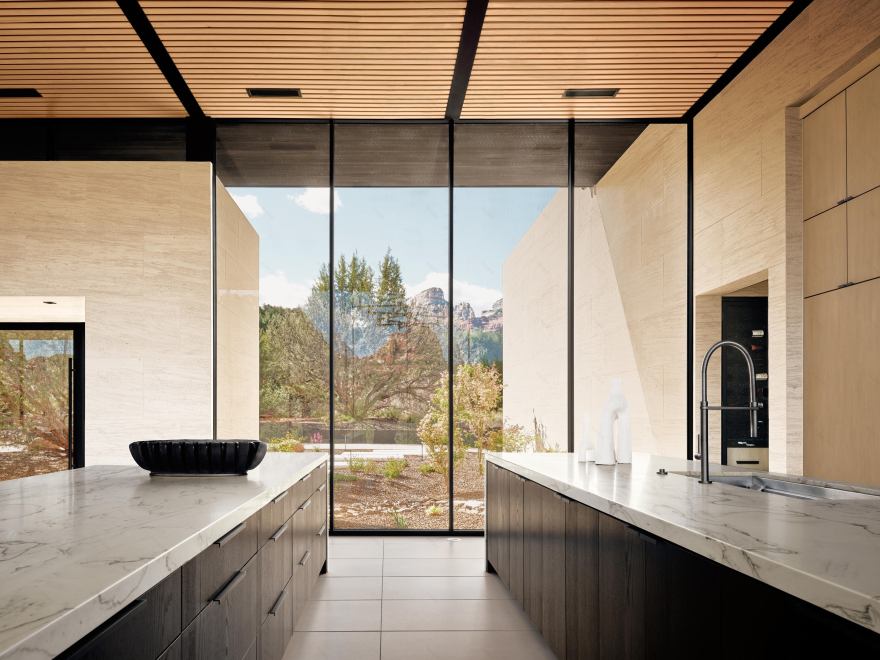
Seven Canyons takes its shape from a demanding site and a precise brief. Designed by Arizona-based firm The Ranch Mine, the house sits within Sedona’s Seven Canyons community on a 1.2-acre property with wide red rock views. Rather than treating those conditions as a backdrop, the project turns them into the basis of the plan, the massing, and the material palette.
The constraints are concrete. A tight building envelope, strict HOA height limits, mature junipers that must remain undisturbed, and Wildland Urban Interface fire codes all narrow the range of possible moves. The design answers with restraint, using the natural slope to lift the rear of the house and avoid fencing. That decision preserves the sweep of the landscape while also creating a protected outdoor area for the owners’ dog.
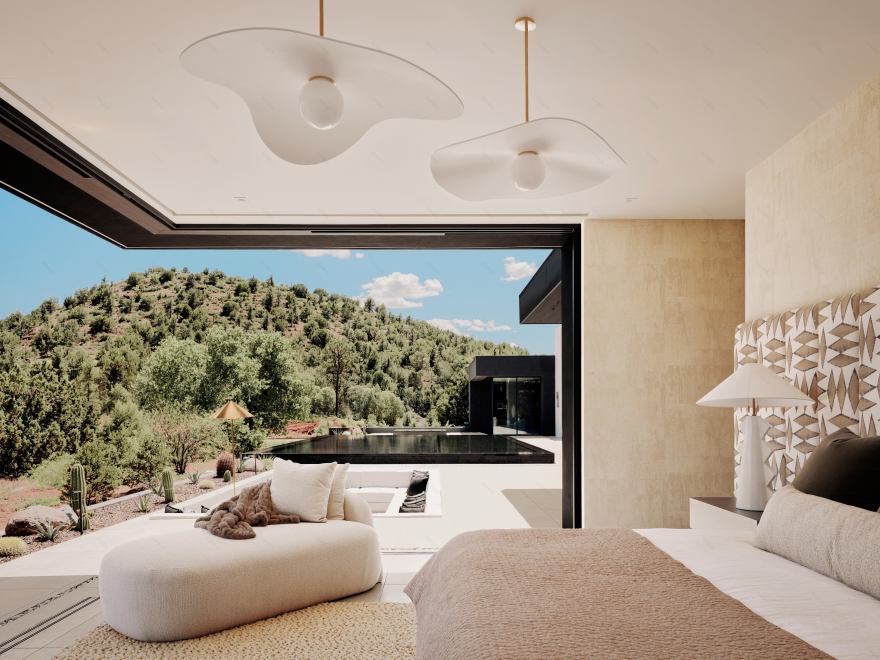
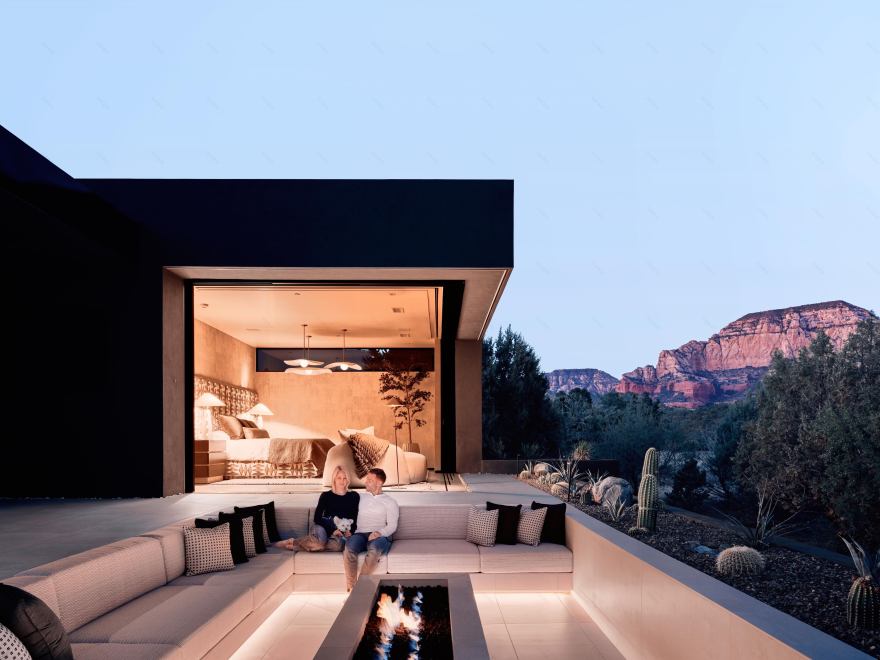
At the center of the house, an H-shaped plan gives the project both clarity and flexibility. Daily life gathers in the great room, while two flanking wings separate the primary suite and garage from the guest rooms and office. The arrangement is straightforward, but it produces a strong sequence of outdoor spaces. One courtyard opens toward the sunset and mesa beyond. The other receives morning light as it reaches the red rocks. The plan does more than divide functions; it sets up a daily rhythm tied to time, weather, and direction.
That relationship grows stronger through the glass. Full-height openings pocket away, reducing the boundary between interior and exterior and allowing the house to work as a frame for air, light, and distance. The effect is not simply openness for its own sake. It gives the central living spaces a direct exchange with the two courtyards and lets the changing conditions of Sedona register across the rooms throughout the day.
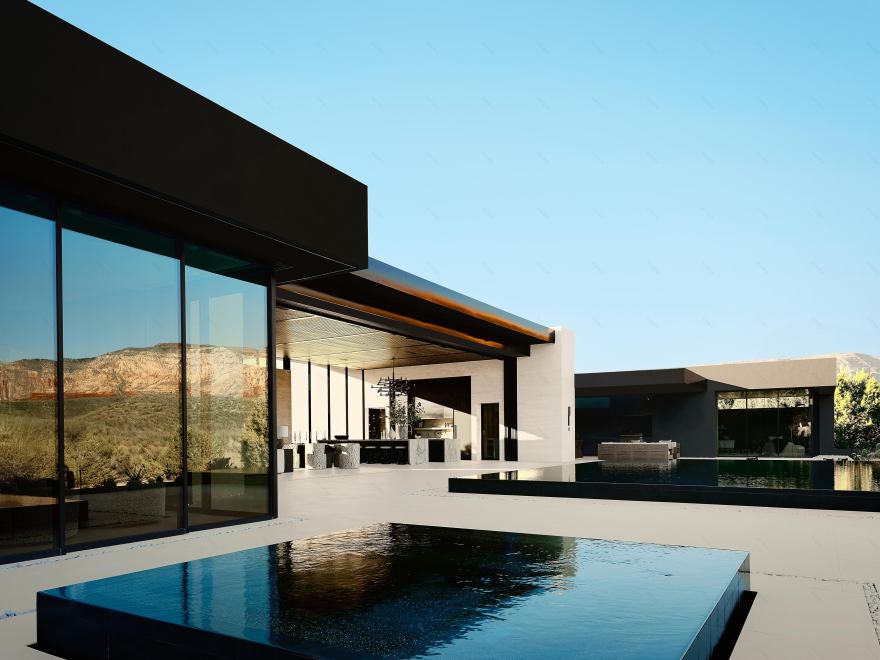
Materials carry the same discipline. Dark integrally colored stucco helps the building recede into the terrain, while limestone walls refer to the area’s uplifted geologic formations. The stone also changes with the light, shifting in tone across the day. Metal fascia and the pool pick up colors already present in the sky and surrounding rock, tying the architecture more closely to its setting without forcing contrast.
The interior palette stays neutral, leaving the reds and greens of the landscape to remain dominant. Fire-treated timber brings warmth under deep overhangs, and tile flooring continues from the interior to the pool deck, extending the sense of continuity. In the end, Seven Canyons is most convincing in the way it edits rather than adds. It uses plan, slope, and a spare set of materials to make the desert feel immediate and constant.
南京喵熊网络科技有限公司 苏ICP备18050492号-4知末 © 2018—2020 . All photos and trademark graphics are copyrighted by their owners.增值电信业务经营许可证(ICP)苏B2-20201444 苏公网安备 32011302321234号
苏公网安备 32011302321234号客服
消息
收藏
下载
最近