

创作上传
VIP
收藏下载
登录 | 注册有礼
查看完整案例

收藏

下载

分享
Waterloo Park | Michael Van Valkenburgh Associates, Inc.
项目陈述
PROJECT STATEMENT
滑铁卢公园是一项公私合作计划的首个实施阶段。该计划旨在对长期衰败的沃勒溪(Waller Creek)区域进行全面改造,将其打造为一条全长1.5英里的绿色廊道及串联式公园体系,连接奥斯汀东区与市中心。在改造之前,滑铁卢公园长期面临严重洪水风险,并在社区大型活动期间出现过度使用的问题。随后,该区域被确定为防洪分流隧道的入口位置——这一关键基础设施将下游28英亩土地从洪泛区中移除,显著提升了整体防洪能力。公园的更新建设成为未来绿道体系的先导项目。它不仅为整个公园系统确立了统一的设计语言,也通过将防洪基础设施、户外演出场地以及大规模本土生态景观有机整合,创造出一种在奥斯汀城市公园中极为少见的复合型公共空间体验。

▲滑铁卢公园的建成激活了奥斯汀市中心的公共活动,并推动了滑铁卢绿道——这一未来将沿沃勒溪延展的串联式公园体系的启动。Waterloo Park has helped to catalyze activity in downtown Austin, launching Waterloo Greenway, a future chain of parks along Waller Creek. © Photo by John Sutfin, Courtesy of Waterloo Greenway Conservancy
项目说明
PROJECT NARRATIVE
推动基础设施边界
市政府投资建设的地下防洪隧道,促使一个新成立的保护机构承担起引导沃勒溪转型的任务,使其成为支撑这一快速发展区域的结构骨架——该区域如今已从溪流洪泛区中解放出来。虽然防洪基础设施的施工曾对滑铁卢公园核心区域造成严重破坏,但公园的重新设计巧妙利用这一设施,通过策略性设置长度约400英尺的后张预应力梁,恢复了被占用的公园空间。
这一结构性介入使公园功能得以重新回归社区公共空间的核心,同时也为设计在无障碍通行、空间活动组织以及场所营造方面探索创新解决方案提供了更大的自由度。
融合具有催化作用的公共项目
项目场地位于州议会大厦穹顶视线廊道与场地洪泛高程之间,在这一特殊的空间条件下,设计将一座先进的演出场馆嵌入场地剖面之中。此类场馆往往面临运营和经济可持续性的挑战,并且容易在空间上压倒其所在环境。而在本项目中,“公园优先”的设计理念贯穿始终,以避免形成公园中的“死角空间”,并尽量减少其对日常公园体验的影响。
舞台上方的格构式顶棚作为公园入口的重要标识,而其余约2.5万平方英尺的设施空间则通过从街道标高逐级下沉的方式隐藏于地形之中,屋顶则被景观与露台覆盖,因此在公园大多数位置几乎不可见。对于这一规模的演出场馆而言,这种布局方式尚属首次,其后台屋顶同时也作为观众进入场馆的公共入口。
除了承接来自全国各地的演出活动外,场馆同样为社区提供服务。几乎同等数量的社区活动在此举办,例如瑜伽课程、舞蹈课堂、艺术装置展示,以及传统文化节庆在滑铁卢公园的回归,使公园重新成为社区生活的重要舞台。
在公园中塑造种植与功能的关系
在防洪隧道入口施工中幸存下来的原有橡树被保留下来,并从周边开发地块移植了多株大型橡树,与之共同形成围绕公园边缘的浓密橡树林框架。围绕作为演出场地核心的中央草坪,其余景观则被组织为一系列类似“涡流”的空间单元,引导游客从橡树林框架缓慢游走进入公园内部。
起伏显著的地形、多样化的路径与座椅类型,以及建立在防洪基础设施之上的独特观景点,共同营造出一组风格丰富、如同花园般的公共空间。当人们在公园中行走时,这些空间彼此展开、相互衔接:包括德州丘陵风格花园、由绿柄黄槐点缀的草地雨水花园、位于两株原生橡树之下的木平台、嵌入石质攀爬坡面的地面滑梯儿童游乐区、被沙漠柳环绕的小型广场,以及边缘生长着落羽杉的高位湿地露台。
来自防洪分流隧道的水流在场地东南角一处新建的渗泉中涌出,并沿着以钙结石块(caliche blocks)铺设的再造溪床流动,形成一处源头泉眼,标志着沃勒溪市中心河段及其未来步道系统的起点。
公园周围整齐统一的橡树树冠与地面层丰富的植物群落形成鲜明对比。公园共种植132种植物,其中95%为德克萨斯中部本土物种,既减少了灌溉需求,也为当地传粉昆虫提供了重要栖息环境。

▲400英尺长的后张预应力结构梁恢复了约半英亩公园用地,这些土地此前因建设沃勒溪防洪分流隧道而被占用。A 400-foot post-structured beam reclaims a half-acre of parkland that was lost a result of Waller Creek’s flood bypass tunnel. © Watershed Protection Department, Austin

▲为保护在周边施工中受到威胁的常绿栎,多株巨型树木被移植至公园原有树木形成的外围林带之中,其中包括图中这棵约四层楼高、重达33万磅的大树。Live oaks were threatened by nearby construction (like this 4-story, 330,000-pound tree) were transplanted into the park’s existing tree perimeter. © Courtesy of Waterloo Greenway

▲公园为社区创造了新的公共活动空间,并在复兴中的沃勒溪、德州州议会大厦以及新的文化演出场馆之间建立起重要联系。The park creates new spaces for the community and helps bridge between the revitalized creek, the State Capitol, and a new cultural venue. © Elizabeth Felicella

▲螺旋式的步道在坡度较大的场地中提供无障碍通行路径,同时保护了现有树木,并在公园内部组织出层次丰富的空间体验。A coiling promenade provides accessible routes within the steep site, preserves existing trees, and curates multilayered spaces within the park. © Photo by Brian Fitzsimmons, Courtesy of Waterloo Greenway Conservancy
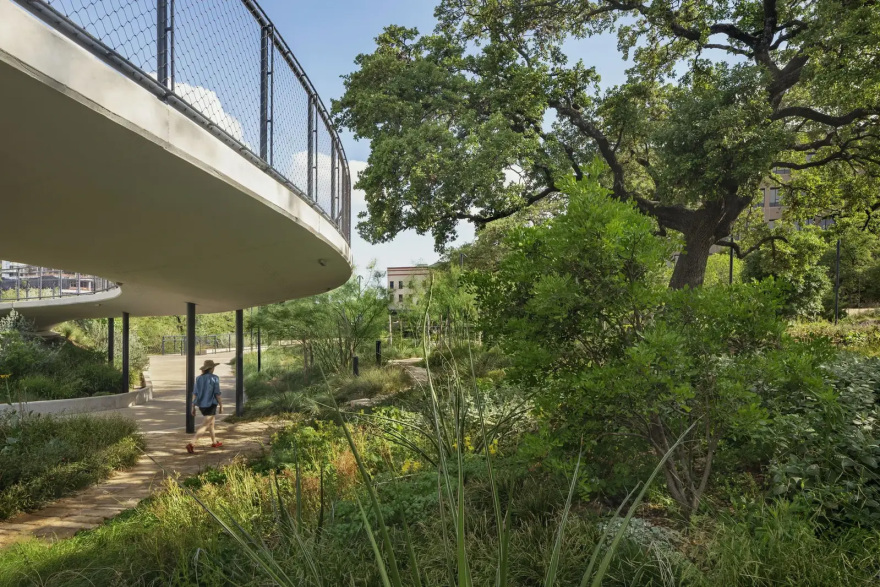
▲高架步道带来多样化的景观体验:人们既可以在树冠之上漫步,也可以在下方树荫中停留休憩。The elevated walkway shapes dynamic experiences of the park landscape — walking amidst tree canopies above or enjoying the shade below. © Elizabeth Felicella

▲螺旋步道与地面无障碍步道系统、丰富的地被植物景观以及一条攀爬式环形小径相互补充。The coiling promenade is complemented by accessible ground-level walks, a rich carpet of ground plain planting, and a scramble path loop. © Elizabeth Felicella

▲多条路径的交织营造出一种被自然包裹的环境,使游客能够沉浸于德州丘陵生态花园的本土生态之中。The overlap of various paths creates a protected environment for immersive moments within the native ecology of the Texas Hill Country Garden. © Elizabeth Felicella

▲步道俯瞰公园中一系列新的“涡流”景观,包括游乐景观、小型广场、静谧休憩空间以及雨水花园。The promenade overlooks new “eddies” of park program – play landscapes, small plazas, quiet seating niches, stormwater gardens. © Elizabeth Felicella

▲两株常绿栎的树冠在一处多功能平台上方形成宜人的遮荫。该平台通过创新施工方式安装,以避免破坏树木根系。The canopies of two live oaks create welcoming shade over a multi-purpose deck installed with an innovative approach to avoid damaging their root mats. © Elizabeth Felicella

▲露天剧场位于州议会大厦视线廊道下方,其后台空间及观众服务设施均被整合进公园的地形剖面之中。The amphitheater sits just below a Capitol view corridor, with all back-of-house and audience services tucked into the cross-section of the park. © Ryan Vestil

▲通过举办收益型活动,场馆为公园中的免费社区项目提供资金支持,其中包括文化节庆、舞蹈课程、瑜伽活动以及艺术装置展示。Revenue-producing events help underwrite free community-based programs – including cultural festivals, dance classes, yoga, and art installations. © Photo by Suzanne Cordiero, Courtesy of Waterloo Greenway Conservancy

▲公园生态系统由一系列设施支持,这些设施负责收集并引导场地地表径流。Park ecosystems are supported by a series of features that conduct surface water from the site. © Elizabeth Felicella

▲来自隧道的水流在一处源头渗泉中涌出,这一设计借鉴了自然涌泉的地质形态,并最终汇入沃勒溪。Water from the tunnel emerges from a headwater seep, an interpretation of the geology of an emergent spring that feeds into Waller Creek. © Michael Van Valkenburgh Associates, Inc.

▲人工构建的生态系统将隧道这种具有机械属性的基础设施与自然化景观结合在一起,象征着沃勒溪的重生与再造。The constructed ecology brings together the machine-like features of the tunnel and the naturalism that heralds the reinvention of Waller Creek. © Elizabeth Felicella

▲通过重新构建防洪基础设施与城市公共空间之间的关系,该项目促成了溪流沿线生态环境与社会活动的共同复兴。A reimagined relationship between flood control infrastructure and civic space has enable renewed ecology and social activity along the creek. © Michael Van Valkenburgh Associates, Inc.
PROJECT NARRATIVE
Pushing Infrastructural Boundaries
The City’s investment in an underground flood control tunnel prompted the challenge for a new conservancy to guide Waller Creek’s reinvention as an armature for the rapidly developing area now removed from the creek’s floodplain. While the core of Waterloo Park was devastated by the construction of this flood control infrastructure, the park’s redesign leverages its presence with the tactical addition of a 400-foot-long post-tensioned beam on which to restore lost park area. This structural addition allows park program to reclaim the center of this community-oriented space and frees the design to invent unique solutions to accessibility, programming, and placemaking.
Integrating a Catalytic Program
Sandwiched between a view corridor to the state capitol dome and the site’s flood plain elevation, the project integrates a state-of-the-art performance venue into the cross section of the site. Venues such as this often struggle to be economically and operationally viable and tend to overwhelm the sites in which they sit. Here, a “park first” philosophy governed the design to avoid creating a dead space in the park and to minimize its impact on site experience for daily park users. While the lattice-like canopy over the stage signals park entry, the rest of the 25,000 square-foot facility is invisible from most points in the park as it is stepped down from the street elevation and its roof is covered in landscape and terraces. This configuration is a first-of-its-kind for a venue of this scale, with the back-of-house roof also serving as the public entrance to the venue. Complimenting the national acts that visit the park and its audiences, an almost equal number of community-based events utilize the facility to bring the community into the park for yoga, dance classes, art installations, and the return of cultural festivals to Waterloo Park.
Cultivating the Relationship of Planting and Program in a Park
The existing oaks that survived the tunnel inlet construction are augmented by large oak transplants from adjacent development sites to form a thick frame around the park perimeter. Surrounding the central lawn that anchors the venue, the rest of the park landscape is formed as a series of landscape “eddies” that choreograph slow meanders from the oak frame into the park. The dramatic topography, the range of pathway and seating types, and the unique vantage points built atop the flood infrastructure afford a highly eclectic collection of garden-like spaces. Each of these spaces unfold into one another when walking through the park: a Hill Country garden, grassy rain gardens lined with palo verde, a wood deck carefully installed under a pair of existing oaks, a play area organized around an in-grade slide set into an embankment of stone scrambles, a small plaza shrouded in desert willow, a perched wetland terrace with an emergent cypress edge. Water drawn from the bypass tunnel emerges from a newly constructed seep at the southeast corner of the site along a reinvented creek bed lined with caliche blocks, forming the headwater spring to herald the downtown reach of creek and its forthcoming trail system. The unifying oak canopy around the park is juxtaposed with a rich tapestry of ground plane plantings composed of 132 species. Ninety-five percent of the park’s plant species are native to central Texas, reducing irrigation needs and providing substantial habitat for native pollinators.
南京喵熊网络科技有限公司 苏ICP备18050492号-4知末 © 2018—2020 . All photos and trademark graphics are copyrighted by their owners.增值电信业务经营许可证(ICP)苏B2-20201444 苏公网安备 32011302321234号
苏公网安备 32011302321234号客服
消息
收藏
下载
最近