

创作上传
VIP
收藏下载
登录 | 注册有礼
查看完整案例

收藏

下载

分享

翻译
École Secondaire de Djilakh
Wisdom Rooted in Life, Knowledge Shared in Community
Semi-Finalists, Senegal Secondary School Competition
Scope: Architectural Design, Competition Project
Building Type: Educational Architecture
Location: Djilakh, Thies, Senegal
Area: 500 sq.m.Year: 2026Status: Conceptual
Djilakh is a rural village in Senegal that currently has no secondary school, a condition that has contributed to persistently high dropout rates among local youth. In response, this school is proposed as a catalyst for local development. It functions as a community-based learning hub, offering an alternative curriculum that prioritizes life-skills education such as local trades, agriculture and personal finance to better align learning with the socio-economic realities of the village.
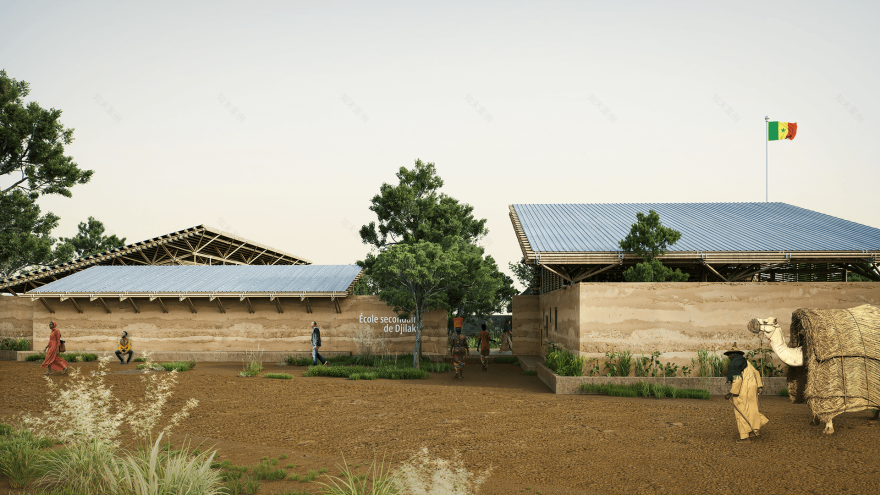
The school is designed to harmonize with its cultural context through a site strategy rooted in local settlement patterns. Inspired by Penc typology of Lebu, classrooms are clustered around existing trees to form communal courtyards, reflecting organic centralized village.
The buildings are arranged to create two distinct courtyards: an orchard, enclosed with classrooms, fostering close interaction with nature and supporting daily-life skills. The second courtyard accommodates a playground linked to a multipurpose space extending toward the public context. This zone enables collective activities and allows community access during term breaks, while the remaining areas remain secure and private.
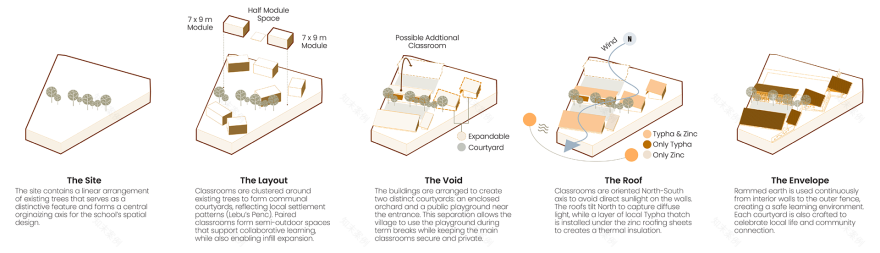
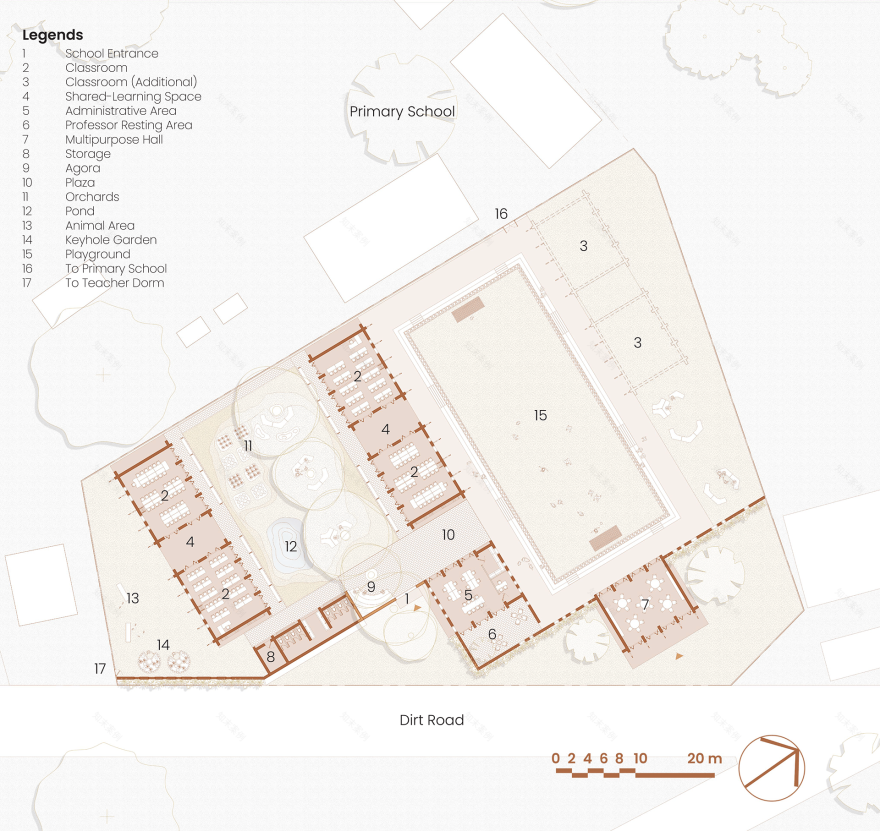
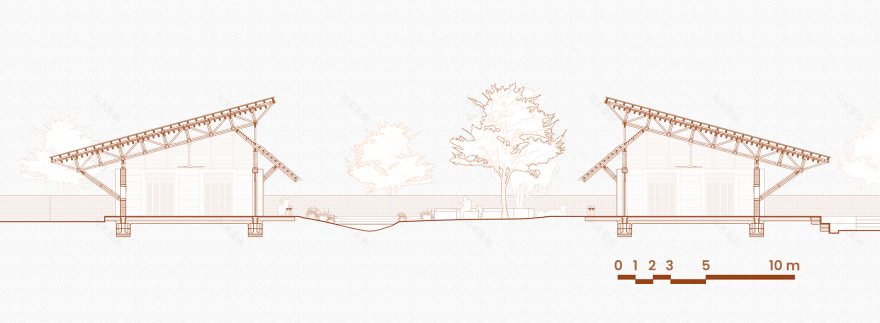
Each classroom is designed as a 7 x 9 m module, with its long side oriented along the north–south axis to minimize solar heat gain. In addition, an intermediate space is introduced between every two classrooms, serving as a collaborative learning area. This space also allows for future adaptation, as it can be infilled to create additional classrooms if spatial demands increase.
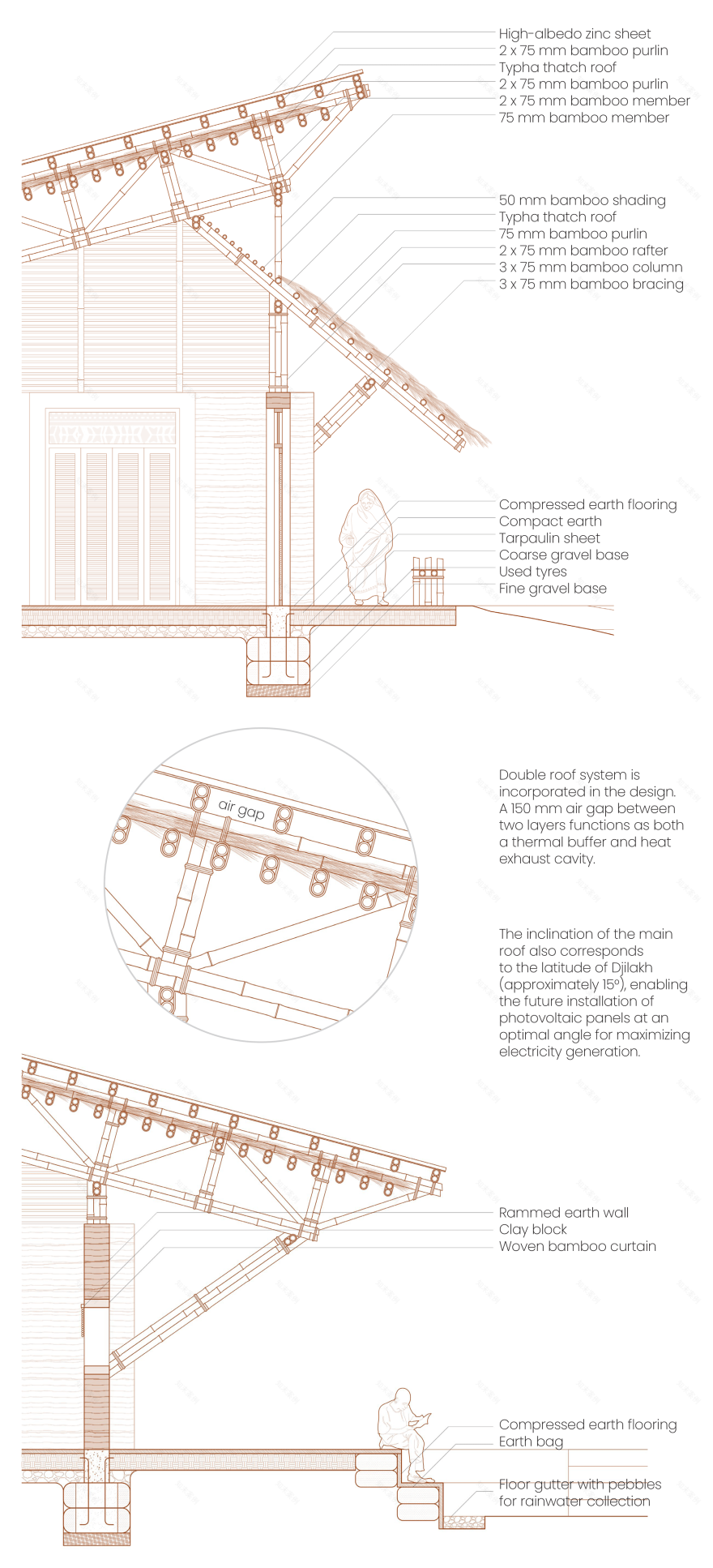
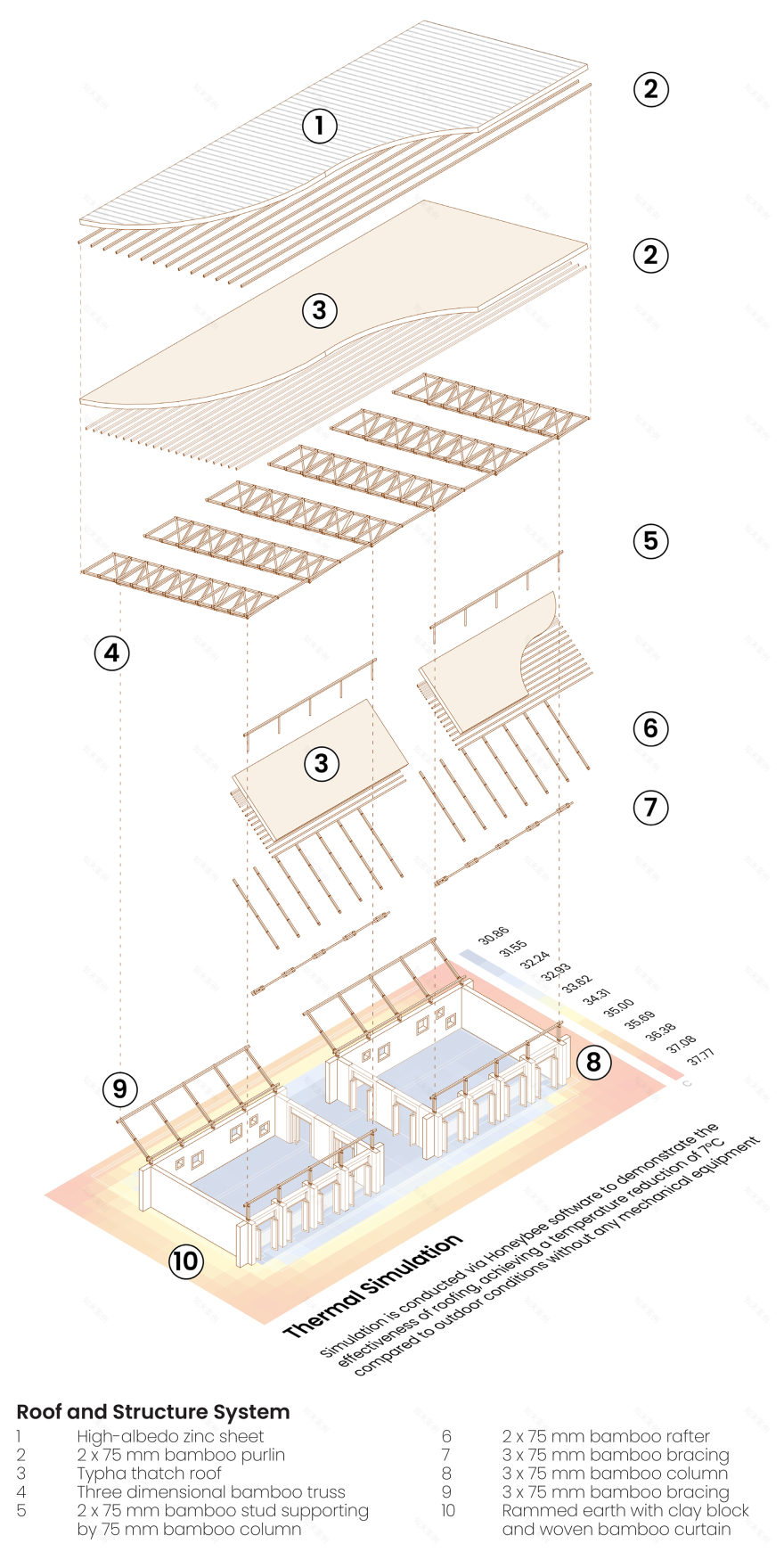
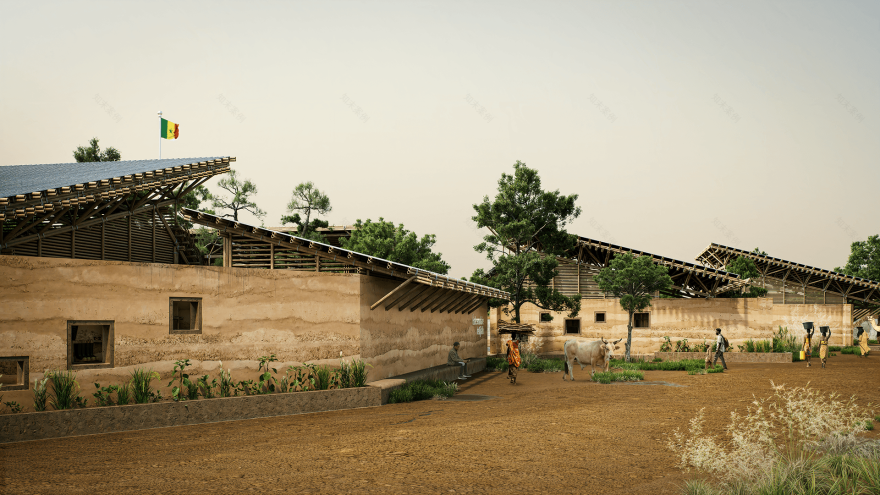
The roof design plays a critical role in balancing daylight and thermal performance. Roofs covering two classrooms are oriented towards the north to capture diffuse daylight, while the remaining classrooms receive filtered light through existing trees. Roof overhangs extending up to 4 m are incorporated to reduce direct solar radiation entering the interior spaces. This roof also creates a large under-roof volume, allowing hot air to rise and accumulate at higher levels, enhancing passive cooling.
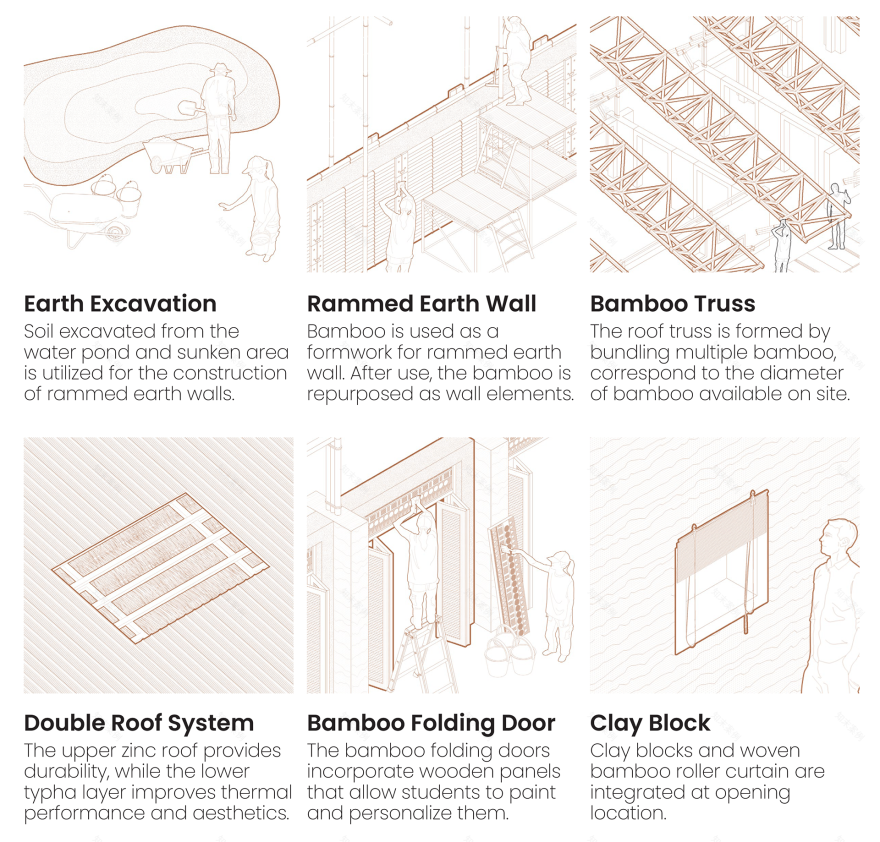
A double-roof system is applied to the main spaces to further reduce indoor temperature. The upper layer consists of high-albedo zinc sheets for durability and rain protection, while the lower layer uses Typha thatch for thermal insulation. A 150 mm air gap between two layers also functions as both a thermal buffer and heat exhaust cavity. Moreover, thermal simulation is conducted via Honeybee software to demonstrate the effectiveness of this roof strategy, achieving an average temperature reduction of 7°C compared to outdoor conditions without any mechanical equipment.
Rammed earth is employed as the primary wall material due to its high thermal mass, resulting in lower daytime temperature. The material is sourced from on-site soil excavated during the construction of the water pond and sunken area. Clay blocks are incorporated as permeable wall elements and openings, enabling efficient natural ventilation throughout the building.
School main entrance
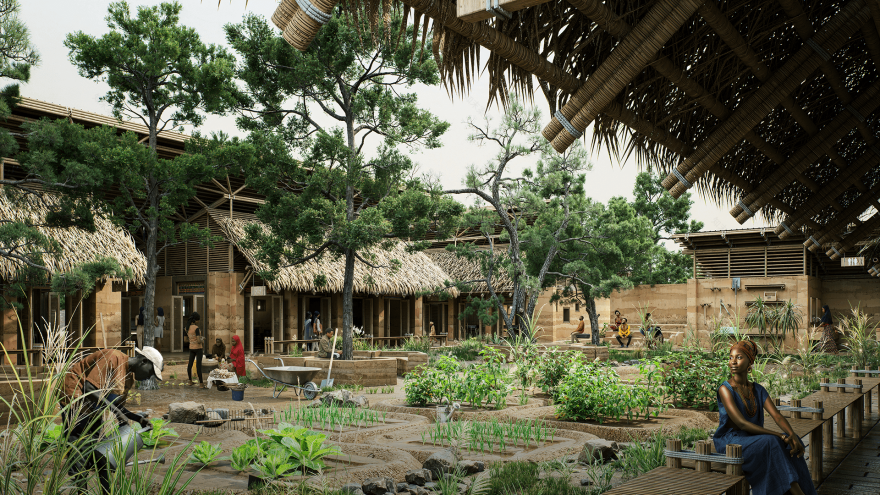
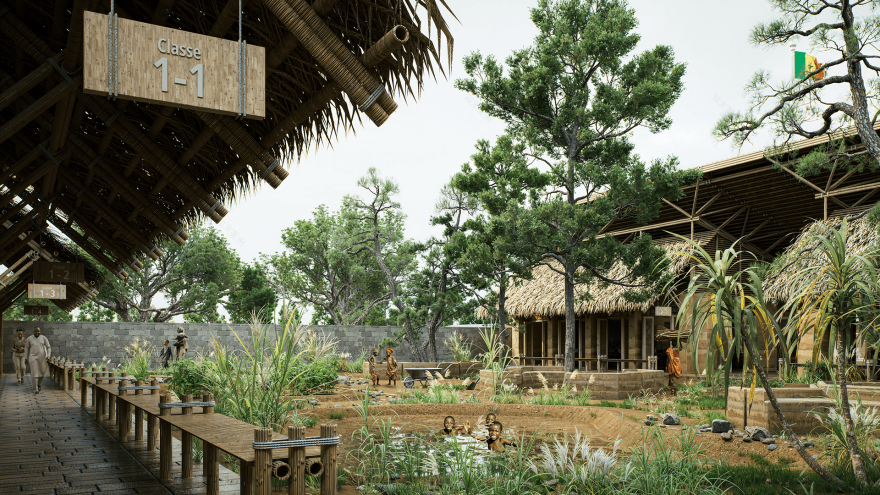
Orchards
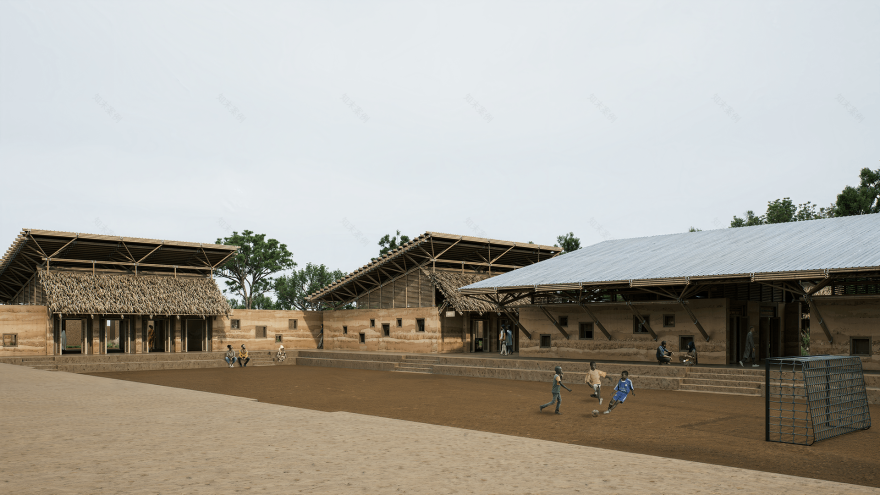
Playground
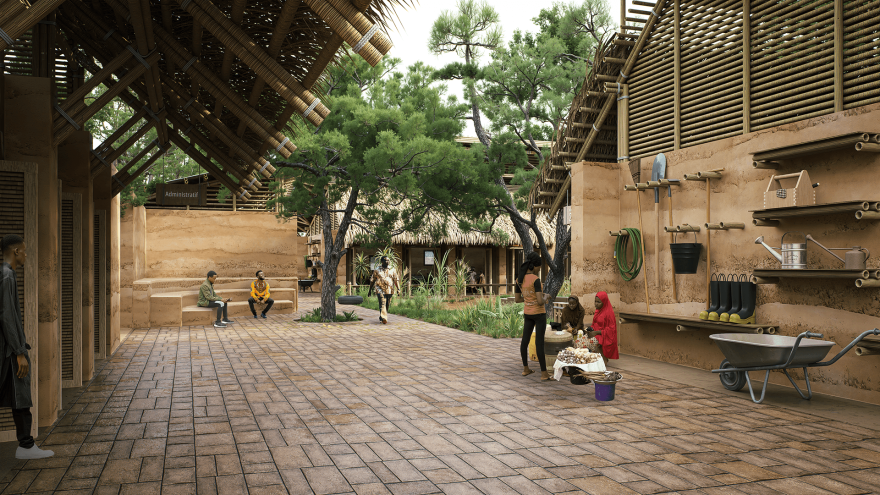
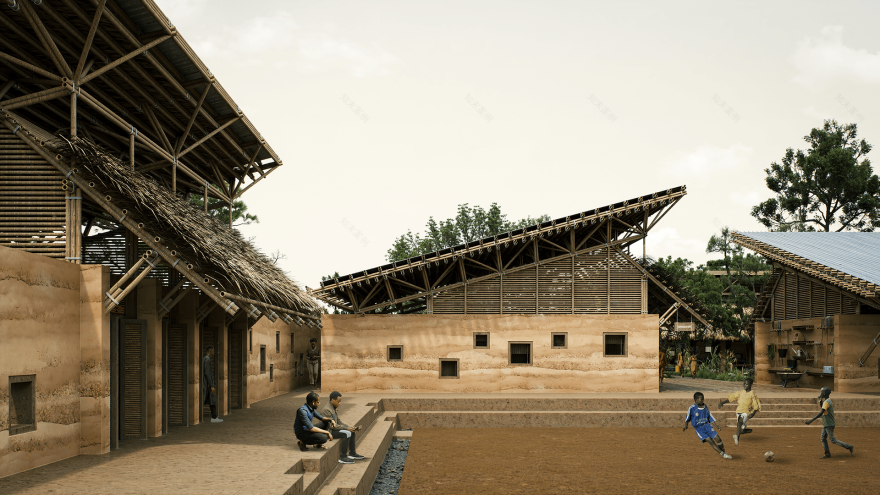
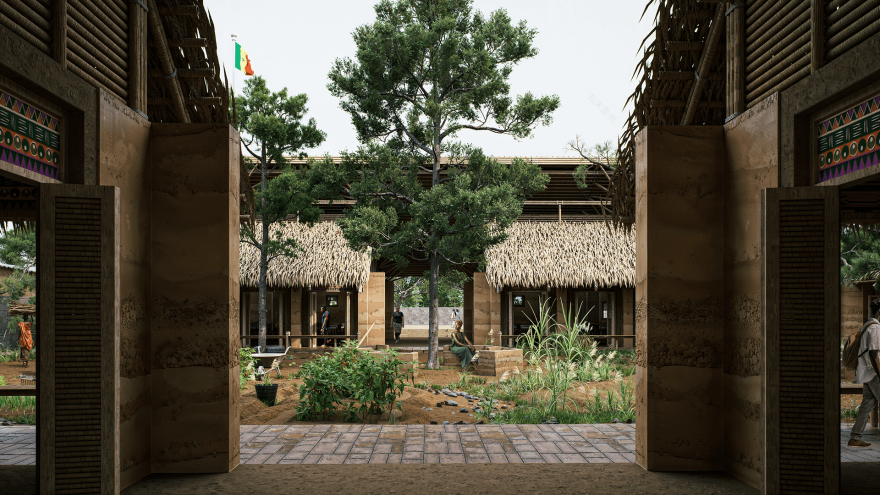
Agora, Playground, Shared-learning space
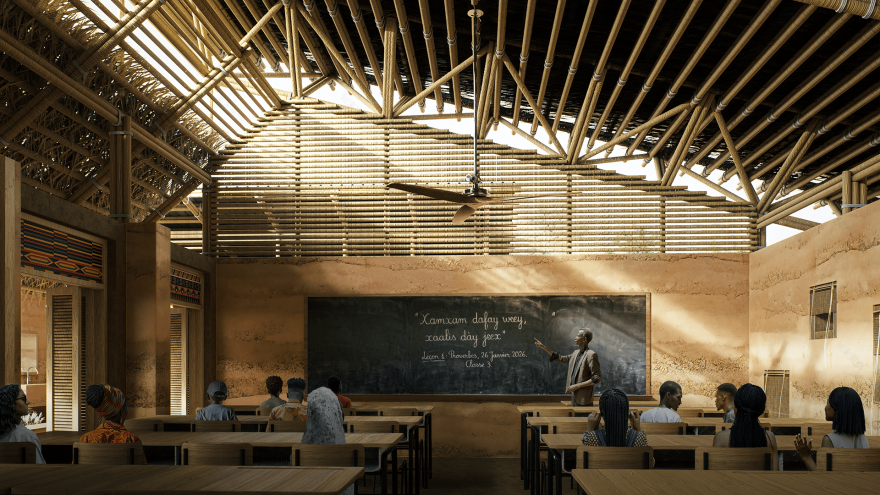
Classroom
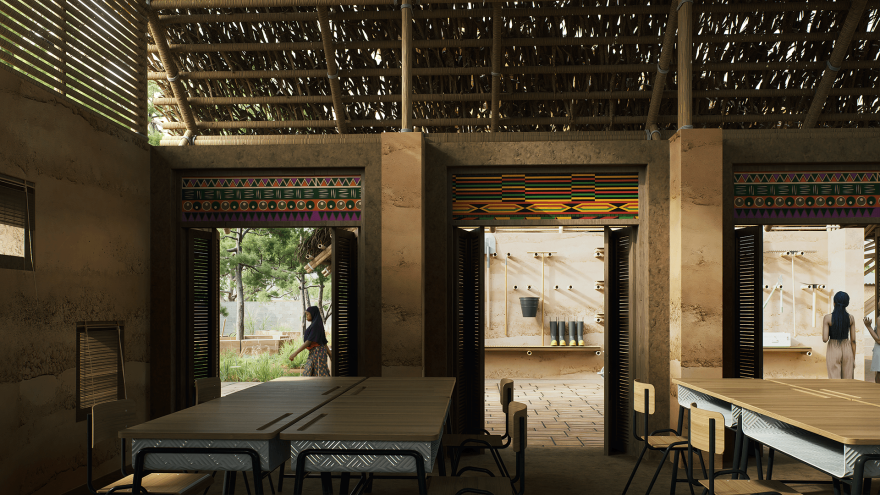
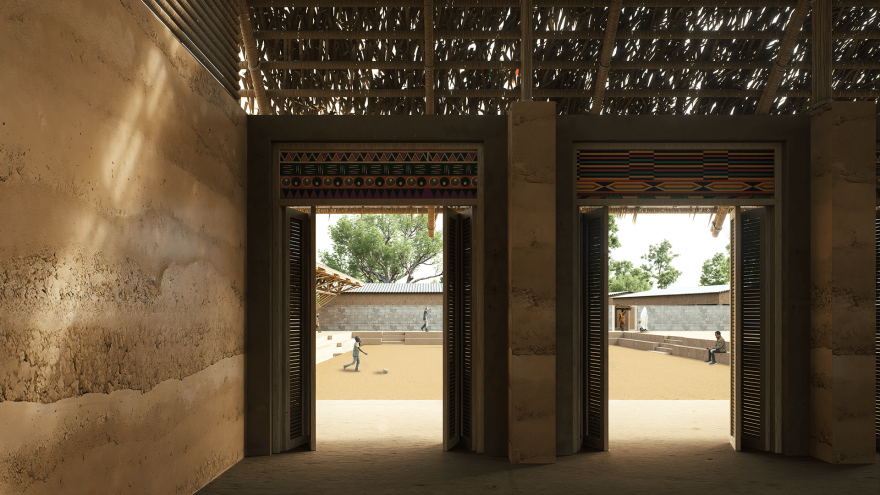
Administrative area, Multipurpose hall
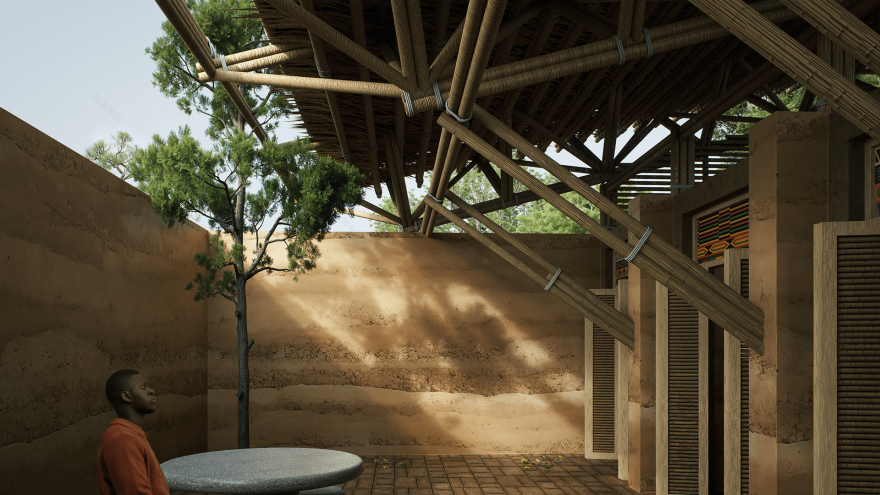
Teacher resting area
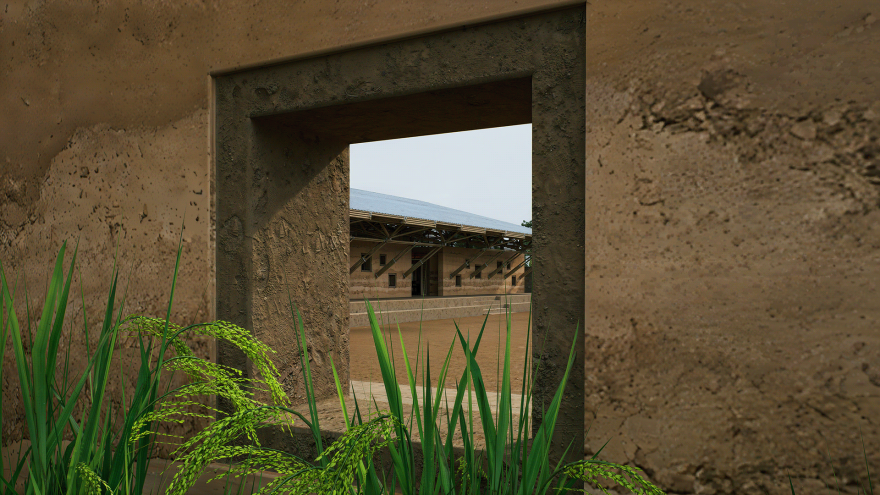
Team Member:
Akdanai Rothakit, Thanathas Ratana-amnuaysiri, Nattaphat Likitgijjanon, Achiraya Wongdechakul
南京喵熊网络科技有限公司 苏ICP备18050492号-4知末 © 2018—2020 . All photos and trademark graphics are copyrighted by their owners.增值电信业务经营许可证(ICP)苏B2-20201444 苏公网安备 32011302321234号
苏公网安备 32011302321234号客服
消息
收藏
下载
最近