

创作上传
VIP
收藏下载
登录 | 注册有礼
查看完整案例

收藏

下载

分享

翻译
Architects:Vincent Callebaut Architectures
Area:8209m²
Year:2026
Photographs:Vincent Callebaut Architectures
Structures:André Verdier Ingénieur Conseil
MEP:DEXO
Landscape Design:Land'Act Paysages & Territoires
Urban Planner:West 8
Main Contractor:Sectp
Category:Apartments
Construction Costs:ACEEC
Control Office:Groupe Qualiconsult
Facade Work:Rampa Prefa
Planters:Atech
City:Montpellier
Country:France

"The residences unfold as bioclimatic, shell-like envelopes shaped by the Mediterranean Sea, sun and wind, creating a breathable microclimate." Vincent Callebaut

Delivered in March 2026 within the emblematic program "Jardins Secrets", two residential buildings by Vincent Callebaut Architectures have now entered the city of Montpellier at a human scale, at the heart of the Cité Créative, on the historic site of the former École d'Application de l'Infanterie (EAI).

The project comprises Théia for Bouygues Immobilier (75 housing units, including 17 affordable ones, 5,364 m²) and Opale & Sens for Vestia Groupe (38 housing units, including 11 affordable ones, 2,845 m²), bringing together 113 homes designed in close alignment with the issues of RE2020, biodiversity and social mixity.
Awarded in the competition launched by the City of Montpellier in 2021, these two developments were later honored with the "Silver Pyramid for Global Quality" (La Pyramide d'Argent de la Qualité Globale), awarded by the Real Estate Developers Federation of Occitanie‑Mediterranean (Fédération des Promoteurs Immobiliers d'Occitanie‑Méditerranée) in autumn 2024.
A Mediterranean manifesto inspired by Art Nouveau — The "Jardins Secrets" project responds to a dual challenge: respecting the memory of a former military site and inventing a new generation of dense, green and regenerative Mediterranean urbanity. Located less than one kilometer from the historical center of Montpellier's Ecusson as the crow flies, it integrates seamlessly into the city's suburbs, engaging in dialogue with the refined, orderly neighboring heritage architectures, while asserting a resolutely organic language.

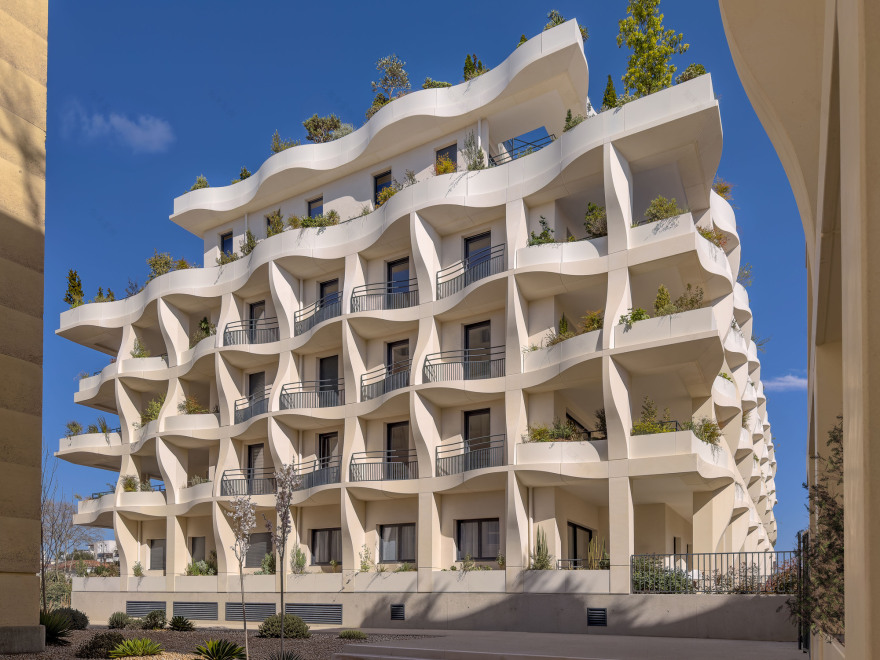
Between Art Nouveau and contemporary biomimicry, "Jardins Secrets" calls on Victor Horta, Antonio Gaudí and Émile Gallé to reactivate a tradition of ornament, this time placed at the service of climate and nature. The façades of Théia and Opale & Sens unfold like architectural shells, true exoskeletons delicately shaped by light and wind. These urban shells alternate between protective envelope and porous structure, filtering the sun, channeling air currents and offering the inhabitants a gentle, stabilised microclimate.

These mineral laces, entirely composed of convex and concave curves, behave like finely bisequed moucharabiehs, where waves sculpt the shade and set the light in motion. They optimise thermal inertia, solar protection and natural ventilation, while recalling that the right angle does not exist in nature and that architecture can conform to its fluid, generous forms.
This "Art Nouveau 2.0" writing expresses a vision: an architecture that is sensitive, performative and anchored in the Genius Loci, where "form follows climate", parametrized according to the sun's path and the prevailing wind axis. Here, the shell becomes a living model: an intelligent envelope, both poetic and rational, protecting the inhabitants like a natural habitat, while opening up to life and the Mediterranean context, much like a conch catching the sunlight, the breath of the sea and the murmur of the wind.

Ecology, climate and regenerative biodiversity — At the heart of the Cité Créative, "Jardins Secrets" participates in a continuous landscape with the neighbouring Parc Montcalm, forming an ecological corridor where built and vegetated spaces interact in permanence.

The project puts into practice: Rainwater harvesting and greywater recycling for the irrigation of suspended gardens in a closed loop; A low‑carbon structure combined with high-performance thermal insulation; Dense vegetation inspired by Mediterranean garrigue, creating an urban cool island through evapotranspiration and a sanctuary for local fauna and endemic flora; The two buildings rely on shared renewable energy sources: connection to the district biomass boiler and installation of photovoltaic panels on the roofs, to maintain very low energy consumption at the level of the eco‑neighbourhood, in line with current performance standards.

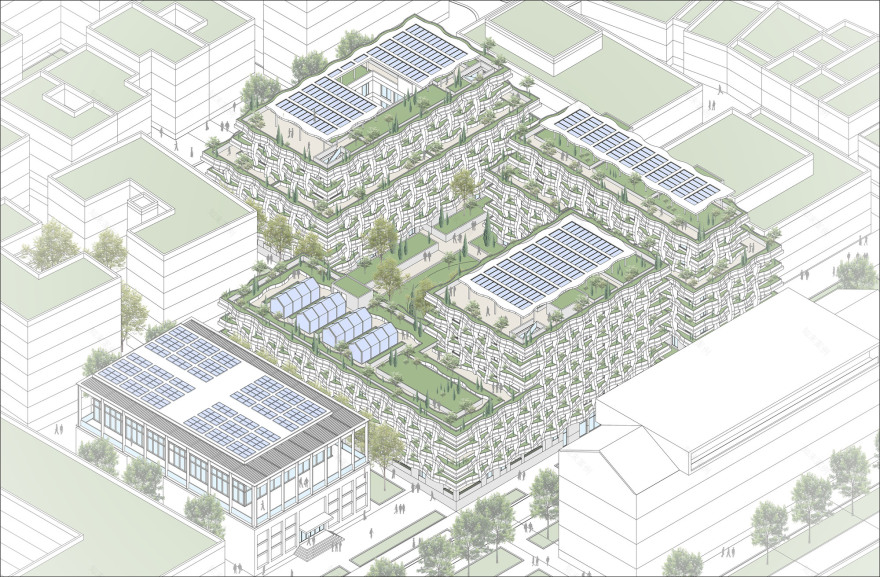
A dense yet porous urban morphology — The 113 housing units (75 at Théia, 38 at Opale & Sens) gather around a large ground‑floor courtyard in open soil, a true vegetal sponge penetrated by trees rooted directly in the earth. This device combats soil sealing and rainwater runoff, at the same time reinforcing the thermal comfort of the ensemble.
The project articulates with the neighbourhood through: public pedestrian walkways connecting the Cité Créative; shaded private alleys and vegetated patios optimising summer comfort; ground‑floor levels raised by one metre (at the request of the chief urban planner) to preserve the privacy of residents while respecting the height of preserved heritage buildings.

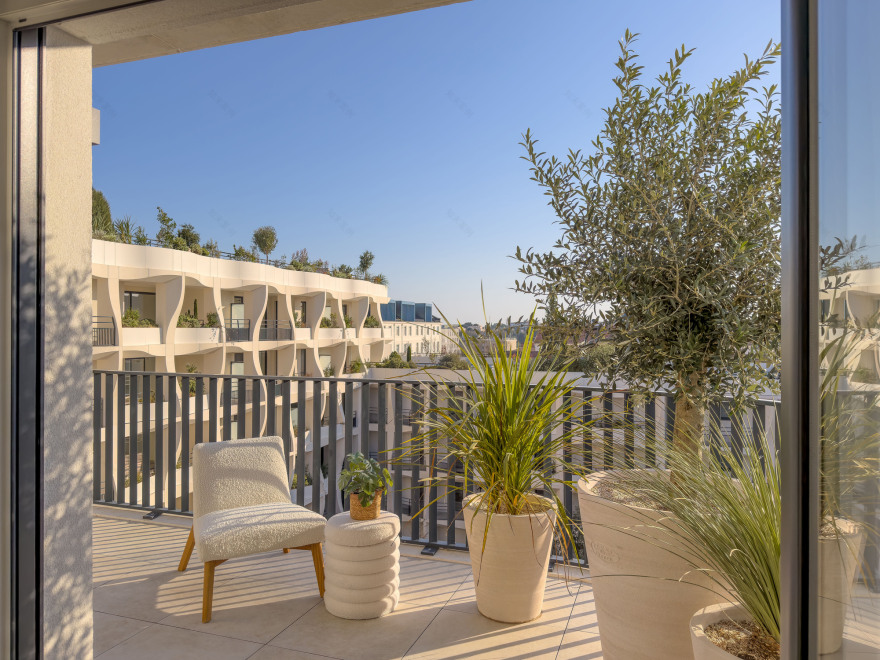
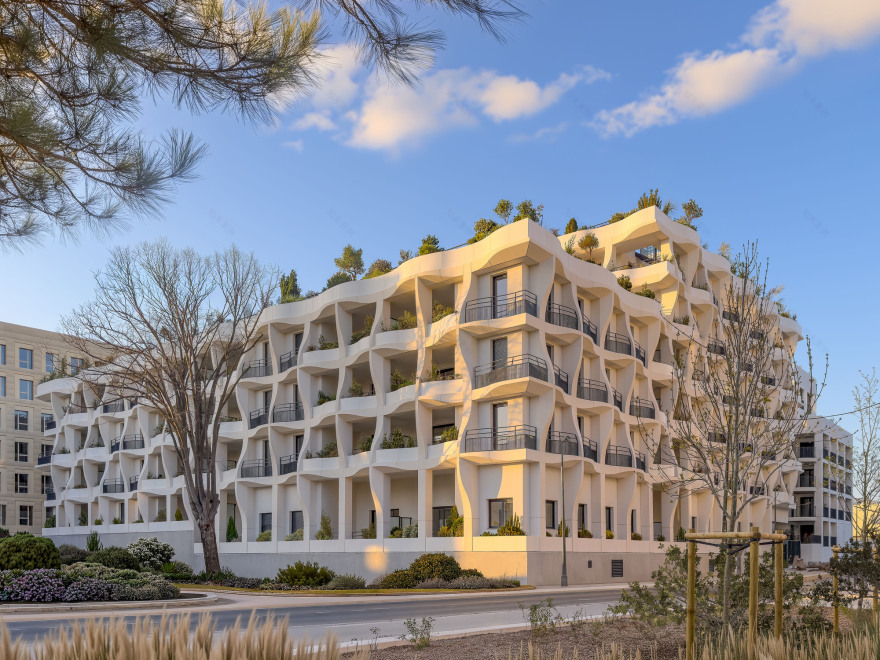
Théia: 75 housing units, including 17 affordable ones — Developed for Bouygues Immobilier, Théia occupies an "L"‑shaped massing in R+5 along rue Frida Kahlo (east) and in R+3 along the lane leading to the future, rehabilitated cinema "Le Cocon" (south). The apartments, from T2 to T5, are cross‑ventilated or multi‑orientated, with two key typological devices: Deep loggias of 3.5 m, overlooking the heart of the plot and the skyline, which extend the living room as a "bonus room", with privacy ensured by curved raised planters; Haussmann‑style balconies for the bedrooms, with curved wrought‑iron railings.

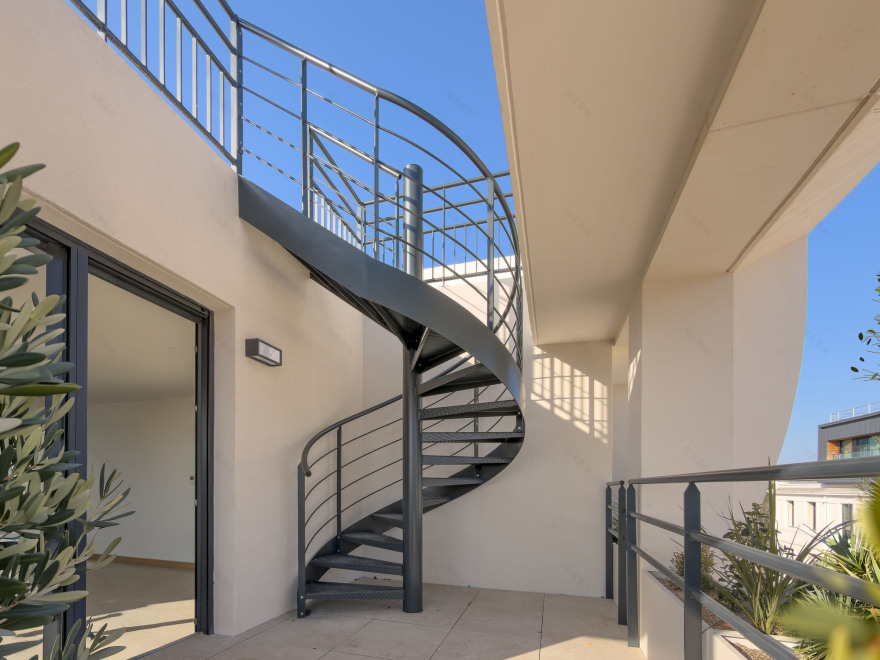
The roofs are developed as accessible terraces, offering panoramic views over the Montpellier landscape, while the outer corner of the "L" faces the arrival of the recently delivered tram line 5. To preserve the open soil of the central garden, the shared parking, naturally ventilated by a large central patio, is contained beneath the buildings, while soft mobility is enhanced by well‑designed bicycle rooms on the ground floor and a basement car park.
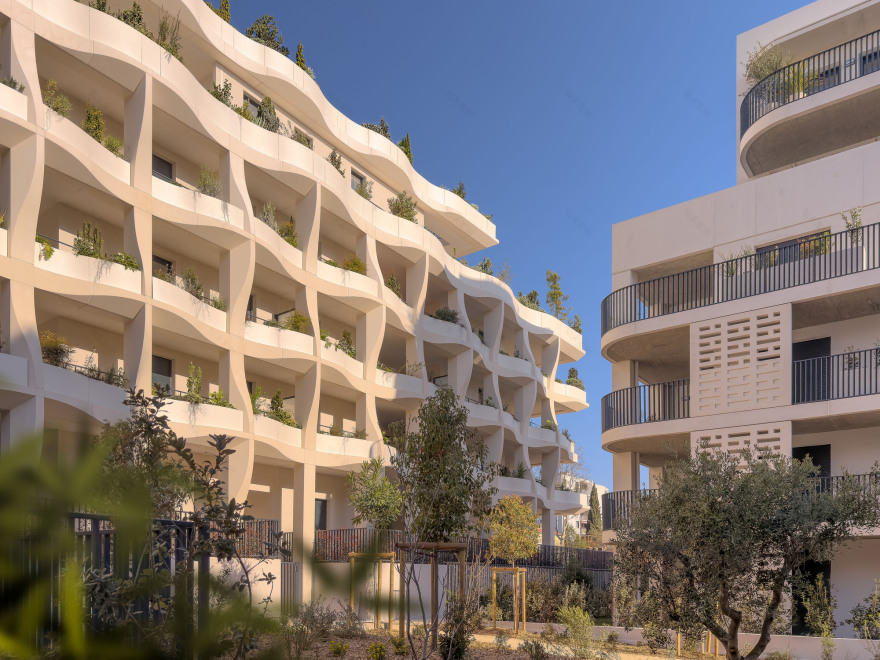
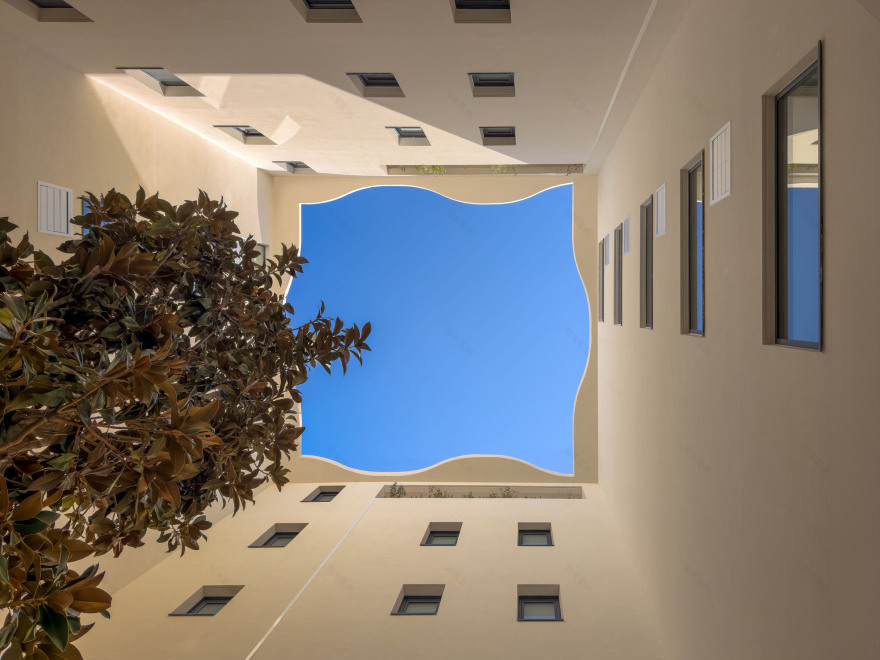
Opale & Sens : 38 housing units, including 11 affordable ones — For Vestia Groupe, Opale & Sens rises to R+3, with a double‑top‑floor duplex at R+4/R+5 set back by 3.5 m around its entire perimeter, along allée Mila Racine. The building's core is pierced by a full‑height central patio, which provides: natural ventilation for the dwellings; a calm urban buffer hosting access to the lobbies and the bicycle rooms. The façades alternate between: vegetated loggias for the living rooms, facing the heart of the plot and the angles; Haussmann‑style balconies for the bedrooms, facing the street.

The ground‑floor apartments benefit from private elevated gardens, while continuous balconies draw sweeping waves along the more intensively planted façade facing the garden, strengthening the efficiency of an urban "cool island".

Towards regenerative urbanity — At the heart of the Cité Créative, "Jardins Secrets" embodies a new generation of resolutely regenerative urbanity: dense yet porous housing, community gardens in open soil, shaded alleys, attics and densely vegetated roof terraces, material and energy sobriety, and shared renewable energy.

Drawing on Mediterranean ecosystems, the project moves beyond simple sustainability to produce: social ties around shared spaces and communal gardens; the restoration of ecological cycles (water, energy, biodiversity); climate and landscape resilience adapted to contemporary challenges.
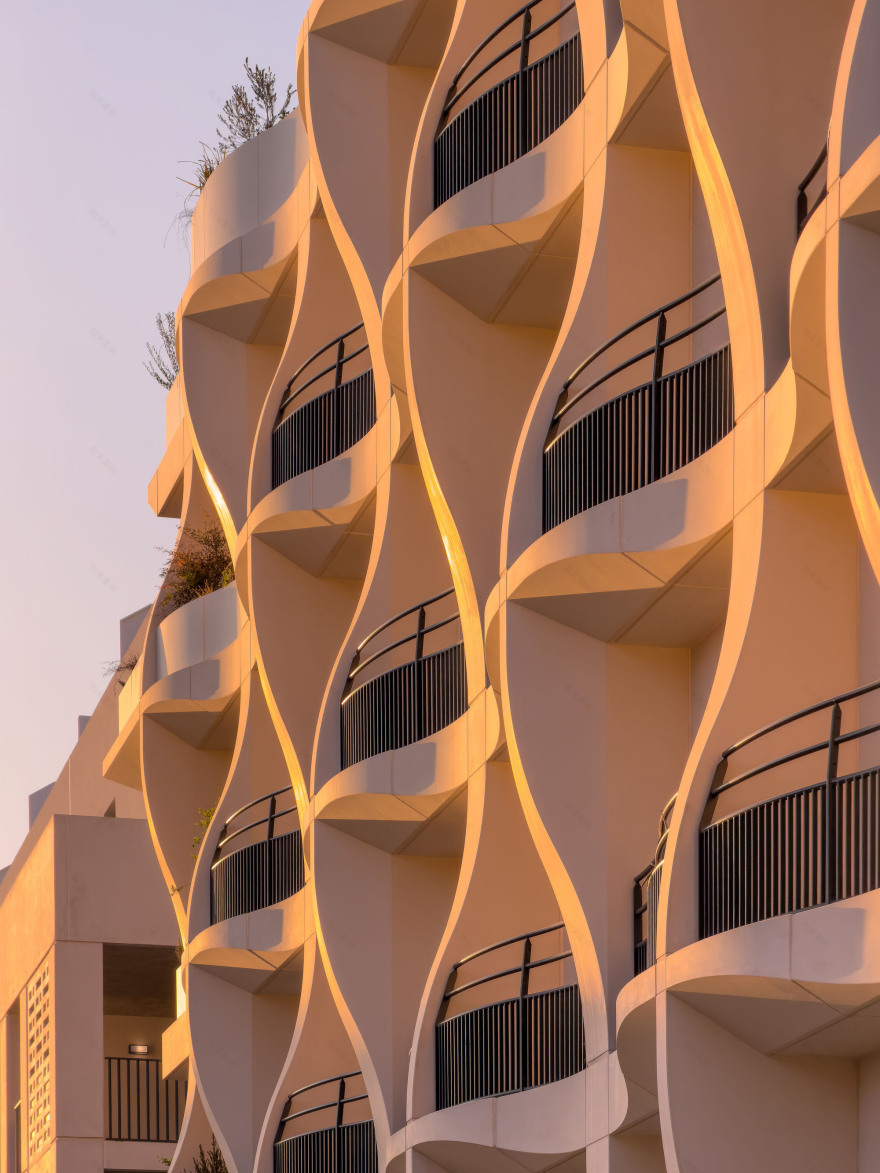
With "Jardins Secrets", Art Nouveau finds a 2.0 expression, both poetic and deeply ecological. Théia and Opale & Sens embody a design philosophy where architecture draws inspiration from the living world to coexist with it, reconciling aesthetics, performance and well‑being within an affordable housing framework.
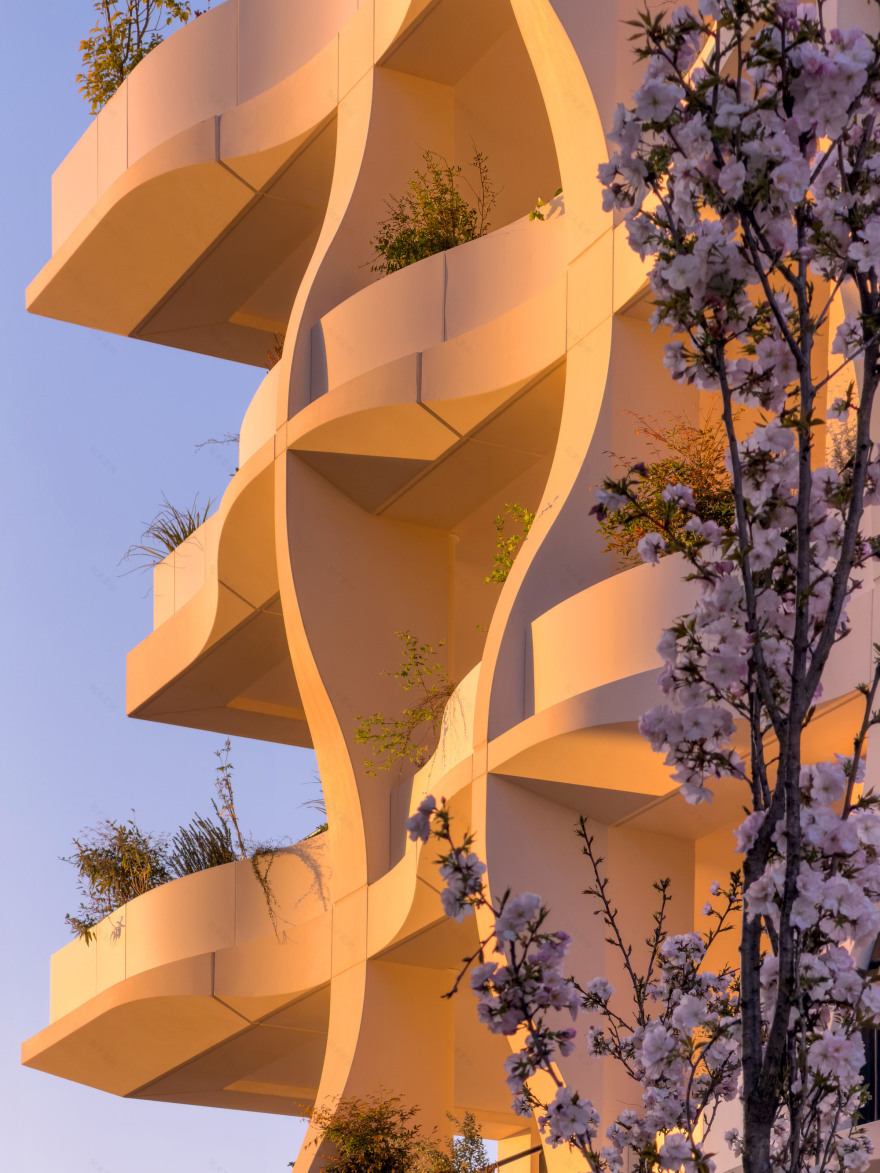
Architecture thus becomes a mediator between the inhabitant, the climate and nature, articulating comfort, sobriety and landscape in a renewed constructive language.
Project gallery
南京喵熊网络科技有限公司 苏ICP备18050492号-4知末 © 2018—2020 . All photos and trademark graphics are copyrighted by their owners.增值电信业务经营许可证(ICP)苏B2-20201444 苏公网安备 32011302321234号
苏公网安备 32011302321234号客服
消息
收藏
下载
最近