

创作上传
VIP
收藏下载
登录 | 注册有礼
查看完整案例

收藏

下载

分享
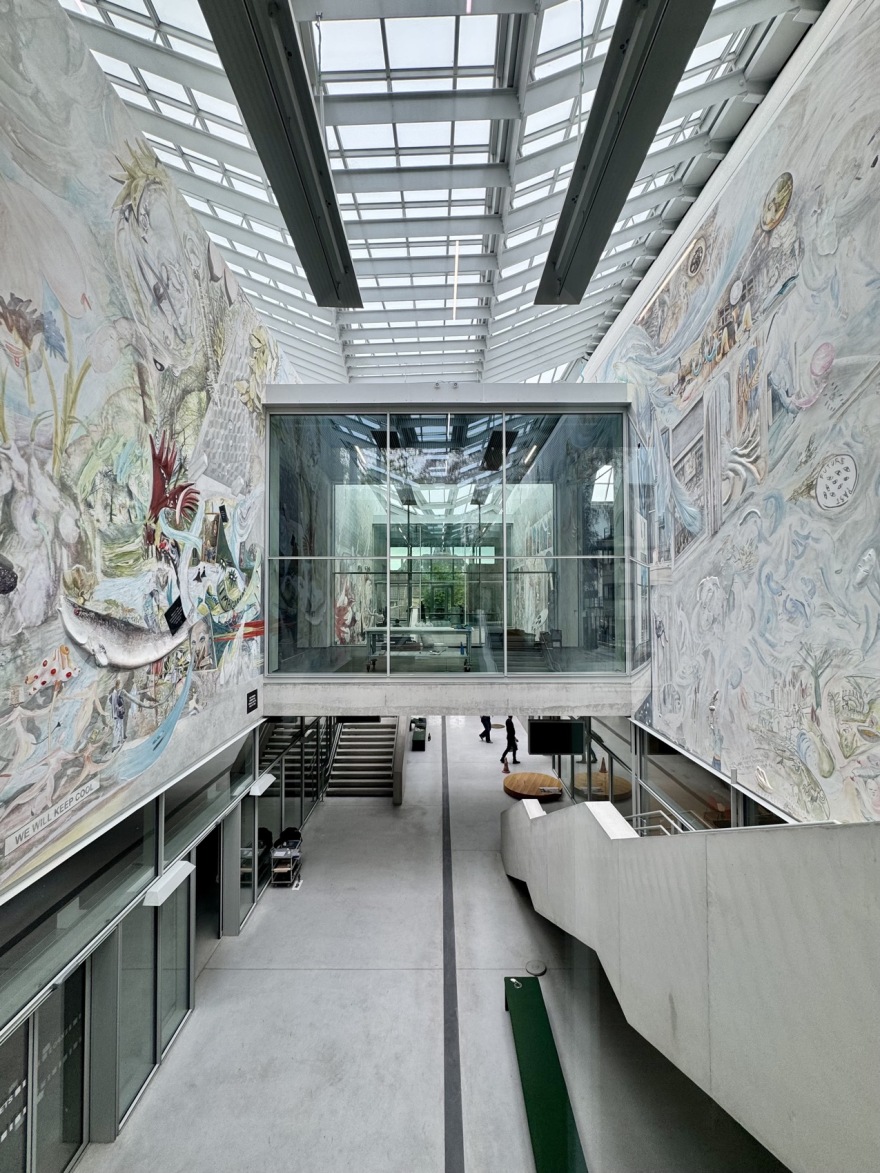
历经七年的设计、规划与建造,位于布鲁日的新展览馆 BRUSK 将于2026年5月星期五正式向公众开放。BRUSK 由 Robbrecht en Daem architecten 与 Olivier Salens architecten 设计,并由 CIT Red 开发完成。BRUSK 位于布鲁日市中心,毗邻格罗宁格博物馆(Groeningemuseum),是一座具有高度公共开放性的展览建筑。展厅被抬升至上层,并由一条公共通道(Scala Grande)彼此分隔,从而形成了开放、透明且可自由通行的首层空间。这座建筑并不刻意要求行人驻足停留;恰恰相反,这条通道使人们能够直接穿行整个建筑群。这条通道的核心,是法国艺术家 Laure Prouvost 最新揭幕的大型壁画《The Whispering Walls Rêve》。无论是否计划参观展览,所有人都被邀请来发现这件艺术作品。
Following seven years of design, planning and construction, the new exhibition hall BRUSK in Bruges will open to the public on Friday & May 2026. BRUSK was designed by Robbrecht en Daem architecten and Olivier Salens architecten and developed by CIT Red. Located next to the Groeningemuseum and in the city center of Bruges, this is an exhibition hall with a highly convivial character. The exhibition areas are at a raised level and separated from each other by a public passageway (Scala Grande), creating an open, transparent and freely accessible ground level. The building does not necessarily call on walkers to stop; on the contrary, the passageway makes it possible to walk straight through the complex. The centrepiece of this passageway is the recently unveiled, monumental fresco ‘The Whispering Walls Rêve’ by the French artist Laure Prouvost: a work of art that anyone – whether or not they intend to visit an exhibition – is invited to discover.
▼通向博物馆公园的开放界面,Open edge towards the future museum park © Filip Dujardin
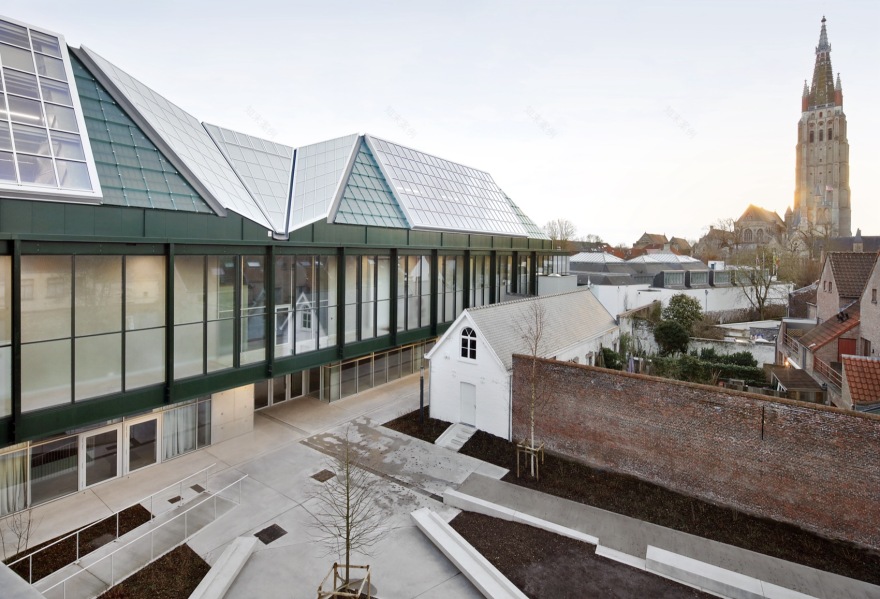
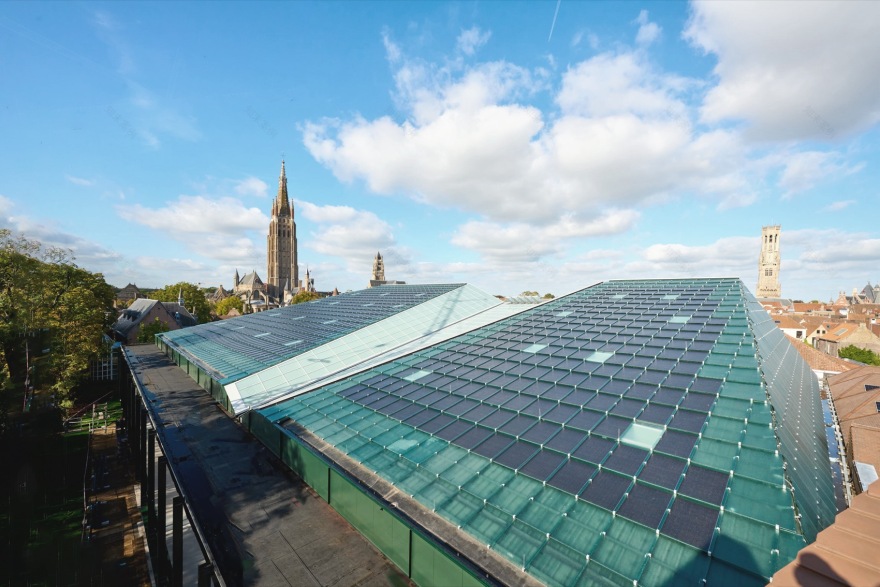
整个首层空间完全向城市、市民与访客开放。它更像是一座公共广场,而非传统公共建筑,以开放而自由的方式创造并激发公众与艺术相遇的可能性,让居民、行人与访客在此汇聚。未来,这一层还将进一步连接至新的博物馆公园。BRUSK 的展厅因其自然采光方式与独特尺度而在博物馆建筑中脱颖而出。展厅主要引入北向天光——这也是过去大型艺术工作室常见的采光方式——而其空间高度则令人联想到教堂与大教堂。BRUSK 的外立面覆盖着具有纹理感并能够发电的玻璃“鳞片”,为建筑提供可持续能源。
This ground level is given over in its entirety to the city, its inhabitants and its visitors. It is more like a public square than a public building, which openly and freely creates and stimulates opportunities for encounters between the public and art and bring residents, passers-by and visitors together. In the future, this level will open out onto a new museum park. BRUSK’s exhibition rooms stand out in the museum landscape due to their natural fall of light (from the north, as was usually the case in the great artistic workshops of the past) and their unique height (making them reminiscent of a church or cathedral). The exterior of BRUSK is covered in textured and electricity generating glass ‘scales’, which provide the building with a sustainable form of energy.
▼步道通向展览空间入口,Pathway leading to the exhibition entrance © Paul Robbrecht

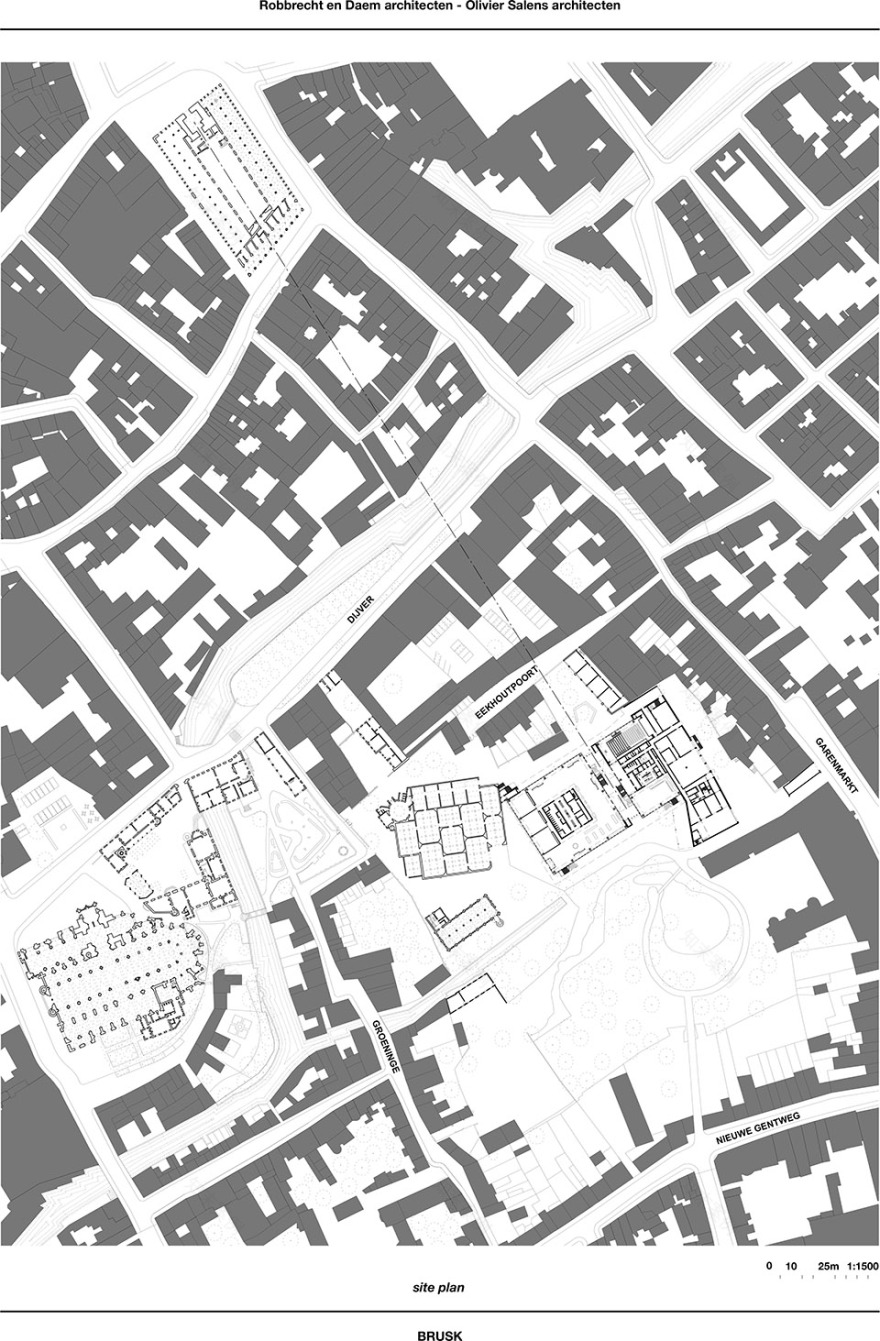
周边分布着多座重要建筑地标,包括圣母教堂(Onze-Lieve-Vrouwekerk)、钟楼(Belfry)以及圣救世主主教座堂(Sint-Salvator Cathedral)等,BRUSK 因此成为城市重要建筑群的一部分。这些历史建筑在 BRUSK 的设计过程中发挥了根本性的作用。两条视觉轴线——一条朝向钟楼,一条朝向圣母教堂——赋予建筑深层次的城市联系感,并使这些历史地标之间得以进一步“对话”。与此同时,展览馆也保留了历史天际线。建筑并不依靠高度彰显自身,而是通过一连串小巷、通道与小型公园,在步行过程中逐渐被发现。它有意回应了这片历史城区内部原有的空间张力。BRUSK 与格罗宁格博物馆以及未来的博物馆公园,共同构成了全新“布鲁日博物馆街区”的核心。而 BRON 则是 Musea Brugge 的科研中心,在这里,馆藏、专业知识与研究资源汇聚于一个富有活力的环境之中。BRUSK 的开放,也同步推出了两场展览:土耳其裔美国 AI 艺术家 Refik Anadol 的个人展,以及文化历史展览《Bigger Picture》。
▼城市草图,City sketch© Paul Robbrecht

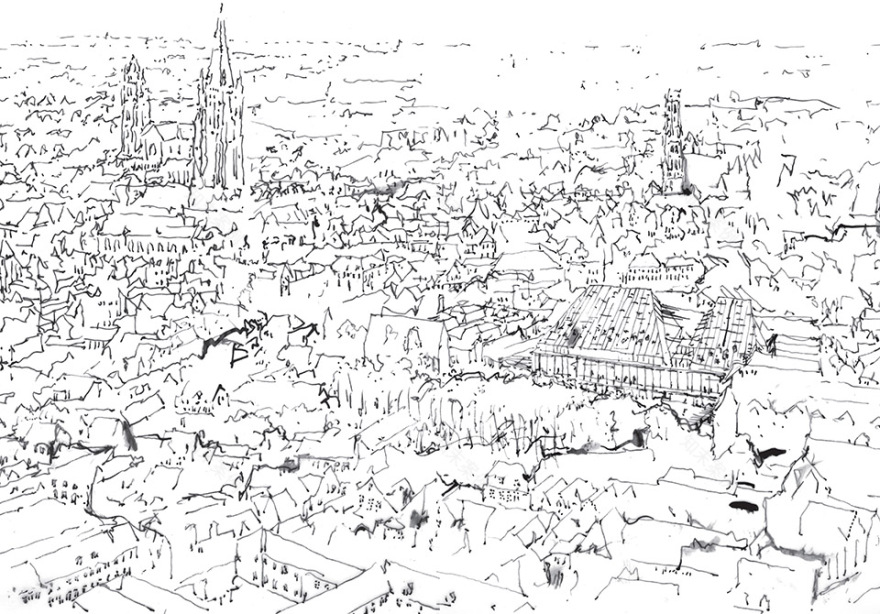
With several large architectonic buildings (Onze-Lieve-Vrouwekerk, the Belfry, Sint-Salvator Cathedral…) in the immediate vicinity, BRUSK forms a cluster with important components in the city. These monuments played a fundamental role the design of BRUSK. The two visual axes – one in the direction of the Belfry, one in the direction of the Onze-Lieve-Vrouwekerk – invest the design with a deep sense of urban connectivity and allow these monuments to communicate further with one another. The exhibition hall also preserves the historic skyline. The building does not make its presence felt by virtue of its height; you discover it by walking through a sequence of alleys, passageways and small parks. It deliberately connects with the historic tension of this inner area.
Together with BRUSK, the Groeningemuseum and the future museum park, BRON also forms the beating heart of the new Bruges Museum Quarter. BRON is the scientific research centre of Musea Brugge, where the collection, expertise and knowledge resources come together in a stimulating environment.
The opening of BRUSK marks the launch of two exhibitions: a solo exhibition by the Turkish-American Al artist Refik Anadol and the cultural-historical exhibition ‘Bigger Picture’.
▼历史城区中的绿色展览屋顶,Green exhibition roofscape in the historic city © Olivier Salens

迈向“工作室”类型学
Towards the typology of a workshop
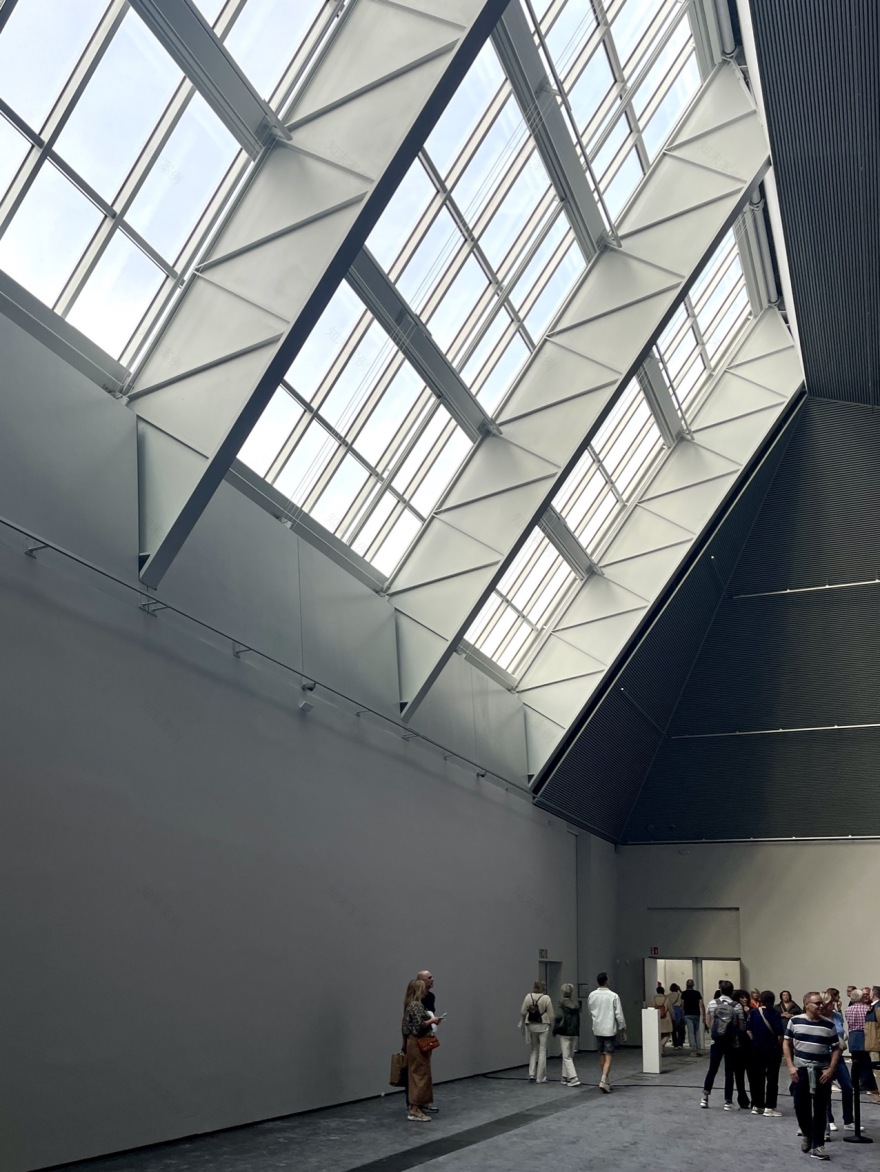
BRUSK 的一层设有两个大型展厅(分别为 40×40 米与 20×40 米),其设计旨在回应一种典型艺术家工作室的特征(例如 Claude Monet 位于吉维尼的工作室)。与大多数工作室一样,这些展厅朝向艺术家尤为珍视的北向光线。两扇朝北的大型窗户,使自然光充沛地进入 BRUSK 的两座主展厅,而每扇窗户都可以根据需要进行遮光或漫射处理。此外,缓缓倾斜的屋顶中还整合了额外开口,使南向光线得以进入,从而形成冷调北光与暖调南光之间微妙的融合。通过以亲密尺度的“工作室”类型作为展览空间原型,艺术作品展示之地与其最初诞生之地之间的联系被进一步强调。
The first floor of BRUSK houses two large museum spaces (40 x 40 m and 20 x 40 m) designed to reflect the characteristics of an archetypical artist’s workshop (think of Claude Monet’s atelier in Giverny as a beautiful example). Like most workshops, these museum spaces are aligned towards the northern light that is so highly appreciated by artists. Two large, north-facing windows allow the light to flow copiously into both of BRUSK’s main halls. Each window can be darkened or diffused as required. Additional openings have been integrated into the gently sloping roof, allowing southern light to enter, resulting in a subtle blend of cool northern light and warm southern light. By using the intimate typology of the workshop as the basis for the exhibition spaces, the link between the place where a work of art is displayed and the place where it was first created is more strongly underlined.
▼屋顶采光与纯净展示界面,Roof lighting and minimal exhibition enclosure © Filip Dujardin
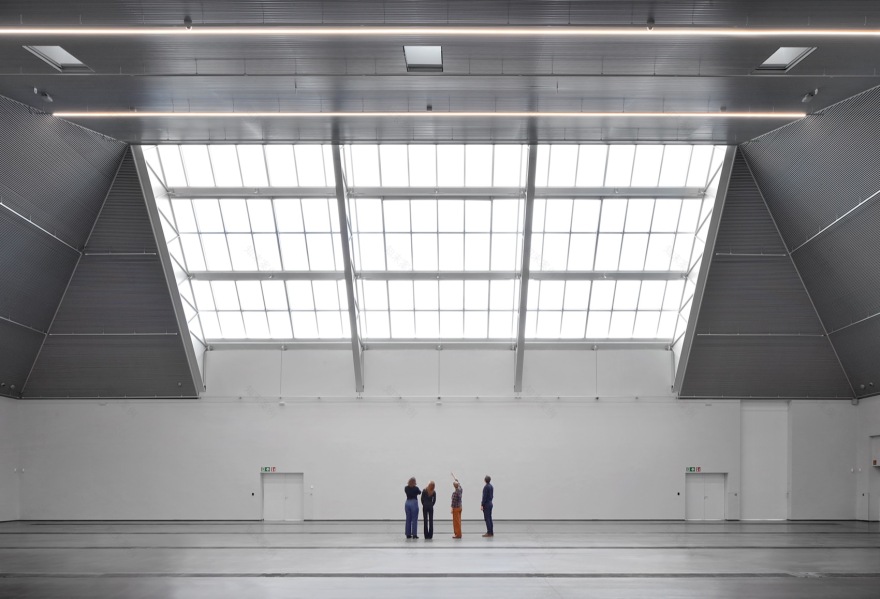
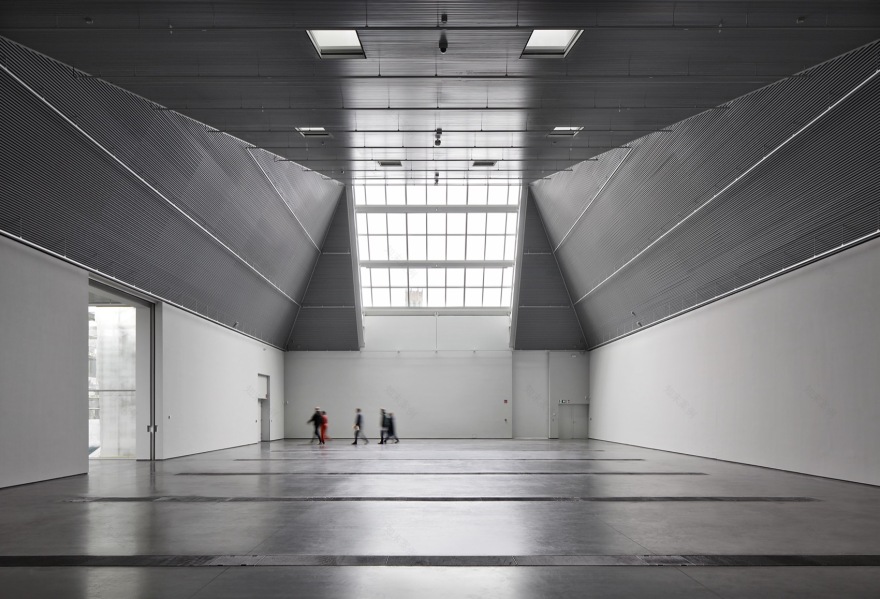
围绕艺术作品与其展示空间之间关系的思考,BRUSK 将这一概念进一步延展。如今,博物馆已成为公众接触艺术最主要的场所。然而,许多中世纪艺术作品最初是为教堂或大教堂这类高大空间而创作的。几个世纪以来,这些作品逐渐脱离原始环境,被转移至具有完全不同尺度、采光与氛围的博物馆空间之中。BRUSK 为拥有丰富中世纪艺术珍藏的布鲁日,提供了一种具有历史维度的当代博物馆空间。因此,BRUSK 的两座展厅被赋予了13.75米的特殊高度,以回应教堂空间巨大的垂直尺度。由此,这两个空间都散发出某种“大教堂式”的氛围,这对于整个布鲁日,尤其是格罗宁格博物馆而言,具有重要意义。但这并不意味着 BRUSK 不属于当代艺术。相反,这座新建筑将承载布鲁日所有现代性的表达。尤其是在这样一座散发着浓厚历史气息的城市中,BRUSK 成为古典艺术与当代艺术共存并轮流展出的象征性场所,在这座拥有数百年历史的艺术中心中建立起一种现代对话。▼自然天光引入展览空间,Natural daylight entering the exhibition space © Filip Dujardin
可步行与可穿行的首层空间
A practicable and passable ground floor level
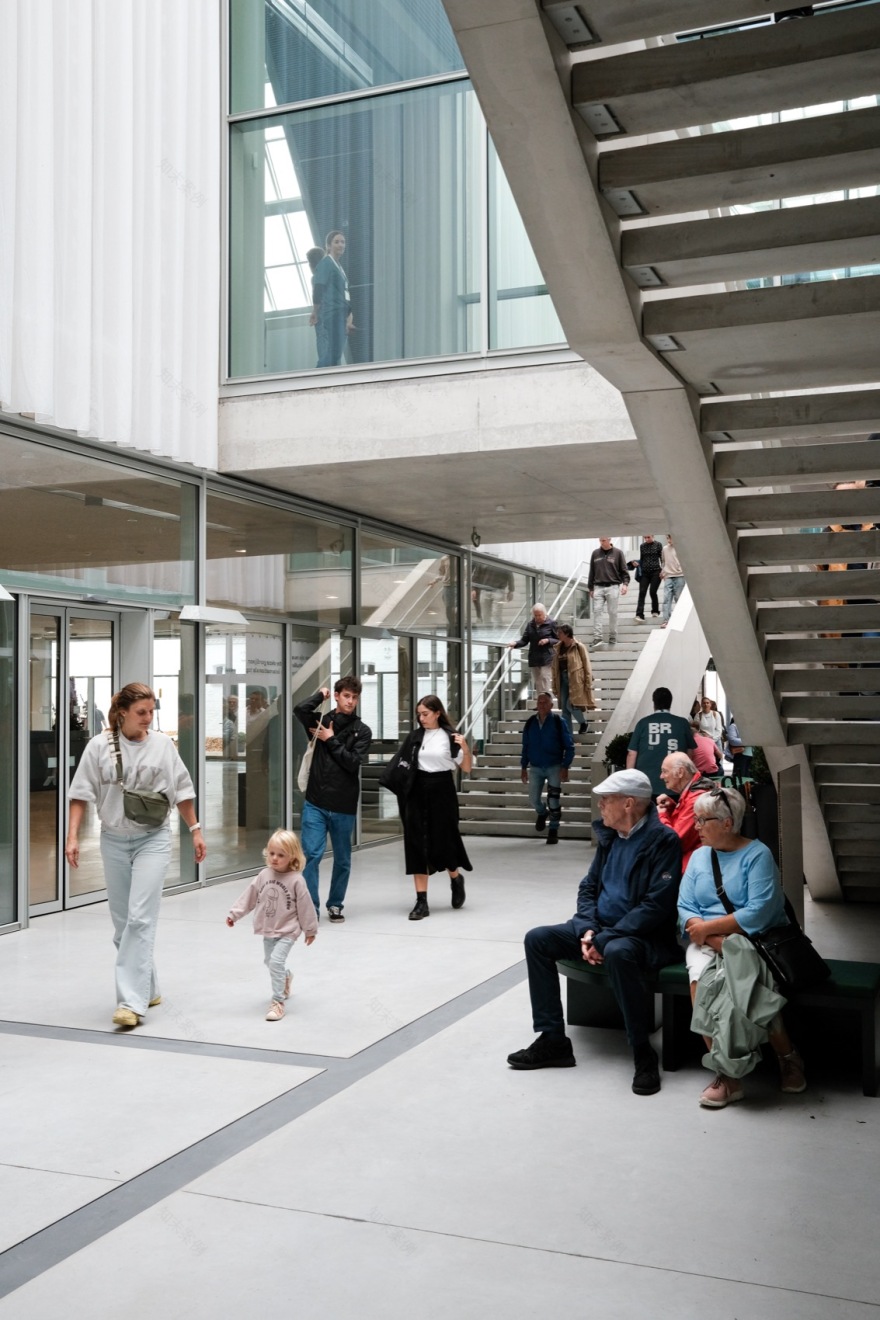
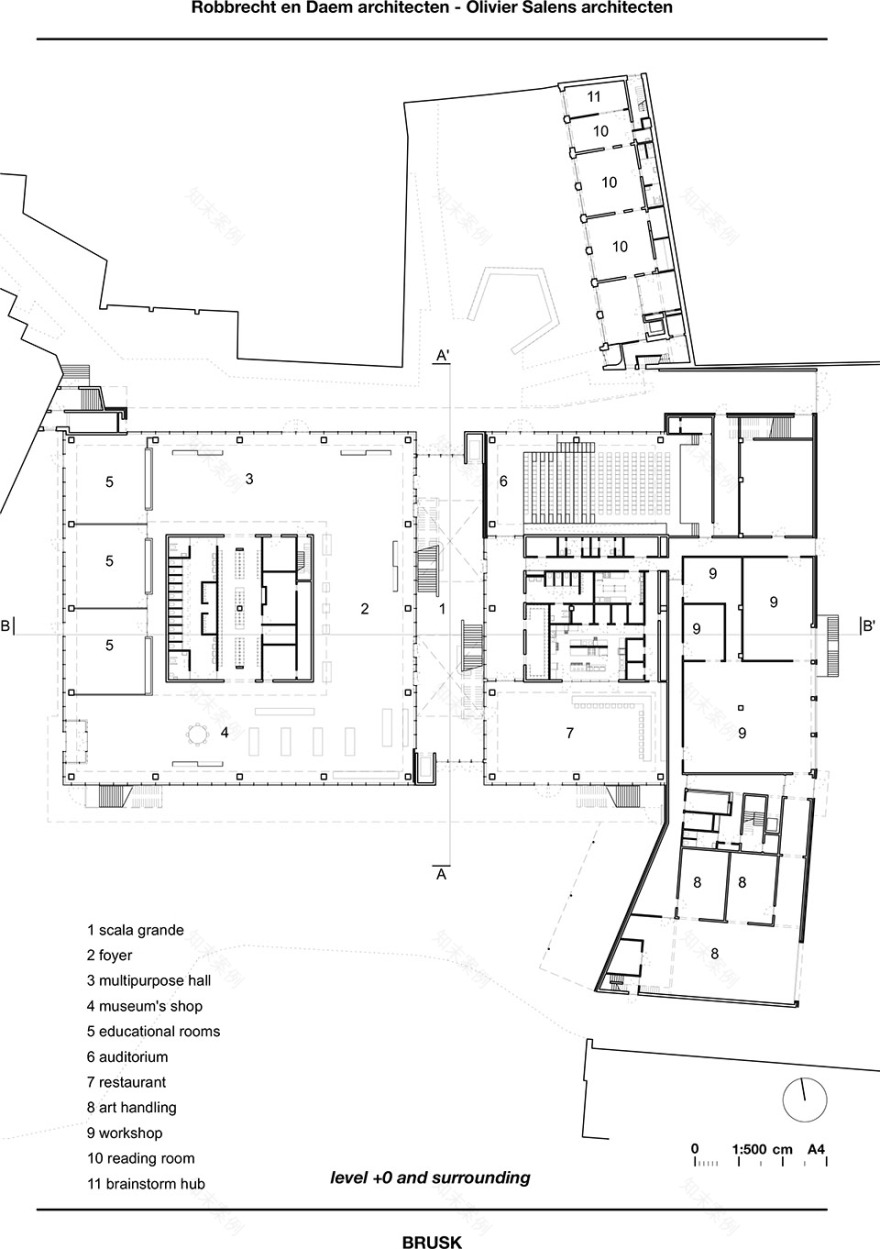
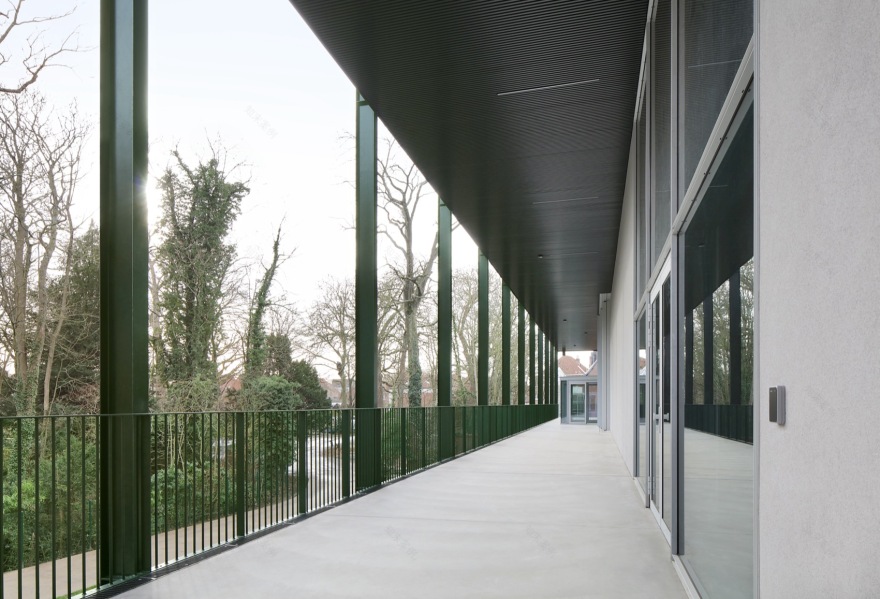
公共广场没有围墙,它不包含任何阻碍人与人相遇的事物。这正是 BRUSK 低门槛首层空间的设计起点。首层由玻璃包围,却完全向公众开放,重新营造出室外空间般的开放感。三处入口使游客、本地居民、艺术爱好者乃至普通行人都能够自由进出建筑。设计回应了行人的行进轨迹,因此将展厅整体抬升至更高楼层,使人们能够在地面层通过 Scala Grande——这条位于建筑中心、却拥有室外气候感受的内部街道——穿行整个建筑体量。BRUSK 并非一个终点,相反,城市真正地穿过了这座建筑。从拥有钟楼与密集街巷的“城市之城”,延续至“绿色之城”与未来的博物馆公园。Scala Grande 在 BRUSK 作为相遇场所的角色中承担着关键连接作用。它像一只开放而延展的邀请之手,吸引那些犹豫的路人进入其中。在建筑内部,Scala Grande 还提供了一种微妙的“穿透式观看体验”,形成一种富有魅力的相遇方式。交汇的楼梯进一步强化了人与人之间的相遇感、情感联系与目光交流。同样,这些楼梯也成为博物馆与城市之间的纽带。除 Scala Grande 外,这一公共层还容纳了多个进一步增强整体活力的功能空间,包括接待区、售票处、书店、儿童工作坊、教育空间、报告厅与餐厅,并最终通往室外露台与未来的博物馆公园。
A public square does not have walls. It contains nothing that can prevent people from meeting. This was the starting point for the low-threshold ground floor level of BRUSK. Surrounded by glass but with complete accessibility for the public, this level recreates the openness of an outdoor space. Three entrances make it possible for tourists, local residents, art lovers and even ordinary pedestrians to move freely into and out of the building. The design mirrors the trajectory of the walker and therefore elevates the museum spaces centrally to a higher level, so that it is possible at ground level to move through the entire volume via the Scala Grande, the central interior street of the complex, but with an outdoor climate. BRUSK is not a final destination; on the contrary, the city quite literally runs through the building. From the ‘urban city’, with its Belfry and network of small streets towards the ‘green city’ and the future museum park. This Scala Grande plays an important connective role in BRUSK’s function as a meeting place. It is an open and extended hand of invitation that encourages doubtful passers-by to come inside. In the building’s interior, the Scala Grande also offers a subtle ‘through-view experience, which is a fascinating way of meeting. The converging staircases also reinforce the sense of encounter, the human connection, and the exchanged glances. In the same way, these staircases also form the link between the museum and the city. In addition to the Scala Grande, this public level also contains a number of other functionalities that add to the dynamism of the overall experience. These include in succession a reception area, ticketing desk, bookshop, children’s workshop, educational space, auditorium and restaurant, before exiting to the outside terrace and the future museum park.
▼开放首层中的城市交流,Urban interaction within the open ground floor © Joris Van Huychem
灵活的使用方式
Flexibility in use
BRUSK 是一个充满潜力的空间,未来将在这里发生许多我们如今尚无法预见的事件。它不仅能够展出尺度极大的艺术作品,其展厅本身也具有高度灵活性。由于可以被划分为不同单元,因此既能够同时举办多场展览,也可以分别独立使用。可分隔的展厅在布展与撤展过程中同样高效:其中一个展厅可以独立布展,而不会对另一展厅造成任何影响。
BRUSK is a space with great potential, where unexpected events will take place that we cannot yet imagine. Naturally, it is an exhibition hall capable of displaying exceptionally large works of art, but the exhibition halls can also be used with great flexibility. Because they can be divided up into different compartments, a wide variety of exhibitions can take place simultaneously or separately. The divisible halls also prove efficient when it comes to setting up and dismantling exhibitions: an exhibition can easily be set up in one hall without the other hall being affected in any way.
▼展厅与公共空间的视觉联系,Visual connection between gallery and public space © Filip Dujardin

尽管这里被称为“展览”,但空间使用上的灵活性实际上扩展了这一概念的边界。在设计过程中,项目已考虑到未来可能发生的多样化活动以及博物馆景观的变化。当今世界的博物馆正逐渐被各种非传统艺术形式“占领”。展览不再只是单纯的“展示”,而可能包含舞蹈、歌唱与游戏。BRUSK 希望成为所有艺术形式及其跨界融合的媒介。除了展览空间外,餐厅与报告厅同样被设计为高度灵活的空间。这两个空间都可以在闭馆后继续开放,并可轻松提供给外部机构使用。
Although we speak of ‘exhibitions’, the flexibility with which the space can be used allows this term to be expanded. During the design process, account was taken of a diverse programme of possible events and of anticipated changes in the museum landscape. The world’s museums are currently being ‘conquered’ by various forms of non-traditional art. Exhibitions are no longer a matter of simple ‘display’, but can involve dancing, singing and play. BRUSK wishes to be an instrument for all possible forms of art and their cross-fertilisation. In addition to the exhibition spaces, the restaurant and auditorium were also designed to be highly flexible. Both can remain open after closing time and can be easily made available to external parties.
▼展览空间中的视觉穿透,Visual transparency within the exhibition space © Filip Dujardin

后勤系统
Logistical apparatus
一座后勤单元通过连桥与 BRUSK 相连。这一结构被有意布置在街道一侧,从而使整个场地能够完全保持无车化、无物流干扰。该单元通过四个不同楼层中的功能叠置形成紧凑布局,并通过空中连桥直接连接 BRUSK 的两座展厅,使两处空间能够分别得到服务,而无需穿越其中一个展厅才能到达另一个。后勤单元与连桥的位置不仅服务于 BRUSK,也为未来格罗宁格博物馆的物流系统预留了可能性。借助玻璃幕墙,访客甚至可以看到后勤运作过程,使 BRUSK 选择展示而非隐藏其运营系统。
Via a walkway, a logistical unit is attached to BRUSK. This structure is deliberately positioned on the street side, so that the site itself remains completely car-free and logistics-free. The unit is a cleverly conceived stacking of functions at four different levels, designed to create a compact footprint. It is linked directly with the two museum spaces in BRUSK by means of an overhead walkway, in such a way that both spaces can be serviced without the need to cross the one to get to the other. The positioning of the logistical unit and its walkway have been planned not only with BRUSK in mind, but also to make possible the future provision of logistical services to the Groeningemuseum. Thanks to the glass wall, visitors can also see the logistics operations. This allows BRUSK to showcase its operations rather than hide them.
▼人群穿行于高尺度展厅空间,People moving through the large-scale gallery © Paul Robbrecht
BRON校舍
BRON 与 BRUSK、格罗宁格博物馆及未来的博物馆公园共同构成了全新布鲁日博物馆街区的核心。BRON 是 Musea Brugge 的科研中心,在这里,馆藏、专业知识与研究资源汇聚于一个充满活力的环境中。在 BRUSK 建设的同时,这座建于1931年的旧校舍也完成了翻新,并于2025年11月开放。BRON 通过一座连桥与 BRUSK 的后勤单元相连。
Together with BRUSK, the Groeningemuseum and the future museum park, BRON also forms the beating heart of the new Bruges Museum Quarter. BRON is the scientific research centre of Musea Brugge, where the collection, expertise and knowledge resources come together in a stimulating environment. At the same time as BRUSK was being built, this former school building, dating from 1931, was renovated. It opened in November 2025. BRON is connected to the logistical unit of BRUSK via a walkway.
▼玻璃界面连接艺术与流线,Glass enclosure linking art and circulation © Olivier Salens
色彩与材料
Colour and materials
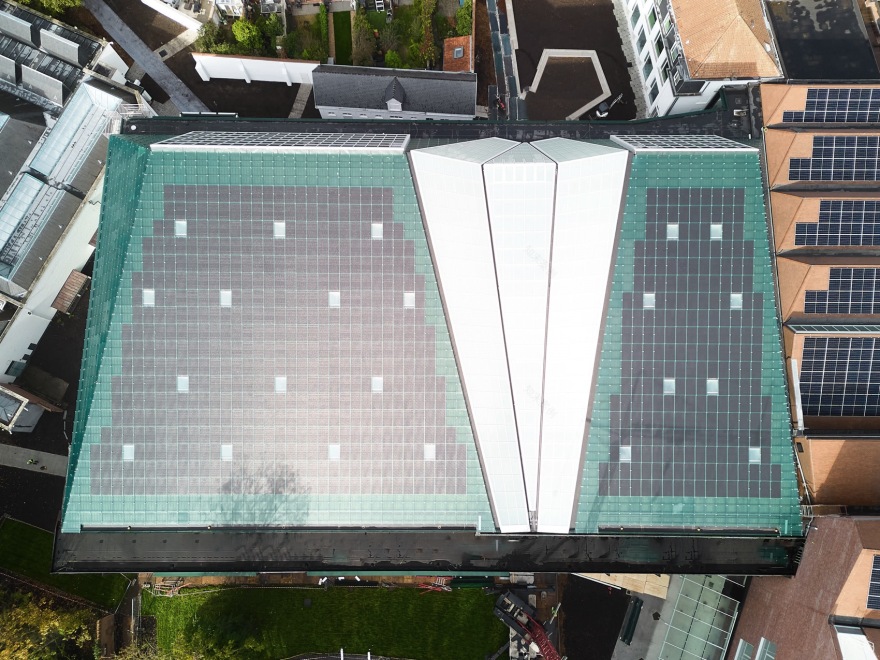
BRUSK 的整体外立面覆盖着深绿色玻璃板,并以鳞片状排列于建筑表面。这些玻璃面板内嵌光伏电池,形成面积达1300平方米的太阳能屋顶,为建筑提供可持续能源。带有纹理的玻璃创造出迷人的光影变化。深绿色与城市特有的红棕色调形成互补关系,既强化了周边绿意,也使建筑仿佛成为毗邻新公园的自然延续。
BRUSK is covered completely with dark green glass plates, arranged on the exterior surface in a scale pattern. These glass panels contain photovoltaic cells, resulting in a 1,300 m solar roof that provides sustainable energy. The textured glass creates a fascinating play of light. The dark green color is complementary with the characteristic red-brown tints of the city, which enhances the surrounding greenery and allows the building to become a natural extension of the adjacent new park.
▼光伏玻璃覆盖的屋顶系统,Photovoltaic glass roof system © Yvan Glavie
可持续性
Sustainability
生态可持续性在 BRUSK 中发挥着关键作用。除可发电玻璃屋面外,BRUSK 地下还设置了地热能源系统(BEO),在冬季为场地内所有建筑提供自然供暖,并在夏季提供自然降温,包括 BRUSK、BRON 与格罗宁格博物馆。BRUSK 的能源效率超过现行 BEN 标准两倍以上,并尽可能遵循循环建造原则。
Ecological sustainability plays a key role at BRUSK. In addition to the electricity-generating glass roof tiles, a geothermal energy field (BEO) beneath BRUSK provides natural heating in winter and cooling in summer for all buildings on the site: BRUSK, BRON and the Groeningemuseum. BRUSK is more than twice as energy-efficient as the current BEN standard and meets circular construction principles wherever possible.
▼绿色玻璃鳞片构成建筑表皮,Green glass scales forming the building envelope © Yvan Glavie
Laure Prouvost 的大型壁画
Monumental fresco by Laure Prouvost
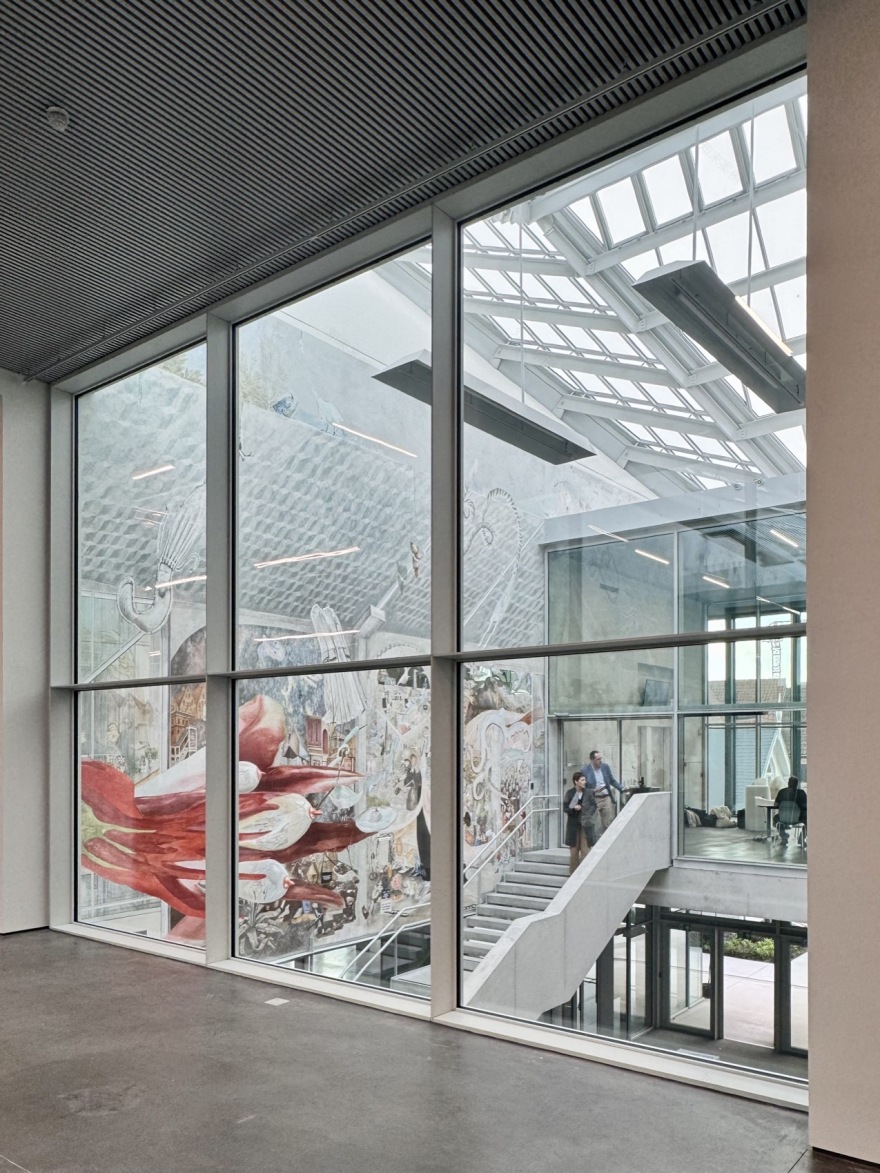
Scala Grande 的核心,是法国艺术家 Laure Prouvost 最新揭幕的大型壁画《The Whispering Walls Rêve》。这件面积达350平方米的作品,以一种充满游戏感的方式穿越布鲁日的历史与城市景观、Musea Brugge 的艺术收藏、历史与当代女性肖像,以及 Giotto di Bondone 的壁画传统。解放、全球化与生态等主题贯穿于整件作品之中。
The centrepiece of the Scala Grande is the recently unveiled, monumental fresco ‘The Whispering Walls Rêve’ by the French artist Laure Prouvost. Over a surface of 350 m2 the artwork is a playful journey through Bruges’ history and cityscape, the art collection of Musea Brugge, various portraits of historical and contemporary women and referential frescos of Giotto di Bondone. Themes such as emancipation, globalisation and ecology are a common thread through this work of art.
▼Scala Grande中的大型壁画,Monumental fresco within the Scala Grande © Olivier Salens
博物馆公园:2031年的绿色相遇场所
The museum park: a green meeting place from 2031
BRUSK 的建筑始终围绕“连接”展开:城市与建筑之间、艺术与公众之间、过去与未来之间。当南侧新的博物馆公园建成后,这一愿景将被进一步强化。该公园由瑞士景观建筑师 Georges Descombes 与 Tractebel 联合设计,将重新打开一条历史水道。在古老树木的荫蔽下,户外艺术与丰富活动将成为场地核心。公园建设将于2028年启动,并于2031年起成为围绕 BRUSK、BRON 与翻新后的格罗宁格博物馆(2031)的全新绿色公共相遇空间。
The architecture of BRUSK is designed with connection in mind: between city and building, between art and public, between past and future. This vision will be further strengthened once the new museum park on the south side is completed. The design by the Swiss landscape architect Georges Descombes i.c.w. Tractebel reopens a historic watercourse. Beneath centuries-old trees, outdoor art and a wide range of activities will take centre stage. Construction will begin in 2028. From 2031 onwards, the museum park will become a new green meeting place surrounding BRUSK, BRON and the renovated Groeningemuseum (2031).
▼项目区位图,Site plan ©Robbrecht en Daem architecten + Olivier Salens architecten
▼首层平面,Ground floor plan©Robbrecht en Daem architecten + Olivier Salens architecten
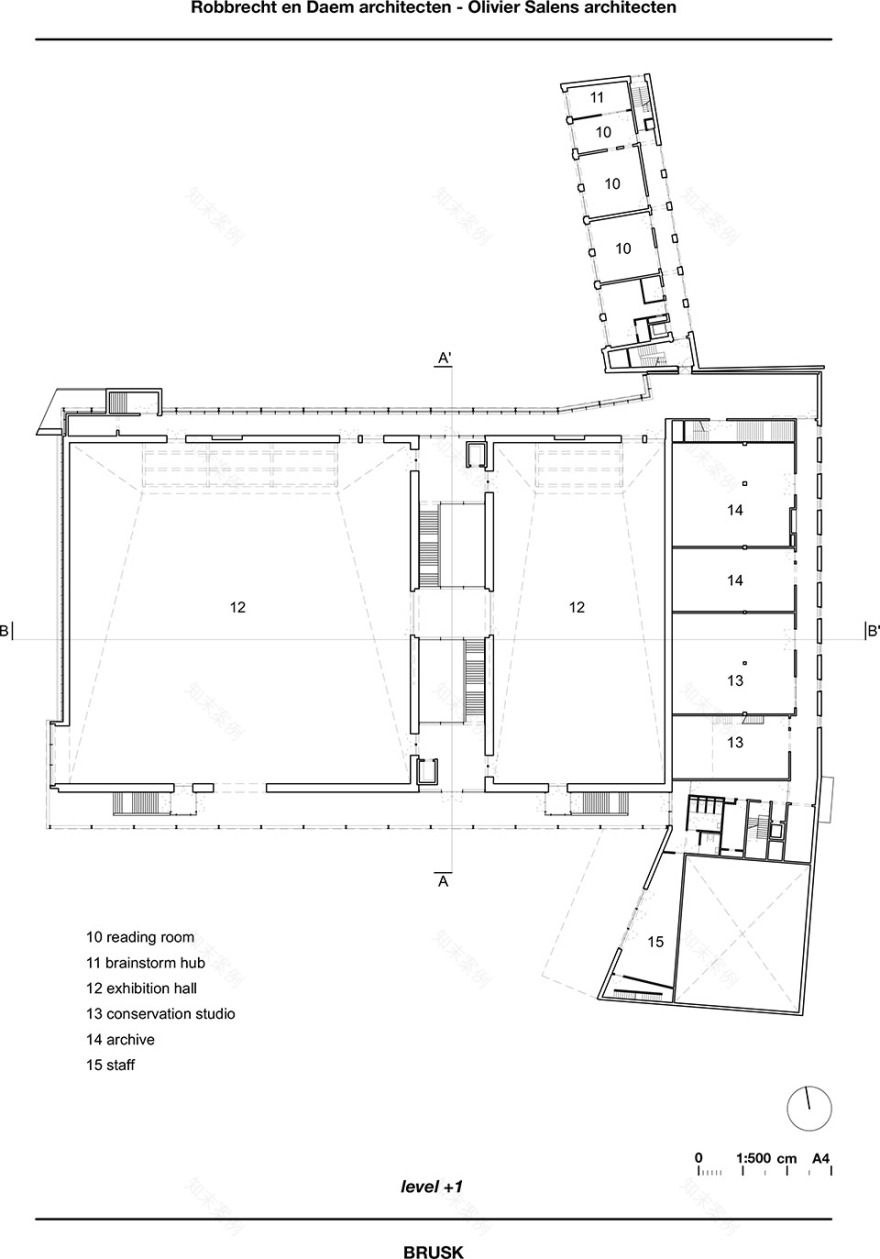
▼一层平面,First floor plan©Robbrecht en Daem architecten + Olivier Salens architecten
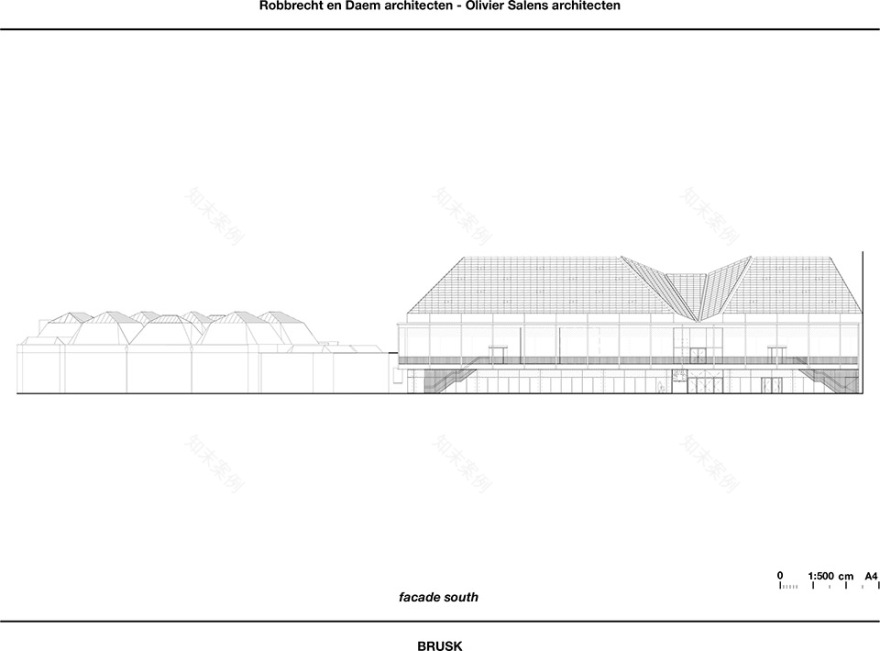
▼南北立面,North-South elevation ©Robbrecht en Daem architecten + Olivier Salens architecten
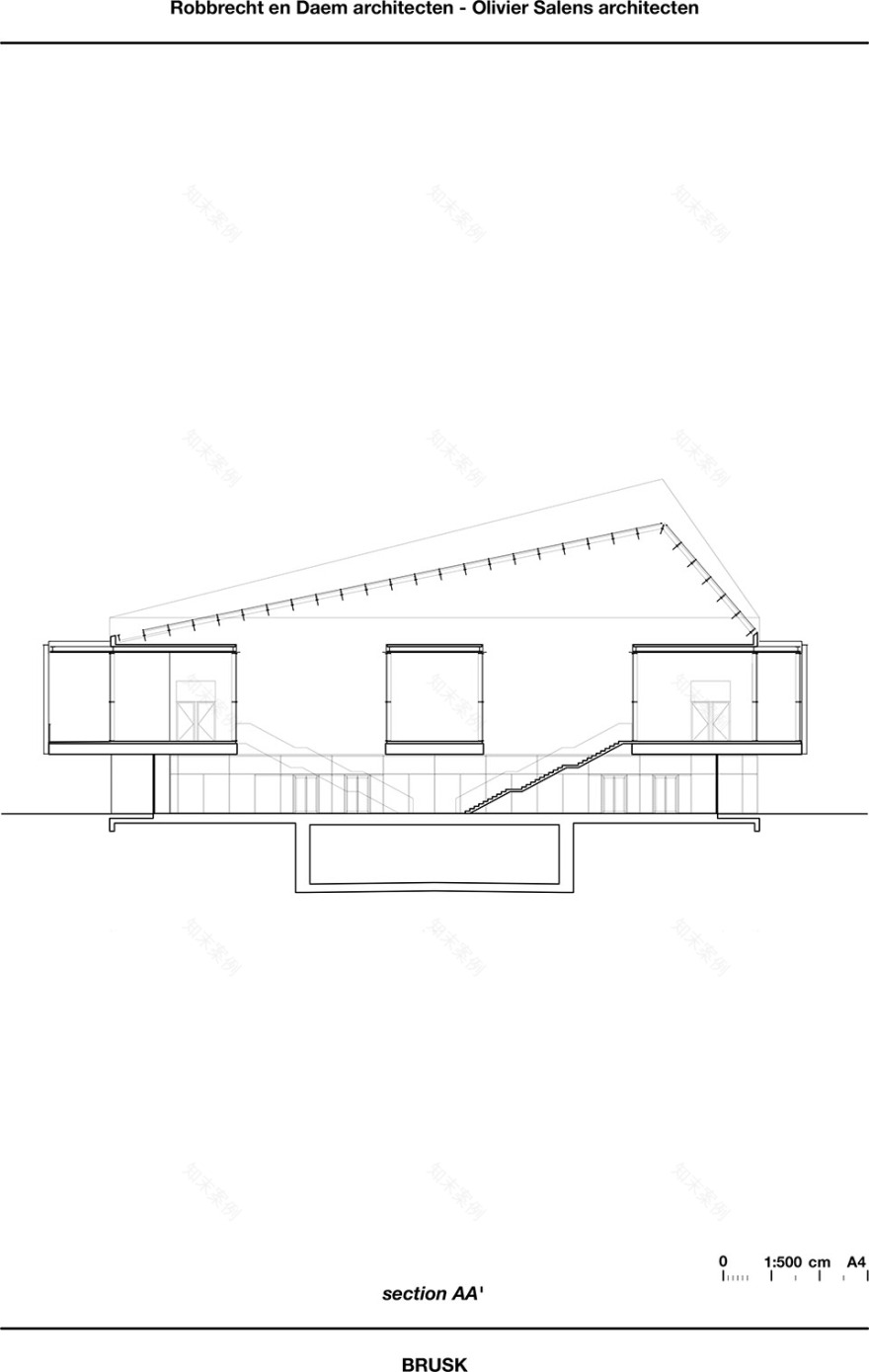
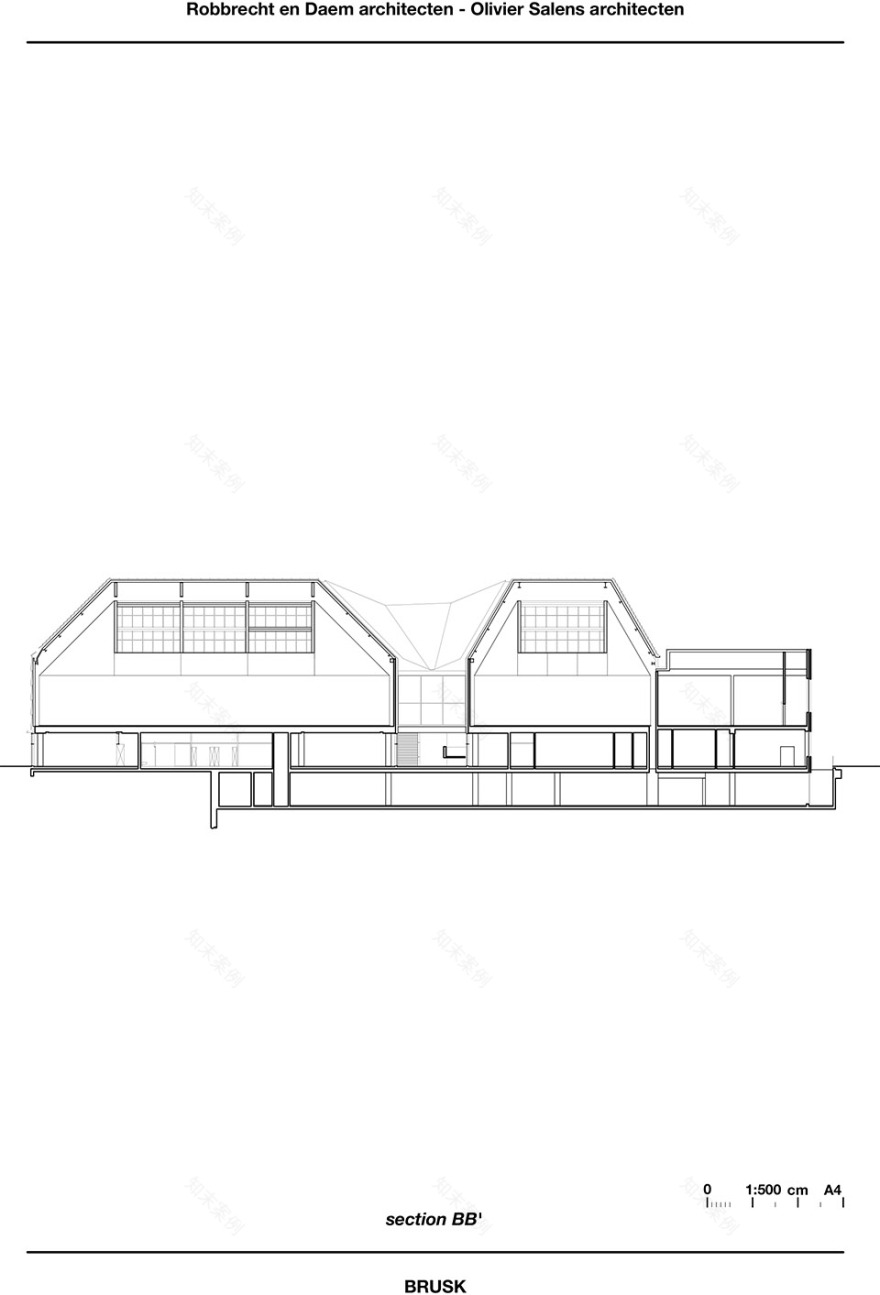
▼剖面,Section ©Robbrecht en Daem architecten + Olivier Salens architecten
Data
Project name: BRUSK
Location: Dijver 12, Bruges
Surface area: 9,500 m2
Period: 2019 – 2025
Client: City of Bruges
Architects: Robbrecht en Daem architecten & Olivier Salens architecten
Developer: CIT Red
Contractor: CIT Blaton
Landscape architects: Georges Descombes i.c.w.. Tractebel
Structural engineering: Ney & Partners
Services engineer: De Klerck Engineering, Max Fordham
Acoustics: Bureau De Fonseca
Safety: Scope
Sustainability: SuReal Sustainability Experts
南京喵熊网络科技有限公司 苏ICP备18050492号-4知末 © 2018—2020 . All photos and trademark graphics are copyrighted by their owners.增值电信业务经营许可证(ICP)苏B2-20201444 苏公网安备 32011302321234号
苏公网安备 32011302321234号客服
消息
收藏
下载
最近